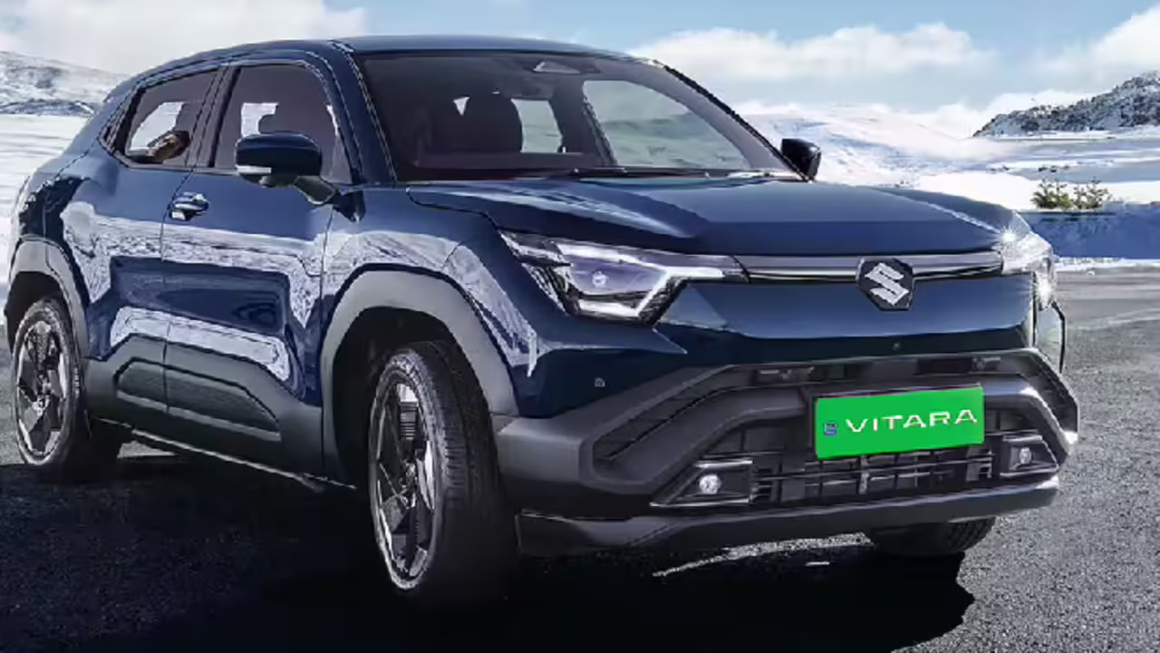
With a rise in demand for electric vehicles in India, the top manufacturers are releasing car variants packed with performance and features that are capable of directly competing with regular petrol and diesel-style SUVs. Prime examples of this are the Maruti Suzuki e Vitara and the Tata Nexon EV.
The e Vitara is one of Maruti Suzuki’s most decisive entries into electrified mobility. Positioned as a family SUV with strong range figures, modern features, and a safety-centric design philosophy, it seeks to replace not just city runabouts but also petrol SUVs for regular highway use.
On the other hand, with its compact size, dependable range, and outstanding safety record, along with Tata’s growing electric vehicle ecosystem, the 2023 Tata Nexon EV is, simply put, arguably one of India’s more well-rounded electric sport utility vehicle options.
Two SUVs trying to meet this market need by targeting similar buyers (i.e., a driver seeking a practical electric SUV for everyday use) are going about the task differently.
In this comparison, we look at how the Maruti Suzuki e Vitara and Tata Nexon EV stack up in key areas that matter most to real buyers: dimensions, battery and performance, features and comfort, safety, and price.
Table of Contents
Maruti Suzuki e Vitara vs Tata Nexon EV: Dimensions
| Specification | Maruti Suzuki e Vitara | Tata Nexon EV |
| Length | 4,275 mm | 3,994 mm |
| Width | 1,800 mm | 1,811 mm |
| Height | 1,635 mm | 1,609 mm |
| Wheelbase | 2,700 mm | 2,498 mm |
| Ground Clearance | 185 mm | 205 mm |
| Boot Space | Approx. 310 litres | Approx. 350 litres |
The dimensions of the e Vitara indicate that it is designed for a different-sized “bracket” than the Nexon Electric Vehicle (EV). The Vitara is intended to compete in the compact SUV segment and has dimensions that are similar to petrol engines in the SUV marketplaces (e.g. Hyundai Creta and KIA Seltos). For example, the overall length of the e Vitara is considerably larger than that of the Nexon EV and has a greater wheelbase than that of the Nexon EV due to the fact that the Nexon EV uses a smaller platform.
This size difference has immediate implications.
First, the e Vitara’s wheelbase of 2,700 mm translates into genuinely more rear-seat space. Indian buyers who frequently carry family members or need extra legroom on long drives will notice this immediately. Longer wheelbase numbers typically mean more comfortable seating and a more relaxed cabin ambience overall.
In urban environments, the compact dimensions of the Tata Nexon EV make parking and navigating through reduced spaces easy, while its 205 mm ground clearance provides it with a significant advantage compared to e Vitara when traversing through unsurfaced, uneven roads. If your route home has speed bumps every 100 metres, or potholes or internal roads with many bumps, you will be comfortable and stable in the Nexon EV.
Additionally, the boot area is affected by the difference in shape of the two vehicles. The e Vitara has a rear end that is square-shaped, which results in an increased boot space; whereas, the Nexon EV has a boot that is limited in size due to having a rear-end that has a slope to it. Families travelling with large cases will clearly see the advantage of the e Vitara with the extra boot space.
In summary, the e Vitara is the bigger SUV with more cabin space, especially for rear passengers and luggage. The Nexon EV is more compact and city-friendly, with higher ground clearance and easier manoeuvrability.
Also Read: Complete Guide to Buying a Maruti Suzuki e Vitara
Maruti Suzuki e Vitara vs Tata Nexon EV: Battery & Performance
| Specification | Maruti Suzuki e Vitara | Tata Nexon EV |
| Battery Options | 49 kWh / 61.1 kWh | 40.5 kWh / 45.2 kWh |
| Claimed Range | Up to 543 km | Up to 455 km (larger pack) |
| Power Output | Up to 172 bhp | 129 PS |
| Torque | 192.5 Nm | 245 Nm |
| Drivetrain | Front-wheel drive | Front-wheel drive |
| DC Fast Charging | Yes | Yes |
| 10–80% DC Charge | Approx. 45 mins | Approx. 57 mins |
This is one of the most defining sections in any electric SUV comparison.
Wouldn’t you love to have an electric SUV capable of driving far on a single charge? If you’re looking for one, check out the new Maruti Suzuki eVitara. It has a massive 61.1 kWh (220-volt) battery providing up to 543 km of range from a single charge. That’s more than enough distance for most people to complete their regular travels without needing to make multiple charging stops along the way.
The Tata Nexon EV has been a strong performer in this segment since its launch, offering up to around 455 km on its larger 45.2 kWh battery pack. While lower than the e Vitara’s claimed figure, this is still a strong range for routine city use and regular highway journeys.
Power and torque figures show a different slant.
With a maximum power of 172 bhp the e Vitara emphasises silky smooth and very confident, but not overly-performance oriented acceleration; while Nexon EV provides you with a solid punch in city traffic, and lots of torque for steady cruising on highways at 129 PS and 245 Nm respectively.
Both SUVs support DC fast charging, but the charging times are different. The e Vitara is quoted at around 45 minutes for a 10 to 80% DC charge on compatible chargers, whereas the Nexon EV typically takes a bit longer, around 57 minutes, due to battery size and thermal management differences.
Real-world battery life and range can vary based on driving habits, temperatures, AC usage, and terrain. But in straightforward usage patterns, the e Vitara promises fewer stops and more travel comfort on long distances. And, the Nexon EV’s range is more than enough for city travel and weekend trips.
Both SUVs will suit your daily city driving and the odd trip along the highway. However, if you mainly travel on highways and occasionally need to recharge, the eVitara’s larger battery capacity will make it easier to travel long distances.
Maruti Suzuki e Vitara vs Tata Nexon EV: Features & Comfort
| Feature | Maruti Suzuki e Vitara | Tata Nexon EV |
| Infotainment | Large touchscreen | 10.25-inch touchscreen |
| Instrument Cluster | Full digital | Semi-digital |
| Climate Control | Automatic | Automatic |
| Ventilated Seats | Yes | Yes (available) |
| Sunroof | Panoramic | Panoramic |
| Powered Driver Seat | Yes | Yes (higher trims) |
| Rear AC Vents | Yes | Yes |
| Drive Modes | Multiple | Multiple |
| Connected Tech | Yes | Yes |
Features significantly shape the daily experience of these electric SUVs, and here the two cars reflect slightly different philosophies.
When it comes to ease of use, comfort and design intended for long journeys, the Maruti Suzuki e Vitara meets these needs very well. Its large and modern infotainment unit, fully digital instrument cluster, and features such as ventilated seats, panoramic roof are designed to provide comfort throughout your day.
The Tata Nexon EV also has a well-rounded feature list, with a sizeable touchscreen, dual-tone interiors, ventilated seats on higher trims, and a panoramic sunroof. Tata’s cabin design has been refined over multiple generations of the Nexon platform, and the EV version benefits from this mature packaging.
Both SUVs offer competitive levels of rear passenger comfort; however, the longer wheelbase of the e Vitara creates a noticeable difference with regard to spaciousness for adult customers travelling over long distances. The rear passenger seats in the Nexon EV are also comfortable, but adult customers who are taller may enjoy more comfort with the increased amount of rear seat space that is available with the e Vitara when travelling for long distances.
Connected technology, including smartphone connectivity, real-time vehicle status, and remote services, is present in both, but the user experience differs subtly. The Nexon EV’s system is well-established and familiar to many Indian buyers, whereas the e Vitara’s interface represents Maruti’s first holistic electric SUV ecosystem, designed to be intuitive and simple.
For family use, if you value the layout of your cabin and the consistency of features, then the e-Vitara’s interior will feel more sophisticated than that of either of the other two vehicles (on both short and long journeys). If you prefer the Tata experience of using proven technologies to deliver ergonomically balanced functionality, the Nexon EV offers those capabilities in a smaller package than other EVs currently available.
Maruti Suzuki e Vitara vs Tata Nexon EV: Safety
| Safety Feature | Maruti Suzuki e Vitara | Tata Nexon EV |
| Bharat NCAP Rating | 5-star | 5-star |
| Protective Structures | Strong AOP & COP scores | Strong AOP & COP scores |
| Airbags | 6 + driver knee airbag | 6 |
| Electronic Stability Control | Yes | Yes |
| Traction Control | Yes | Yes |
| Hill Hold Assist | Yes | Yes |
| ISOFIX | Yes | Yes |
| ADAS | Level 2 | Level 2 (selected trims) |
Both SUVs are among the safest options in the Indian EV space.
The Maruti Suzuki e-Vitara has received five stars from Bharat NCAP, reflecting its superior results when tested during independent crash testing for adult and child passengers. The e-Vitara comes with an extensive range of active safety technology, including Level 2 ADAS. These features include adaptive cruise control, lane assist, emergency braking, and many other contemporary driver support systems.
The Tata Nexon EV has also earned a five-star Bharat NCAP rating in independent tests. Tata’s safety philosophy is already well respected in the petrol and diesel Nexon models and carries over to the EV version, ensuring strong structural integrity and occupant protection.
Each of the available trims of these two SUVs comes with at least one airbag, electronic stability control, hill hold assist, traction control, an ISOFIX child seat anchor, and a 360-degree view camera system. Higher trim levels include additional airbag types.
In short, neither SUV compromises on safety. Both deliver strong protection and modern active safety equipment suitable for urban and highway driving. The choice here depends less on safety numbers and more on variant choices and feature sets that matter to you.
Maruti Suzuki e Vitara vs Tata Nexon EV: Price Comparison
| Variant Level | Maruti Suzuki e Vitara (Ex-Showroom) | Tata Nexon EV (Ex-Showroom) |
| Base Variant | Around ₹17.0 lakh | ₹14.99 lakh |
| Mid Variant | ₹19–20 lakh | ₹15.99–₹17.99 lakh |
| Top Variant | Up to ₹22.50 lakh | Up to ₹20.99 lakh |
Pricing is a key differentiator between these two electric SUVs.
The Tata Nexon is, undoubtedly, one of the most successful and well-priced electric SUVs in the Indian market today. Starting at under ₹15 lakh for the base version, with additional models still at or below ₹21 lakh, Tata Nexon models are very well priced based on the level of safety equipment, safety features and distribution networks provided.
The Maruti Suzuki e Vitara starts slightly higher, closer to ₹17 lakh ex-showroom at the base end and rising into the low ₹20 lakh band for higher variants. The higher price band reflects not just its larger battery and longer claimed range, but also the focus on larger proportions, rear-seat comfort, and Maruti’s brand positioning.
When considering all costs related to ownership, buyers must look at several things: total cost of ownership, service/support, future usage of charging infrastructure, and anticipated resale value. The Nexon is priced at a more affordable level for most households looking at their first EV, with little premium versus buying a gas vehicle. The Vitara is priced higher than the Nexon because of its size and greater range.
Summary: Maruti Suzuki e Vitara vs Tata Nexon EV
The comparison between the Maruti Suzuki e Vitara and Tata Nexon EV highlights two different approaches to electric SUVs in India.
Tata has done an excellent job creating an electric SUV that delivers good value for the money, comes with plenty of safety features and has many practical uses. The vehicle is capable of being driven both around town and away for the weekend. The price is set for the average consumer, therefore, it has mass-market potential.
The Maruti Suzuki e Vitara takes the concept further with a larger battery, higher claimed range, and more family-centric packaging. Its longer wheelbase and SUV proportions make it feel more confidence-inspiring on highways and long trips.
If you’re looking for an affordable, urban-friendly electric SUV, the Tata Nexon EV is a great choice.
On the other hand, if you’re looking for an electric SUV that is slightly larger and has more range than the Tata Nexon, then consider the Maruti Suzuki e Vitara, as it is spacious enough to accommodate your needs as well as provide you with an efficient vehicle for your daily highway trips.
Also Read :
Comparison: Maruti Suzuki Grand Vitara vs Hyundai Creta
Comparison: Maruti Suzuki Vitara Brezza vs Tata Nexon
FAQs: Maruti Suzuki e Vitara vs Tata Nexon EV
Q. Which electric SUV has better claimed range: Maruti Suzuki e Vitara or Tata Nexon EV?
The Maruti Suzuki e Vitara offers up to 543 km claimed range, while the Tata Nexon EV offers up to 455 km on its larger battery.
Q. Which SUV is more affordable: Maruti Suzuki e Vitara or Tata Nexon EV?
The Tata Nexon EV has a lower starting price under ₹15 lakh ex-showroom, whereas the e Vitara starts closer to ₹17 lakh.
Q. Which SUV provides more rear passenger space: Maruti Suzuki e Vitara or Tata Nexon EV?
The Maruti Suzuki e Vitara’s longer wheelbase translates into more rear legroom and comfort compared to the more compact Nexon EV.
Q. Which electric SUV has stronger safety credentials: Maruti Suzuki e Vitara or Tata Nexon EV?
Both SUVs have five-star Bharat NCAP ratings and comprehensive safety equipment, making them strong choices in safety.
Q. Which electric SUV should I buy: Maruti Suzuki e Vitara or Tata Nexon EV?
Choose the Tata Nexon EV if value, pricing, and urban practicality matter most. Choose the Maruti Suzuki e Vitara if long range, rear seating comfort, and highway usability are your top priorities.