For many families shopping for a premium diesel SUV, the choice often narrows down to two Jeeps. The Compass is the brand’s well-known five-seater, while the Meridian stretches the same idea into a longer SUV with an extra row of seats. Underneath, they share the same 2.0-litre diesel engine, so the natural question is how much more the bigger Meridian really asks of you at the fuel pump. The Meridian has picked up a few updates in 2026, including a limited-run Track Edition and sliding second-row seats on select variants. The Compass, meanwhile, continues with its familiar line-up of manual and automatic versions, with both two-wheel and four-wheel drive on offer. In the sections ahead, we’ll walk you through how these two compare on claimed and real-world mileage, what they’re likely to cost you every month, and how their prices line up.
Table of Contents
Jeep Compass vs Jeep Meridian: Specifications
Both Jeeps rely on the same 2.0-litre Multijet turbo-diesel, which puts out 170 hp and 350 Nm. You can pair it with a 6-speed manual or a 9-speed automatic in either SUV, and four-wheel drive is available on select automatic variants of both.
| Specification | Jeep Compass | Jeep Meridian |
| Engine | 2.0L turbo-diesel | 2.0L turbo-diesel |
| Power and torque | 170 hp / 350 Nm | 170 hp / 350 Nm |
| Gearboxes | 6-speed MT or 9-speed AT | 6-speed MT or 9-speed AT |
| Drivetrain | Front-wheel drive or 4×4 | Front-wheel drive or 4×4 |
| Seating | 5 | 5 or 7 |
| Fuel tank | 60 litres | 60 litres |
With the mechanicals so closely matched, the Meridian’s extra length and weight are what set the two apart when it comes to fuel.
Also Read: How to Buy a Used Jeep Compass
Jeep Compass vs Jeep Meridian: ARAI Mileage Figures

Jeep lists separate claimed figures for each version of the Compass, with the front-wheel-drive manual leading the way at 17.3 km/l. The Meridian, interestingly, has just one published figure, 16.25 km/l for the diesel automatic, which sits right alongside the Compass automatic on paper.
| Variant | Compass | Meridian |
| Diesel MT, front-wheel drive | 17.3 km/l | Not published |
| Diesel AT, front-wheel drive | 16.2 km/l | 16.25 km/l |
| Diesel AT, 4×4 | 15.3 km/l | Not published separately |
On paper, then, the bigger Meridian doesn’t seem to give much away. As we’ll see next, though, the real-world picture is quite a bit different.
Jeep Compass vs Jeep Meridian: Real World Fuel Efficiency
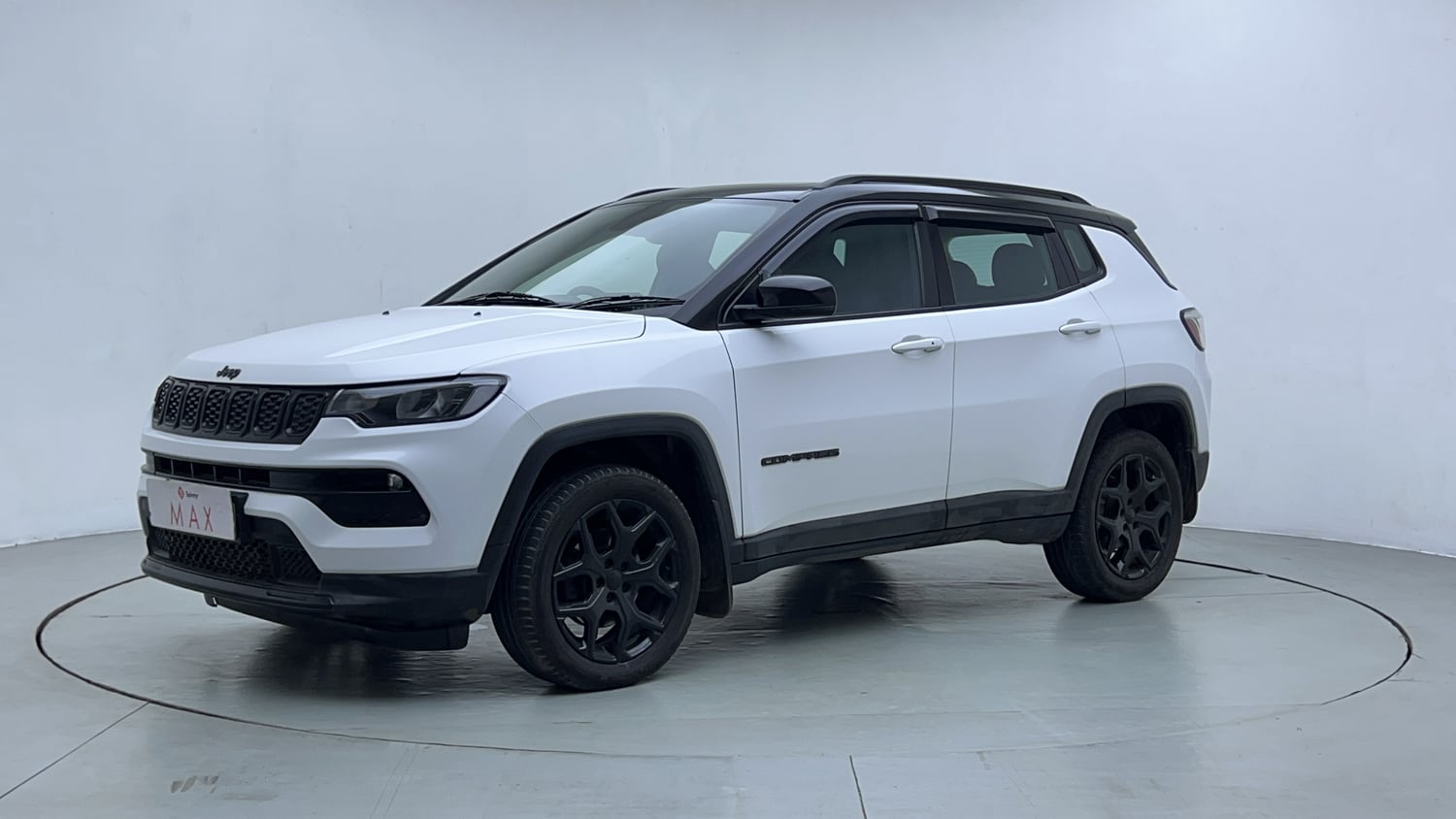
Out on the road, the Compass proves to be the more frugal of the two. In real-world testing, the front-wheel-drive Compass diesel automatic returned about 10.99 km/l in the city and an impressive 18.1 km/l on the highway, comfortably beating its claimed figure once it settled into a cruise.
The Meridian’s numbers come from long-term ownership of the top Overland 4×4 automatic, which gives a good sense of everyday use. One long-term test saw around 7.5 km/l in the city and about 11.7 km/l on the highway. Another, spread across 21,000 km and including a demanding drive up to Ladakh, settled at an overall average of 12.2 km/l.
| Version | City | Highway | Mixed |
| Compass diesel AT, front-wheel drive | 10.99 km/l | 18.1 km/l | 13.67 km/l (50:50) |
| Meridian diesel AT 4×4 (long-term test) | 7.5 km/l | 11.7 km/l | 9.14 km/l (50:50) |
| Meridian diesel AT 4×4 (21,000 km average) | – | – | 12.2 km/l (overall) |
The Compass figures are for a front-wheel-drive car, while the Meridian results are for the heavier 4×4 version, which naturally uses more fuel. A front-wheel-drive Meridian should sit somewhere in between, though we don’t yet have a dedicated real-world test for it. Even so, the overall picture is clear enough. The Compass is lighter and shorter, and that shows most on the highway, where it can stretch a litre of diesel noticeably further.
Jeep Compass vs Jeep Meridian: Fuel Cost Comparison

Let’s turn these figures into a monthly bill. We’ve assumed 1,000 km of driving a month, split evenly between city and highway, which comes to 12,000 km over a year. Diesel has been taken at ₹90 a litre for simplicity, so you may want to adjust it to your local rate.
| Version | Mileage used | Cost per km | Monthly (1,000 km) | Yearly (12,000 km) |
| Compass diesel AT, front-wheel drive | 13.67 km/l | ₹6.58 | ₹6,581 | ₹78,970 |
| Meridian diesel AT 4×4 (21,000 km average) | 12.2 km/l | ₹7.38 | ₹7,377 | ₹88,525 |
| Meridian diesel AT 4×4 (city and highway test) | 9.14 km/l | ₹9.85 | ₹9,846 | ₹1,18,154 |
Depending on how and where you drive, the Meridian is likely to cost somewhere between ₹800 and ₹3,250 more each month than the Compass. Owners who spend more time on open highways will find themselves toward the lower end of that range, while those stuck in heavy city traffic should expect the higher figure. It’s also good to remember that the Meridian is carrying more space and, in most versions, two extra seats. For a family that genuinely needs that room, the extra fuel spend may feel like a fair trade.
Also Read: Jeep Meridian Alternatives: Competitors of Jeep Meridian
Jeep Compass vs Jeep Meridian: Price Comparison
There’s a fair gap between the two at the starting line. The Compass is priced from about ₹17.99 lakh to ₹30.45 lakh, while the Meridian begins at ₹23.33 lakh and goes up to around ₹37.82 lakh for the Track Edition 4×4 (all prices ex-showroom). If you’d like the new sliding second-row seats on the Meridian, those variants start at about ₹30.01 lakh.
| Car | Approx. ex-showroom price |
| Jeep Compass | ₹17.99 lakh to ₹30.45 lakh |
| Jeep Meridian | ₹23.33 lakh to ₹37.82 lakh |
In simple terms, the Compass lets you enjoy Jeep’s diesel performance and build quality at a lower price, with lower fuel bills to match. The Meridian asks for more upfront, but in return gives you a longer cabin, the option of seven seats and more luggage room for family trips.
Buying used? Both have been around for a while, which works in your favour. The Compass has been on sale in India since 2017 and the Meridian since 2022, so you’ll find a healthy range of options on Spinny across budgets. While shortlisting, take a careful look at the inspection report and service history, and if you’re considering a 4×4, check how it has been used. Every Spinny Assured car goes through a 200-point inspection and comes with a 1-year warranty, fixed pricing and a 5-day money-back guarantee.
Summary
The Compass and the Meridian may share an engine, but they don’t share a fuel bill. On paper, their claimed figures look almost identical, yet in real-world driving the lighter Compass pulls clearly ahead, especially on the highway, where it can go well beyond 18 km/l. The Meridian, for its part, makes up for it with space. If your family needs a third row or plenty of room for luggage on long drives, its higher running costs are part of the package, and a front-wheel-drive version will help keep them in check. If five seats are enough, though, the Compass is the more economical way to enjoy the same Jeep feel, both at the showroom and at the fuel pump.
Related Blogs:
Jeep Compass vs Hyundai Tucson Real World Mileage Comparison
Mahindra Scorpio N vs Jeep Compass Real-World Mileage Comparison
Toyota Innova Hycross vs Jeep Meridian
Comparison: Toyota Fortuner vs Jeep Meridian
FAQs about Jeep Compass and Jeep Meridian Mileage Comparison
Q. How much extra fuel does the Meridian’s third row really cost me?
While both SUVs have nearly identical claimed figures, real-world driving shows the Meridian using noticeably more diesel, mainly because of its added length and weight. Depending on your routine, that could mean anywhere from ₹800 to over ₹3,000 more each month compared to a Compass.
Q. Is the Compass manual a better choice if I want the best mileage?
It’s the most efficient version, with a claimed 17.3 km/l, so it’s well worth considering if you’re comfortable with a clutch. That said, the 9-speed automatic holds its own surprisingly well on long highway runs, so if most of your driving is out of the city, you won’t be giving up much by choosing the automatic.
Q. Does choosing a 4×4 version affect fuel economy?
On the Compass, the claimed figure drops from 16.2 km/l for the front-wheel-drive automatic to 15.3 km/l for the 4×4, and the extra hardware tends to have a bigger effect in city traffic. Unless you plan to head off-road or drive in tricky conditions often, the front-wheel-drive versions will be kinder on your wallet.
Q. What’s new on the 2026 Meridian, and does it change the mileage?
The Meridian has gained sliding second-row seats on select variants this year, along with a limited-run Track Edition that brings some styling updates. The engine and gearboxes remain the same, though, so you can expect fuel economy to stay much as it was.
Q. Can the Meridian really cover close to 1,000 km on a full tank?
That’s what the claimed figure works out to with its 60-litre tank, but everyday driving usually tells a different story. Going by the long-term average of around 12.2 km/l, you’re more likely to see somewhere around 700 to 750 km between fill-ups.
Q. Would a used Compass make more sense than a new Meridian for a small family?
It can, if five seats suit your needs. A pre-owned Compass diesel offers the same engine and Jeep character for far less money, and it’s also the easier of the two to live with when it comes to running costs. Just make sure you check its service history and test drive it properly before deciding.