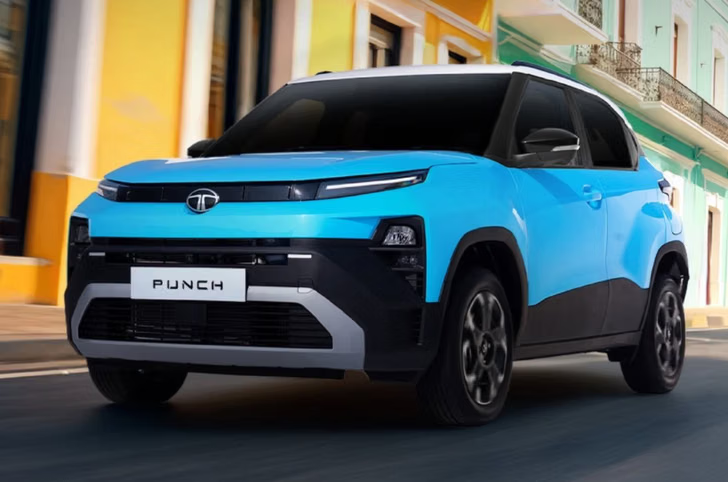
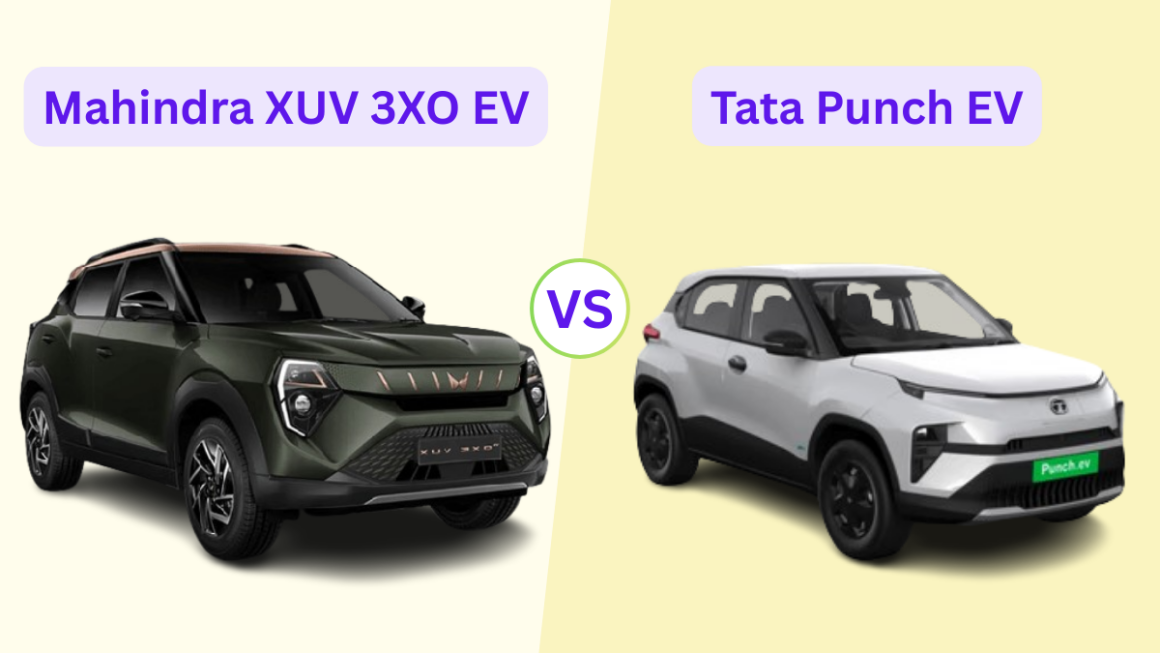
If you’re shopping in the sub-4m electric SUV space, the XUV 3XO EV and the Tata Punch EV are two very different takes on the “compact EV for India” idea. Mahindra is going after punchy performance and a more premium cabin experience, while Tata’s Punch EV leans into practicality, safety credibility, and a wide variant spread that can fit multiple budgets.
Below is a section-by-section comparison of dimensions, performance, features, safety, and pricing, so you can pick the one that fits your daily usage (city runs, weekend drives, family duty, or primarily solo commuting).
Mahindra XUV 3XO EV vs Tata Punch EV: Dimensions
Before you compare numbers, it helps to think about how you’ll feel these dimensions in real life, parking ease, rear-seat comfort, and boot practicality for airport runs or grocery-heavy weeks.
| Dimension | Mahindra XUV 3XO EV | Tata Punch EV |
| Length | 3,900 mm | 3,880 mm |
| Width | 1,821 mm | 1,742 mm |
| Height | 1,617 mm | 1,622 mm |
| Wheelbase | 2,600 mm | 2,445 mm |
| Boot Space | 364 L | 366 L |
| Ground Clearance | 190 mm | 195 mm |
What these numbers mean on the road
- Cabin room & stability: The XUV 3XO EV’s longer wheelbase (2,600 mm) usually translates to a more planted feel at speed and potentially better rear-seat knee room than you’d expect in this footprint.
- City friendliness: Punch EV is slightly shorter and narrower, which tends to feel less stressful in tight lanes and packed parking lots, especially if your daily route includes older city pockets.
- Boot practicality: Boot space is almost identical (364L vs. 366L), so luggage practicality is a near tie.
- Bad-road confidence: Both list 190 mm ground clearance, so speed breakers and broken patches should be manageable in either.
Mahindra XUV 3XO EV vs Tata Punch EV: Engine & Transmission
Since both are EVs, “engine” here effectively means battery + motor output, and “mileage” maps best to claimed range (your real-world range will vary with speed, AC use, traffic, and driving style).
| Spec | Mahindra XUV 3XO EV | Tata Punch EV |
| Engine options | Electric motor | Electric motor |
| Transmission options | 1-speed automatic | 1-speed automatic |
| Power | 147.5 bhp | Up to 120.7 bhp (LR) |
| Torque | 310 Nm | 154 Nm |
| Mileage / Range | 456 km (claimed) | Up to 421 km (claimed, LR) |
Driving experience: what you’ll actually notice
- Punch off the line: The xuv 3xo ev has a clear advantage on paper with 310 Nm torque, which typically shows up as quicker overtakes and a stronger mid-range surge, useful when you want to gap traffic confidently.
- Punch EV’s two personalities: The Punch EV is sold in standard-range and long-range formats, so your experience depends heavily on the variant. LR trims with the bigger battery and higher output feel noticeably stronger than base versions.
- Range expectations: Claimed figures show the XUV 3XO EV ahead (456 km vs. 421 km), but don’t treat that as a promise. Still, if your usage includes frequent longer runs, the extra claimed headroom can reduce charging anxiety.
- Charging reality check: Public charging availability and your home or office setup matter as much as the battery size. Also note that Mahindra’s pricing communication highlights the home charger as an add-on in some cases, so budgeting may differ from Tata’s.
Mahindra XUV 3XO EV vs Tata Punch EV: Features & Comfort
Features aren’t just “nice-to-have” in EVs; they shape how premium the car feels day-to-day (screens, cabin cooling, seating comfort, and driver assistance).
| Feature | Mahindra XUV 3XO EV | Tata Punch EV |
| Infotainment system | Dual 10.25-inch screens (incl. infotainment) | 10.25-inch touchscreen |
| Music system | 7-speaker Harman Kardon | 4-speaker system |
| Climate control | Dual-zone climate control | Automatic climate control |
| Ventilated seats | Yes (variant-dependent) | Yes (variant-dependent) |
| Adjustable steering | Yes (variant-dependent) | Yes (variant-dependent) |
| Drive modes | Yes (variant-dependent) | Yes (variant-dependent) |
| Instrument cluster | 10.25-inch digital (as part of dual-screen setup) | 10.25-inch digital driver’s display |
| Sunroof | Panoramic sunroof | Voice‑assisted Electric Sunroof |
| Adjustable seats | (Trim-dependent) | (Trim-dependent) |
| Rear AC vents | (Trim-dependent) | (Trim-dependent) |
| 60:40 rear seat split | (Trim-dependent) | (Trim-dependent) |
| Cruise control | Available (incl. ADAS-linked on higher trims) | Available (variant-dependent) |
Who feels more premium day-to-day?
- Cabin “wow” factor: XUV 3XO EV leans premium with dual 10.25-inch screens, a Harman Kardon audio setup, and a panoramic sunroof; these are the features you notice every single drive.
- Punch EV is surprisingly loaded too: The Punch EV counters with a large 10.25-inch touchscreen plus a 10.25-inch digital driver display on higher variants, plus ventilated seats and a sunroof—very solid for the segment.
- Comfort takeaway: If you want a more “big-car” cockpit feel, the XUV 3XO EV edges ahead; if you want maximum features per rupee and are okay with choosing the right variant carefully, the Punch EV can match a lot of the everyday essentials.
Mahindra XUV 3XO EV vs Tata Punch EV: Safety Features
Safety should be a decision anchor in India, especially in family use. Also, NCAP rating takes priority over “more airbags.”
| Safety Item | Mahindra XUV 3XO EV | Tata Punch EV |
| GNCAP Safety Rating | Not officially listed for EV; XUV 3XO has 5-star Bharat NCAP | Not officially listed for EV; Punch EV has 5-star Bharat NCAP |
| Airbags | Up to 6 airbags on higher variants (as listed by car portals) | Standard-fitment includes curtain airbags per Bharat NCAP notes (variant applicability details apply) |
| ABS with EBD | Yes (variant-dependent) | Yes (variant-dependent) |
| ESC | Yes (variant-dependent) | ESC noted as standard fitment in Bharat NCAP notes |
| Traction control | Yes (variant-dependent) | Yes (variant-dependent) |
| Automatic headlamps | Available | Available (variant-dependent) |
| Rain-sensing wipers | Available | Available (variant-dependent) |
| Hill hold assist | Available (variant-dependent) | Available (variant-dependent) |
| Hill descent control | Variant-dependent | Variant-dependent |
| Rear sensors | Yes | Yes |
| Rear parking camera | 360-degree camera mentioned; rear camera included | 360°- surround view camera systemx |
| ISOFIX | Yes | Yes |
| ADAS | Level-2 ADAS mentioned (higher trims) | Not prominently positioned as ADAS-led; safety assist focuses on ESC + protection systems |
Safety verdict (with NCAP priority)
- Both vehicles have strong safety credibility, but the Punch EV is explicitly celebrated for its Bharat NCAP achievement, and Bharat NCAP’s own model page includes specific notes on safety-assist tech availability.
- Mahindra has also publicly highlighted 5-star Bharat NCAP performance for the XUV 3XO and its safety positioning as a brand priority.
- If you’re comparing variants, always check which safety features are standard vs variant-dependent before finalizing, because “top trim safety” and “base trim safety” can look very different in India.
Mahindra XUV 3XO EV vs Tata Punch EV: Price Comparison
Pricing is where these two separate clearly: Punch EV starts lower and spreads across many variants, while XUV 3XO EV sits higher but tries to justify it with performance and cabin polish.
| Price (Ex-showroom) | Mahindra XUV 3XO EV | Tata Punch EV |
| Base variants | ₹13.89 lakh (AX5) | ₹9.99 lakh (base) |
| Mid variants | ₹14.96 lakh (AX7L) | Mid variants vary widely by trim/battery |
| Upper mid variants | Up to ~₹14.44 lakh range for top-end trims (listed) | |
| Top variant | ₹14.96 lakh (AX7L) | Up to ~₹14.44 lakh (listed) |
Value for money: what you’re paying for
- Punch EV’s biggest advantage is entry price: Starting at ₹9.99 lakh, it’s the more accessible electric SUV, especially for first-time EV buyers moving up from a hatchback.
- XUV 3XO EV is priced like a higher segment feel: Starting at ₹13.89 lakh, it asks you to pay for stronger output and a more premium in-cabin experience (screens, audio, sunroof, and higher-trim tech).
- Don’t forget charging hardware costs: Mahindra’s communicated pricing can involve an add-on charger cost in some contexts, factor that into your “real price.”
Summary
Choose Tata Punch EV if your priorities are:
- Lower entry price and more budget control via many trims
- Strong safety credibility via Bharat NCAP positioning
- A compact footprint that feels naturally city-friendly
Choose the xuv 3xo ev if your priorities are:
- Stronger power and torque for confident performance
- A more premium cabin experience (screens, audio, panoramic sunroof, higher-trim tech)
- More claimed range headroom on paper
Also Check – Comparison: Mahindra XUV 3XO vs Hyundai Venue
FAQ about Mahindra XUV 3XO EV vs Tata Punch EV
Q. Which one is better for city driving?
The Punch EV’s smaller footprint and lower starting price make it an easy city-first pick, especially if your daily run is short and predictable.
Q. Which EV feels quicker in real-world overtakes?
The XUV 3XO EV has much higher torque on paper, which typically translates to stronger overtakes and a more effortless pull once you’re already rolling.
Q. Is the Punch EV safer than the XUV 3XO EV?
Both have strong Bharat NCAP credibility in their respective official communications, but always confirm the exact safety kit on the variant you’re buying (since features can vary by trim).
Q. Which offers better value at the top end?
At higher trims, Punch EV can get feature-rich for the money, but XUV 3XO EV’s premium cabin and stronger performance can feel more “worth it” if you value driving feel and cockpit experience.
Q. Is Mahindra XUV 3XO a safe car?
Yes, the Mahindra XUV 3XO is a safe car. Based on a robust foundation, it is also packed with multiple safety functions, including six airbags, ABS with EBD, electronic stability control and a reinforced body structure. Mahindra cars are traditionally known for being well-built cars. Although official crash test ratings differ by variant, the overall level of safety kit is good for the class and a stable recommendation for urban and highway travel.