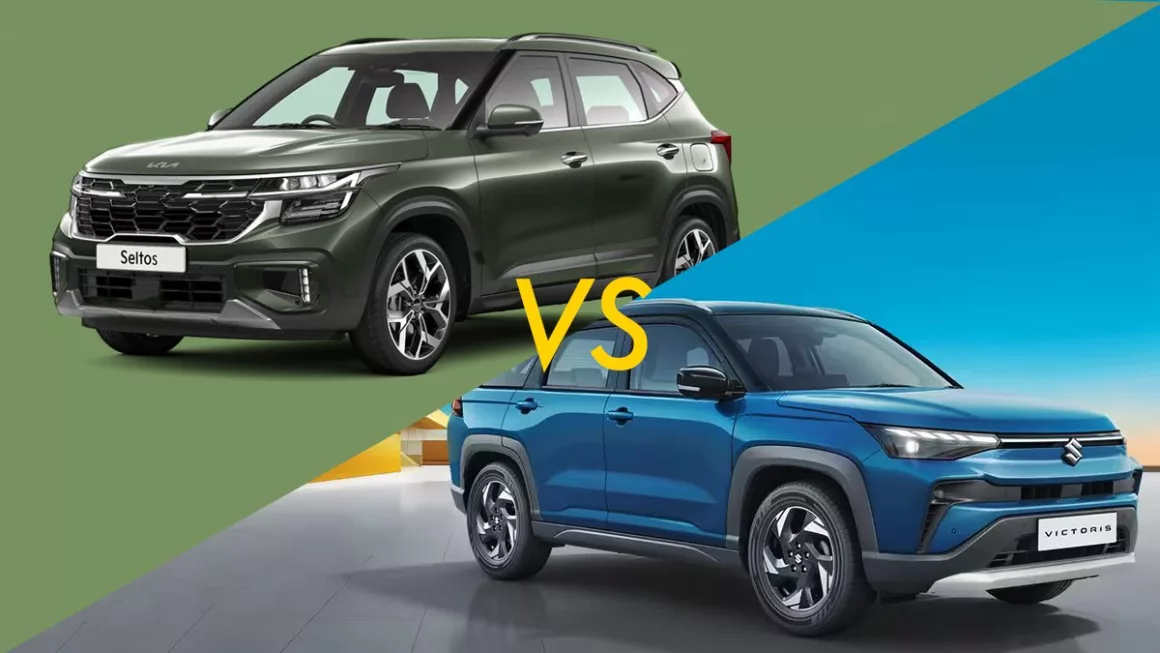
The recently launched Maruti Suzuki Victoris is Maruti’s second mid-size SUV, after the Maruti Suzuki Grand Vitara that was launched in 2022. While the Grand Vitara is sold from Maruti’s premium subsidiary, NEXA, the Victoris is sold from Maruti’s Arena dealerships, which are far more spread out across the nation than the NEXA dealerships. With the greater reach of its new mid-size SUV, Maruti is looking to challenge the segment leader, Hyundai Creta, more strongly. However, in addition to challenging the Creta, the Victoris can be a compelling alternative to Creta’s sibling, the Kia Seltos. To put things into a sensible perspective, in this article on the Maruti Suzuki Victoris vs Kia Seltos, we compare the two on key parameters and determine which one you should buy.
Maruti Suzuki Victoris vs Kia Seltos: Dimensions & Design
| Maruti Suzuki Victoris | Kia Seltos | |
| Length | 4,360 mm | 4,365 mm |
| Width | 1,795 mm | 1,800 mm |
| Height | 1,655 mm | 1,645 mm |
| Wheelbase | 2,600 mm | 2,610 mm |
| Ground Clearance | 210 mm | 190 mm |
| Boot Space | 439 litres (mild-hybrid), 320-litres (CNG) | 433 litres |
The Kia Seltos is longer, wider, and has a longer wheelbase compared to the Maruti Victoris. While the Victoris is slightly taller than the Seltos, its ground clearance is significantly more than that of the Seltos. On the inside, the Seltos offers better headroom, legroom, and shoulder room to the rear passengers, and overall, five passengers will find themselves more comfortable in the Seltos compared to the Victoris. An interesting thing about the Victoris is that it does not offer a spare tyre, which leaves 119 litres of boot space under the boot floor in the mild-hybrid versions that offer 439 litres of boot space (320 litres + 119 litres). Whereas, in CNG variants, the CNG tank is integrated under its body.
As far as looks are concerned, the Victoris looks cleaner and sportier than the Seltos. The Victoris features a rather clean and chiselled bumper, with a concealed grille area, a wide air dam and a skid plate element lower down. The segmented LED DRLs are connected by a chrome strip. The side profile highlights strong character lines and squared-off wheel arches with plastic cladding, giving it a muscular stance, while the raked rear windscreen gives it a coupe-like profile. At the rear, the Victoris follows the modern fashion of connected taillights; in Victoris, it is a segmented light bar that connects the taillamps. With this, the Victoris gets a flat tail gate and a chunky dual-tone bumper.
On the other hand, the Kia Seltos looks more aggressive. At the front, the Seltos features Kia’s traditional tiger nose grille, sleek split headlamps set up with boomerang-shaped DRLs that extend into the grille. On the sides, the Seltos rides on 18-inch alloy wheels, larger than the 17-inch alloy wheels on the Victoris. Like the Victoris, the Seltos gets blacked-out pillars and black cladding covering the bottom of the SUV. At the rear, the Seltos also features connected tail lamps, but here the LED bar connecting the tail lamps is not segmented, and the tail lamps are vertically positioned.
While there are marginal dimensional differences between the Maruti Victoris and Kia Seltos, the Kia Seltos offers more space on the inside.
Maruti Suzuki Victoris vs Kia Seltos: Engine & Transmission
| Maruti Suzuki Victoris | Kia Seltos | |
| Engine | 1.5-litre Mild Hybrid petrol 1.5-litre Strong Hybrid Petrol | 1.5 litre NA petrol engine 1.5 litre turbo diesel engine 1.5-litre turbo petrol engine |
| Power | 103 PS (mild hybrid) 87.8 PS (CNG mode) 100 PS (petrol mode) 116 PS (strong hybrid) | 115 PS (NA petrol) 116 PS (diesel) 160 PS (turbo petrol) |
| Torque | 139 Nm (mild hybrid) 121.5 Nm (CNG mode) 137 Nm (petrol mode) 141 Nm (strong hybrid) | 144 Nm (NA petrol) 250 Nm (diesel) 253 Nm (turbo petrol) |
| Transmission | 5-speed manual with mild hybrid and CNG variants 6-speed torque converter automatic with mild hybrid e-CVT with strong hybrid | 6-speed manual and CVT automatic (NA petrol engine) 6-speed iMT & 7-speed DCT (turbo petrol engine) 6-speed manual, 6-speed iMT, & 6-speed torque converter automatic (turbo diesel engine) |
| Mileage | Up to 21.18 km/l (mild hybrid) Up to 27.02 km/kg (CNG) Up to 28.65 km/l (strong hybrid) | Up to 18.4 km/l (petrol) Up to 21.8 km/l (diesel) |
Of all the factors, the powertrain options of these two SUVs are what most differentiate them from each other. Sharing its powertrains with the Maruti Grand Vitara, the Victoris is focused on frugality. It delivers fantastic fuel efficiency and is certain to keep you happy if you want to keep the running cost as low as possible. At the same time, Victoris offers the weakest engines in its segment, and while they are plenty refined, they feel underpowered on the go. You are most likely to downshift a gear or two for quick overtakes and other quick acceleration requirements.
On the other hand, the Kia Seltos offers significantly more energetic engines, including the most powerful engine of the segment, a 1.5 turbo petrol unit. Even the naturally aspirated engine of the Seltos is powerful enough to meet your daily driving requirements. At the same time, the turbocharged petrol engine delivers exciting performance, complemented by a DCT automatic.
Among the engine offerings, the Victoris offers the advantage of CNG variants and an all-wheel-drive drivetrain (mild-hybrid automatic only), while the Seltos has the advantage of a diesel engine.
The Maruti Victoris delivers appealing fuel efficiency figures, but its engines feel underpowered on the go. On the other hand, the Kia Seltos offers a more exciting performance and a more well-rounded driving experience.
Maruti Suzuki Victoris vs Kia Seltos: Features & Comfort
| Maruti Suzuki Victoris | Kia Seltos | |
| Infotainment system | 10.1-inch touchscreen infotainment system | 10.25-inch touchscreen infotainment system |
| Music system | 8-speaker Infinity sound system with Dolby Atmos | 8-speaker Bose sound system |
| Climate control | Automatic | Dual-zone Automatic |
| Ventilated seats | Front ventilated seats | Front ventilated seats |
| Adjustable steering | Tilt and Telescopic adjust | Tilt and Telescopic adjust |
| Drive modes | Terrain Modes – Snow, Sport, Lock, Auto (all-wheel drive only)Drive modes: ECO + Normal + Power (Strong hybrid only) | Normal, Eco, Sports |
| Instrument cluster | Digital instrument cluster | Digital instrument cluster |
| Sunroof | Panoramic sunroof | Panoramic sunroof |
| Adjustable seats (manual or electric) | 8-way powered driver seat | 8-way powered driver seat |
| Rear AC vents | Available | Available |
| 60:40 rear seat split | Available | Available |
| Cruise control | Available | Available |
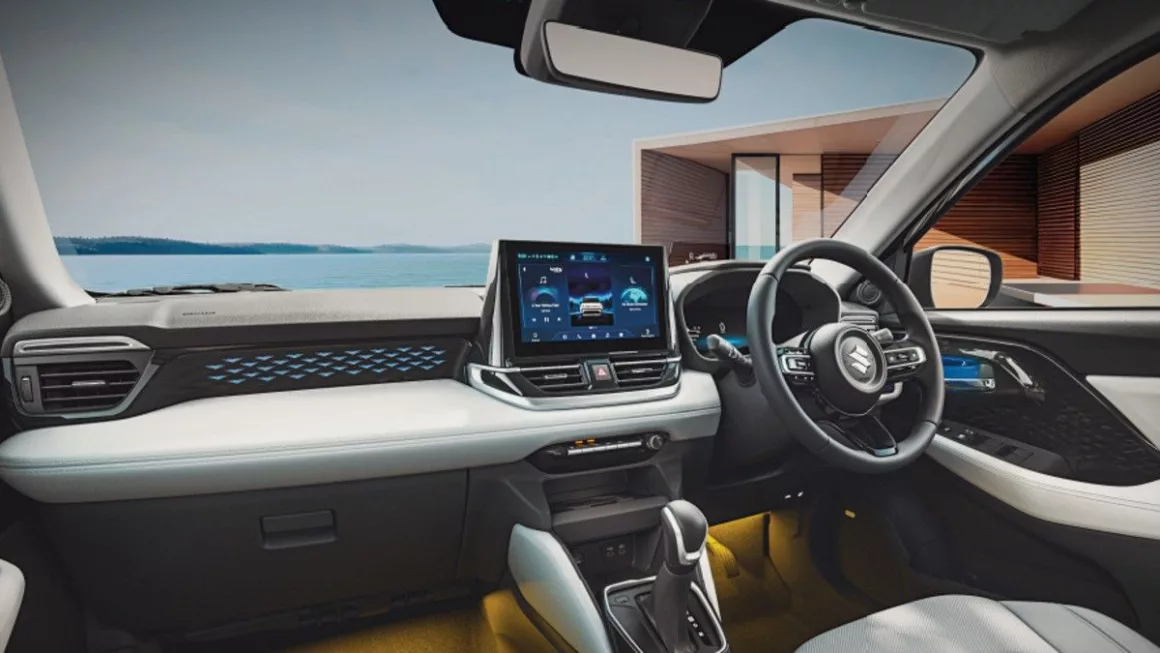
On the inside, both Maruti Victoris and Kia Seltos feel upmarket; however, the Seltos scores higher as far premium quotient is concerned. The Seltos’s dashboard is cleaner and has a layered effect. The centre of attraction is the curved, dual-screen setup, consisting of 10.25-inch screens for the instrument cluster and infotainment system. Its HVAC panel looks more premium than that of the Victoris, and like the Maruti rival, it features physical buttons for most controls, while high-quality rotary dials and switchgear uplift the look of things overall. Meanwhile, the Victoris looks and feels like a typical ‘Maruti,’ but that is not a bad thing at all. Like most modern Maruti cars, it features a trapezoidal free-standing touchscreen with trapezoidal AC vents below. A key element that uplifts the atmosphere is the pixelated backlight on the front passenger’s side of the modern-looking layered dashboard. Unlike the Grand Vitara, which gets a part-digital instrument cluster, the Victoris features a fully digital instrument cluster and an all-new three-spoke steering wheel.

In terms of features, both Victoris and Seltos offer plenty of amenities. Both offer premium sound systems, ventilated front seats, panoramic sunroof, head-up display, and more. However, there are some advantages to each. For example, the Victoris offers the advantage of a powered tailgate with gesture control, and the Seltos offers the advantage of a dual-camera dashcam and dual-zone climate control.
On the inside, the Kia Seltos feels slightly more premium than the Maruti Victoris, and in terms of features, both are almost equally equipped.
Maruti Suzuki Victoris vs Kia Seltos: Safety Features
| Maruti Suzuki Victoris | Kia Seltos | |
| NCAP Safety Rating | 5-star in Bharat NCAP | Not tested |
| Airbags | Six | Six |
| ABS with EBD | Yes | Yes |
| ESC | Yes | Yes |
| Traction Control | Yes | Yes |
| Automatic headlamps | Yes | Yes |
| Rain-sensing Wipers | Yes | Yes |
| Hill hold assist | Yes | Yes |
| Hill descent control | Yes | No |
| Rear sensors | Yes | Yes |
| Rear parking camera | 360-degree camera | 360-degree camera |
| ISOFIX Child seat anchor points | Yes | Yes |
| ADAS | Level-2 ADAS features | Level-2 ADAS features |
The Maruti Victoris has scored a 5-star rating in the Bharat NCAP safety test, emerging as one of the safest cars in India. On the other hand, the Kia Seltos has not undergone any NCAP test so far, so no comments can be made about its structural strength. However, what can be appreciated is its feature wealth. The Seltos is well-equipped with safety equipment and offers all the upmarket safety features expected of its segment, including the Level-2 ADAS safety suite. Like the Seltos, the Victoris is impressively equipped with many safety features, including a Level-2 ADAS safety suite.
Maruti Suzuki Victoris vs Kia Seltos: Price comparison
| Maruti Suzuki Victoris | Kia Seltos | |
| Base variants (Ex-Showroom) | Rs 10.50 – 11.50 lakh | Rs 11.19 – 14.61 lakh |
| Mid variants (Ex-Showroom) | Rs 11.80 – 16.38 lakh | Rs 14.46 – 17.28 lakh |
| Upper mid variants (Ex-Showroom) | Rs 13.57 – 18.39 lakh | Rs 15.82 – 18.71 lakh |
| Top variant | Rs 15.24 – 19.99 lakh | Rs 20 – 20.56 lakh |
The Maruti Victoris is slightly more affordable than the Kia Seltos. With that being said, it is worth mentioning that the Seltos offers more space and powerful engines. Therefore, as for the value, both Victoris and Seltos at neck to neck.
Maruti Suzuki Victoris vs Kia Seltos: Which one should you buy
There is no doubt that the Maruti Victoris is a capable mid-size SUV. It offers a host of upmarket features that lend a rich ownership experience, and it has proven its mettle in the passenger safety department with a 5-star rating in the Bharat NCAP safety test. However, like most Maruti cars, the main highlight of the Victoris is its fuel efficiency. But in the case of Victoris, an appealing fuel efficiency comes at the cost of power, which makes its performance devoid of excitement, and the SUV feels underpowered in certain driving conditions. Another drawback of the Victoris is inadequate space for three passengers in the rear seat. All in all, it would be best to physically experience and take a test drive before you come to a conclusion about the Victoris.
On the other hand, the Seltos, much like its sibling, the Hyundai Creta, is a better all-around package. Its refined and reliable engines are powerful enough for all your driving requirements. While the Seltos is not as fuel-efficient as the Victoris, it offers better space to rear-seat passengers. So, if you want an SUV which pleases both driver and passengers, the Seltos will be a better choice.
Maruti Suzuki Victoris vs Kia Seltos: FAQs
Which is larger among the Maruti Suzuki Victoris and Kia Seltos?
Maruti Suzuki Victoris is 4,360 mm long, 1,795 mm wide, 1,655 mm tall, and has a wheelbase of 2,600 mm. Kia Seltos is 4,365 mm long, 1,800 mm wide, 1,645 mm tall, and has a wheelbase of 2,610 mm. Therefore, the Kia Seltos is 5 mm longer, 5 mm wider, 10 mm shorter, and has a 10 mm longer wheelbase compared to the Maruti Victoris.
Among the Maruti Suzuki Victoris and Kia Seltos, which SUV delivers more mileage?
The Maruti Suzuki Victoris can deliver a mileage of up to 21.18 km/l with a mild-hybrid engine, up to 27.02 km/kg with CNG, and up to 28.65 km/kg with its strong hybrid engine. Whereas the Kia Seltos can deliver a mileage of up to 18.4 km/l with petrol and up to 21.8 km/l with diesel. Therefore, the Maruti Victoris is more fuel efficient than the Kia Seltos.
Among the Maruti Suzuki Victoris and the Kia Seltos, which offers better sound quality?
The Kia Seltos offers an 8-speaker Bose sound system, and the Maruti Victoris offers an 8-speaker Infinity sound system. Both SUVs offer quiet and almost equally premium sound qualities.
Which safety features are available in the base variant of the Maruti Suzuki Victoris?
The safety features of the base LXi variant of the Maruti Suzuki Victoris include 6 airbags, ABS with EBD, hill hold control, electronic stability program, ISOFIX anchorages, and more.
What types of automatic transmission systems are available in the Maruti Suzuki Victoris and the Kia Seltos?
The Kia Seltos offers a 6-speed torque converter automatic, CVT automatic, and 7-speed DCT automatic, while the Maruti Suzuki Victoris offer a 6-speed torque converter automatic and an e-CVT automatic.
Which model of Kia is best?
The best Kia model for you depends on your specific criteria. The Kia Carens is a comfortable and spacious option for a family car. The Kia Serantos is among the most popular for those that love SUVs due to the specs and driving experience. For a limited budget, the Kia Sonet is an affordable option. But the Seltos is generally viewed as the best all-rounder thanks to its mix of styling, features and performance.