


















Maruti Baleno Mileage Comparison: Petrol vs CNG

Maruti Suzuki Baleno
Last updated 3 months ago

The Maruti Baleno ranks amongst the best-selling premium hatchbacks in India due to its fashionable looks, spacious interiors, and excellent fuel efficiency. It has a 1.2-litre petrol engine and is available in petrol and CNG variants to suit all types of customers who want high performance as well as economical running costs.

While petrol variants are available with both manual and automatic transmissions, the CNG variant is offered only with a manual gearbox. This versatility, along with Maruti’s proven reliability, makes the Baleno a strong choice for city commuters and highway travellers alike.

In this comparison, we will examine the ARAI mileage readings of both variants, delve into real-world performance, and help you decide between petrol and CNG based on their running costs and feasibility.

Maruti Baleno ARAI Mileage Figures

Official ARAI-certified mileage for the Baleno across all engine and transmission options is:

Engine & Transmission ARAI Mileage (km/l)
Petrol – Manual22.35 km/l
Petrol – Automatic22.94 km/l
CNG – Manual30.61 km/kg

Maruti Baleno Real-World Mileage vs ARAI Mileage

Though ARAI test miles are computed with standard test conditions, actual road driving results in different figures. The petrol variant of Baleno delivers around 20-21 kmpl, while the CNG model offers a whopping 30-31 km/kg and is therefore highly cost-effective for regular commuters.

Among the reasons for variation between ARAI and actual on-road mileage are:

  • Driving Habits: Frequent sudden acceleration, hard braking, and aggressive driving can lower fuel efficiency. Maintaining smooth and steady driving helps the vehicle get closer to its ARAI mileage.
  • Traffic Movement: Stop-and-go city traffic reduces fuel economy more than continuous high-speed runs. Vehicles perform more efficiently on highways where motion is consistent and uninterrupted.
  • Load & Use of AC: Carrying heavy loads or running the air conditioner continuously increases fuel consumption. Moderate loading and mindful AC usage help maintain better mileage.
  • Servicing: Regular maintenance, including timely servicing, clean filters, and correct tyre pressure, keeps the engine running efficiently. Neglecting these can gradually reduce fuel economy.
  • Overall Efficiency: The Baleno offers a fuel-efficient package in its segment. The CNG variant is particularly appealing for users seeking low running costs on long-distance drives.

Overall, Baleno boasts a fuel-efficient package for its segment, and the CNG variant is especially attractive for users who want a low running expense over long distances.

Maruti Baleno Fuel Efficiency Comparison: Petrol vs CNG

When it comes to fuel economy, the Maruti Baleno’s petrol and CNG variants cater to distinct driving needs. The petrol version strikes a balance between performance and efficiency, making it suitable for mixed-use driving. The CNG variant, however, is tuned for maximum savings, making it a preferred option for budget-conscious, high-mileage commuters. In real-world driving, the differences become more evident in urban settings, where traffic congestion and frequent stops impact consumption.

Maruti Baleno City Fuel Efficiency Comparison

Under urban circumstances, petrol Balenos provide decent mileage but unsatisfactory fuel efficiency under crawling traffic circumstances. Petrol versions of AMT consume slightly more fuel than the manual versions because of transmission loss. Meanwhile, the CNG version is significantly more economical for normal city travel, especially under crawling traffic circumstances.

The primary reasons for such a discrepancy are:

  • Fuel Efficiency: The CNG variant performs better in slow-speed, stop-and-go traffic, delivering more kilometres per unit of fuel. This makes it particularly suitable for daily commuters who spend significant time in urban traffic. Over the long term, it can significantly reduce running costs.
  • Engine Configuration: The Baleno’s CNG version operates in an economy-optimised mode, keeping engine revs low in heavy traffic. This approach minimises fuel consumption while ensuring smooth performance even in congested city conditions.
  • Traffic Situations: Petrol engines tend to waste fuel as they repeatedly accelerate and decelerate in urban driving. In contrast, CNG engines are most efficient at low speeds and continuous driving, making them ideal for city commutes.
  • Idle Efficiency Time: CNG engines consume fuel more efficiently while idling, a definite advantage in slow-moving traffic. This feature helps maintain better overall mileage during frequent stops.
  • Heat Control: Petrol engines can lose efficiency due to overheating during stop-and-go urban driving. CNG engines, however, maintain near-ideal operating temperatures, ensuring consistent mileage even in prolonged traffic conditions.

Maruti Baleno Highway Fuel Efficiency Comparison

On highways, the petrol version of Baleno also offers great mileage, particularly at fixed speeds with low braking. The petrol variant with manual gears performs better in efficiency terms than the AMT version because power delivery is linear. Meanwhile, the CNG variant delivers good fuel economy on highways, though it offers slightly less power during overtaking, which may be noticeable on high-speed stretches.

The most important factors that decide highway mileage are:

  • Cruising Economy: Petrol engines are best adapted to steady higher speeds, providing smooth and economical operation. CNG provides a high cost saving per kilometre but incurs more for long runs because of a marginally poorer top-end response.
  • Load and Air-Conditioning Consumption: Overloading a Baleno or continuous AC running will decrease efficiency with both fuels, but the effect will be more noticeable with the CNG car because of its lower power output.
  • Driving Style: Smooth cruising speeds are crucial for achieving the best mileage. Abrupt gear-changing into fast speeds or hard overtakes adversely impacts petrol as well as CNG performance.
  • Altitude and Topography: Petrol models perform better on hilly or mountainous roads due to greater power output, whereas CNG models might require more downshifting in order to keep pace.
  • Availability of Fuel and Refuelling Points: Petrol is more convenient with extensive availability for highway driving over long distances, whereas operators of CNG must plan refuelling stops due to low availability, which has an effect on the efficiency of travel.

Maruti Baleno Fuel Cost Comparison: Petrol vs CNG

Understanding fuel costs is essential when deciding between the petrol and CNG variants of the Maruti Baleno. Let’s compare the running expenses based on a typical monthly driving of 1500 km and a few other aspects to help you gauge which option fits your budget better:

AspectsPetrolCNG
Monthly Running Distance1500 km1500 km
Monthly Fuel Use~67 litres~50 kg
Average Monthly Fuel Cost₹6,700*₹2,500*
Average Yearly Fuel Cost₹80,400*₹30,000*
5-Year Fuel Cost₹4,02,000*₹1,50,000*

Note: Calculations are based on an average petrol price of ₹100/litre and a CNG price of ₹50/kg. Actual expenses will vary regionally and with fuel price fluctuations.

Maruti Baleno Mileage vs Competitors

Comparing the Maruti Baleno’s mileage with that of some of its closest rivals provides insight into its fuel efficiency. Here’s a look at official mileage figures for petrol and CNG variants (wherever applicable):

ModelPetrol Mileage (km/l)CNG Mileage (km/kg)
Maruti Baleno22.35 km/l30.61 km/kg
Tata Altroz19.33 km/l26.2 km/kg
Hyundai i2020.35 km/lN/A
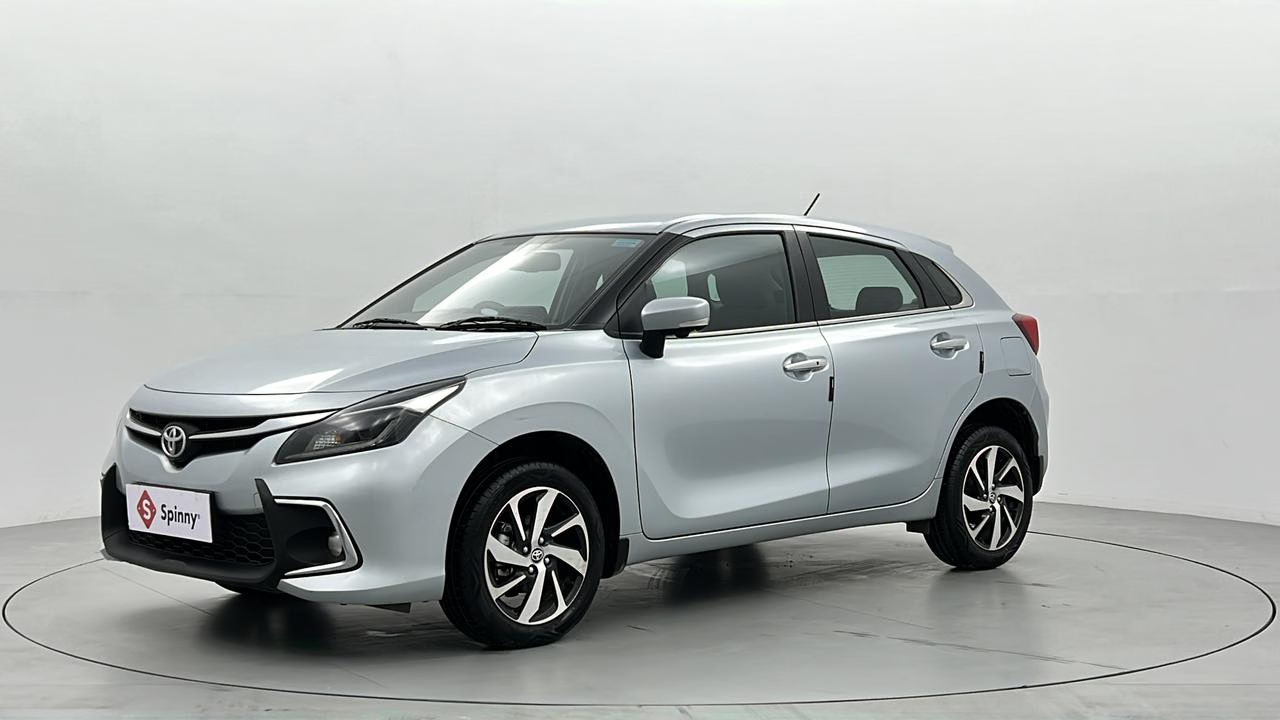
Toyota Glanza22.35 km/l30.61 km/kg

The Maruti Baleno is among the top performers in its class, especially with the CNG variant, which delivers one of the highest claimed mileages in the premium hatchback segment.

Summary

On running expenses and fuel efficiency, the Baleno CNG is a winner among drivers looking to reduce long-term fuel costs. Its ultra-low cost-per-kilometre positioning makes it ideal for everyday city driving and intercity users who prioritise running cost benefit over outright performance.

The petrol version, while less fuel efficient, has improved acceleration and refilling ease due to increased availability of fuel pumps. It is the appropriate alternative for those with fewer CNG facilities in their area or for those who require additional power while cruising on highways.

Your ultimate choice between the two rests on your daily commute, the prevalence of CNG in your region, and your inclination towards economy or performance. 

FAQs About Maruti Baleno Mileage Comparison

  1. Q. Is the Maruti Baleno CNG safe to drive in the long term?

    Yes, the Baleno’s factory-installed CNG kit is long-lasting and comes with a manufacturer’s guarantee. With maintenance, it provides assured performance in the future. The majority of owners have reported smooth efficiency and reduced running costs over petrol variants.

  2. Q. How frequently should I have the Maruti Baleno CNG system serviced?

    Routine servicing at intervals of 10,000–15,000 km is suggested in order to keep the CNG kit functioning in terms of performance, safety, and mileage. On-time maintenance also prevents sudden breakdowns and maintains smoother engine performance.

  3. Q. Is switching between petrol and CNG possible while driving the Maruti Baleno?

    Yes, Baleno CNG is a bi-fuel car and allows for easy fuel switching according to driving needs and fuel availability. It is not jerky, so you will not feel any change in performance.

  4. Q. Is the Baleno CNG less powerful than the petrol model?

    The power output of the CNG model is slightly less, something which becomes evident when overtaking or climbing an extremely high hill, but otherwise adequate for run-of-the-mill city and highway driving. Under everyday driving conditions, most drivers don’t notice the difference.

  5. Q. Do Baleno CNG drivers face a problem with CNG availability?

    CNG retailing stations are fast increasing in metro cities, but rural town or village consumers have to enquire beforehand about the availability and then drift towards the CNG mode. Nonetheless, owing to government efforts, the CNG coverage is steadily increasing throughout the country.

Share

Leave a Comment

Your email address will not be published. Required fields are marked *

A-Z Glossary

Every car part & feature, explained

News

The latest from the automotive world

Best Cars

The crème de la crème of cars

Rules & Regulations

Every law & regulation, explained

Car Ownership

Everyday car-care tips & advice

Buying a car

Make the right buying decision

Selling a car

Make the right selling decision

Miscellaneous

Cars & eveything in-between

5,000,000+ Readers

We’re ❤️ne big family!

Follow us for accurate, impartial & up-to-date information around everything related to cars – Latest news & developments, best options for every budget & lifestyle, ownership tips, buying & selling advice and a lot more on Spinny Magazine.

Unbiased
4.5/5
Reliable
4.5/5
Helpful
4.5/5
Scroll to Top

Want to Sell your Car?

Choose your brand below to get started: