
Purchasing a car requires some skill and patience. You shouldn’t buy a used car without first checking its condition and paperwork. advantage, especially in manual and CNG form. Similarly, you cannot determine the value of a used car by its condition alone. The vehicle documents also play a crucial role in determining whether a used car should be purchased or not.
For instance, if it’s a stolen car or a car that has been involved in a crime, you cannot purchase it due to legal reasons. Similarly, a car with an unpaid loan can’t be transferred to your name until the loan is closed and the bank issues an NOC. For these and similar issues, you must verify all the car documents before making a payment. The car documents that you must verify, along with their details, are provided in this article.
Table of Contents
Car Documents to Verify Before Purchasing It
Here are the car documents you must examine carefully before purchasing a used car in India:
Registration Certificate
When the car is purchased, the Regional Transport Office (RTO) registers it on the owner’s name and assigns it a unique vehicle registration number. A Registration Certificate or RC is also provided to the car owner when they take delivery of the new car.
This RC contains all the vehicle details such as the owner’s name, vehicle registration number, date on which the vehicle was registered, RC validity date, chassis number, engine number, and so on. So, the key details related to a used car can be easily found on its RC. So, the RC is the first and foremost document that needs to be verified before paying for a used car in India. Make sure the seller’s name matches the RC, check the number of previous owners, and check whether the RC is marked ‘Duplicate’.
Also Read: RC Transfer – How To Transfer Vehicle Ownership
Invoice
The invoice of the car generated when the owner purchased it is proves the original purchase (the RC is the legal proof of ownership). It contains the unique Vehicle Identification Number (VIN), engine number, and other details. So, ask the owner for the car’s original invoice to verify its legal purchase.
Insurance Document
The Insurance policy of the car must be checked thoroughly as it is important to drive a car that is insured to avoid any legal or financial issues in India. Ensure that the car’s insurance is still valid or else you will have to purchase it separately. Also, confirm the insurance coverage and check past history of claims as it will provide you with an idea about the car’s accidental history. Get the policy transferred to your name, normally within 14 days of the ownership transfer. The No Claim Bonus stays with the seller and doesn’t move to you.
Also Read: How to Check Insurance by Vehicle Number: A Complete Guide
Pollution Under Control (PUC) Certificate
A new car’s PUC is valid for one year from registration. After that, it must be renewed regularly. certificate to ensure that it meets the emission standards. If you don’t produce the PUC when asked by the RTO officer while driving the car, you can be fined up to ₹10,000 under Section 190(2) of the MV Act. So, to avoid that, you must ensure that the used car you are about to purchase has a valid PUC. If not, you can ask the owner to obtain the PUC certificate from a nearby PUC centre.
Also Read: How to Renew a PUC Certificate in India?
Service Records
Examine the service and maintenance records of a car properly because you would want to purchase a car that is regularly maintained and serviced by the previous owner. Check that the odometer readings rise steadily across service entries, because sudden drops can mean the odometer was tampered with.
Road Tax Receipt
It is mandatory to pay the road tax for all vehicles in India. So, along with the car’s invoice, you must also ask the owner to provide you with the road tax receipt of the car. If the road tax isn’t paid, Most states collect lifetime road tax for private cars at registration. If you move the car to another state, you’ll pay road tax there and can claim a pro-rata refund from the original state. In case the RTO officer finds it while examining your car documents.
Also Read: Road Tax Rules & Regulations for Cars in India
NOC from the Bank
If a loan was taken to purchase the car, you must ask the owner to provide the No Objection Certificate (NOC) from the bank from which it was procured. This is important because the RC cannot be transferred to your name unless the hypothecation status is cleared. For that, you need to submit Form 35, check the NOC’s date, because many banks’ NOCs are valid for only about 90 days, along with the NOC to the RTO while applying for the RC transfer.
RC Transfer Forms
Along with Form 35, Forms 29 and 30 are needed for the change of ownership. Form 35 is needed if the car has a loan. Form 28 is needed if the car is moving to another state or RTO area to complete the RC transfer process.
Dual Fuel Certificate
If a car has been integrated with a retrofitment CNG or LPG kit, you must check that the CNG/LPG kit is endorsed on the RC (fuel type should read Petrol/CNG) and that the cylinder has a valid hydro-test certificate, renewed every 3 years.
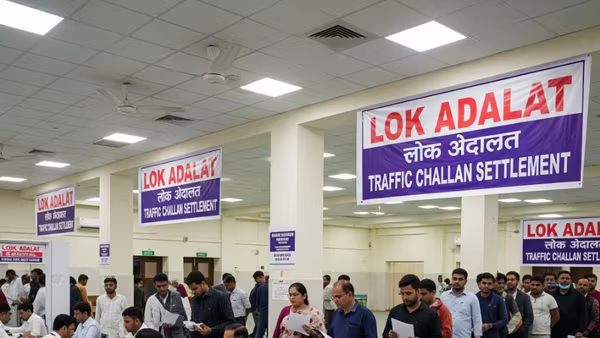
Along with these documents, you shall also have to check whether any challan is pending on the vehicle or not. It is important because all the pending challans need to be cleared before applying for the RC transfer. You can check all the vehicle details online using sites such as Spinny or Parivahan Sewa. The pending challans can be verified online using the challan or vehicle number via the Spinny eChallan webpage.
Summary
Before you pay for a used car in India, check its documents as carefully as you check its condition. The key papers are the Registration Certificate (RC), the original purchase invoice, a valid insurance policy, the Pollution Under Control (PUC) certificate, service records and the road tax receipt and check that the car isn’t reported stolen or blacklisted. If the car was bought on a loan, you also need the bank’s NOC, and if a CNG or LPG kit was fitted later, the dual fuel certificate. Together with the RC transfer forms, these confirm that the seller is the legal owner and the car has no unpaid loan or legal problems. They also make sure the RC can be moved to your name without trouble. Before paying, check for pending challans online on Spinny or the Parivahan portal.
Related Blogs:
Buying A Used Car In India: A Complete Guide
Vehicle Inspection & Auto Check Guide for Used Cars
FAQs about Used Car Documents
Q. Which documents should I check before buying a used car in India?
Check the RC, original invoice, insurance policy, PUC certificate, service records and road tax receipt. If the car was bought on a loan, also ask for the bank NOC. If a CNG or LPG kit was fitted after purchase, ask for the dual fuel certificate. Together, these confirm ownership, legal standing and maintenance history.
Q. How can I check whether a used car has a pending loan?
Look at the hypothecation entry on the RC, or check the car’s details online with the registration number on Parivahan. If a bank is still listed, the seller must give you the bank’s NOC and Form 35. Without these, the RC can’t be transferred to your name.
Q. Which forms are needed to transfer RC ownership of a used car?
Forms 29 and 30 cover the change of ownership. Form 35 is needed if the car had a loan, along with the bank’s NOC. Form 28, an NOC from the original RTO, is required if the car is being moved to another state. Submit these at the RTO with the RC, insurance, PUC and both parties’ ID and address proof.
Q. How do I check pending challans on a used car?
Enter the vehicle registration number on Spinny’s eChallan page or the Parivahan eChallan portal. Make sure the seller clears all pending challans before you pay, because the RC transfer can be held up until they’re settled.
Q. Can I buy a used car without its original invoice or service records?
You can, but it’s riskier. The invoice proves the car was legally bought and lets you match the chassis and engine numbers. Service records show whether it was well looked after. If either is missing, rely more on the RC details, an online vehicle check and a professional inspection.
Q. Why is car insurance history important when buying a used car?
Past insurance claims show whether the car has been in accidents or had major repairs. Also check that the policy is valid and gets transferred to your name. Driving uninsured is illegal in India, and a lapsed policy has to be renewed before you drive.