
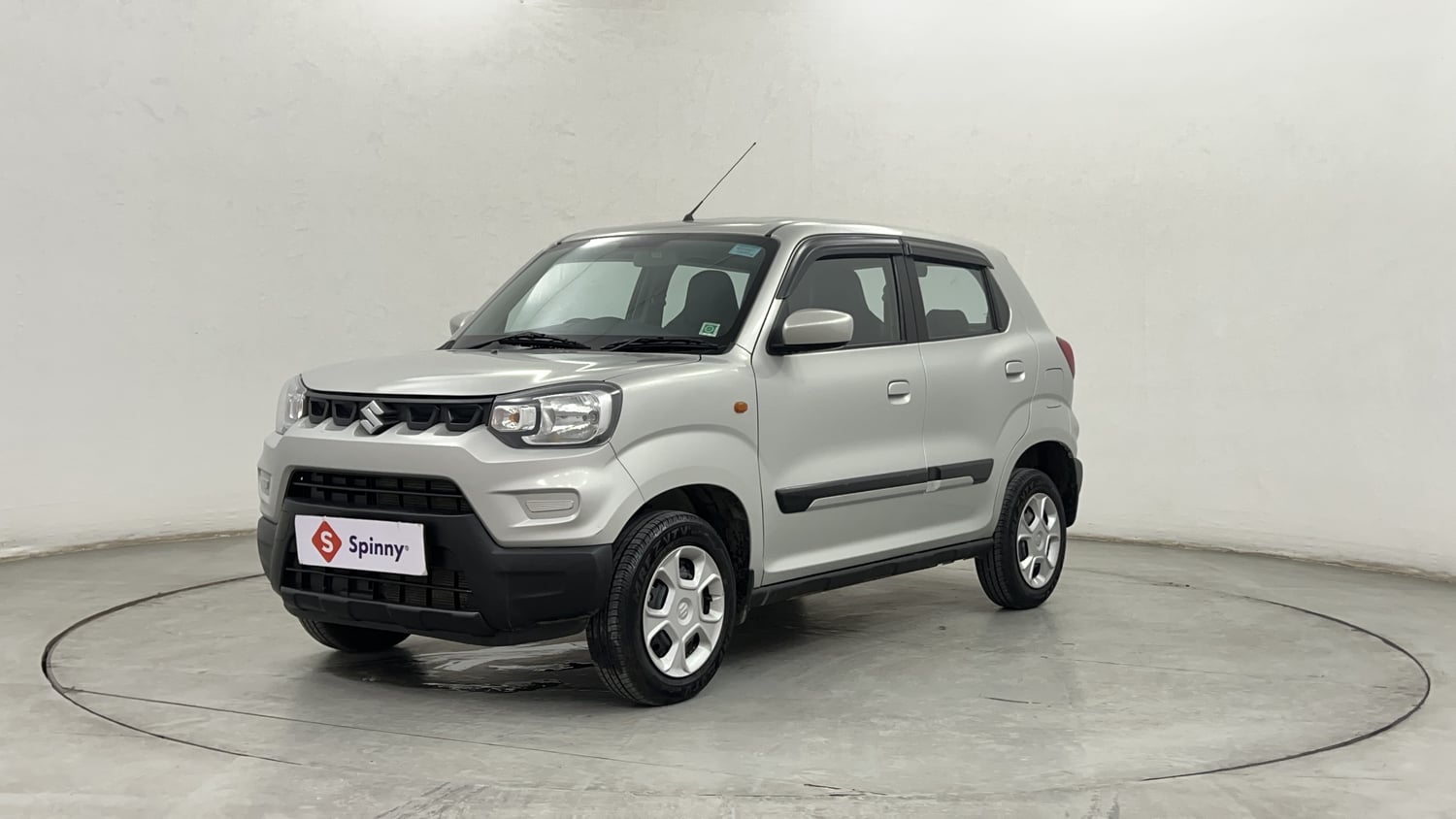
Maruti Suzuki S-Presso is a well-established product within the micro-SUV/entry hatchback category in the Indian market. Known for its tall-boy design, good ground clearance, and fuel-efficient 1.0-litre K10C Next-Gen DualJet engine, the Maruti S-Presso is available in two versions, including Petrol and factory-equipped S-CNG versions.
Although there are no visible differences between the two variants, some factors such as mileage, storage space, performance, and overall running cost are important when deciding which of the two to buy. The following comparison will provide insight into both versions from different perspectives.
Table of Contents
Maruti S-Presso Petrol vs Maruti S-Presso CNG: Dimensions
| Specification | Maruti S-Presso Petrol | Maruti S-Presso CNG |
| Length | 3565 mm | 3565 mm |
| Width | 1520 mm | 1520 mm |
| Height | 1553 mm (VXi/VXi+) | 1567 mm |
| Wheelbase | 2380 mm | 2380 mm |
| Boot Space | 270 Litres | Significantly Reduced (Occupied by CNG Cylinder) |
| Ground Clearance | 180 mm | 180 mm |
As far as physical size goes, the two variants have similar measurements for their length, width, wheelbase, and ground clearance, providing an upright seating posture and easy ingress into the cabin. However, the standard 60-litre CNG tank fitted in the S-CNG variant occupies the boot area inside the car, resulting in significantly reduced boot space when compared to the 270-litre boot space in the Petrol variant. Moreover, the CNG variant is also marginally taller than the Petrol variant in terms of overall unladen height owing to modified rear springs.
Summary: The Petrol variant is far superior as far as utility of boot space goes, while other physical dimensions are similar between the two variants.
Maruti S-Presso Petrol vs Maruti S-Presso CNG: Engine & Transmission
| Feature / Specification | Maruti S-Presso Petrol | Maruti S-Presso CNG |
| Engine Options | 1.0L K10C DualJet Petrol | 1.0L K10C DualJet Petrol + CNG Kit |
| Transmission Options | 5-Speed Manual / 5-Speed AMT (AGS) | 5-Speed Manual |
| Power | 67 bhp @ 5500 RPM | 56 bhp @ 5300 RPM (CNG Mode) |
| Torque | 89 Nm @ 3500 RPM | 82.1 Nm @ 3400 RPM (CNG Mode) |
| ARAI Mileage | 24.12 – 25.30 km/l | 32.73 km/kg |
The Petrol version exploits all the potentiality of the 1.0L K10C engine and provides a powerful 67 bhp and torque of 89 Nm that enable good urban acceleration and easy highway riding. It also allows choosing an automatic gearbox (AMT/AGS) that enables clutchless city driving. At the same time, in the CNG version, the peak power decreases to 56 bhp, and the torque reaches 82.1 Nm, producing a somewhat subdued throttle response when overtaking. However, the S-CNG version compensates for that drawback by providing outstanding fuel efficiency figures of 32.73 km/kg as opposed to the petrol’s maximum 25.30 km/l, thus substantially decreasing costs per kilometer.
Summary: The Petrol version demonstrates better power characteristics and automatic transmission availability, while the CNG version wins hands down regarding fuel economy.
Also Read: Maruti Suzuki S-Presso Running Cost Breakdown: 5-Year Service Cost, Fuel Cost
Maruti S-Presso Petrol vs Maruti S-Presso CNG: Features & Comfort
| Feature | Maruti S-Presso Petrol | Maruti S-Presso CNG |
| Infotainment System | 7-inch SmartPlay Studio Touchscreen | Standard Audio System / Basic Head Unit |
| Music System | 2 Speakers | 2 Speakers |
| Climate Control | Manual AC with Heater | Manual AC with Heater |
| Ventilated Seats | Not Offered | Not Offered |
| Adjustable Steering | Not Offered | Not Offered |
| Drive Modes | Not Offered | Petrol / CNG Fuel Switch Mode |
| Instrument Cluster | Digital Centrally Mounted | Digital Centrally Mounted with Dual Fuel Gauges |
| Sunroof | Not Offered | Not Offered |
| Adjustable Seats | Manual (Recline & Slide) | Manual (Recline & Slide) |
| Rear AC Vents | Not Offered | Not Offered |
| 60:40 Rear Seat Split | Single Piece Folding | Single Piece Folding |
| Cruise Control | Not Offered | Not Offered |
The two variants have the same core features including the digital dashboard, front power windows, and manual AC. The Petrol engine comes in all trim levels up to the highest level VXi+. This means that one can enjoy high-end features such as the 7-inch infotainment touch screen with Apple CarPlay and Android Auto compatibility. The S-CNG engine is only available in mid-range levels (LXi and VXi). This means that comfort-oriented features such as the touch screen display are not included in the CNG variant. The CNG digital dashboard has unique fuel gauges for the petrol and gas levels at the same time.
Summary: The Petrol version is equipped with a better feature range as compared to the mid-level CNG version.
Also Read: Maruti Suzuki S-Presso Running Cost Breakdown: 5-Year Service Cost, Fuel Cost
Maruti S-Presso Petrol vs Maruti S-Presso CNG: Safety Features
| Safety Feature | Maruti S-Presso Petrol | Maruti S-Presso CNG |
| GNCAP Safety Rating | 1 Star (Updated Test Protocol) | 1 Star (Updated Test Protocol) |
| Airbags | Dual Front Airbags (Standard) | Dual Front Airbags (Standard) |
| ABS with EBD | Yes (Standard) | Yes (Standard) |
| ESC (Electronic Stability Control) | Yes (Standard) | Yes (Standard) |
| Traction Control | Not Offered | Not Offered |
| Automatic Headlamps | Not Offered | Not Offered |
| Rain-Sensing Wipers | Not Offered | Not Offered |
| Hill Hold Assist | Yes (AMT Variants Only) | Not Offered |
| Hill Descent Control | Not Offered | Not Offered |
| Rear Sensors | Reverse Parking Sensors (Standard) | Reverse Parking Sensors (Standard) |
| Rear Parking Camera | Not Offered | Not Offered |
| ISOFIX Child Seat Anchor Points | Not Offered | Not Offered |
| ADAS | Not Offered | Not Offered |
Both petrol and CNG variants use the Heartect platform of Maruti and have similar safety features, which include dual frontal airbags, Anti-lock Brakes (ABS) with EBD, parking sensors, and ESP. Nevertheless, safety rating agencies give importance to the strength of their structure, where both the variants hold the same 1-Star Global NCAP Safety rating. The petrol AMT version of this car has an extra hill-hold assist, while the CNG variant has a factory-built micro-switch, which will prevent the engine from running with the fuel lid open.
Summary: The basic safety kit is the same in both variants.
Maruti S-Presso Petrol vs Maruti S-Presso CNG: Price Comparison
| Variant / Trim | Maruti S-Presso Petrol (Ex-Showroom) | Maruti S-Presso CNG (Ex-Showroom) |
| Base Variants (Std / LXi) | ~₹4.26 Lakh – ₹5.01 Lakh | ~₹5.92 Lakh (LXi CNG) |
| Mid Variants (VXi) | ~₹5.21 Lakh | ~₹6.12 Lakh (VXi CNG) |
| Upper Mid / Automatic Variants | ~₹5.67 Lakh (VXi AMT) | N/A |
| Top Variant (VXi+ / VXi+ AMT) | ~₹5.50 Lakh – ₹5.95 Lakh | N/A |
Petrol model comes with an entry-level pricing which makes it more affordable for the customers who want something cheaper. The upgrade to the S-CNG model from the stock petrol model requires the payment of a premium price of about ₹90,000 for the manual trims. However, for customers with heavy usage (more than 1,500km per month), the savings on the fuel costs due to CNG make the premium amount pay off within 18 to 22 months.
Summary: The Petrol model offers low pricing and more choice of trims while the CNG model is expensive upfront but becomes profitable later on when used over long distances.
Also Read: Maruti Suzuki S-Presso Image Gallery: Interior, Exterior
Summary
Both the Maruti S-Presso Petrol and CNG models meet the needs of their target audience well:
- Select the Maruti S-Presso Petrol model if you need maximum trunk capacity (270 liters), if you need maximum car features such as touchscreen entertainment system, if you would like an automatic AMT gearbox, or if you drive less than 30 kilometers a day.
- Select the Maruti S-Presso CNG if your main concern is getting the lowest per kilometer running costs, if you drive extensively in a city traffic with heavy congestion (more than 40-50 kilometers a day), and if you can compromise on boot space and automatic gearbox to make savings over the long run.
On balance, the Maruti S-Presso CNG is the best choice for drivers with a large mileage because of its unique running savings. The Maruti S-Presso Petrol model is clearly a better choice for urban families.
FAQ about Maruti S-Presso Petrol vs Maruti S-Presso CNG
Q. What would be the mileage comparison of S-Presso Petrol vs. S-Presso CNG on the road?
In practical scenarios, the mileage of S-Presso Petrol stands at 14 to 16 kilometers per litre in cities and 18 to 20 kilometers per litre on highways, whereas S-Presso CNG provides a mileage of 22 to 24 kilometers per kilogram in cities and 26 to 28 kilometers per kilogram on highways.
Q. Is there any automatic (AMT) gearbox option on the S-Presso CNG variant?
No, the factory-fitted S-Presso CNG kit is provided only with the manual 5-speed transmission in the Maruti S-Presso. AMT or AGS box comes only in the petrol version of the model.
Q. How much boot space is left in S-Presso CNG?
The 60-liter CNG tank takes up most of the original 270-liter capacity of the boot floor.
Q. Is the performance of the S-Presso CNG substantially inferior compared to its petrol counterpart?
The performance of the engine falls from 67 bhp/89 Nm to 56 bhp/82.1 Nm once the vehicle is run on CNG. Although driving in the city becomes easy and comfortable, the car needs to be downshifted while overtaking on highways.
Q. How soon can one get back the extra money invested in the S-Presso CNG variant?
Taking into consideration a distance of 1,500 kilometers per month, it takes around 18 to 22 months to get back the money invested in the purchase of the CNG variant.