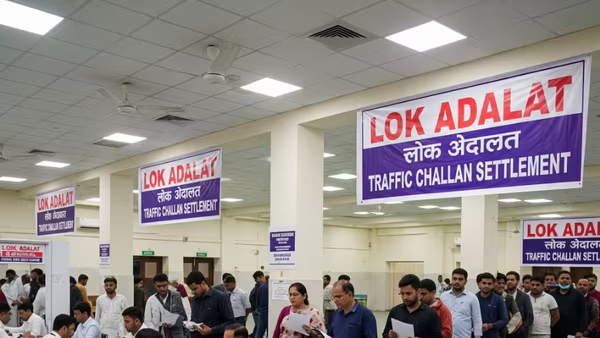
Lok Adalat is a people’s court where pending cases are settled by agreement between the parties, usually in a single sitting, with no court fee and no appeal afterwards. The next National Lok Adalat is on 12 December 2026, and for vehicle owners it is one of the simplest ways to clear old car, bike and court challans in one go.
Challans are only part of what it handles. Lok Adalat also settles bank recovery matters, motor accident claims and many other civil disputes. This guide covers the 2026 dates, the types of Lok Adalat, which cases qualify and how the process works. Before the next sitting, check pending e-challans on the vehicle.
Table of Contents
National Lok Adalat dates 2026
The National Legal Services Authority (NALSA) organises four National Lok Adalats every year. In 2026, the sittings are scheduled on the second Saturday of March, May, September and December.
| Sitting | Date | Status |
|---|---|---|
| 1st National Lok Adalat | 14 March 2026 | Held |
| 2nd National Lok Adalat | 9 May 2026 | Held |
| 3rd National Lok Adalat | 12 September 2026 | Held (some states rescheduled) |
| 4th National Lok Adalat | 12 December 2026 | Upcoming |
States can hold their sitting on a different date. In 2026, for example, the second sitting took place in June or July in Telangana, Gujarat and Karnataka, and Delhi moved its third sitting to 25 October. With the next sitting due on 12 December 2026, this is a good time to check your e-challan status and note any challans already sent to court.
What is Lok Adalat?
Lok Adalat is where a pending case or dispute can be closed by agreement, without going through a full court trial. The two sides sit before a bench, usually led by a serving or retired judge, talk through the issue and settle on terms they both accept. That settlement is recorded as an award, which has the same force as a court decree.
For most people, a few things make it worth considering:
- It costs nothing. There is no fee to have a case heard, and if a pending court case is settled, the court fee already paid is refunded.
- It is quick. Many cases, including traffic challans, are settled on the day of the sitting.
- No lawyer is needed. People can appear on their own and speak directly to the bench.
- The decision is final. Once both sides agree, the matter is closed and no appeal lies against it.
Lok Adalats are set up under the Legal Services Authorities Act, 1987, and organised by NALSA along with state and district legal services authorities. They take up cases already pending in court as well as disputes that have not reached court yet, such as an overdue loan, a disputed electricity bill or an old traffic challan.
Types of Lok Adalat
There are four main types, each set up for a slightly different purpose.
- National Lok Adalat: Held on the same day across the country, usually four times a year. It handles a large volume of cases, including traffic challans, bank recovery and motor accident claims.
- State Lok Adalat: Organised by a state legal services authority on dates of its choosing, sometimes focused on particular types of cases.
- Permanent Lok Adalat: A standing body for disputes about public utility services, such as transport, electricity, water, telephone and insurance. Unlike the others, it can decide a case on merit if the parties do not reach a settlement.
- Virtual Lok Adalat: A virtual sitting in which parties join through a video link. Several states, including Maharashtra, use it to settle traffic challans without a visit to the venue.
Also Read: Virtual Court Challan: How to Check, Pay or Contest Traffic Challans Step by Step
Lok Adalat in major cities and states
Each state legal services authority runs its own sittings, dates and token process, so the steps vary slightly from city to city. The state authority’s notice, usually released a few weeks before, confirms the exact date, venue and booking window.
| City / region | State legal services authority | What to note | Detailed guide |
|---|---|---|---|
| Delhi | Delhi State Legal Services Authority (DSLSA) | Online token booking. Sittings at district court complexes | Lok Adalat in Delhi |
| Gurugram / Faridabad | Haryana State Legal Services Authority (HALSA) | Sittings at district courts | Lok Adalat in Haryana |
| Mumbai | Maharashtra State Legal Services Authority (MSLSA) | e-Lok Adalat option. Meeting link sent after registration | Lok Adalat in Mumbai |
| Bengaluru | Karnataka State Legal Services Authority (KSLSA) | Token from the help desk at the venue | Lok Adalat in Bangalore |
| Hyderabad | Telangana State Legal Services Authority | Dates can differ from the national calendar | Lok Adalat in Telangana |
| Ahmedabad / Surat | Gujarat State Legal Services Authority (GSLSA) | Challans marked “referred to court” are mostly settled here | Lok Adalat in Gujarat |
Which cases and offences are covered in Lok Adalat?
Most civil disputes can be taken up, along with criminal cases that the law allows the parties to settle. The key distinction is between compoundable and non-compoundable offences.
A compoundable offence is one where the complainant and the accused are allowed to settle, after which the case is closed. These offences are listed under Section 359 of the Bharatiya Nagarik Suraksha Sanhita (BNSS), which replaced Section 320 of the Code of Criminal Procedure. Most traffic offences can also be compounded by paying a fine under Section 200 of the Motor Vehicles Act, which is why traffic challans make up a large part of every National Lok Adalat.
A non-compoundable offence is treated as an offence against society rather than against one person, so the parties cannot settle it between themselves.
| Category | Examples | Covered? |
|---|---|---|
| Civil disputes | Bank and car loan recovery, motor accident claims, insurance claims, electricity and water bills, family disputes (except divorce), labour and property matters | Yes |
| Compoundable offences | Traffic challans, simple hurt, criminal intimidation, defamation, criminal trespass | Yes |
| Non-compoundable offences | Serious criminal offences, drunk driving, hit and run, minor driving | No |
Divorce cases and matters already decided by a court are also excluded, and all such cases continue in the regular court.
Also Read: How To Claim Car Insurance
How Lok Adalat works
A case moves through five clear steps.
- Referral or application: A pending case is referred by the court, either at the request of the parties or because the court feels it can be settled. For a pre-litigation dispute, one of the parties applies to the legal services authority.
- Listing: The case is listed for a sitting, and both parties are told the date and venue. For traffic challans, this usually means a notice or an online token.
- Hearing: The parties appear before the bench, which explains the options and helps them work towards a settlement.
- Settlement: If both sides agree, the terms are recorded. In a challan case, the settled amount is usually paid the same day.
- Award: The bench passes an award based on the settlement.
The award is treated as a decree of a civil court. It is final and binding, and no appeal lies against it. If the parties do not settle, the case simply goes back to the court where it was pending.
Benefits of Lok Adalat
A Lok Adalat has many benefits for vehicle owners as well as people relying for other disputes.
- No court fee: There is no fee to have a case heard, and if a pending case is settled, the court fee already paid is refunded.
- Faster disposal: Many cases are closed on the day of the sitting itself.
- Simple process: Strict rules of procedure and evidence do not apply, and parties can speak directly to the bench.
- Agreed outcome: The settlement is reached by consent, so neither side has a decision imposed on it.
- No lawyer needed: Parties can appear on their own, although they may bring a lawyer if they wish.
Lok Adalat for traffic challans
For most vehicle owners, the main reason to attend is to clear pending traffic challans. Challans left unpaid for a long time are forwarded to the virtual court, and the National Lok Adalat gives owners a chance to settle many of them at once. Any reduction in the amount is decided by the bench and is not guaranteed.
| Offence | Applies to | MV Act section | Standard fine | Covered? | What to note |
|---|---|---|---|---|---|
| Over-speeding | Both | Sec 183 | ₹1,000–₹2,000 (LMV) | Yes | Usually caught on camera |
| Red light jumping / dangerous driving | Both | Sec 184 | ₹1,000–₹5,000 | Yes | Repeat offences carry higher fines |
| Riding without a helmet | Bike | Sec 194D | ₹1,000 | Yes | Licence disqualification can also apply |
| Triple riding | Bike | Sec 194C | ₹1,000 | Yes | Licence disqualification can also apply |
| Driving without a seatbelt | Car | Sec 194B | ₹1,000 | Yes | Applies to front and rear seats |
| Wrong / no-parking | Both | Sec 177 / 122 | ₹500 onwards | Yes | Amounts vary by state |
| Driving without insurance | Both | Sec 196 | ₹2,000 | Yes | Renew the insurance before the hearing |
| Drunk driving | Both | Sec 185 | ₹10,000 and/or jail | No | Must go before a regular magistrate |
| Minor driving | Both | Sec 199A | ₹25,000 | No | Guardian or owner held liable |
Fines as per the Motor Vehicles Act, 2019. States may notify different amounts.
The process is broadly the same across states. Owners check which challans are pending, then book a token when the state portal opens, usually a few days before the sitting. On the day, they carry the token, challan printouts, RC, driving licence and photo ID, appear before the bench and pay the settled amount. The disposal receipt is proof that the challan is closed.
Car challans
Over-speeding, red light jumping, seatbelt and parking challans are among the most common car challans settled at the sitting. Car owners should carry the RC and a valid insurance certificate, since an expired policy can itself lead to a fresh challan. A quick car e-challan check shows how many notices are pending against the registration number.
Bike challans
Bike owners commonly receive camera-based challans for riding without a helmet, triple riding and over-speeding. These are settled the same way as car challans, with the bike’s RC and the rider’s licence. A bike challan check shows which notices are still unpaid before a token is booked.
Court challans
A challan not paid within the given time is sent to the virtual court, after which it can no longer be paid as a regular e-challan. These court challans are among the cases most often settled at a National Lok Adalat. Before booking a token, owners can check their court challan status to confirm whether a notice has reached court.
Clearing old challans also matters when it is time to sell, since pending challans can hold up the RC transfer. Many owners settle them before they sell car.
FAQs about Lok Adalat
Q. What is Lok Adalat in simple words?
Lok Adalat is a forum where two sides sit before a bench and settle their dispute by mutual agreement, instead of going through a full trial. It runs under the Legal Services Authorities Act, 1987, there is no court fee, and once both sides agree, the decision is final.
Q. When is the next National Lok Adalat in 2026?
The next Lok Adalat is on 12 December 2026, which is the fourth and last National Lok Adalat of the year. Some states hold their sittings on other dates, so check your state legal services authority’s notice for the exact date and venue.
Q. Which traffic challans can be settled in Lok Adalat?
Most compoundable challans can be settled in Lok Adalat, including over-speeding, red light jumping, riding without a helmet, driving without a seatbelt, wrong parking and driving without insurance. Serious cases such as drunk driving, minor driving and accidents involving injury cannot be taken up here, and they continue in the regular court.
Q. Is a discount guaranteed on challans?
No, the bench decides the amount case by case. Some challans are settled for less than the original fine, while others are settled at the full amount, so it is best not to count on a reduction.
Q. Can a Lok Adalat award be appealed?
No as Under Section 21 of the Legal Services Authorities Act, 1987, the award is final and binding on both sides, and no appeal is allowed. If the parties cannot reach a settlement, the case goes back to the court where it was pending and carries on from there.
Q. What is the difference between Lok Adalat and Permanent Lok Adalat?
A regular Lok Adalat can only close a case if both sides agree to the terms. A Permanent Lok Adalat deals with disputes over public utility services such as transport, electricity and insurance. If the parties don’t settle, it can decide the case on its merits.
Q. Can bike and court challans be settled in Lok Adalat?
Bike challans are handled the same way as car challans, and you need the RC and the rider’s licence. Challans that have already been sent to the virtual court are among the most common cases settled at these sittings, so they are a good reason to attend.
Q. Is the Lok Adalat process the same in every state?
The basic steps are the same everywhere, but each state legal services authority sets its own dates, venues and token booking method. Check your state authority’s notice, which usually comes out a few weeks before the sitting, for the details that apply to you.