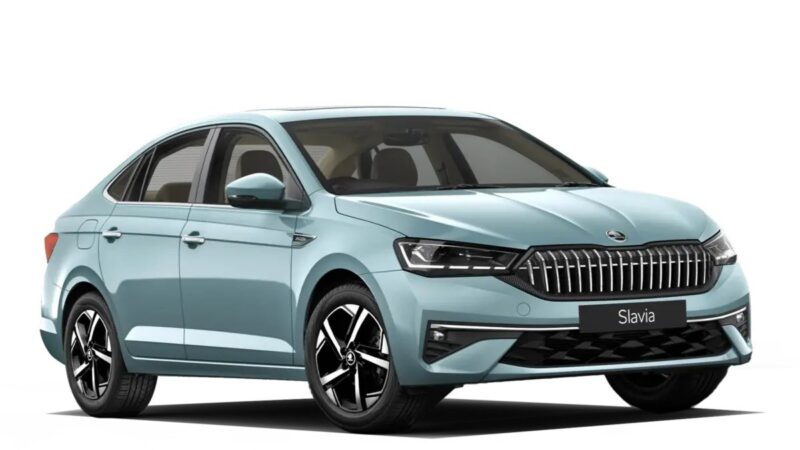
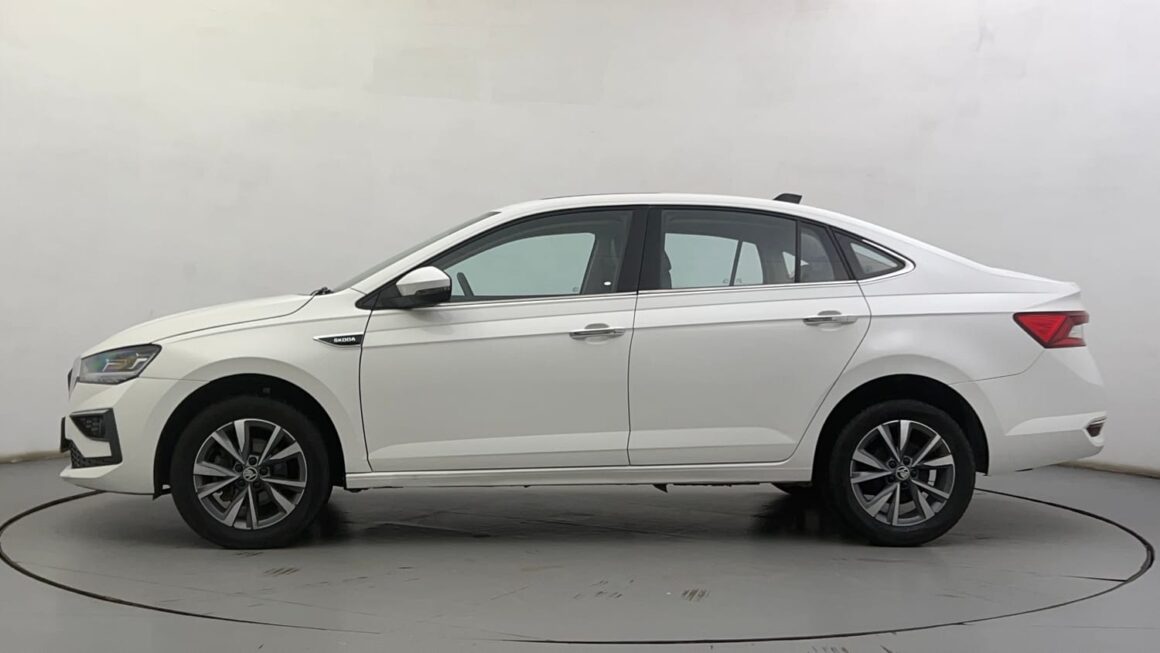
Volkswagen Virtus and Skoda Slavia are similar mid-size cars that deliver excellent turbo-petrol performance along with good cabin space and road manners. These cars share identical platforms and use the same 1.0-litre and 1.5-litre TSI engines. The 1.0 TSI comes with either a 6-speed manual or torque converter automatic gearbox. The other 1.5 TSI engine is now available with a 7-speed DSG unit. So, comparing their mileage doesn’t tell you much, since they are expected to perform differently in real-world conditions.
Their claimed figures show small differences, but real-world mileage usually overlaps because their engines, gearboxes and fuel tanks are nearly identical. Traffic, driving style and transmission choice matter more than the badge. This comparison examines their ARAI figures, everyday efficiency, fuel costs and prices.
Volkswagen Virtus vs Skoda Slavia Specs
The table below compares the key specifications of the Volkswagen Virtus and Skoda Slavia:
| Specification | Volkswagen Virtus | Skoda Slavia |
| Engine options | 1.0-litre TSI petrol; 1.5-litre TSI petrol | 1.0-litre TSI petrol; 1.5-litre TSI petrol |
| Displacement | 999 cc; 1498 cc | 999 cc; 1498 cc |
| Cylinders | 1.0 TSI: 3; 1.5 TSI: 4 | 1.0 TSI: 3; 1.5 TSI: 4 |
| Power | 1.0 TSI: 115 PS; 1.5 TSI: 150 PS | 1.0 TSI: 115 PS; 1.5 TSI: 150 PS |
| Torque | 1.0 TSI: 178 Nm; 1.5 TSI: 250 Nm | 1.0 TSI: 178 Nm; 1.5 TSI: 250 Nm |
| Transmission | 6-speed MT; 6-speed AT; 7-speed DSG | 6-speed MT; 6-speed AT; 7-speed DSG |
| Drive layout | Front-wheel drive | Front-wheel drive |
| Approximate kerb weight | 1100–1275 kg | 1160–1277 kg |
| Fuel tank capacity | 45 litres | 45 litres |
| Boot space | 521 litres | 521 litres |
| Ground clearance | 179 mm | 179 mm |
The two cars have the same layout and wheelbase, as well as the same engines and transmission combinations. The former 1.0-litre TSI produces 115 PS and 178 Nm in torque, which is enough for urban and highway driving. The latter 1.5 TSI produces 150 PS and 250 Nm of torque. It also benefits from active cylinder technology that allows two cylinders to deactivate under light throttle. This lets the larger engine deliver mileage similar to the smaller engine.
The 1.5 TSI manual has been discontinued in both cars, leaving the 7-speed DSG as its only current gearbox. Skoda has also unveiled an updated Slavia that replaces the 1.0 TSI’s 6-speed automatic with an 8-speed unit. Its certified mileage and prices were not announced at the time of writing, so we use the available 6-speed version here. Minor differences in weight, tyres or equipment are unlikely to create a consistent mileage advantage.
Also Read:
Volkswagen Virtus vs Skoda Slavia: ARAI Mileage Figures
The Slavia has a slight advantage over the Virtus in the 1.0 TSI configuration, with a claimed 20.32 km/l compared to 20.19 km/l for the Volkswagen. Somewhat higher figures for the automatic versions are also in Slavia’s favour: 18.73 km/l against Volkswagen’s 18.70 km/l. However, the Virtus surpasses the Slavia in the 1.5 TSI configuration: it claims 19.62 km/l instead of the latter’s 19.36 km/l. Still, the difference is negligible in practical terms.
| Engine and Transmission | Fuel Type | Volkswagen Virtus ARAI Mileage | Skoda Slavia ARAI Mileage |
| 1.0-litre TSI manual | Petrol | Up to 20.19 km/l | 20.32 km/l |
| 1.0-litre TSI automatic | Petrol | Up to 18.70 km/l | 18.73 km/l |
| 1.5-litre TSI DSG | Petrol | 19.62 km/l | 19.36 km/l |
Some Virtus configurations may show slightly different figures, though those presented in the table are claimed to be the maximum possible numbers. The Slavia automatic figure refers to the current 6-speed version, not the freshly announced 8-speed automatic transmission. More importantly, ARAI testing is carried out in laboratory conditions and does not account for heavy traffic, repeated turbo-boosting, long idling periods, or rapid acceleration. The engines are very sensitive to the throttle response, which means that a relaxed driver may achieve the claimed mileage on smooth highways, while during city drives the consumption will be noticeably higher.
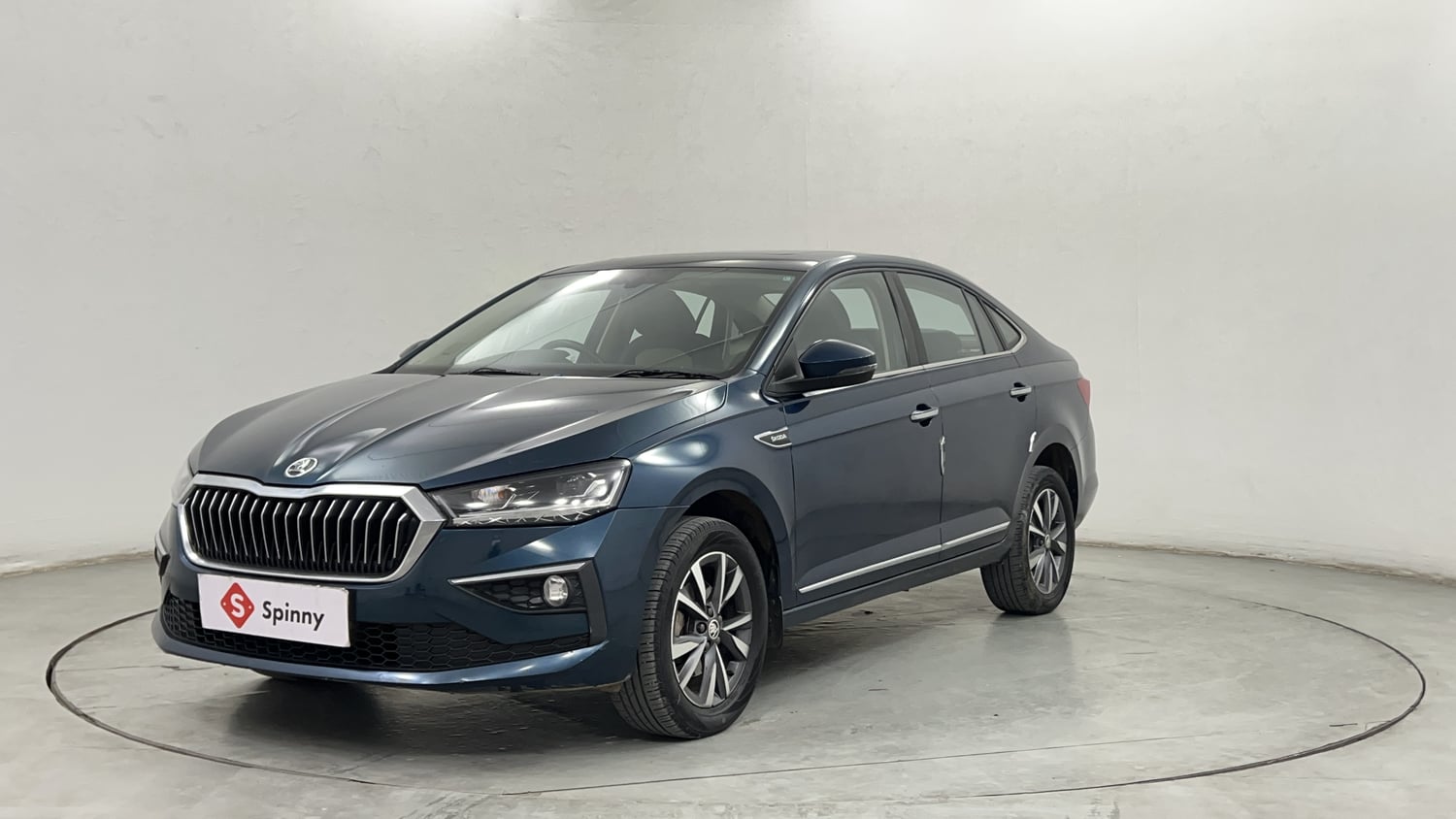
Volkswagen Virtus vs Skoda Slavia: Real World Fuel Efficiency
The 1.0 TSI manual is usually the most economical choice for regular city and mixed driving. In moderate traffic, both sedans can return approximately 11–13 km/l, while extremely congested short trips may pull the number below 10 km/l. On highways, the Virtus manual commonly delivers around 18–20 km/l and the Slavia around 17–19 km/l. The 1.0 automatic is more convenient in traffic but consumes more fuel, usually returning 9–12 km/l in the city and 14–17 km/l on highways. Since route conditions and driver inputs cause larger variations than the mechanical differences between these cars, treat these numbers as realistic ranges rather than guaranteed results.
| Driving Condition | Volkswagen Virtus 1.0 TSI | Skoda Slavia 1.0 TSI |
| City | Manual: 11–13 km/l; Automatic: 9–11 km/l | Manual: 11–13 km/l; Automatic: 9–12 km/l |
| Highway | Manual: 18–20 km/l; Automatic: 14–17 km/l | Manual: 17–19 km/l; Automatic: 14–17 km/l |
| Representative mixed average | Manual: around 15.5 km/l; Automatic: around 12.5 km/l | Manual: around 15 km/l; Automatic: around 12.5 km/l |
| Approximate full-tank range | Manual: up to 675–700 km; Automatic: around 540–575 km | Manual: around 650–675 km; Automatic: around 540–575 km |
| Driving Condition | Volkswagen Virtus 1.5 TSI DSG | Skoda Slavia 1.5 TSI DSG |
| City | Around 10–13 km/l | Around 9–12 km/l |
| Highway | Around 17–20 km/l | Around 16–19 km/l |
| Representative mixed average | Around 14.5 km/l | Around 14 km/l |
| Approximate full-tank range | Around 650 km | Around 630 km |
There may be a perception of the 1.5 TSI DSG being quite fuel-inefficient; however, the reality is more nuanced. In dense traffic, it definitely consumes more fuel, but due to high torque and cylinder deactivation, the consumption improves on open roads. Highway performance is herein on par, if not better than that of the 1.0 automatic. For instance, one of the test runs of the Slavia yielded results of 10.5 km/l and 13.4 km/l for the city and highway, respectively, for the 1.0 automatic, while the 1.5 DSG performed at 9.3 km/l and 15.6 km/l, respectively. Owners also report better highway performance during uninterrupted road trips. Thus, it is important to focus on the powertrain rather than the brand.
Also Read: Things to Check Before Buying a Used Skoda Slavia
Volkswagen Virtus vs Skoda Slavia: Fuel Cost Comparison
The calculation below assumes monthly running of 1,500 km and petrol priced at ₹112.02 per litre. Representative mixed mileage has been used for each engine and transmission. These estimates are intended to show the effect of gearbox and driving pattern, although actual expenditure will change with traffic, fuel price, route, passenger load and driving style.
| Model and Powertrain | Average Mileage | Monthly Fuel Use | Monthly Fuel Cost | Annual Fuel Cost | Five-Year Fuel Cost |
| Virtus 1.0 TSI manual | 15.5 km/l | 96.77 litres | ₹10,841 | ₹1.30 lakh | ₹6.50 lakh |
| Slavia 1.0 TSI manual | 15 km/l | 100 litres | ₹11,202 | ₹1.34 lakh | ₹6.72 lakh |
| Virtus 1.0 TSI automatic | 12.5 km/l | 120 litres | ₹13,442 | ₹1.61 lakh | ₹8.07 lakh |
| Slavia 1.0 TSI automatic | 12.5 km/l | 120 litres | ₹13,442 | ₹1.61 lakh | ₹8.07 lakh |
| Virtus 1.5 TSI DSG | 14.5 km/l | 103.45 litres | ₹11,588 | ₹1.39 lakh | ₹6.95 lakh |
| Slavia 1.5 TSI DSG | 14 km/l | 107.14 litres | ₹12,002 | ₹1.44 lakh | ₹7.20 lakh |
Based on the figures in the table, the Virtus can be considered slightly more fuel-efficient, but the indicators overlap, and even a small difference of 0.5 km/l can reverse the results. The findings lead to the conclusion that the 1.0 manual has the lowest fuel expenditure, whereas the 1.0 automatic would likely be too expensive in heavy traffic. However, the 1.5 DSG can be cheaper than the 1.0 automatic when driven on the highway. Cost calculations do not include service, insurance, or related expenses.
Also Read: Complete Guide to Buying a Volkswagen Virtus
Volkswagen Virtus vs Skoda Slavia Price
| Model | Variants | Price (Ex-Showroom) |
| Volkswagen Virtus | Comfortline to GT Plus Sport | Approximately ₹10.70 lakh–₹19.20 lakh |
| Skoda Slavia | Classic to Monte Carlo | Approximately ₹10.00 lakh–₹18.19 lakh |
The current price of the Slavia is lower, and it is also cheaper than the Virtus even at the upper end of the range. However, these prices can only be interpreted after the facelift range launches, and pricing is finalised. Buyers are to compare similar engine-transmission-equipment combinations rather than just starting prices. Since the two sedans show virtually equal fuel consumption, it would make sense to go for the better-priced variant, provided the offer from the dealer is good enough.
Summary
There is no decisive mileage winner between the Volkswagen Virtus and Skoda Slavia. The Slavia has a marginal ARAI advantage with the 1.0 TSI, while the Virtus leads slightly with the 1.5 DSG. Their real-world figures overlap because they share the same mechanical package. Choose the 1.0 manual for the lowest fuel cost, the 1.0 automatic for urban convenience and the 1.5 DSG for stronger performance with impressive highway efficiency. Between the two cars, price, features and personal preference matter more than mileage.
FAQs
Q. Which delivers better real-world mileage, the Volkswagen Virtus or Skoda Slavia?
Neither car has a consistent real-world advantage. Their engines and gearboxes are the same, so mileage ranges overlap. The Virtus may appear slightly ahead in some tests, but traffic, driving style and route can easily reverse the difference.
Q. What mileage can the Virtus and Slavia 1.0 TSI manual deliver?
Both 1.0 TSI manuals can return around 11–13 km/l in city traffic and approximately 17–20 km/l on highways. A mixed average of 15–15.5 km/l is realistic for balanced use.
Q. Is the 1.5 TSI DSG more fuel-efficient than the 1.0 automatic?
It can be more efficient on highways. Active Cylinder Technology and stronger torque help the 1.5 TSI cruise economically, while the 1.0 automatic tends to consume more fuel in congestion. The 1.0 manual remains the most economical overall.
Q. Why does TSI mileage drop sharply in heavy traffic?
Repeated acceleration brings the turbocharger into boost, increasing fuel use. Short trips, idling, frequent gear changes and continuous air-conditioning can reduce mileage further, occasionally producing single-digit figures in severe congestion.
Q. Will the updated Slavia’s 8-speed automatic improve mileage?
The additional ratios may help the engine run at lower speeds during cruising, but its certified and real-world mileage had not been announced at the time of writing. A reliable conclusion will require official figures and independent road tests.