It goes without saying that a used car is more affordable than a new car, whether it is an ICE-powered car or an electric car. However, when it comes to electric cars, a new phenomenon has recently emerged that makes them more affordable. Baas or Battery as a Service separates the battery’s price from the electric vehicle’s ex-showroom price, making its upfront cost more affordable. Then the battery is offered for rent, and the buyer can pay a monthly fee to use it. So, a used EV or an EV with BaaS- which one offers more affordable ownership? We answer this question by evaluating and comparing the ownership costs of a used EV and an EV with BaaS.
What is BaaS or Battery as a Service?
First, let’s understand BaaS. As mentioned, BaaS is a battery rental model which separates the battery’s cost from the electric vehicle’s cost, substantially dropping the ex-showroom price of the vehicle. All the same, it does not mean you do not need to pay for the battery. To use the battery, you pay a monthly fee to the service provider. A key point to note is that most BaaS schemes have a minimum monthly fee, and you have to pay that fee whether you break even or not.
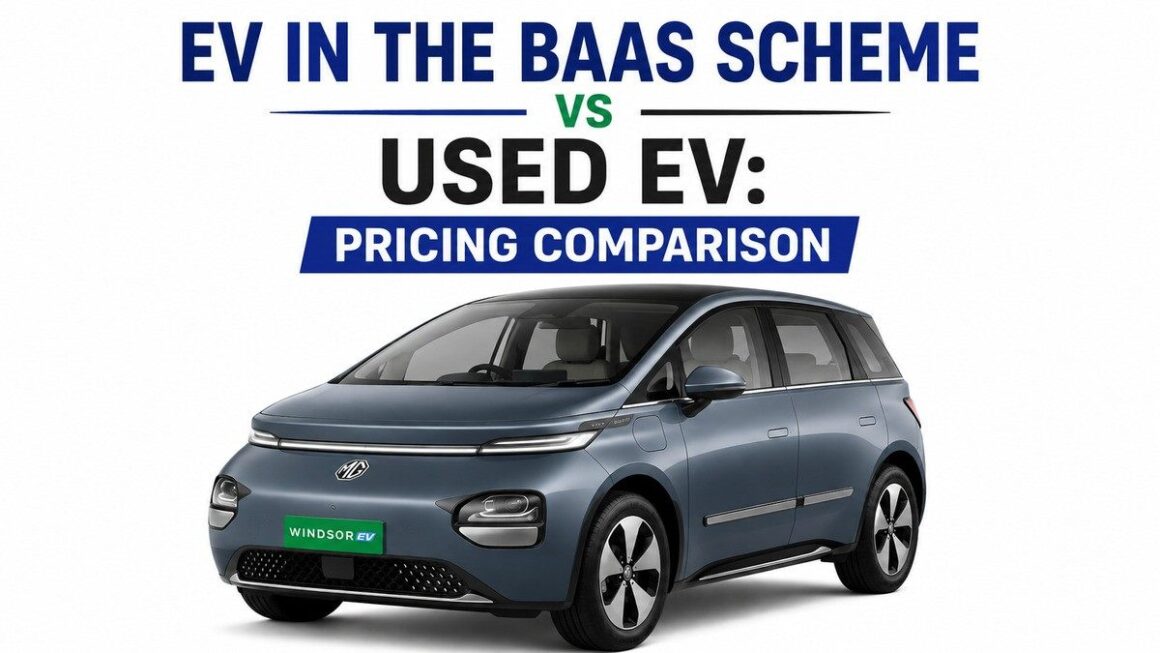
For example, the most finance partners of MG Motor charge a minimum monthly fee for 1,500 km running per month for their BaaS schemes. So, if you buy an MG Windsor EV in the BaaS scheme, which has the BaaS price of Rs. 9.99 lakh + Rs. 3.9/km (38 kWh battery) to Rs. 13.60 lakh + Rs. 4.5/km (52.9 kWh battery), you will have to pay at least Rs. 3.9 X 1,500 = Rs. 5,850 every month for the smaller 38 kWh battery pack.
ALSO READ: Battery as a Service (BaaS) Explained
How different is buying a used EV from buying an EV with BaaS?
Buying a used EV is pretty much the same as buying a used ICE-powered vehicle, given EVs depreciate at nearly the same rate as ICE-powered vehicles. However, there is a concern with EVs: the battery. An electric car’s battery life is 8 to 10 years, while internal combustion engines last much longer. Moreover, while many electric car brands offer a lifetime warranty on their electric car batteries, it is valid for only the first owners. If the vehicle is resold, the warranty is reduced to 8 years / 1,60,000 km for the second owner, which is calculated from the day the vehicle was bought as a brand-new model. So, if you are the second owner of an electric car and need to replace the battery after 8 to 10 years of its age, you will need to bear the cost of replacement and the new battery. Although with the latest technologies, electric car batteries’ lives have been extended, and they last much longer than before.
Meanwhile, if you buy an electric vehicle with BaaS, it is the service provider who maintains battery maintenance, keeps it in optimal health, and replaces it if needed. Although a lifetime warranty on the battery can only be enjoyed if you are the first owner of the electric car.
Moreover, while buying an electric car with BaaS, you have to pay a significantly lower upfront cost compared to the down payment you will need to pay for a used EV.
Note: In BaaS, the battery subscription charges do not include RTO tax, Insurance, TCS, and other statutory taxes, and you have to pay taxes on the full vehicle value because the battery is part of your vehicle.
ALSO READ: Electric Cars Available with BaaS Scheme in India
EV in the BaaS scheme vs Used EV: Price Difference
To learn about the ownership cost differences, let’s compare the ownership cost of an EV with BaaS and the ownership cost of a used or second-hand EV. We will use the MG Windsor EV, the first car in India to offer BaaS, for evaluations.
Case A – MG Windsor EV (Base Excite variant) with BaaS
Upfront cost: Rs. 9.99 lakh
Downpayment (20%): 20 % of Rs. 9.99 lakh = Rs. 1,99,800
Loan amount: Rs. 7,99,200
Monthly EMI on 9% interest: Rs. 16,590
Charging cost
- The average domestic tariff for electricity is Rs. 8/unit (kWh).
- Charging a 38-kWh battery pack requires around 41 units (assuming minor transmission losses), costing Rs. 328.
- Given the MG Windsor EV 38 kWh battery’s claimed driving range of 332 km and real-world driving range, it will take around 5 full charging cycles to cover 1,500 km.
- Monthly electricity usage cost for 1,500 km will be around 5 X Rs. 328 = Rs. 1,640
Minimum monthly charge: Rs. 3.9 X 1,500 = Rs. 5,850
Total monthly expenditure: Rs. 5,850 + Rs. 1,640 + Rs. 16,590 = 24,080
Total yearly expenditure: Rs. 24,080 X 12 = Rs. 2,88,960 + maintenance cost
5 years’ expenditure: Rs. 2,88,960 X 5 = Rs. 14,44,800 + maintenance cost
5 years ownership cost: Rs. 1,99,800 + Rs. 14,44,800 = Rs. 16,44,600 + maintenance cost
Now, if you do not finance the vehicle:
Total monthly expenditure: Rs. 5,850 + Rs. 1,640 = 7,490
Total yearly expenditure: Rs. 7,490 X 12 = Rs. 89,880 + maintenance cost
5 years’ expenditure: Rs. 89,880 X 5 = Rs. 4,49,400 + maintenance cost
5 years ownership cost: Rs. 9,99,000 + Rs. 4,49,400 = Rs. 14,48,400 + maintenance cost
ALSO READ: MG Windsor BaaS Explained: Price, Payment Plan
Case B – A used MG Windsor EV (Base Excite variant)
Estimated cost: Rs. 12 lakh
Downpayment (20%): 20 % of Rs. 12 lakh = Rs. 2,40,000
Loan amount: Rs. 9,60,000
Monthly EMI on 11% interest: Rs. 20,873
Charging cost: Rs. 1,640
Total monthly expenditure: Rs. 20,873 + Rs. 1,640 = 22,513
Total yearly expenditure: Rs. 22,513 X 12 = Rs. 2,70,156 + maintenance cost
5 years’ expenditure: Rs. 2,70,156 X 5 = Rs. 13,50,780 + maintenance cost
5 years ownership cost: Rs. 2,40,000 + Rs. 13,50,780 = Rs. 15,90,780 + maintenance cost
Now, if you do not finance the vehicle:
Total monthly expenditure: Rs. 1,640 = 7,490
Total yearly expenditure: Rs. 1,640 X 12 = Rs. 19,680 + maintenance cost
5 years’ expenditure: Rs. 19,680 X 5 = Rs. 98,400 + maintenance cost
5 years ownership cost: Rs. 12,00,000 + Rs. 98,400 = Rs. 12,98,400 + maintenance cost
EV in the BaaS scheme vs Used EV: Which one is affordable?
By the calculation done above, it is clear that considering 5 years of ownership of a used EV and an EV in the BaaS scheme, it is the used EV which should be more affordable. Moreover, the fact that the battery subscription charge in BaaS does not include RTO tax, Insurance, TCS, and other statutory taxes tips the scale more in favour of a used EV. Moreover, while a used EV does not offer a lifetime warranty on the battery, you might not need one, as the latest technologies have made batteries capable of lasting much longer than before.
As far as BaaS is concerned, it does not remove the battery’s cost from the electric vehicle’s cost. Essentially, BaaS makes an electric vehicle more affordable by splitting the electric vehicle’s cost into two – vehicle cost + battery cost. In BaaS, you finance the battery by paying small monthly fees to the service provider to use it. Since you finance the battery, you do not need to pay for the battery upfront. That is how financing makes things affordable – allowing small monthly payments for a product.
Therefore, a used EV save you more money than an EV with a BaaS scheme in the long run. Whereas BaaS works with a different concept, it saves you from paying for the battery at the time of the purchase and allows you to make small monthly payments to use it.
FAQ
Between a used EV and an EV with BaaS, which one is more affordable?
A used EV save you more money than an EV with a BaaS scheme in the long run. Whereas BaaS works with a different concept, it saves you from paying for the battery at the time of the purchase and allows you to make small monthly payments to use it.
Can I buy a used EV in a BaaS scheme?
Yes! You can buy a used EV with a Battery as a Service (BaaS) scheme. For this, you will need to sign a new battery lease or agreement with the BaaS provider; then the finance company or BaaS provider will run a credit check for you to qualify for the battery lease.
In the BaaS scheme, can I take a loan on the vehicle?
Yes! In the BaaS scheme, you can finance the vehicle’s cost, which does not include the battery’s cost.