Driving without using a helmet can result in a fine of ₹1,000 and disqualification for three months from obtaining a driving licence under the Central Motor Vehicles Act. This law is applicable to both the rider and the pillion rider who is duly authorised.
The amount shown on an individual challan can still differ because states may prescribe their own compounding amounts and enforcement procedures. If you think a helmet challan has been issued against your two-wheeler, you can check your bike challan on Spinny using the registration number.
Table of Contents
An overview of helmet fines in India
| Question | Current rule |
| Central penalty | ₹1,000 |
| Driving licence consequence | Disqualification for three months |
| Does the pillion passenger need a helmet? | Yes, when above four years |
| Must the chin strap be fastened? | Yes |
| Main statutory exemption | A Sikh person wearing a turban |
| Child aged nine months to four years | Helmet, safety harness and maximum speed of 40 km/h |
| Required helmet standard | BIS-certified helmet complying with IS 4151:2015 |
| Can state challan amounts differ? | Yes |
| Can the challan be paid online? | Usually through Parivahan eChallan or an authorised state portal |
Helmet Rules in 2026: What You Need to Know
- Riding without a helmet attracts a ₹1,000 fine under Section 194D, and it applies to the rider as well as any pillion above four years of age.
- On top of the fine, your licence can be disqualified for three months.
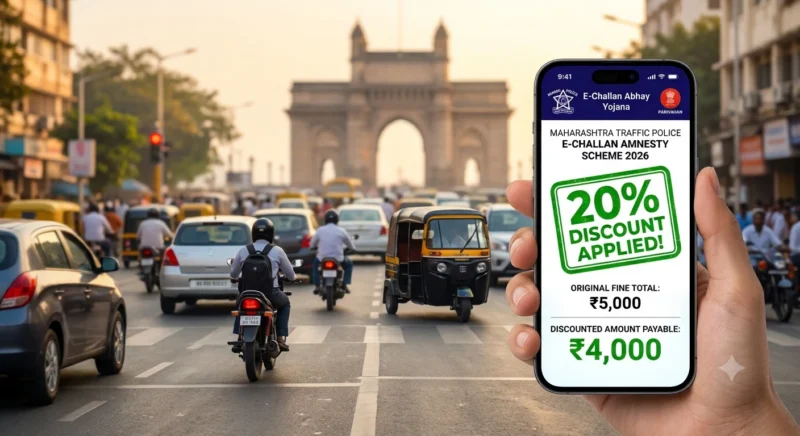
- A helmet challan now comes with a deadline: pay it or contest it online within 45 days of issue (rule in force from 21 January 2026). After that, it counts as accepted and must be paid within 30 days.
- Helmet challans add up. Five or more traffic offences in one calendar year, counted from 1 January 2026, can cost you your licence after a hearing by the licensing authority.
- Check and pay on Spinny’s bike challan page, Parivahan eChallan or your state traffic police portal.
What does the law say about riding without a helmet?
According to Section 129 of the Motor Vehicles Act, any person over the age of four years who drives, rides or sits on a motorcycle when in public should use protective headgear.
Section 194D provides the penalty for violating this requirement:
- A fine of ₹1,000
- Disqualification from holding a driving licence for three months
This means the rider should not begin the journey when a legally covered passenger is not wearing a compliant helmet.
The ₹1000 penalty figure should not just be defined as average. It is an amount mentioned in the central legislation, though an amount collected through a challan by local authorities may be different due to some valid state notifications.
Also Read: Driving Licence: MCWG Full Form
Why can the helmet challan differ by state?
States are allowed to establish compounding amounts and authorise their officials to resolve certain violations. A compounding amount is the penalty paid in order to settle a suitable violation without the case going through the full resolution in court.
| Term | Meaning |
| Central statutory penalty | Punishment stated in the Motor Vehicles Act |
| State compounding amount | Notified amount accepted to settle the offence |
| Court penalty | Consequence imposed when the matter proceeds to court |
States can revise these notifications. An older traffic-police table may therefore no longer reflect a current challan.
Prior to depending upon a state-wise number, confirm the details from the respective state transport office, traffic police website or Parivahan eChallan records. Currently, the compounding fee for this violation is ₹1,000 in Delhi. Low amounts such as ₹100 or ₹200 available on older websites may be based on regulations that were in force prior to 2019 amendments.
Also Read: Most Common Traffic Challans in India and How to Avoid Them
Does a pillion passenger need a helmet?
Yes. The law covers both the rider and a person being carried on the motorcycle.
A pillion passenger above four years of age must wear compliant protective headgear in a public place. The helmet must also be securely fastened.
The driver of the motorcycle may have to face legal action should someone be allowed to violate the rule regarding helmets. Ensure that every passenger is wearing a good helmet that is fitted properly and fastened securely.
Helmet rules for children below four years
Children aged between nine months and four years are covered by additional safety requirements.
When such a child is carried as a pillion passenger:
- The appropriate helmet or pre-approved protective headgear should be worn by the kid.
- The child should be strapped to the driver via an approved safety strap.
- The maximum speed of a motorcycle should not exceed 40 km/h.
The harness used to fasten the kid should ensure that the child does not have any problems breathing and is not in any threat of being strangled. A child should never be carried loosely between adults.
Who is exempt from wearing a helmet?
A Sikh individual wearing a turban is exempt from the operation of Section 129 of the Act while operating a motor vehicle or riding a motorcycle in public space.
A specific exception has been established in law that is not a general religious exception that will apply simply because someone self-identifies as a Sikh without wearing a turban.
A medical condition, personal discomfort or a short journey does not automatically create an exemption.
What counts as a legal helmet in India?
In order to be classified as a legal motorcycle helmet, the headgear has to adhere to the relevant regulatory standard of the Bureau of Indian Standards, IS 4151: 2015.
Check for:
- The BIS Standard Mark
- The relevant standard number
- The manufacturer’s name
- Certification or licence details
- A secure chin strap and working buckle
- The correct size
- Clear product labels
Simply having an ISI sticker does not confirm the helmet’s authenticity. Many helmets carry fake marks. The manufacturer’s details may be confirmed via the BIS portal or through the BIS Care application.
Is an open-face or half-face helmet legal?
An open-face helmet that has been certified is not inherently illegal. A helmet can adhere to BIS standards irrespective of whether it has a lower face guard or a visor.
| Helmet type | General legal position |
| BIS-certified full-face helmet | Permitted |
| BIS-certified open-face helmet | Permitted |
| BIS-certified modular helmet | Permitted |
| Helmet carrying only ECE or DOT approval | Not sufficient by itself for Indian compliance |
| Novelty or non-certified cap-style helmet | Not compliant |
A full-face helmet provides better protection of the face and jaw. This could make a full-face helmet a safer alternative compared to open-face ones, even if the helmets are legally certified.
Does a helmet have to be strapped legally?
Protective headgear must be fastened properly using a strap or some other fastening device.
The following examples do not depict proper use of helmets.
- The strap is unfastened.
- The strap is too loose for the helmet to stay fastened.
- The helmet hangs from the rider’s arm.
- The helmet is too large to be held in place.
These rules are in place as a poorly secured helmet can separate from the wearer during a crash.
When should a motorcycle helmet be replaced?
There is no dependable rule for consumers to follow regarding the measurement of helmet padding or shell thickness.
As a general rule of thumb, change your helmet if
- There has been a major impact.
- The shell is cracked or deformed.
- The inner liner is compressed or loose.
- The strap or buckle is broken.
- The shield obstructs vision.
- The manufacturer’s advised period has passed.
Do not buy a used helmet when its impact history is unknown. Do not drill holes, cut the shell or make unauthorised structural changes.
Why wearing a helmet matters
Road deaths in India include a large number of deaths from accidents involving two-wheelers. Using a safe, quality helmet significantly minimises the risks of fatality or brain injury as long as the helmet is worn correctly and fastened appropriately.
Its protection depends on certification, fit, fastening, condition and coverage. A loose, damaged or counterfeit helmet may provide far less protection than the wearer expects.
What happens when a helmet challan is issued?
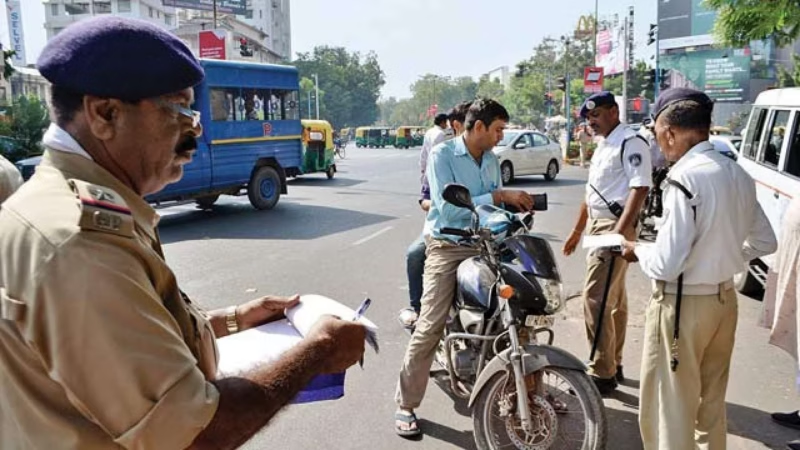
A helmet offence may be recorded during a traffic stop or through camera-based enforcement.
The general process can include:
- The officer or system records the vehicle and offence.
- A physical or electronic challan is generated.
- The challan is linked to the vehicle or driving-licence details.
- Payment or court action is completed through the route shown.
Various additional offences may be involved in the same challan, such as carrying three persons on one bike, riding with no motor vehicle insurance, dangerous driving or carrying a small child without any safety measures. This can make the total amount exceed that of the helmet fine.
How to check and pay a helmet challan online
Use the official Parivahan eChallan portal or an authorised traffic-police portal. You can also check pending helmet challans on Spinny’s e-challan page.
- Conduct a search with the challan number, vehicle number or driving-licence information.
- Check for the registration number, offence committed, location, date and the amount.
- Choose a payment method.
- Make payment using the available option as mentioned in the official payment gateway.
- Keep the receipt and the transaction number for reference.
- Confirm that the challan status changes to paid or disposed.
Do not use links sent through unknown calls or messages. Never share an OTP, PIN or banking password.
What if the challan payment fails?
If money is debited, but the challan remains unpaid:
- Don’t rush to pay a second time.
- Look for the transaction-in-process or payment-verification option.
- Use the official check-payment-status service.
- Keep the bank receipt.
- File a grievance about the status if it does not change.
A second payment can create a duplicate transaction and a longer refund process.
Can every helmet challan be paid online?
No. Some challans can be settled online, while others may be referred to a virtual or physical court.
Court-related cases are capable of being resolved using online procedures like virtual hearings or submitting documents and appearing before court. Payment alone should not be assumed to close every case. Confirm that the final status shows paid or disposed.
Can riding without a helmet affect insurance?
Helmet non-use does not automatically invalidate every insurance or accident-compensation claim.
The impact of the rider can become significant if there are arguments made regarding the involvement of the rider in the resultant injuries, especially in cases of head injuries.
The result is dictated by the evidence, injuries, insurance coverage, and the ruling from the court or claims tribunal, as there is no automatic rejection in such matters.
Also Read: Lok Adalat 2026: What is Lok Adalat, Dates, Types and Cases Covered
Final verdict
According to the central Motor Vehicles Act, it is prohibited to operate or allow someone else to operate a motorcycle without a helmet. Penalty for violating this rule includes a monetary penalty of ₹1,000 and suspension of driving licence for three months.
The rule applies to the rider and legally covered pillion passengers. Children aged nine months to four years require a helmet, prescribed safety harness and a maximum riding speed of 40 km/h.
The helmet must be in accordance with the relevant BIS standard and must also fit properly and be securely fastened. Helmets that have an open face may be legal once they have gone through the right certification, but novelty and counterfeit helmets are not compliant.
State compounding amounts can differ, so verify the exact challan through the official Parivahan or traffic-police portal rather than relying on an old online table.
Related Blogs:
Road Tax Rules & Regulations for Cars in India
Vehicle Registration Renewal Process in India
How to Renew a PUC Certificate in India?
FAQs About Riding Without Helmet Fine
Q. What is the fine for riding without a helmet in India?
Section 194D provides a ₹1,000 fine and three months’ disqualification from holding a driving licence.
Q. Can the helmet fine differ by state?
Yes. States can prescribe compounding amounts and enforcement procedures through current notifications.
Q. Does a pillion passenger need a helmet?
Yes. A pillion passenger above four years of age must wear compliant and securely fastened protective headgear.
Q. Is an open-face helmet legal in India?
It can be legal when it is properly BIS-certified and securely fastened. A non-certified cap-style helmet is not compliant.
Q. What is the helmet rule for a child below four years?
A child aged nine months to four years must wear a helmet, be secured with a prescribed safety harness and be carried at no more than 40 km/h.
Q. Is a helmet illegal in India?
No, wearing a helmet is entirely legal and, in fact, mandatory in India. It is riding a two-wheeler without a helmet that is illegal under Section 129 of the Motor Vehicles Act.
Q. Is an ECE- or DOT-certified helmet legal without a BIS mark?
Foreign certification alone does not establish compliance with the Indian legal requirement. The helmet should also carry the applicable BIS certification.
Q. Can I be fined when the helmet strap is open?
Yes. The law requires the helmet to be securely fastened.
Q. How can I pay a helmet challan online?
Use the official Parivahan eChallan portal or an authorised state traffic-police portal.
Q. What should I do if money is debited but the challan remains unpaid?
Check the payment-verification or pending-transaction section before trying again.
Q. Does riding without a helmet automatically cancel an insurance claim?
No. It may be relevant to the claim, but the outcome depends on the evidence, injuries and legal findings.
Q. Can I wear an MX (motocross) helmet on the road?
You can, as long as it’s a certified, road-legal helmet that’s properly fastened, certification is what really matters. Do keep in mind that MX helmets are built for off-road use, so they often skip a visor and have an open peak, which isn’t ideal for everyday highway riding.
Q. Is it okay to put stickers on helmets?
Generally yes, stickers are fine as long as they don’t cover the ISI certification mark or damage the shell/visor.
Q. Is riding gear illegal in India?
No, riding gear is not illegal at all. In fact a helmet is legally required, and wearing proper gear like gloves, a riding jacket, and boots is strongly encouraged for your safety. Skipping the helmet is what gets you fined, not wearing the gear.
Q. How many days do I get to pay a helmet challan?
Under the rules in force from 21 January 2026, you have 45 days from the challan date to pay it or contest it online. After that, it’s treated as accepted.