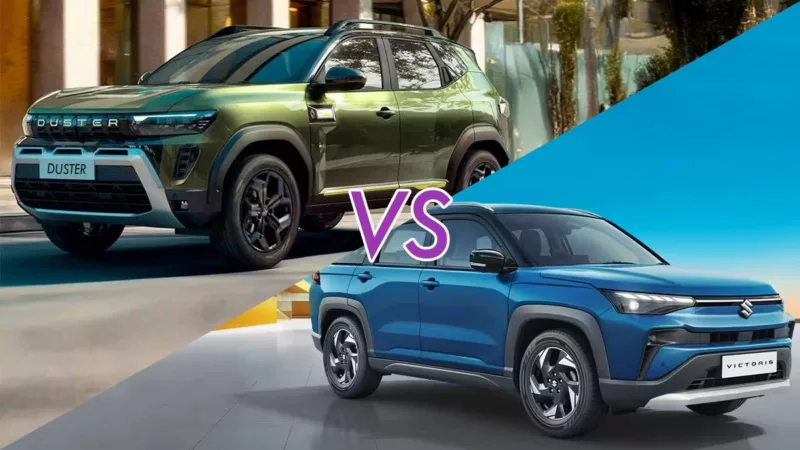
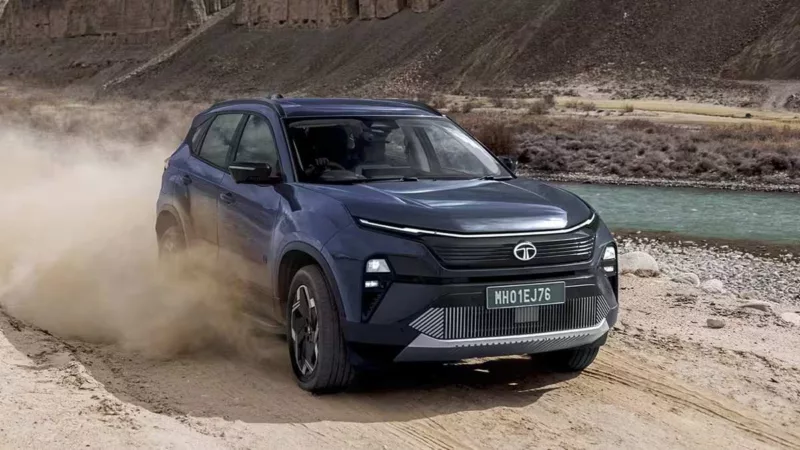
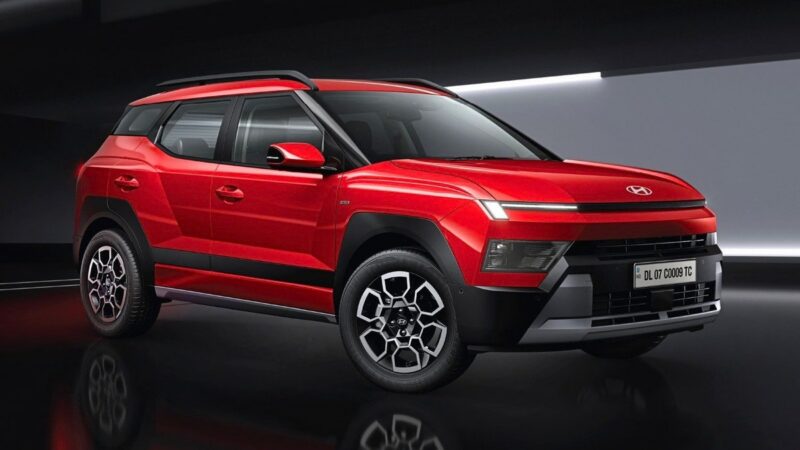
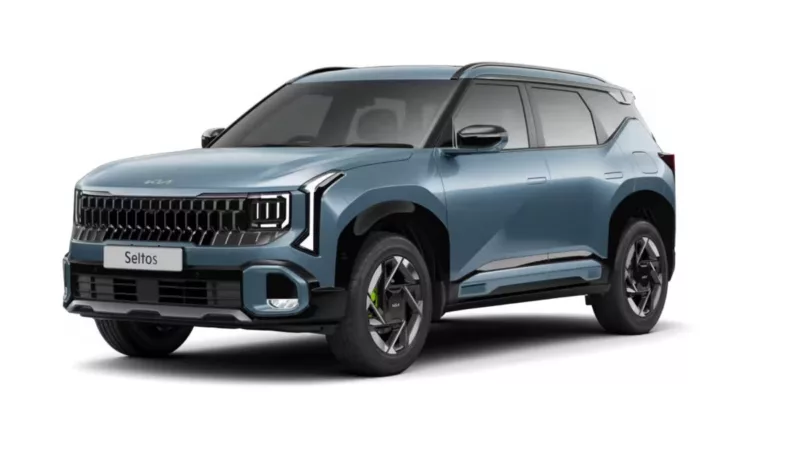
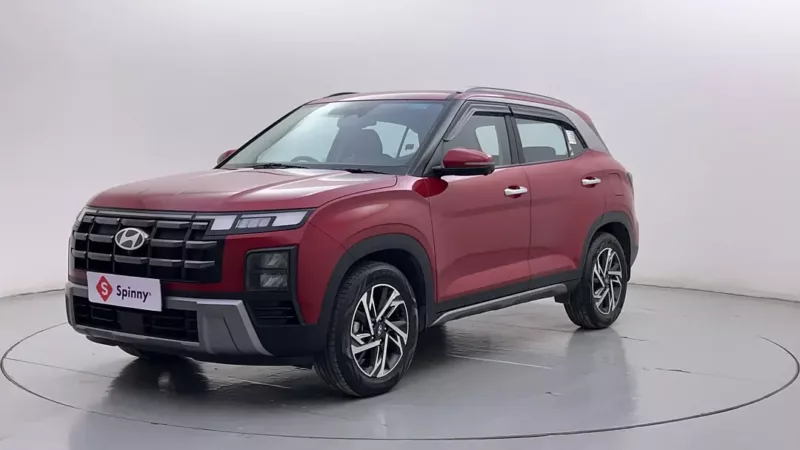
The Renault Duster and Nissan Tekton are almost the same car. The 1.0 turbo-petrol manual is rated at 19.41 kmpl in the Duster and 19.4 kmpl in the Tekton, and the 1.3 turbo DCT at 18.45 kmpl and 18.5 kmpl. Both SUVs went on sale in 2026, share the same platform and engines, and are each other’s most-searched rival.
Claimed figures, however, don’t tell you what you’ll see in rush-hour traffic or on an expressway run. Below, we set the ARAI numbers against independent city and highway tests, work out what each SUV costs to fuel every month, and flag where the evidence is still thin. The Duster also offers something the Tekton doesn’t: a 1.8-litre strong hybrid which is launched in October 2026.
Table of Contents
Renault Duster vs Nissan Tekton Specs
The Tekton is built on the same platform as the Duster and uses the same petrol engines. Nissan gave it its own styling, cabin and equipment, but kept the Duster’s powertrains. That means any mileage gap between the two comes down to weight, tyres, gearing and test conditions, not the engines.
Both start with a 1.0-litre, three-cylinder turbo-petrol (about 100 hp, 166 Nm) that comes only with a six-speed manual. Above it sits a 1.3-litre, four-cylinder turbo-petrol (163 hp, 280 Nm) with a six-speed manual or a six-speed dual-clutch automatic (DCT). Renault names these TCe 100 and TCe 160; Nissan calls them T160 and T280, after their torque figures.
The one real difference is the Duster’s 1.8-litre E-Tech 160 strong hybrid, which launched on 19 October 2026. It pairs the petrol engine with electric motors, a 1.4 kWh battery and a multi-mode automatic. Neither SUV gets a diesel or a factory CNG option.
| Specification | Renault Duster | Nissan Tekton |
| Engine 1 | 1.0L turbo-petrol, 3-cyl (999 cc) | 1.0L turbo-petrol, 3-cyl (999 cc) |
| Power / torque (1.0) | 99 bhp / 166 Nm | 100 hp / 166 Nm |
| Engine 2 | 1.3L turbo-petrol, 4-cyl (1,333 cc) | 1.3L turbo-petrol, 4-cyl (1,333 cc) |
| Power / torque (1.3) | 163 hp / 280 Nm | 163 hp / 280 Nm |
| Hybrid | 1.8L E-Tech 160 strong hybrid (160 PS combined) | Not offered |
| Transmissions | 6MT (1.0, 1.3), 6DCT (1.3), multi-mode auto (hybrid) | 6MT (1.0, 1.3), 6DCT (1.3) |
| Drive layout | Front-wheel drive | Front-wheel drive |
| Weight | 1,380 kg (1.3 MT) | Not published |
| Fuel tank | Not published | 50 litres |
Because the hardware is shared, the petrol versions should return near-identical mileage. The tests below largely confirm that.
““
Renault Duster vs Nissan Tekton ARAI Mileage Figures
The certified figures for the shared petrol engines are effectively identical. Renault quotes to two decimals and Nissan rounds to one, which explains the tiny differences below. The 1.0 turbo manual is the most efficient petrol version in both SUVs at about 19.4 kmpl. Oddly, the 1.3 DCT is rated higher than the 1.3 manual, by roughly 0.7 kmpl in each car. The Duster hybrid is in a different league on paper at 29 kmpl, but it has not been independently tested yet.
| Car | Engine & transmission | Fuel type | ARAI mileage |
| Renault Duster | 1.0 turbo, 6-speed manual | Petrol | 19.41 kmpl |
| Nissan Tekton | 1.0 turbo, 6-speed manual | Petrol | 19.4 kmpl |
| Renault Duster | 1.3 turbo, 6-speed manual | Petrol | 17.75 kmpl |
| Nissan Tekton | 1.3 turbo, 6-speed manual | Petrol | 17.8 kmpl |
| Renault Duster | 1.3 turbo, 6-speed DCT | Petrol | 18.45 kmpl |
| Nissan Tekton | 1.3 turbo, 6-speed DCT | Petrol | 18.5 kmpl |
| Renault Duster | 1.8 E-Tech 160, automatic | Petrol strong hybrid | 29 kmpl |
ARAI tests run on a fixed cycle with no traffic, no AC load and gentle acceleration, so expect real-world numbers well below these.
Also Read: Comparison: Nissan Tekton vs Renault Duster
Renault Duster vs Nissan Tekton Real-World Fuel Efficiency
In independent tests, the 1.0 turbo manual returned about 12.9 kmpl in the Duster and 12.6 kmpl in the Tekton on a 50:50 city-highway mix. That 0.3 kmpl gap is smaller than the normal variation between two test routes, so treat the two as equal. The Duster figures come from city and highway road tests of the 1.0 MT and 1.3 MT, run with the AC at 22–23°C and default drive modes. The Tekton 1.0 MT was tested separately using the tank-to-tank method: about 100 km of weekday Delhi NCR traffic (23 kmph average) and about 107 km on the Delhi–Mumbai Expressway. To make the figures comparable, we blended each car’s city and highway result over equal distances (a 50:50 split). Because a car burns more fuel in the city, this blended figure is lower than a simple average of the two numbers.
| Petrol manuals | Duster 1.0 turbo MT | Tekton 1.0 turbo MT | Duster 1.3 turbo MT |
| City | 10.42 kmpl | 9.40 kmpl | 9.58 kmpl |
| Highway | 16.85 kmpl | 19.11 kmpl | 18.53 kmpl |
| Average (50:50) | 12.88 kmpl | 12.60 kmpl | 12.63 kmpl |
| Tank range (50 L) | about 640 km* | about 630 km | about 630 km* |
*Renault doesn’t publish the Duster’s tank size; range assumes the same 50-litre tank as the platform-sharing Tekton.
The pattern is interesting. The Duster 1.0 did better in town, while the Tekton 1.0 was clearly stronger on the expressway. Traffic density and highway speed differ between the two tests, so this may reflect the routes rather than the cars. The bigger 1.3 engine costs almost nothing in blended mileage, because its extra torque lets it cruise more easily on the highway.
The automatics are a gap in the evidence. Published real-world figures for the Duster 1.3 DCT are inconsistent, ranging from about 10 to 10.5 kmpl with no city-highway split. There is no independent test yet of the Tekton DCT, the Tekton 1.3 MT, or the Duster hybrid as of October 2026.
Also Read: Nissan Tekton Complete Buying Guide
Renault Duster vs Nissan Tekton Fuel Cost Comparison
At 1,500 km a month, the Duster 1.0 MT costs about ₹290 a month less to fuel than the Tekton 1.0 MT. We used the blended real-world figures above and a Pune petrol price of ₹111.90 per litre (25 October 2026).
| Petrol manuals | Duster 1.0 turbo MT | Tekton 1.0 turbo MT | Duster 1.3 turbo MT |
| Monthly running | 1,500 km | 1,500 km | 1,500 km |
| Mileage used | 12.88 kmpl | 12.60 kmpl | 12.63 kmpl |
| Monthly fuel use | 116.5 L | 119.0 L | 118.8 L |
| Average monthly cost | ₹13,035 | ₹13,320 | ₹13,290 |
| Yearly cost | ₹1,56,419 | ₹1,59,838 | ₹1,59,475 |
| Five-year cost | ₹7,82,096 | ₹7,99,192 | ₹7,97,375 |
Over five years, the gap between the two 1.0 manuals is about ₹17,000, or roughly ₹3,400 a year. That is small enough to be swallowed by driving style, tyre pressure or a different commute. It is not a reason to pick one SUV over the other.
The same logic applies to the 1.3 MT. Its blended figure is within 0.03 kmpl of the Tekton 1.0, so on these tests, the extra 63 hp costs you almost nothing at the pump. Your own split matters: a mostly-city driver will burn more fuel than this table shows, and a highway commuter less.
We have left out the DCT automatics and the Duster hybrid because there is no reliable city-highway test for them yet. The figures also exclude servicing, insurance, tyres and fuel price changes over five years.
Also Read: Tata Altroz vs Toyota Glanza Real-World Mileage Comparison
Renault Duster vs Nissan Tekton Price
Both SUVs start at the same ₹10.49 lakh (ex-showroom) for the 1.0 turbo manual. At the top, the Tekton petrol ends at ₹18.59 lakh and the Duster petrol at ₹18.69 lakh. The Duster hybrid adds a third choice from ₹16.99 lakh.
| Model | Variant | Price (ex-showroom) |
| Renault Duster | Authentic TCe 100 MT (1.0) | ₹10.49 lakh |
| Nissan Tekton | Visia T160 MT (1.0) | ₹10.49 lakh |
| Renault Duster | Evolution TCe 160 MT (1.3) | ₹12.99 lakh |
| Renault Duster | Evolution TCe 160 DCT (1.3) | ₹14.49 lakh |
| Nissan Tekton | N-Connecta T280 MT (1.3) | ₹14.99 lakh |
| Renault Duster | Evolution E-Tech 160 hybrid | ₹16.99 lakh |
| Nissan Tekton | Tekna Plus T280 DCT (1.3) | ₹18.59 lakh |
| Renault Duster | Iconic Dualtone TCe 160 DCT (1.3) | ₹18.69 lakh |
| Renault Duster | Emotion E-Tech 160 hybrid | ₹19.49 lakh |
Hybrid prices are introductory and apply to deliveries by 31 December 2026. Prices vary by city and change over time, so confirm the latest figures with a dealer.
The Duster gets you into a 1.3 turbo for less: ₹12.99 lakh for the manual against ₹14.99 lakh for the Tekton. The base hybrid costs ₹2.50 lakh more than the cheapest Duster 1.3 DCT. Whether it earns that back depends on how close it gets to its 29 kmpl claim in real traffic.
If you’d rather skip the new-car premium, you can also browse quality-checked pre-owned SUVs on Spinny.
Also Read: Comparison: New Renault Duster vs Old Renault Duster
Summary
For the 1.0 turbo manual, the Duster and Tekton are a tie on mileage. Independent tests put them at 12.88 kmpl and 12.60 kmpl on a 50:50 mix, worth about ₹290 a month at 1,500 km. Choose between them on design, features, price and service network, not fuel economy. The 1.3 turbo manual matched the 1.0 in blended mileage in the Duster test, which makes it the better buy if you drive a lot on highways. Real-world data for both DCT automatics is still missing. The Duster hybrid is the only version that could change the picture, with a 29 kmpl claim and no Tekton equivalent. Until it is road-tested, treat its savings as unproven.
Related Blogs:
12 Golden Tips to Increase your Mileage
Sierra vs Seltos vs Duster vs Kushaq: Mid-Size SUV Comparison
FAQs about Renualt Duster and Nissan Tekton Mileage Comparison
Q. Which has better petrol mileage, the Duster or the Tekton?
Neither, in practice. They use the same engines, and their ARAI ratings differ only by rounding. In real-world tests of the 1.0 turbo manual, the Duster returned 12.88 kmpl and the Tekton 12.60 kmpl on a 50:50 city-highway mix, a gap within normal test variation.
Q. Why did the Tekton do better on the highway but worse in the city?
The Tekton managed 19.11 kmpl on the highway against the Duster’s 16.85 kmpl, but 9.40 kmpl in the city against 10.42 kmpl. The two cars were tested separately on different routes, so the gap most likely reflects traffic and cruising speed rather than the cars themselves.
Q. Is the 1.3 turbo much thirstier than the 1.0 turbo?
Not on the evidence so far. The Duster 1.3 MT returned 12.63 kmpl blended, almost the same as the 1.0 MT. It was worse in the city (9.58 kmpl) but better on the highway (18.53 kmpl), so it suits buyers who drive long distances.
Q. Does the Tekton come with a hybrid?
No. The 1.8-litre E-Tech 160 strong hybrid is offered only on the Duster, from ₹16.99 lakh (ex-showroom, introductory). It is rated at 29 kmpl.
Q. Why are the DCT and hybrid missing from the fuel cost table?
There is no reliable city-and-highway test yet for the Tekton DCT or the Duster hybrid, and published Duster DCT figures are inconsistent (about 10 to 10.5 kmpl). Using ARAI figures instead would understate running costs by a wide margin.
Q. What is the fuel tank range of the Duster and Tekton?
The Tekton has a 50-litre tank, which gives about 630 km at its tested 12.6 kmpl. Renault has not published the Duster’s tank size; if it matches the Tekton, expect a similar range of about 640 km for the 1.0 MT.