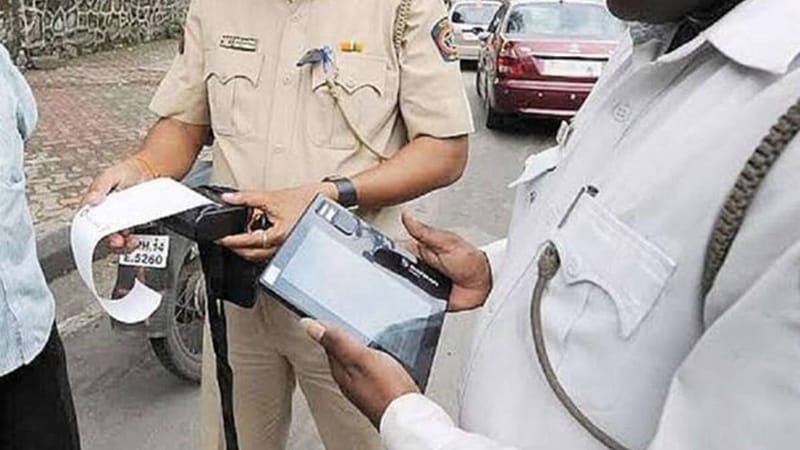
In India, the most frequently referred traffic infraction is speeding. A traffic officer, a mobile radar system, or an automatic camera can detect speed violations.
The penalty is governed mainly by Section 183 of the Motor Vehicles Act. However, the exact amount shown on an overspeeding challan may depend on the vehicle category, state rules and whether the offence is settled through compounding or transferred to a court.
According to regulations at the national level, light motor vehicles, i.e., private cars, should pay penalties of Rs. 1000 – 2000 for any instances of speeding violations. Heavy commercial and public transport vehicles, such as light cargo vehicles (LCVs), trucks, and buses, incur penalties from Rs. 2000 to Rs. 4000 each in cases of overspeeding.
Table of Contents
Overview of Overspeeding Challan in India
| Question | Current position |
| Governing provision | Section 183 of the Motor Vehicles Act |
| Fine for a light motor vehicle | ₹1,000 to ₹2,000 |
| Fine for a medium or heavy vehicle | ₹2,000 to ₹4,000 |
| Repeat offence | Driving licence impounding provisions may apply |
| Dangerous driving | Separate offence under Section 184 |
| Racing or speed trials | Separate offence under Section 189 |
| How to check the challan | Official Parivahan eChallan or state traffic portal |
| How to contest it | Official grievance system or Virtual Court |
| Applicable speed limit | The limit displayed for that road and vehicle category |
The amounts of penalties are determined at the level of the central authority, but the penalty that must be paid in each state or in each locality might vary according to the court’s decisions concerning each specific incident and the rules regarding fines imposed for the violations.
What Is an Overspeeding Challan?
An overspeeding challan is issued when a vehicle is recorded travelling faster than the applicable speed limit.
The limit may depend on:
- The type of road
- The vehicle category
- Local traffic conditions
- Temporary restrictions
- Construction or school zones
- Notifications issued by the state or local authority
Although the road has a speed limit, there may be areas with lower restrictions, such as at the intersection of the road, the market area, the toll place, or the construction area. That is why the driver ought to comply with the road signs rather than rely on generalisations regarding the rules for the area.
What Is the Fine for Overspeeding in India?
Section 183 of the Motor Vehicles Act provides the following penalties:
Light Motor Vehicles
The fine that can be imposed on light motor vehicles is between ₹1,000 and ₹2,000. This may include a range of vehicles, such as private cars classified under the law as light motor vehicles.
Medium and Heavy Vehicles
A medium or heavy goods or passenger vehicle can attract a fine between ₹2,000 and ₹4,000.
Repeat Offences
The second or further offence of speeding may lead to the suspension of the driving license through due course of law.
This does not mean the fine automatically doubles in every state. The amount can depend on state compounding rules, the offence record and whether the case is handled by a court.
Do Overspeeding Fines Differ by State?
The Motor Vehicles Act provides the framework for penalties; however, the exact amount of challan can differ across states.
State governments can notify compounding amounts for traffic offences. Some cases may also be treated as court challans, meaning the final penalty is determined through the applicable court process rather than paid immediately as a fixed amount.
Thus, the generic chart of fines through the states may turn irrelevant. The amount mentioned on the official challan is the amount one should consider as the payable amount, but the person still reserves the right to raise a complaint or challenge the case.
When checking a challan, confirm:
- The offence section
- The vehicle category
- The issuing state or department
- Whether the challan is payable online
- Whether it has been transferred to a court
How Are Speed Limits Decided?
Section 112 of the Motor Vehicles Act deals with speed limits.
The Central Government has the authority to set a maximum speed limit for various types of vehicles. State governments and local authorities can set limits lower than that of the Central Government for certain roads, zones or categories of vehicles.
This means a car may be legally capable of travelling at a high speed but must still follow the lower limit shown on the road.
Speed limits may differ for:
- Private cars
- Two-wheelers
- Buses
- Trucks
- School vehicles
- Commercial passenger vehicles
The limits can also vary from one point of a city or highway to another. It is advisable to see the signs after every intersection, toll plaza, flyover or construction location.
How Is Overspeeding Detected?
Overspeeding can be recorded through several types of enforcement equipment.
Fixed Speed Cameras
Speed enforcement cameras are installed in designated places and use speed detection technologies. They take an image of a vehicle along with its number plate, speed, date, time, and place.
Mobile Radar Devices
Traffic officers may use mobile radar equipment from a roadside position or enforcement vehicle. Radar calculates speed using reflected radio waves.
LiDAR Speed Guns
LiDAR technology relies on a laser to find the distance of a vehicle for a small segment of time during which it calculates the speed.
Average-Speed Systems
Some systems measure the time a vehicle takes to travel between two points. The average speed is then compared with the permitted limit.
Automatic Number Plate Recognition
ANPR technology only scans a vehicle’s number plate. However, it has no ability to detect speed in itself. It should be connected to a radar system or any other speed detection system to process an overspeed violation.
A conviction should not rest solely on one person’s visual opinion that a vehicle appeared to be moving too fast. Speed evidence generally needs to be supported by an approved mechanical or electronic device.
What Happens After a Repeat Offence?
The legal consequences of repeated overspeeding can go beyond another fine.
An appropriate authority has the prerogative to confiscate and send the driver’s licence through formal procedures. It is upon the authority or the court to act further in light of the particular crime and law.
It is useful to understand the difference between these terms:
- Seizure: An officer takes possession of the licence.
- Impounding: The licence is officially retained and forwarded under the legal process.
- Suspension or disqualification: The driver is prevented from using the licence for a specified period.
It must be noted that the timing and consequences of action should never be the same in every situation.
Overspeeding vs Dangerous Driving vs Racing
These are separate offences under the Motor Vehicles Act.
Overspeeding
Section 183 of the legislation refers only to the violation of the speed limits without the necessity for the vehicle to take part in a race or other dangerous activity.
Dangerous Driving
Section 184 applies when a vehicle is driven at a speed or in a manner considered dangerous to the public, taking into account the road, traffic and surrounding circumstances.
Dangerous driving can lead to imprisonment or to a fine of not less than ₹1000-₹5000 for the first offence. If a particular offence is repeated within a term, then the punishment will be more stringent.
A driver can therefore face both overspeeding and dangerous-driving proceedings when the circumstances justify separate offences.
Racing or Speed Trials
The unauthorised racing or participation in speed trials is created in a separate section, that is Section 189.
A first offence can attract imprisonment of up to three months, a ₹5,000 fine, or both. A subsequent offence can lead to imprisonment of up to one year, a ₹10,000 fine, or both.
Using a mobile phone while driving, drinking alcohol and disobeying lane rules are also regarded as separate crimes and therefore do not become part of an overspeeding violation because they have occurred at the moment of speeding.
How to Check an Overspeeding Challan Online
You can check a challan through the official Parivahan eChallan portal.
The portal allows searches using:
- Challan number
- Vehicle registration number
- Driving licence number
The general process is:
- Open the official Parivahan eChallan website.
- Select the option to check challan status.
- Enter the challan, vehicle or licence details.
- Complete the security verification.
- Review the pending challan information.
The page may include information regarding the offence, the date, the authority that issued the ticket, the amount due, and the payment status. In some cases, photos can be provided, depending on the system that is being used for enforcement.
Some states operate their own official traffic-police portals. If the challan does not appear on Parivahan, check the official portal of the state where the offence occurred.
How to Pay an Overspeeding Challan Online
Once the correct challan appears:
- Confirm the vehicle number, offence and date.
- Select the online payment option.
- Choose the available payment method.
- Complete the transaction.
- Save the receipt or acknowledgement number.
- Recheck the challan status after payment.
In the event of a deduction made from your account, it’s important not to make another payment immediately if your payment status says pending. You can either use the pending transaction feature of the portal or contact the issuing authority for payment reference.
If the challan has already been transferred to Virtual Court or a physical court, the normal eChallan payment option may no longer be available.
How to Contest a Wrong Overspeeding Challan
Raise a grievance when the challan contains a genuine error, such as:
- The vehicle does not belong to you.
- The car had already been sold.
- The registration plate was cloned.
- The location or date is incorrect.
- The vehicle shown is different.
- The recorded offence does not match the evidence.
- The challan has already been paid.
Before court transfer, use the official grievance facility on the national or relevant state portal.
Supporting evidence may include:
- Sale and ownership-transfer documents
- RC copy
- Police complaint for a cloned plate
- Payment receipt
- Vehicle photographs
- Toll, parking or service records
- Dashcam or GPS records
Such evidence can support the complaint but does not guarantee automatic cancellation.
In case your case has been forwarded to a virtual court, you can look for it using your challan or your vehicle details. Based on what is available now, you can pay your challan, or you can choose to contest the case, which may involve sending the case to a physical court for a hearing.
What Happens if an Overspeeding Challan Is Not Paid?
An unpaid challan does not simply disappear.
Depending on its status and jurisdiction, it may:
- Remain pending against the vehicle
- Be transferred to Virtual Court
- Be forwarded to a regular court
- Lead to a notice or summons
- Require resolution before certain transport-related processes
The repercussions would differ from state to state and from case to case. It would not be correct to assume that for every unpaid overspeeding challan, the insurance claim is automatically blocked or the vehicle gets seized immediately.
Check the status regularly and resolve the matter through the official portal or court shown on the challan.
How to Identify a Fake Challan Message
Fake challan messages often create urgency and direct users to unofficial payment links.
Before paying:
- Do not open links from unknown numbers.
- Do not install an app sent through a message.
- Never share an OTP, password or card PIN.
- Search for the challan independently on the government portal.
- Check whether the domain belongs to an official government service.
- Compare the registration number, date and offence carefully.
The authorised eChallan site does not request drivers to disclose any passwords or credit card details either through phone calls, emails or texting.
Pending Challans When Buying or Selling a Car
Pending vehicle-linked challans should be checked before a used-car transaction.
A buyer should check the status of the registration number through the official challan site and make sure that the seller resolves any outstanding valid offences. The seller should maintain any evidence of ownership transfer as well as payment made.
If a challan was issued after the vehicle had been sold, the previous owner may need to submit:
- Sale documents
- Delivery receipt
- Ownership-transfer application
- Updated RC details
- Other evidence showing when possession changed
Delay in transfer of ownership may result in disputes because a notice generated by a camera is usually linked with the owner of the registered vehicle.
How to Avoid Overspeeding Challans
The simplest way to avoid a speeding challan is to treat road signs as the controlling limit.
Useful habits include:
- Reduce speed before entering a lower-limit zone.
- Do not rely entirely on other vehicles’ speed.
- Use cruise control carefully on open roads when conditions permit.
- Set navigation before starting the journey.
- Avoid holding or operating a phone while driving.
- Allow extra time instead of trying to recover a delay through speed.
- Slow down further in rain, fog, heavy traffic or poor visibility.
- Watch for temporary limits near roadworks and diversions.
The displayed speed limit is the highest possible limit and not the enforced speed limit. Weather, traffic and road conditions dictate a lower safe speed.
FAQs
Q. What is the fine for overspeeding a car in india?
For a light motor vehicle, the central penalty under Section 183 is between ₹1,000 and ₹2,000. The exact amount can vary by state and case.
Q. Is the overspeeding fine the same in every state?
No. The Motor Vehicles Act provides central ranges, but states can prescribe compounding amounts and some cases may be handled by a court.
Q. Can my licence be suspended for overspeeding?
Repeat offences can lead to licence impounding provisions. Suspension or disqualification depends on the applicable legal process and should not be assumed to be automatic in every first-offence case.
Q. Can I pay an overspeeding challan online?
Yes, if online payment is enabled. Use the official Parivahan eChallan portal or the relevant state traffic-police portal.
Q. Can I contest a camera challan?
Yes. Use the official grievance facility before court transfer or the contest option through Virtual Court where available.
Q. What if someone else was driving my car?
The notice may initially be linked to the registered vehicle. Driver-related action can require identification of the person driving. Follow the instructions on the challan or contact the issuing authority.
Q. Is dangerous driving the same as overspeeding?
No. Overspeeding is covered by Section 183, while dangerous driving is a separate offence under Section 184.
Q. Does an unpaid challan affect car sale?
A pending challan can create complications during a used-car transaction. It should be checked and resolved before ownership transfer.