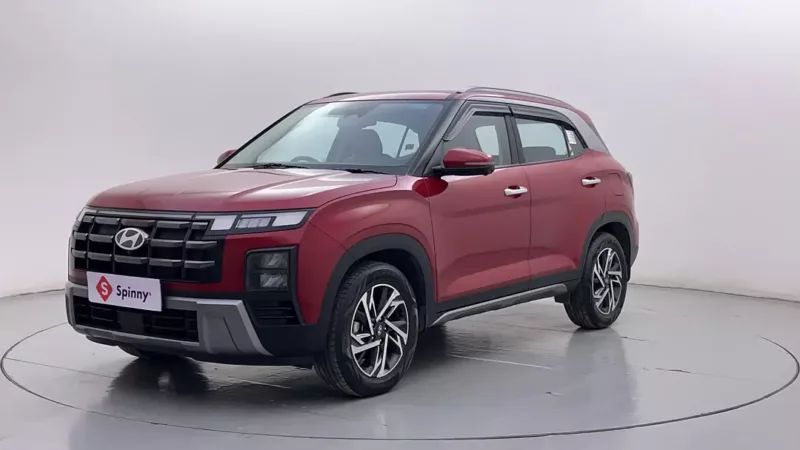
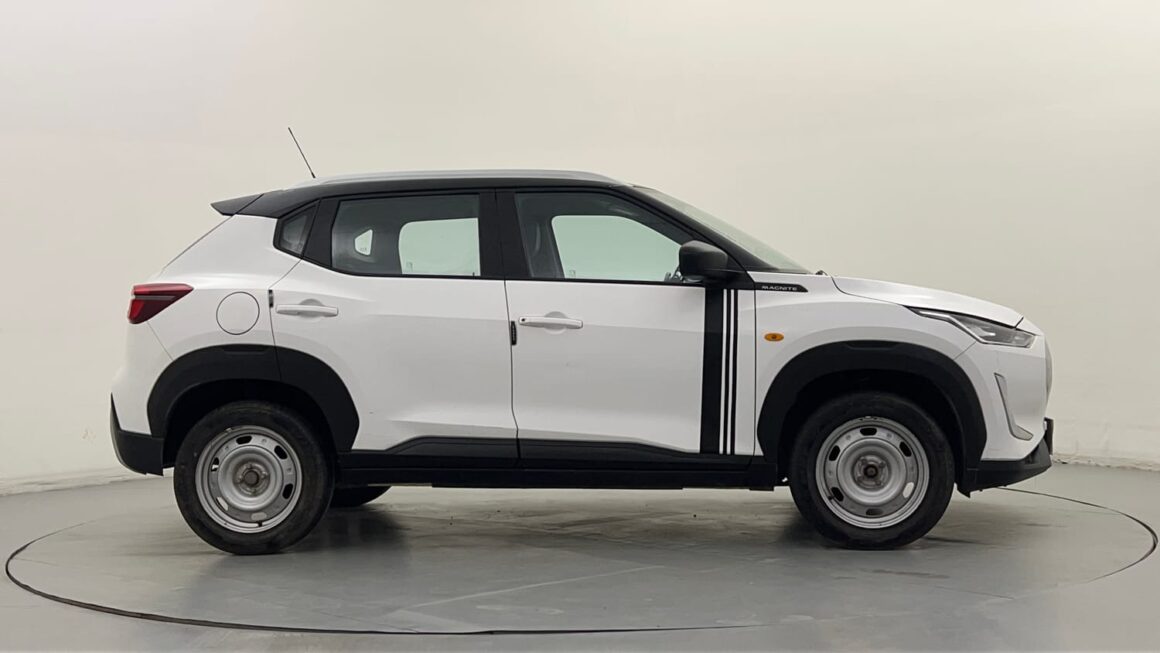
Launched in 2020 and 2019, respectively, the Nissan Magnite and Mahindra XUV300 are compact SUVs. The Magnite’s engine has petrol manual, AMT and CVT variants and has an option for a CNG kit. The engine of the XUV300 is gasoline or a diesel engine with manual or AMT gearbox, claiming the best mileage of 19.9 km/l for the Magnite and 20.1 km/l for the XUV300. Which one performs better on Indian roads?
The Magnite remains on sale, while the XUV300 was replaced by the XUV 3XO in 2024. That makes this a new-car versus used-car comparison. Published tests cover both standard turbo-petrol manuals, plus the Mahindra diesel and Magnite CVT. We’ll examine claimed mileage, road-test results and monthly fuel costs before reaching a verdict.
Table of Contents
Nissan Magnite vs Mahindra XUV300 Specs
Though both SUVs are front-wheel drive, their performance specifications vary. The Nissan Magnite uses a 999cc NA petrol engine paired with a manual or AMT transmission, and a turbo petrol engine of the same displacement with a manual and CVT transmission. The Mahindra XUV300 is powered by two forms of petrol: a 1,197 cc turbo-petrol and a more powerful 1,197 cc TGDi TurboSport, plus a 1,497 cc diesel with manual or AMT depending on the variant.
The Nissan’s smaller engines and lighter quoted kerb weights help explain its petrol figures. Its brochure gives 1,019 kg for a top-spec naturally aspirated variant and 1,103 kg for a top-spec turbo variant; other trims differ. The XUV300 offers stronger petrol torque and a diesel with 300 Nm. Its tank holds 42 litres against the Magnite’s 40 litres.
| Specification | Nissan Magnite | Mahindra XUV300 |
| Petrol engines | 999 cc naturally aspirated; 999 cc turbo | 1,197 cc turbo; 1,197 cc TGDi turbo |
| Diesel engine | Not offered | 1,497 cc turbo-diesel |
| Petrol transmissions | Five-speed MT or AMT for naturally aspirated engine; five-speed MT or CVT for turbo | Six-speed MT or AMT for standard turbo; six-speed MT for TGDi |
| Diesel transmissions | Not offered | Six-speed MT or AMT |
| CNG availability | Approved retrofit for eligible naturally aspirated variants | No manufacturer CNG option |
| Drive layout | Front-wheel drive | Front-wheel drive |
| Quoted kerb weight | 1,019 kg naturally aspirated; 1,103 kg turbo, for listed top trims | Varies by engine and trim; check individual vehicle |
| Petrol/diesel tank | 40 litres | 42 litres |
The road tests below use the XUV300’s standard petrol, not its higher-output TGDi. Magnite turbo-manual results also cannot stand in for its AMT or CNG figures.
Also Read: Nissan Magnite Mileage Comparison: Petrol vs Turbo Petrol
Nissan Magnite vs Mahindra XUV300 ARAI Mileage Figures
The highest mileage for the petrol version of the Magnite turbo manual is stated as 19.9 km/l. For the naturally aspirated manual version, the figure is around 19.4 km/l, while that for the AMT is reported to be 19.7 km/l. The turbo CVT system is reported to give 17.9 km/l according to the current specifications of the gearbox.
The mileage claims for the XUV300 vary depending on the engine, year and variant. The quoted figure for the petrol engine is around 17 km/l, while the turbo petrol manual variant is said to give 18.24 km/l. For the diesel versions, some manual variants give a mileage of 20.1 km/l, while others list only 20 km/l. Diesel AMT gives a mileage of 19.7 km/l. Hence, the mileage for a particular variant should be confirmed while buying the used vehicle.
| Car | Engine and transmission | Fuel | Claimed mileage |
| Nissan Magnite | 1.0 naturally aspirated MT | Petrol | 19.4 km/l |
| Nissan Magnite | 1.0 naturally aspirated AMT | Petrol | 19.7 km/l |
| Nissan Magnite | 1.0 turbo MT | Petrol | 19.9 km/l |
| Nissan Magnite | 1.0 turbo CVT | Petrol | 17.9 km/l |
| Nissan Magnite | 1.0 naturally aspirated, eligible CNG retrofit | CNG | No comparable Nissan km/kg claim confirmed |
| Mahindra XUV300 | 1.2 standard turbo MT/AMT | Petrol | Around 17 km/l; varies by variant |
| Mahindra XUV300 | 1.2 TGDi MT | Petrol | 18.24 km/l in listed variants |
| Mahindra XUV300 | 1.5 diesel MT | Diesel | Up to 20.1 km/l in listed variants |
| Mahindra XUV300 | 1.5 diesel AMT | Diesel | Up to 19.7 km/l in listed variants |
Nissan’s government-approved CNG retrofit began with the naturally aspirated manual and has also been offered with the AMT. No comparable CNG mileage claim is confirmed here. Petrol km/l and CNG km/kg cannot be compared as though they were the same unit.
Nissan Magnite vs Mahindra XUV300 Real World Fuel Efficiency
According to the road tests, the Nissan Magnite turbo manual delivered an average fuel efficiency of 12.8 km/l in city conditions while achieving a highway mileage of 16.1 km/l. A separate test showed that the original XUV300 standard turbo-petrol manual managed 9.7 km/l in city driving and 14.8 km/l on the highway. In this particular assessment, it is important to point out that Nissan was ahead of its opponent in both circumstances, even though the tests were not conducted simultaneously.
The XUV300 diesel manual returned 14.4 km/l city and 17.9 km/l highway in that Mahindra XUV300 test. Another diesel test found 15.4 and 19.89 km/l, showing how conditions change results. A newer Magnite turbo CVT test returned 9.5 km/l in town and 15.22 km/l on the highway. Its city figure matters for buyers facing heavy traffic.
| Tested version | City | Highway | Simple average* | Indicative full-tank range* |
| Magnite turbo petrol MT | 12.8 km/l | 16.1 km/l | 14.45 km/l | 578 km |
| Magnite turbo petrol CVT | 9.5 km/l | 15.22 km/l | 12.36 km/l | About 494 km |
| XUV300 standard turbo-petrol MT | 9.7 km/l | 14.8 km/l | 12.25 km/l | About 515 km |
| XUV300 diesel MT | 14.4 km/l | 17.9 km/l | 16.15 km/l | About 678 km |
The average is the arithmetic midpoint of the tested city and highway figures; it is a comparison guide, not the result of a measured mixed-route test. Range multiplies that midpoint by the published tank size. Actual usable range will be lower if you refuel before the tank empties.
With its efficient diesel engine and a 42-litre tank, the XUV300 has the maximum expected mileage in this test. However, the petrol manual version of the XUV300 gives better results than the Magnite in this category. Short distances, the number of passengers, and aggressive driving can affect the fuel efficiency of either vehicle.
Similar tests of the Magnite’s naturally aspirated engine and CNG version, and the XUV300’s TGDi engine and AMT version were not conducted. Hence, results cannot be generalised for these different engine models of the engines.
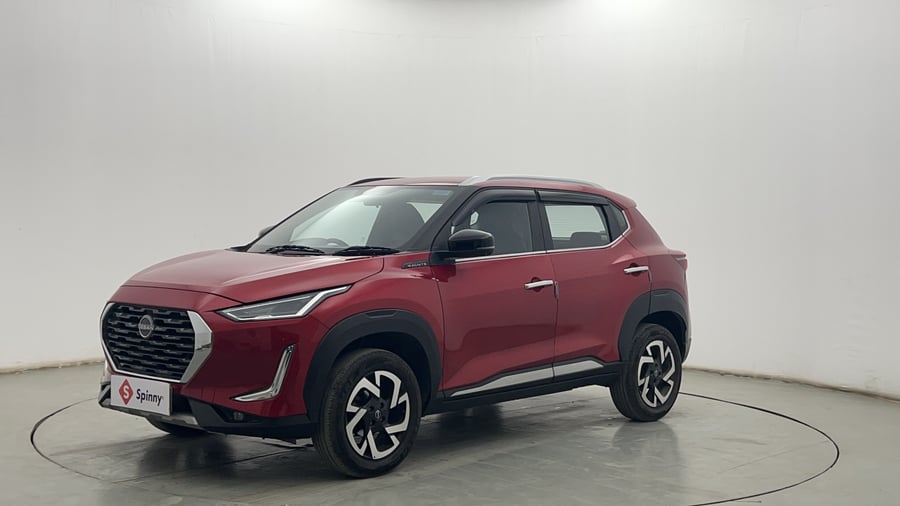
Nissan Magnite vs Mahindra XUV300 Fuel Cost Comparison
Let’s take a distance of 1,500 km each month, translating to 18,000 km for the year, according to the averages posted above. As of September 28, 2026, let’s take the prices of ₹111.90 for petrol and ₹98.55 for diesel. The monthly cost would be calculated as 1,500/average mileage multiplied by the fuel price, and the yearly amount would be based on the unrounded figure.
| Tested version | Fuel | Monthly fuel cost, 1,500 km | Annual fuel cost, 18,000 km | Five-year fuel cost, 90,000 km |
| Magnite turbo MT | Petrol | ₹11,616 | ₹1,39,391 | ₹6,96,955 |
| Magnite turbo CVT | Petrol | ₹13,580 | ₹1,62,961 | ₹8,14,806 |
| XUV300 standard turbo MT | Petrol | ₹13,702 | ₹1,64,424 | ₹8,22,122 |
| XUV300 diesel MT | Diesel | ₹9,153 | ₹1,09,839 | ₹5,49,195 |
The Magnite turbo manual costs about ₹2,086 less monthly, or ₹25,033 less yearly, than the XUV300 petrol manual. The diesel XUV300 is cheapest here: roughly ₹2,463 less monthly than the Magnite turbo manual. The Magnite CVT also costs more to fuel than its manual counterpart.
The term “midpoint” refers to an assumption made in comparisons rather than a measured trip of mixed nature. Tests can vary from year to year and under different conditions, and therefore the same distance may yield different consumption-weighted results depending on whether it was travelled on a city road or highway. Recalculate your specific away-from-home miles and pump prices in order to recalculate.
For example, a commuter who spends nearly every day crawling through traffic should budget nearer the city-test figure. Someone who covers regular intercity distances can use the highway result as a second reference. The difference is particularly large for the Magnite CVT: using its simple average for a mainly urban commute would make the bill look too low.
Also Read: Nissan Magnite Alternatives: Competitors of Nissan Magnite
Nissan Magnite vs Mahindra XUV300 Price
The prices for Magnite listed below are the most recent ex-showroom prices, while the XUV300 prices are past prices before its discontinuation. The price of a used XUV300 depends on its age, number of kilometres travelled, and condition. On-road Magnite prices also include registration and insurance costs.
The price comparison therefore works best as a starting point for shortlisting, not as a calculation of which car has the lower total ownership cost. A lower-priced used diesel might save fuel, but a neglected example can need immediate work. Get an inspection and estimate those expenses before treating fuel savings as a reason to buy.
| Car | Example variant | Price status | Approximate ex-showroom price |
| Magnite | Visia naturally aspirated MT | Current | ₹5.68 lakh |
| Magnite | Visia naturally aspirated AMT | Current | ₹6.27 lakh |
| Magnite | N-Connecta turbo MT | Current | ₹8.77 lakh |
| Magnite | Acenta turbo CVT | Current | ₹9.26 lakh |
| XUV300 | W2 standard petrol MT | Historical | ₹7.99 lakh |
| XUV300 | W6 standard petrol AMT | Historical, approximate | Around ₹10.6 lakh |
| XUV300 | W8 diesel MT | Historical, approximate | Around ₹13.05 lakh |
Nissan sets the price for the CNG conversion independently and shows the combined total of packs separately on its price page. Get a written price quotation for the installation of the kit. For a second-hand XUV300, verify the price being asked and the history of services rendered.
Summary
The Magnite turbo wins the tested petrol-manual comparison: 12.8 versus 9.7 km/l city, and 16.1 versus 14.8 km/l highway. At 1,500 km monthly, it costs about ₹2,086 less to fuel than the tested XUV300 petrol manual.
The XUV300 diesel manual is the least expensive vehicle in terms of fuelling, among all the evaluated powertrains. Thanks to its average mileage of 16.15 km/l with an inexpensive diesel, it gives an indicative fuel expense of ₹9,153 monthly. Then again, the purchase price and its service records should be taken into consideration.
You should go for the Magnite if you are buying a new SUV that is engine-tested and rated to perform better in terms of fuel economy than petrol-powered cars. Do check out the vehicle’s km/kg statistics before evaluating the price of the Magnite CNG model.
Also Explore: Nissan Magnite Image Gallery: Interior, Exterior
FAQs about Nissan Magnite vs Mahindra XUV300 Mileage
Q. Which is more fuel-efficient, the Nissan Magnite or Mahindra XUV300?
The Magnite turbo manual beats the XUV300 standard petrol manual in both tests. The XUV300 diesel manual travels farther per litre than either petrol version and has the lowest calculated monthly fuel bill.
Q. What mileage did the Magnite turbo manual return in real driving?
It returned 12.8 km/l in the city and 16.1 km/l on the highway. Their simple midpoint is 14.45 km/l, against a claimed 19.9 km/l. Traffic, speed and load can change your result.
Q. Is the XUV300 diesel cheaper to run than the Magnite petrol?
Yes, in this test-based example. At 1,500 km monthly and the stated Pune prices, the XUV300 diesel costs about ₹2,463 less per month to fuel than the Magnite turbo manual. Servicing, repairs, insurance and purchase prices are excluded.
Q. Does the Magnite CNG have a confirmed real-world mileage figure?
The CNG kit is a government-approved retrofit for eligible naturally aspirated manual and AMT Magnites. A comparable independent city-and-highway km/kg test is unavailable here. Ask a seller for full-to-full records before estimating savings over petrol.
Q. Can I buy a new Mahindra XUV300 in 2026?
The XUV300 was replaced by the XUV 3XO in 2024. Prices shown here for the XUV300 are historical, not new-car quotes. You would generally compare a new Magnite with a used XUV300 today.
Q. Why does the Magnite CVT use more fuel than its manual in the tests?
The turbo CVT returned 9.5 km/l city and 15.22 km/l highway, against 12.8 and 16.1 km/l for the turbo manual in another test. Traffic, temperatures and gearbox behaviour can affect this difference.