The existing three-door Mahindra Thar is equipped with 245/75 R16 tyres in the AXT variant and 255/65 R18 tyres in the LXT variant. The guide provides information on the correct tyre sizes, tyre pressure checks, tyre replacement costs, spare-wheel use, TPMS, tyre rotation, and tyre upsize options.
This article applies only to the three-door Thar. The five-door Thar Roxx has a different variant structure and wheel range.
Table of Contents
Mahindra Thar tyre size and pressure: Quick answer
| Item | Current three-door Thar |
| AXT tyre size | 245/75 R16 |
| AXT wheel | 16-inch steel |
| LXT tyre size | 255/65 R18 |
| LXT wheel | 18-inch alloy |
| AXT tyre type | Tubeless all-terrain |
| LXT RWD tyre type | Tubeless highway-terrain |
| LXT 4WD tyre type | Tubeless all-terrain |
| Road pressure | Follow the driver-side placard |
| Typical cold-pressure range | Around 32–34 PSI, depending on fitment |
| Spare wheel | Full-size, tailgate-mounted |
| TPMS | Available on LXT |
| Factory 19-inch option | No |
According to the brochure provided by Mahindra, the AXT variants use 16-inch tyres, and the LXT variants use 18-inch tyres. The company differentiates the highway-terrain tyres used in the rear-wheel-drive LXT variant from those used in the 4WD variants, which use all-terrain tyres.
Which Mahindra Thar does this guide cover?
Mahindra currently sells the three-door Thar in two broad trims, AXT and LXT.
The AXT is a base model that utilises a smaller steel wheel with a taller tyre sidewall. On the other hand, the better-trimmed LXT comes with 18-inch alloy wheels.
The Thar Roxx is a separate five-door SUV. Its 18- and 19-inch specifications should not be applied to the three-door Thar.
Mahindra Thar tyre size by variant
| Variant | Factory tyre size | Wheel | Factory tyre positioning |
| Thar AXT | 245/75 R16 | 16-inch steel | Tubeless all-terrain |
| Thar LXT RWD | 255/65 R18 | 18-inch alloy | Tubeless highway-terrain |
| Thar LXT 4WD | 255/65 R18 | 18-inch alloy | Tubeless all-terrain |
The brand and tread pattern installed on the car from the factory may differ based on the production batch. When buying replacement tyres, the size, load index, speed rating and intended purpose should be considered instead of only brand comparison.
How to read the Thar tyre size
Consider the AXT size, 245/75 R16:
- 245: Tyre width in millimetres
- 75: Sidewall height as a percentage of width
- R: Radial construction
- 16: Wheel diameter in inches
The LXT comes with 255/65 R18. The tread of this variant is 10mm wider than the AXT, but its sidewall is shorter. The AXT has around 184mm sidewall height, while the LXT has about 166mm.
A complete marking also includes a load index and speed rating, such as 111H. Use a replacement that meets or exceeds the ratings printed on the original tyre and vehicle label.
Also Read: Types of tyres
AXT 16-inch vs LXT 18-inch tyres
| AXT 16-inch setup | LXT 18-inch setup |
| Taller sidewall | Shorter sidewall |
| Better cushioning over sharp impacts | More direct steering response |
| Steel wheel is easier to repair | Alloy wheel looks more premium |
| Lower replacement cost | Wider road footprint |
Having a wider LXT tyre does not mean it will offer better grip. Apart from the width, grip can depend on the material used, as well as other factors like the tread pattern, the age of the tyre, its air pressure, ambient temperature, and surface conditions.
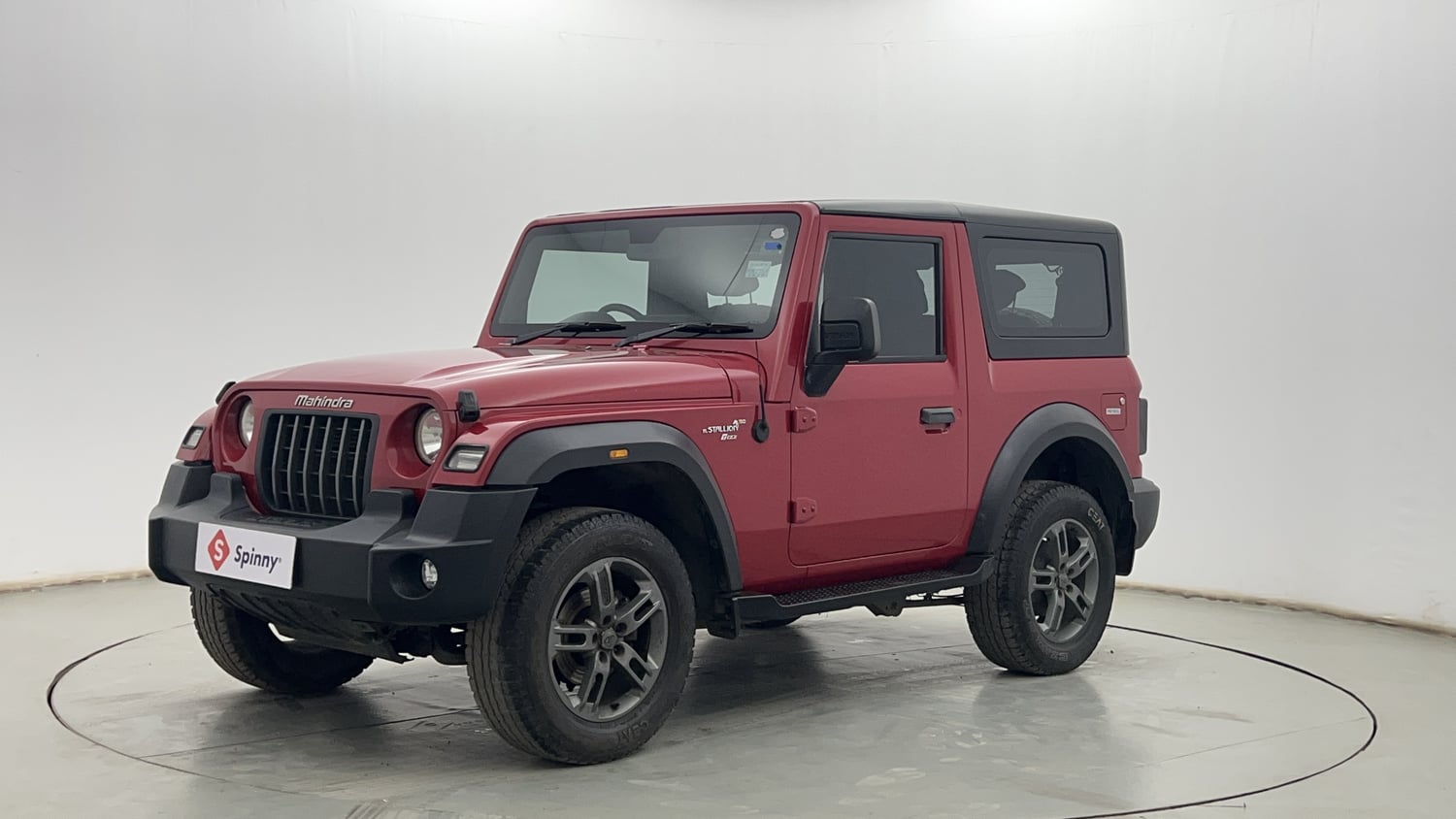
Mahindra Thar tyre pressure
The safest pressure reference is the label fitted to the driver-side door area. The latest owner’s manual supplied with the vehicle should also be checked.
There is a lot of inconsistency with the online compression figures available for the Mahindra Thar. Some indicate 32 PSI, while a different source recommends 34 PSI, or a different number for 16 to 18 inches of tyres, which essentially means that one standard figure cannot apply to all the existing Thars.
As a practical guide, current recommended cold tyre pressure generally falls around 32–34 PSI, but the placard on the individual vehicle must take priority.
Check the tyre pressure properly every month, before going for a long drive, just before fully loading the vehicle, and after travelling off-road. A cold tyre has usually been parked for at least three hours.
Do not release air simply because a warm tyre displays a higher reading after driving. Heat naturally increases pressure.
Road pressure vs off-road pressure
To broaden the contact area, certain drivers may reduce the air pressure in their tyres while driving on sand, loose mud or rocky paths. This increases grip; however, it can also increase sidewall flex and contribute to tyre and wheel damage.
There is no single safe off-road pressure for every Thar. The correct figure depends on the tyre, wheel, terrain, load and driving speed.
Utilise an accurate gauge and be cautious when re-inflating your tyres back to correct road pressure after driving on unconventional surfaces. Maintaining low pressure and driving at high speeds can result in the overheating of the tyre and its separation from the wheel.
Mahindra Thar tyre price in India
| Tyre size | Approximate price per tyre |
| 245/75 R16 | Around ₹6,800–₹13,000 |
| 255/65 R18 | Around ₹9,000–₹13,500 |
| Premium A/T or M/T tyres | Can cost more |
From the latest listings, the prices for 245/75 R16 start at ₹6,800. Premium products in this category can cost around ₹13,000. The prices for the 255/65 R18 category are about ₹12,000–₹13,500, although the exact price will depend on the brand and tread design.
A set of four AXT tyres may therefore cost roughly ₹27,000–₹52,000 before fitting. Four LXT tyres may cost approximately ₹36,000–₹54,000. A complete five-tyre replacement costs more because the Thar carries a rear-mounted spare.
The quotation can include the service charge for tyre fitting, balancing, alignment, valves, TPMS sensor installation, disposal, as well as warranty registration. Please check the manufacturing date before purchasing the promoted offer.
Also Read: How to choose the right tyre for your car
Highway, all-terrain and mud-terrain tyres
Highway-terrain tyres
Highway-terrain tyres prioritise lower road noise, wet-road behaviour, ride comfort and efficiency. They suit owners who mainly drive in cities and on highways.
All-terrain tyres
All-terrain tyres mix on-road usability with grip on loose surfaces, gravel, tracks, etc. They serve people who use both the highways and off-roads.
Mud-terrain tyres
Mud-terrain tyres use larger tread blocks for loose-surface traction. They are usually noisier, heavier and less refined on the road. Do not choose them only for appearance if most driving is on tarmac.
Mahindra Thar spare wheel
The current Thar model has a full-sized spare tyre mounted on the tailgate instead of a compact version. The spare tyre is available for both versions of Thar.
Confirm the individual spare’s exact size and wheel type before delivery or when buying used.
Do not forget to inspect it for pressure, tread wear, cracks, sidewall damage, the manufacturing date, and the condition of the wheel. Even if it has been used rarely, it can become unsafe over time.
How Thar TPMS and Tyre Direction Monitoring work
At present, the current LXT incorporates Tyretronics tire-pressure monitoring as well as Tyre Direction Monitoring. However, the AXT does not include these features in the latest document.
Mahindra states that Tyretronics monitors the four road tyres and the spare.
TPMS does not substitute manual tyre pressure verification; it cannot provide measurement for the tread depth or identify all types of damage.
During tyre replacement, tell the technician that sensors are fitted, protect the valves, confirm that readings return and complete tyre-position relearning when required.
When should Thar tyres be replaced?
Do not replace Thar tyres based only on a fixed five-year or 50,000 km rule.
Replacement should take place once the tread reaches the wear indicators, structural damage occurs, cracks occur from ageing, a hole appears which cannot be repaired, or uneven tyre wear makes some part of the tread unsafe.
Built-in tread-wear indicators and a tread-depth gauge are more reliable than a coin test. Tyres should receive professional annual inspection once they have been in service for around five years. This includes the spare.
Rotation, alignment and balancing
Please refer to current guidelines provided by Mahindra to find out about the appropriate rotation period and pattern. This pattern is determined by whether the tyres are directional, whether the spare is included, and whether the TPMS positions require relearning.
Have the alignment checked when the car pulls to one side, the steering wheel sits off-centre, tread wears unevenly, or a wheel hits a large pothole or rock.
It is necessary to check the balancing if there are vibrations at some speeds, as well as after dismounting and re-fitting the tyre.
Can Mahindra Thar tyres be upsized?
Mahindra officially lists only:
- 245/75 R16 for the AXT
- 255/65 R18 for the LXT
A factory fitment of 19 inches is not included in the current brochure for the three-door Thar. The sizes of Thar Roxx wheels do not confirm any compatibility with the three-door model.
An upsize can affect steering, braking, fuel use, ride comfort, speedometer accuracy, suspension clearance, ABS, stability control, TPMS and spare-wheel compatibility.
The overall diameter is just one element of the equation. In addition to the diameter, other parameters such as wheel width, offset, load rating, sidewall clearance, and suspension travel should also be adjusted.
A modification does not automatically cancel the entire vehicle warranty. However, Mahindra can reject a claim for a modified component or a failure caused by an unauthorised tyre or wheel change.
In reality, most Thar owners are recommended to keep original sizes and choose tread patterns suitable for their tour needs.
What to check on a used Mahindra Thar
Inspect:
- Correct size on all five wheels
- Matching load and speed ratings
- Manufacturing dates
- Uneven or cupped wear
- Sidewall cuts, bulges and tread-block damage
- Mismatched H/T, A/T or M/T patterns
- Bent steel wheels or repaired alloys
- TPMS warning lights
- Oversized aftermarket wheels
- Tyre rubbing at full steering lock
- Suspension lifts or altered wheel offset
When it comes to the LXT model, make sure that Tyretronics can provide you with the right information on both original tyres and the spare one. It is better to do a diagnostics check right away if problems occur or aftermarket tyres were added to the car.
Also Read: Car tyre Maintenance Tips and Guide
FAQs
Q. What is the tyre size of the Mahindra Thar AXT?
The current AXT uses 245/75 R16 tubeless all-terrain tyres on 16-inch steel wheels.
Q. What is the tyre size of the Mahindra Thar LXT?
The LXT uses 255/65 R18 tyres on 18-inch alloy wheels. Current RWD versions use highway-terrain tyres, while 4WD versions use all-terrain tyres.
Q. What is the recommended tyre pressure for the Mahindra Thar?
Check the driver-side pressure label and current owner’s manual. Online figures vary, but current references generally fall around 32–34 PSI when cold.
Q. Does the Mahindra Thar have a full-size spare tyre?
Yes. The three-door Thar carries a full-size spare on the tailgate.
Q. Does the Thar have TPMS?
The current LXT has Tyretronics and Tyre Direction Monitoring. The AXT does not receive these features.
Q. How much do Mahindra Thar tyres cost?
A 245/75 R16 tyre generally costs around ₹6,800–₹13,000, while a 255/65 R18 tyre can cost approximately ₹9,000–₹13,500.
Q. When should Mahindra Thar tyres be replaced?
Replace them when the tread reaches the wear indicators, damage appears, or professional inspection finds them unsafe.
Q. Can the three-door Thar use 19-inch tyres?
Mahindra does not list a factory 19-inch wheel for the current three-door Thar.
Q. Are all-terrain tyres suitable for daily road use?
Yes, but they can be noisier and less efficient than highway-terrain tyres.
Q. What should be checked on a used Thar’s tyres?
Check all five tyre sizes, dates, tread patterns, wheel condition, sidewall damage, uneven wear, TPMS warnings and signs of rubbing from modifications.