When selecting a car, you put much thought into the process. Therefore, it would also be a good idea to re-evaluate your car loan periodically. When this happens, there may be an opportunity for you to save money with a better interest rate, a longer repayment period, or an easier way to manage your account with respect to switching lenders.
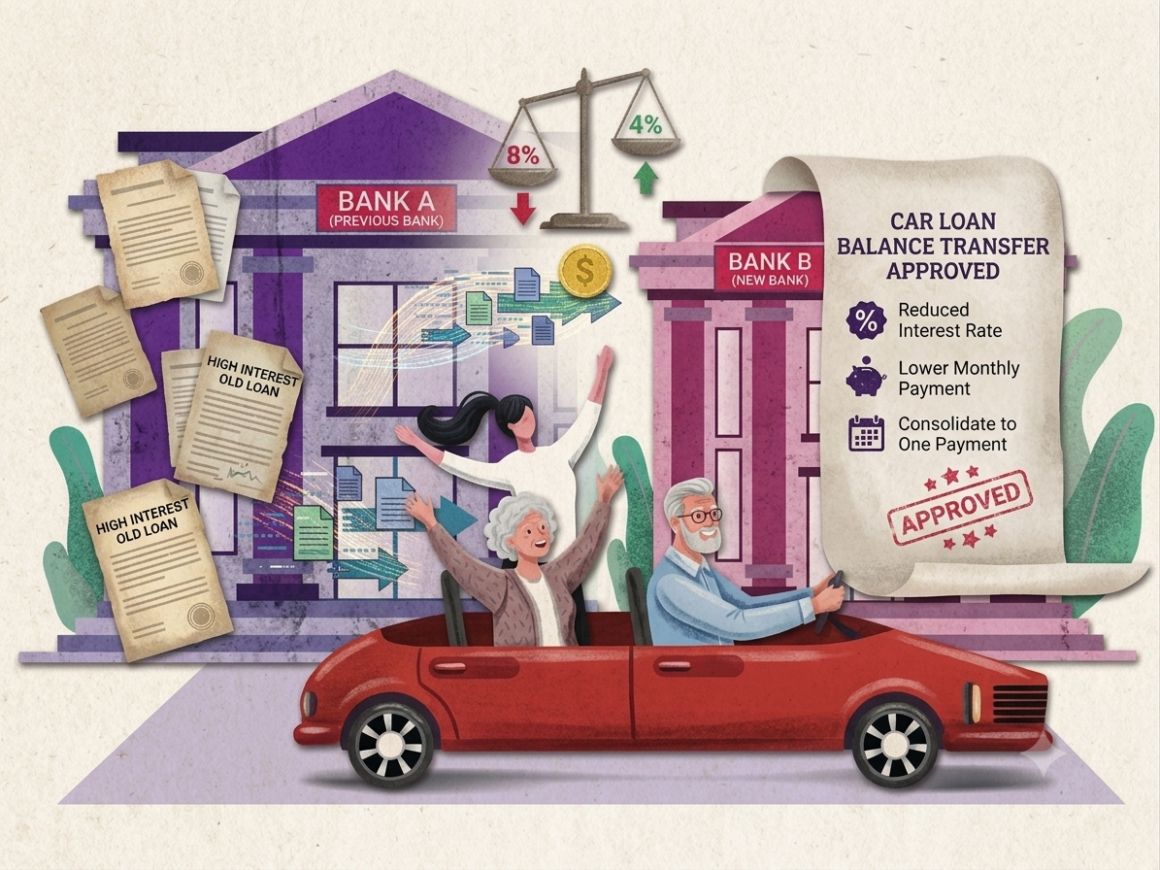
A car loan balance transfer lets you move your outstanding loan to another lender. The important question is whether the new arrangement improves your finances after all the costs are included.
At Spinny, we want to make sure you are aware of your options regarding financing. Below is a list of items that should be reviewed prior to making a decision to switch lenders.
Table of Contents
What Is a Car Loan Balance Transfer?
A car loan balance transfer replaces your existing loan with one from a different lender. The new loan pays off the old lender, and you begin repaying under a new agreement.
You are still the owner of the vehicle and are also the borrower on the loan. This is significantly different from selling the car or having someone else take over the loan obligation for you.
For example, if you still owe ₹3 lakh, the new lender assesses whether it can finance the amount needed to close that account. Its approval depends on your financial profile, the car and its lending policy.
When Could Switching Lenders Help?
A balance transfer may be worth considering when:
- You qualify for a lower rate. Improved income, a stronger credit profile or a more competitive offer may help.
- Your EMI needs adjusting. A different tenure could make monthly repayments more manageable.
- You want better account support. Accessible statements, convenient payment options and responsive service matter throughout repayment.
The first step in the process of switching lenders should be to contact your current lender and inquire whether they will consider changing your terms. Once you have this information, you can compare their offer with the alternative offer that was presented when you were trying to obtain your new lender.
A longer tenure can lower your EMI while increasing total interest. If saving money is your priority, compare offers over the same remaining repayment period first.
Also Read: First-Time Used Car Buyer? Start Here – Loan Guide
Check Whether the Transfer Actually Saves Money
If the outstanding amount of your loan is ₹3 lakh at 16% p.a. and the remaining period is 24 months, there is an offer from another lender for the same period but at 12% p.a. for this amount.
| Detail | Existing loan | Proposed loan |
| Outstanding principal financed | ₹3 lakh | ₹3 lakh |
| Annual interest rate | 16% | 12% |
| Remaining/new tenure | 24 months | 24 months |
| Approximate EMI | ₹14,689 | ₹14,122 |
| Total remaining interest | ₹52,534 | ₹38,929 |
The potential interest saving is approximately ₹13,605. If total switching costs are ₹6,000, paid separately, the net saving becomes approximately ₹7,605.
All information is purely hypothetical and is provided as an example to demonstrate how reductions will be calculated when monthly payments are made. Figures may vary in other lenders’ quotes; therefore, verify all items carefully. If you have to pay any fees associated with your new loan, you must include those fees in your financing total as well as pay interest on the same.
Compare the future payments under both options. Interest already paid on your original loan cannot be recovered through a balance transfer.
Eligibility and Documents to Keep Ready
The new lender usually considers your income, existing financial commitments, credit history, and car loan repayment record. It may also assess the car’s age, condition and value, including its age when the proposed loan ends.
Check whether it accepts balance transfers for your used car and requires a minimum repayment history. Waiting periods vary across lenders.
Documents generally required include photo ID and proof of your address, a copy of your PAN, proof of income, bank statements, a copy of your RC, a copy of your insurance policy, your existing loan agreement, repayment history, and a current quote for foreclosure.
Ask for the exact checklist before applying. If the approved amount falls short of the old loan’s closure amount, you may have to pay the difference yourself.
How to Transfer Your Car Loan to Another Lender
1. Get a Written Foreclosure Quote
In order to find out the exact closure cost from your existing lender, you should request the closure amount. Make sure that you have confirmed the principal amount, accrued Interest as of the closing date, all relevant fees, and the validity of the quote. Be aware that the amount you may see on an app does not necessarily include all of the fees that you will be required to pay at the time of closing.
2. Compare the New Offer and Charges
Review the approved rate, tenure, EMI, and total repayment. Read the Key Facts Statement, including the annual percentage rate, which reflects interest and associated charges.
Include processing fees, documentation and valuation charges, applicable taxes, stamp duty and RTO expenses in your comparison.
The costs associated with foreclosure depend on the type of loan and the regulations in place. According to RBI rules, prepayment charges are prohibited for floating-rate loans taken or renewed after January 1, 2026, for consumer purposes, even when the repayment is funded by another lender. Older loans might also have an exemption under applicable guidelines. For fixed-rate loans, the charges might be disclosed.
3. Apply and Complete Verification
Submit your application and supporting documents. The new lender may verify your income and repayment record and arrange a vehicle valuation. A preliminary eligibility result is not the same as final approval.
Avoid accepting a top-up simply because it is available. Extra borrowing changes the amount you owe and makes the transfer harder to compare with your current loan.
4. Coordinate Payment and Closure
Follow the lenders’ procedures for payments and transfer of funds to the previous account. Check who is to bear any shortfall and how proof of payment will be obtained.
Continue your existing EMIs until the old lender confirms closure or provides written instructions. Check the new mandate, EMI date, and first installment so you can manage the transition without a missed payment.
5. Update the Vehicle Records
Obtain the NOC from the previous lender and relevant documents for the release. Make sure to complete the requisite RTO process for the hypothecation and the registration of interest by the new lender, which requires Form 35 for termination and Form 34 for addition with supporting documentation.
Ask your insurer to update the financier details as required. Keep copies of the closure confirmation, new agreement, payment receipts, and updated records.
Also Read: Car Loan EMI Calculator: Calculate Your Monthly Car Payment in 2026
What If You Financed Your Car Through Spinny?
When you obtained your loan through our services, be sure to identify the name of the lender on your loan document. It could either be Spinny Capital or one of its partner lenders. Reach out to the lender directly to obtain your repayment statement, foreclosure quote and any alterations allowed in the current terms of your loan.
A transfer requires a separate application and approval from the new lender. Financing approval during your Spinny purchase does not guarantee a later balance transfer.
If you are planning to buy your next car through our services, don’t forget that we have several finance options to help you make the right decision. The EMI calculator can help you make your plans, while the agreement will state all applicable charges, interest rate, tenure of loan repayment, and flexibility of repayment.
Also Read: Used Car Loan Documentation FAQs – What Papers Do I Need?
FAQs About Balance Transfer Your Car Loan
Q. Can I transfer a used car loan to another lender?
Yes, where the new lender offers this facility and accepts your borrower profile, car, and existing loan. Approval remains subject to its assessment.
Q. Does a balance transfer change the car’s ownership?
You remain the owner. The lender’s hypothecation details need updating through the applicable process; the car is not being sold to another person.
Q. Can I transfer my loan immediately after taking it?
Check both lenders’ requirements. Minimum repayment history and any applicable foreclosure conditions vary; there is no single waiting period for every loan.
Q. Is a lower interest rate enough reason to switch?
Compare total future repayments and switching costs first. A small rate reduction may offer limited savings if fees are high or few EMIs remain.
Q. Is there a fixed minimum CIBIL score?
There is no single threshold across lenders. Income, repayment history, existing commitments and vehicle eligibility also influence the decision.
Q. How long does a balance transfer take?
Timing depends on verification, valuation, disbursal, closure, and documentation. Ask both lenders for their expected timelines before planning payments.
Q. Is a top-up compulsory with a balance transfer?
Ask whether a transfer without additional borrowing is available. A top-up increases your debt and should be assessed separately against your needs and repayment capacity.
Q. When should I cancel my old EMI mandate?
After the old lender confirms closure and advises on cancellation. Approval or disbursal of the new loan alone does not confirm the old account is closed.