
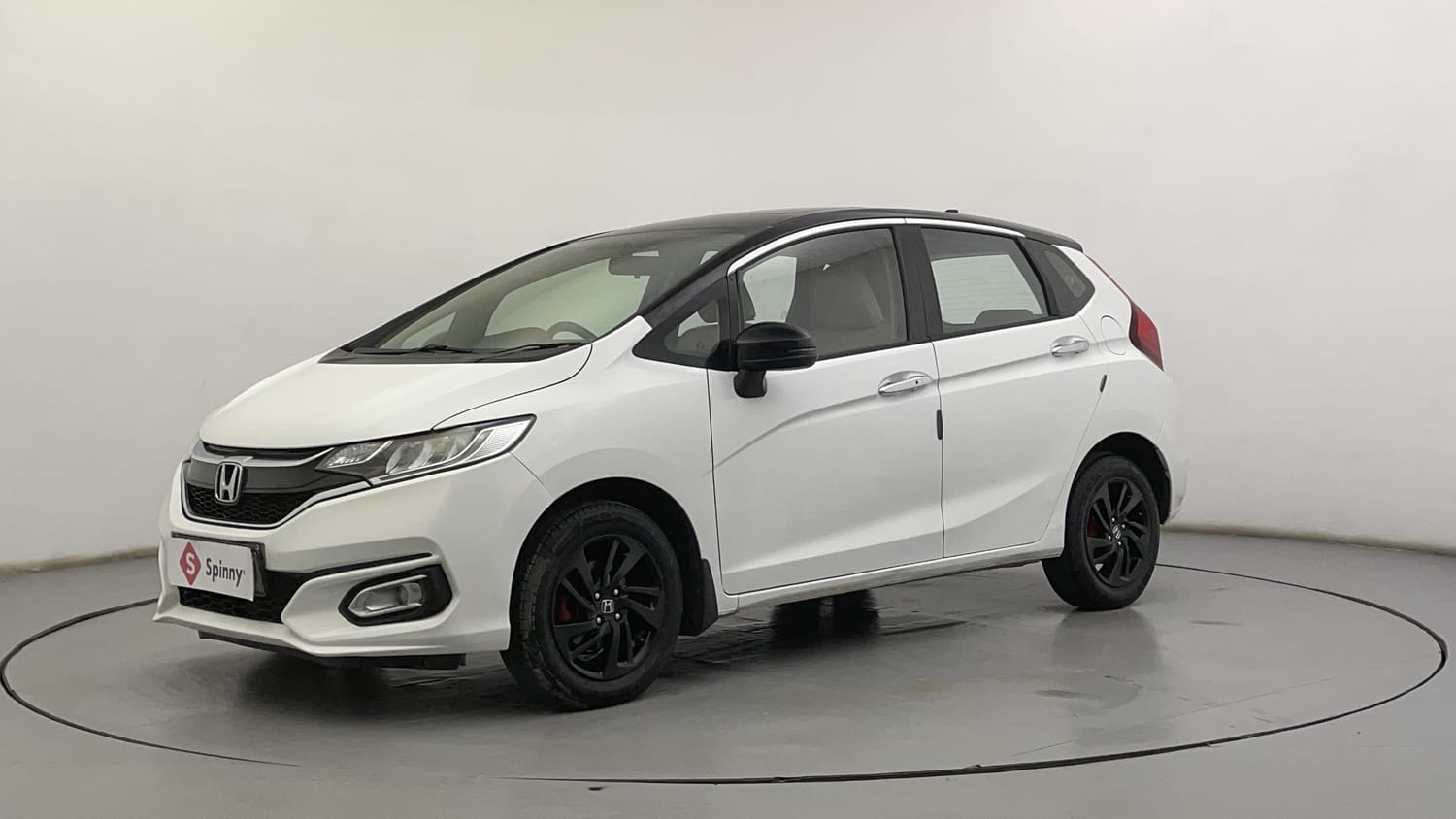
The Honda Jazz has long held a special place in India’s hatchback segment. The hatchback is known for its monovolume mini-MPV body type, impressive interior space utilisation, smooth engines, and renowned Japanese reliability. It remains one of the most practical second-hand cars on the market. The car competes with other premium hatchbacks such as the Maruti Suzuki Baleno, Hyundai i20, and Tata Altroz.
Before it was withdrawn from the Indian automobile market, the latest ex-showroom price range of the Honda Jazz ranged from around ₹7.45 lakh to ₹10.32 lakh. This ultimate guide on used Honda Jazz provides all information regarding specifications, variants, maintenance costs, and reasons why you should/should not go for a second-hand Honda Jazz.
Table of Contents
Specifications of Honda Jazz
The Honda Jazz comes with an excellent range of engines inside that suit driving in cities as well as on highways without any hassle. The third-generation Honda Jazz was introduced in the year 2015 and was fitted with Honda’s famous 1.2-litre i-VTEC engine and also with its powerful 1.5-litre i-DTEC engine.
Check out the detailed technical specifications of the Honda Jazz:
| Specification | Honda Jazz 1.2L i-VTEC Petrol | Honda Jazz 1.5L i-DTEC Diesel |
| Engine Displacement | 1199 cc | 1498 cc |
| Max Power | 89 bhp @ 6000 rpm | 98.6 bhp @ 3600 rpm |
| Max Torque | 110 Nm @ 4800 rpm | 200 Nm @ 1750 rpm |
| Transmission Options | 5-Speed Manual / 7-Step CVT Automatic | 6-Speed Manual |
| ARAI Mileage | 16.6 – 17.1 km/l | 27.3 km/l |
| Boot Space | 354 Litres | 354 Litres |
| Fuel Tank Capacity | 40 Litres | 40 Litres |
| Ground Clearance | 165 mm | 165 mm |
| Seating Capacity | 5 Seater | 5 Seater |
| Global NCAP Safety Rating | 4 Stars | 4 Stars |
Variants of Honda Jazz
In India, Honda Jazz was available in several variants to suit different customer segments. The primary variants included V, VX, and the flagship ZX, while earlier models also offered E and S variants. Honda launched the high-end ZX variant during the BS6 upgrade, packed with luxury features such as the segment-first electric sunroof, full LED in-line headlamps, and LED DRLs.
The following table illustrates the variants of Honda Jazz along with the prices:
| Variant | Transmission Options | Historical Ex-Showroom Price Range |
| Honda Jazz V | 5-Speed Manual / CVT Automatic | ₹7.45 Lakh – ₹9.17 Lakh |
| Honda Jazz VX | 5-Speed Manual / CVT Automatic | ₹7.89 Lakh – ₹9.70 Lakh |
| Honda Jazz ZX | 5-Speed Manual / CVT Automatic | ₹9.34 Lakh – ₹10.32 Lakh |
Best Honda Jazz Variant to Purchase
When looking through second-hand vehicle advertisements, you’ll find that the Honda Jazz VX CVT or ZX CVT offers the best value for money.
The seven-speed CVT transmission includes paddle shifters and provides an effortless drive, characterised by efficient power delivery and fuel economy. The VX version offers plenty of modern equipment: the infotainment system, steering wheel controls, automatic air conditioning, alloy wheels, and keyless button start.
For those who can afford the higher price tag, the ZX version adds an electric sunroof and LED lighting, which make the car look exceptionally modern.
Honda Jazz Warranty and Maintenance Expense
The biggest advantage of driving a Honda is the peace of mind it offers. Honda provides a basic 3-year/Unlimited-Kilometres warranty from the factory, which can be extended to 5 years through authorised Honda warranty packages.
Moreover, Honda provides an “Anytime Warranty” in India, where customers can extend their warranty up to 10 years or 1,20,000 kilometres, provided the car has been serviced regularly at dealerships.
Estimates for Service and Maintenance Expenses
The Honda Jazz is famous for its low cost of maintenance, durable mechanical parts, and availability of spares. Service intervals should take place every 10,000 km or 1 year, whichever comes first.
- Average Annual Routine Service Cost (Petrol): ₹3,500 – ₹5,000 per year
- Average Annual Routine Service Cost (Diesel): ₹5,500 – ₹7,000 per year
DOCX - Estimated 5-Year Maintenance Cost: ₹20,000 – ₹28,000 total
Major servicing like brake fluid replacement, coolant flush, gearbox fluid replacement (CVT), and spark plug replacement happens after 40,000km or 4 years, but the general running costs are very low.
Also Read: Ultimate Guide to Buying a Used Honda Jazz
Why Should You Consider The Honda Jazz
There are few cars in India that can be described as being intelligently engineered like the Honda Jazz. It combines the compact size of a hatchback with the practicality of a larger car.
- Unbeatable Cabin Space And “Magic Seats”
The Honda Jazz stands out because of the sheer amount of space inside the cabin. With Honda’s “Man Maximum, Machine Minimum” design principles at play, the Honda Jazz has enough leg, knee and headroom to comfortably beat many sedans and SUVs in segments above it.
Pre-facelift VX versions came with Honda’s legendary “Magic Seats”, which folded flat, flipped up vertically, or reclined depending on what you needed.
- Smooth CVT Automatic & Superior i-VTEC Engine
If you face tough traffic daily, the Honda Jazz CVT is one of the smoothest hatchbacks with an automatic transmission. This means no jerking or shift shocks, as the Honda CVT provides smoother performance than the jerky automated manual transmissions (AMTs) found in lower-end hatchbacks.
Paddle shifters on higher trims let you drive manually for quick downshifts on open roads. The 1.2L i-VTEC engine is silent, vibration-free, and fuel-efficient.
- Superior Build Quality & Safe Standards
The Honda Jazz comes equipped with great build quality and proven safety standards. Built on an ultra-stiff body frame, the Honda Jazz earned a 4-star crash test rating in Global NCAP tests.
Safety equipment offered by the Honda Jazz includes standard dual airbags, ABS with EBD, rear parking sensors, ISOFIX anchorage points for child seats, and great visibility due to tall glass area and huge quarter glass panels.
Why Should You Not Consider The Honda Jazz?
Even though the Honda Jazz is a masterpiece when it comes to space and comfort, it might not be the ideal choice for every single buyer. Let’s see some of its weaknesses that should be considered prior to buying:
- Lacks Low-End Torque (“Rubber Band Effect”)
Although the 1.2-litre naturally aspirated engine is geared toward fuel economy and efficient city driving, it lacks power when driven aggressively or on the highway, especially compared to modern turbo-petrol hatchbacks.
In case of overtaking at high speed, it produces what is commonly known as the “rubber band effect” in CVT transmissions – engine revs go up, but the acceleration doesn’t increase immediately.
- No Latest Features and Missing Out
Compared with feature-packed rivals such as the Hyundai i20, the Honda Jazz cabin looks more functional than fancy. The top versions lack modern features such as seat ventilation, rear AC vents, a fully digital driver display, a 360-degree camera system, and more.
Moreover, newer facelift versions lack the popular “Magic Seats” configuration and have 60:40 split rear seats only.
- Firm Ride Quality Over Rough Potholes
The Honda Jazz suspension is calibrated to be a bit firmer, thanks to its tall-boy MPV stance, which helps it stay stable on the highway.
Although the car stays planted at speed, rough bumps or road edges can be felt inside the cabin at lower town speeds, resulting in a firm ride quality.
Also Read: Should you buy a pre-owned Honda Jazz
Summary
Overall, the Honda Jazz still stands out as a good choice in terms of used hatchbacks. The vehicle has managed a great balance of reliable Japanese build, affordable servicing costs, a high safety score, and a spacious interior.
If your main concerns are comfortable city driving, an easy-to-use automatic transmission, comfortable backseat seating, and a spacious boot for long family weekends, buying a used Honda Jazz V CVT or VX CVT is one of the best decisions you can make.
FAQs on Purchasing a Used Honda Jazz Car
Q. Is it safe to buy a second-hand Honda Jazz car?
Honda Jazz cars are considered very dependable because of their reliable mechanics. With good mechanical engineering, the 1.2L i-VTEC petrol engine and the CVT transmission of this car can be easily driven well beyond the 1,500,000 km mark with regular oil changes.
Q. What is the actual fuel efficiency of the Honda Jazz petrol car?
The actual or the claimed ARAI mileage of the Honda Jazz petrol car is said to be 16.6-17.1 km/l. However, users have reported actual mileage of 11-13 km/l in cities with heavy traffic and 15-17 km/l on open highways. The diesel variant’s actual highway mileage is claimed to be 20-23 km/l.
Q. How easy is it to find parts for Honda Jazz cars in India?
Yes, Honda still supplies spares for its discontinued cars, and parts like filters, brake pads, suspensions, and body panels are always available.
Q. Honda Jazz Manual Transmission or Honda Jazz CVT?
The automatic CVT is definitely a better option for the heavier urban environment owing to its linear, clutchless shifting and smooth acceleration process. But if you want better throttle control and some engagement during highway drives, then the 5-speed manual transmission is a safe bet.
Q. What are the safety features on the Honda Jazz?
Some safety features on the Honda Jazz include dual frontal airbags, ABS with EBD, speed-sensitive door locks, rear parking sensors, a driver seat belt reminder, and ISOFIX child seat mounts. Additionally, the Honda Jazz has a 4-star Global NCAP safety rating.