
The Toyota Innova Hycross and Toyota Rumion are both spacious family MPV cars, but they cater to very different budgets and buyer requirements. The first one has a bigger size and a more powerful engine, with a choice of a 2.0-litre petrol engine or a 2.0-litre strong hybrid, whereas the Rumion makes use of a less powerful 1.5-litre petrol engine, which can be had with both manual and automatic gear options, in addition to having a factory-fitted CNG option. The numbers also suggest better performance of the strong hybrid Engine of the Hycross, which performs 23.24 km/l as against 20.51 km/l for Rumion’s petrol manual and 26.11 km/kg for the CNG version.
The official numbers make the Hycross hybrid look extremely efficient for its size, but real-world driving changes the order. The much lighter Rumion uses less fuel in petrol form, while CNG lowers its running costs even further. The Hycross counters with significantly more power, passenger space, refinement and long-distance capability. So, which Toyota MPV makes more sense if fuel economy is an important part of the purchase decision?
Table of Contents
Toyota Innova Hycross vs Toyota Rumion Specs
The 1,987cc four-cylinder petrol engine is part of the Innova Hycross‘s configuration. In terms of performance, it produces around 172ps and has 205Nm of torque while operating in regular petrol mode with a CVT. In its hybrid configuration, the vehicle combines the petrol engine with its electric motor to produce a total output of 184ps while using an e-CVT. Both the petrol and hybrid versions are front-wheel drive, and they have a fuel tank capacity of 52 litres each. Measuring 4,755mm in length and with a wheelbase of 2,850mm, the Hycross clearly offers a lot of cabin space.
The Rumion uses a 1,462cc four-cylinder petrol engine producing around 103PS and 139Nm. Buyers can choose a 5-speed manual or 6-speed torque-converter automatic, while the CNG version uses the manual gearbox and produces lower output in gas mode. It is also front-wheel drive but is significantly lighter and smaller than the Hycross, which reduces the amount of energy required to move the vehicle in everyday traffic.
| Specification | Toyota Innova Hycross | Toyota Rumion |
| Engine | 2.0L petrol / strong hybrid | 1.5L petrol / CNG |
| Displacement | 1,987cc | 1,462cc |
| Power | ~172PS petrol / ~184PS hybrid | ~103PS petrol / ~88PS CNG |
| Torque | 205Nm petrol / hybrid electric assistance | 136.8Nm petrol / 121.5Nm CNG |
| Transmission | CVT / e-CVT | 5MT / 6AT(petrol), 5MT (CNG) |
| Drive layout | FWD | FWD |
| Fuel tank | 52 litres | 45 litres petrol |
| Seating | 7 / 8 | 7 |
When we analyse both the cars, we clearly see the advantage of the Hycross. This vehicle can easily carry up to eight persons at high speed. The Rumion, however, being smaller and having a less powerful engine, suits buyers looking for value and budget-friendly transport for their family.
Also Read: Maruti Ertiga vs Toyota Rumion Real-World Mileage Comparison
Toyota Innova Hycross vs Toyota Rumion ARAI Mileage Figures
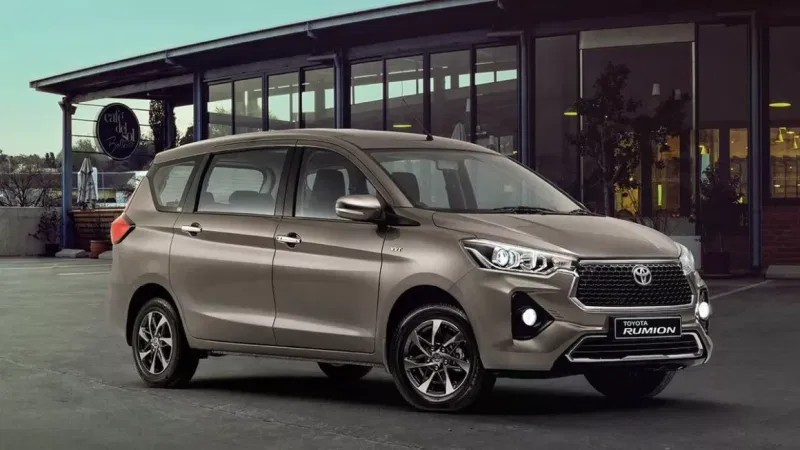
The regular Hycross petrol is officially rated at 16.3 km/l. The strong-hybrid version improves that dramatically to 23.24 km/l, making it one of the most efficient large petrol-powered MPVs on sale. The electric motor assists the engine at low speeds, regenerative braking recovers energy during deceleration, and the petrol engine can shut down more frequently in suitable city-driving conditions.
The Rumion petrol manual asserts a mileage of 20.51 kilometres per litre, while in the case of the automatic it is stated to be 20.11 km/l. Its factory CNG variant is said to achieve a mileage of around 26.11 km/kg. What is interesting is that the hybrid version, Hycross, beats both petrol variants on the official test cycle despite being much more powerful and bigger.
| Car | Engine & Transmission | Fuel Type | ARAI Mileage |
| Toyota Innova Hycross | 2.0L petrol, CVT | Petrol | 16.13 km/l |
| Toyota Innova Hycross | 2.0L strong hybrid, e-CVT | Petrol hybrid | 23.24 km/l |
| Toyota Rumion | 1.5L petrol, 5MT | Petrol | 20.51 km/l |
| Toyota Rumion | 1.5L petrol, 6AT | Petrol | 20.11 km/l |
| Toyota Rumion | 1.5L CNG, 5MT | CNG | 26.11 km/kg |
While the official ranking has the Rumion CNG as number one overall and the Hycross hybrid amongst petrol cars, actual usage scenarios change that picture, for vehicle weight comes into play after the two meet the real world.
Also Read: Toyota Innova Hycross Alternatives: Competitors of Toyota Innova Hycross
Toyota Innova Hycross vs Toyota Rumion Real-World Fuel Efficiency
The regular Hycross petrol is the least economical version in this comparison. Instrumented testing has returned around 6.9 km/l in city driving and 12.4 km/l on highways, producing a combined reference of roughly 9.7 km/l. The strong hybrid performs much better, returning around 13.1 km/l in the city and 16.1 km/l on highways, for a combined reference close to 14.6 km/l.
According to the Rumion petrol automatic’s specifications, it achieves around 14 km/l in urban conditions and 19 km/l on highways to give an approximate combined mileage of 16.55 km/l. Information on laboratory tests of the same car in manual and CNG iterations is less accessible, and the best, closest alternative is the Maruti Ertiga of the same mechanics. The petrol manual version achieves approximately 18.77 km/l combined, while the tested CNG version reaches 22.32 kg/l
| Hycross Petrol | Hycross Hybrid | Rumion Petrol MT* | Rumion Petrol AT | Rumion CNG* | |
| City | 6.9 km/l | 13.1 km/l | 13.5 km/l | 14 km/l | ~20.0 km/kg |
| Highway | 12.4 km/l | 16.1 km/l | 18 km/l | 19 km/l | ~26.0 km/kg |
| Combined reference | ~9.7 km/l | ~14.6 – 16 km/l | ~18.77 km/l | ~16.55 km/l | ~22.32 km/kg |
| Fuel tank | 52L | 52L | 45L | 45L | ~9–10 kg CNG |
*Rumion manual and CNG figures use the mechanically identical Ertiga powertrain as their real-world reference.
The results speak for themselves. The petrol manual Rumion car provides the best real-world petrol mileage, and even its automatic counterpart has better performance than the Hycross hybrid according to all available data. Still, the Hycross hybrid remains impressive since its real-world efficiency numbers come into play while driving a much heavier and more robust automobile.
Toyota Innova Hycross vs Toyota Rumion Fuel Cost Comparison
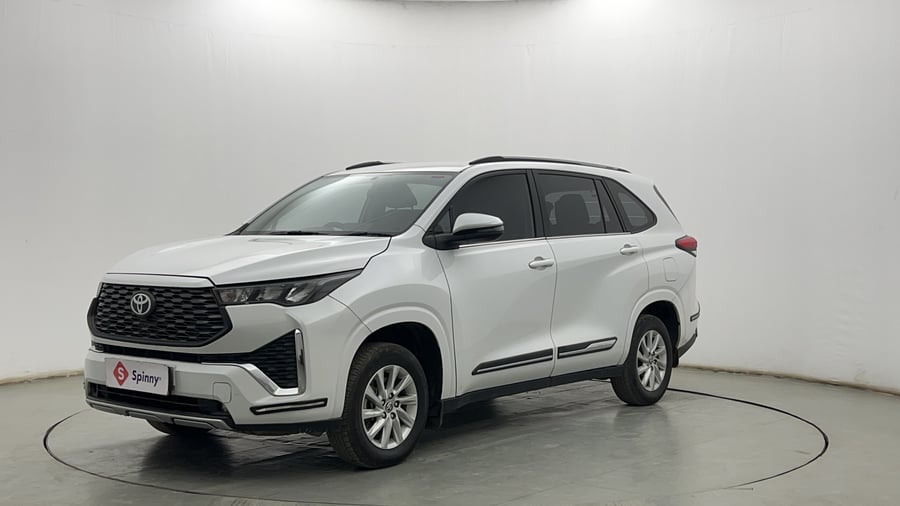
For this comparison, we have assumed 1,500 km of driving every month, equal to 18,000 km annually. Petrol is calculated at approximately ₹102.12 per litre and CNG at ₹86.98 per kg in New Delhi in September 2026. Real-world combined mileage is used rather than ARAI figures to provide a more useful ownership-cost estimate.
| Hycross Petrol | Hycross Hybrid | Rumion Petrol MT* | Rumion Petrol AT | Rumion CNG* | |
| Reference Mileage | 9.7 km/l | 14.6 km/l | 18.77 km/l | 16.55 km/l | 22.32 km/kg |
| Monthly Fuel Use | 154.6L | 102.7L | 79.9L | 90.6L | 67.2kg |
| Monthly Fuel Cost | ₹15,792 | ₹10,492 | ₹8,161 | ₹9,256 | ₹5,845 |
| Annual Fuel Cost | ₹1.90 lakh | ₹1.26 lakh | ₹97,900 | ₹1.11 lakh | ₹70,100 |
| 5-Year Fuel Cost | ₹9.48 lakh | ₹6.30 lakh | ₹4.90 lakh | ₹5.55 lakh | ₹3.51 lakh |
*Rumion MT and CNG use mechanically identical Ertiga real-world references.
The most significant difference is observed between the regular petrol model of the Hycross and the Rumion. In terms of fuel savings, the Rumion saves approximately ₹7,630 per month over the regular petrol model of the Hycross – amounting to an annual savings of over ₹91,000. This translates to a saving of almost ₹4.58 lakhs in the form of fuel expenses during the course of five years, without even factoring in the lower price of the Rumion.
The Hycross hybrid reduces that gap substantially. Compared with the regular petrol Hycross, it saves around ₹5,300 every month at the same usage level, or roughly ₹3.18 lakh over five years. The Rumion petrol manual is still around ₹2,330 cheaper per month to fuel than the hybrid, while the Rumion automatic saves about ₹1,240 per month. The CNG version is the clear running-cost champion, costing approximately ₹5,845 per month at the assumed usage.
Also Explore: Toyota Innova Hycross Image Gallery: Interior, Exterior
Toyota Innova Hycross vs Toyota Rumion Price
The price of the Innova Hycross starts at ₹18.70 lakh without taxes for the basic petrol version and goes all the way up to over ₹31 lakh for the best strong-hybrid model. This difference in costs is due to the presence of a hybrid battery, electric motor and other hardware features that go into making the vehicle a hybrid.
The Rumion starts at approximately ₹9.79 lakh and reaches around ₹14.21 lakh. That means even the most expensive Rumion costs several lakh less than the base Hycross, while the entry Rumion is almost half the price.
| Model | Variant | Approx. Ex-showroom Price |
| Toyota Innova Hycross | G Petrol 7-seat | ₹18.70 lakh |
| Toyota Innova Hycross | GX Petrol 7-seat | ₹19.53 lakh |
| Toyota Innova Hycross | GX(O) Petrol 8-seat | ₹20.84 lakh |
| Toyota Innova Hycross | VX Hybrid 7-seat | ₹26.76 lakh |
| Toyota Innova Hycross | VX(O) Hybrid 7-seat | ₹28.77 lakh |
| Toyota Innova Hycross | ZX Hybrid | ₹31.20 lakh |
| Toyota Innova Hycross | ZX(O) Hybrid | ₹31.84 lakh |
| Toyota Rumion | E Petrol MT | ₹9.79 lakh |
| Toyota Rumion | S Petrol MT | ~₹10.77 lakh |
| Toyota Rumion | S CNG | ₹11.69 lakh |
| Toyota Rumion | G Petrol MT | ~₹11.93 lakh |
| Toyota Rumion | S Petrol AT | ~₹12.35 lakh |
| Toyota Rumion | V Petrol AT | ₹14.21 lakh |
As a result, no significant breakeven point for costs can be identified when the costs of the Hycross would eventually become lower than the Rumion. The Rumion is cheaper both in terms of purchase price and usage costs. The Hycross is a considerably more spacious vehicle which has stronger performance at high speed, better performance with a full load, as well as a close to luxurious experience of owning the vehicle.
The hybrid premium makes the most sense for buyers who already want a Hycross and expect to cover high annual kilometres. It reduces fuel consumption dramatically compared with the regular Hycross petrol, but it does not make the Hycross cheaper to own than a Rumion.
Summary
It is easier to choose the Toyota Rumion when it comes to fuel economy and cost of operating the vehicle. For instance, the manual petrol version of the Rumion has an approximate consumption rate of around 18.77 km/l. Meanwhile, the automatic petrol model gives around 16.55 km/l. Both figures are better than that of the hybrid version of the Innova, which equals around 14.6 km/l.
The Hycross hybrid is still an impressive engineering achievement. It delivers far better mileage than the regular Hycross petrol while providing around 184hp, substantially more space and much stronger performance. For a large family MPV capable of carrying seven or eight occupants comfortably, mid-teens real-world fuel economy is a strong result. The regular Hycross petrol, however, is significantly thirstier and makes more sense for lower-mileage buyers who do not want to pay the substantial hybrid premium.
In conclusion, if your main concerns are the initial purchase price, mileage, and the least amount of fuel expenses, the Toyota Rumion is a better choice. On the other hand, if you are looking for a more spacious, more power-packed, and more premium quality MPV while still being able to save on fuel costs, choose the Toyota Innova Hycross strong hybrid. Purely in terms of running costs, Rumion is the winner; however, when it comes to effectively combining efficiency with space and performance, Hycross comes to the fore.
Related Blogs:
Maruti Ertiga vs Toyota Rumion Real-World Mileage Comparison
Toyota Innova Crysta vs Toyota Rumion Real-World Mileage Comparison
Toyota Innova Hycross vs Renault Triber: Real-World Mileage Comparison
Toyota Innova Crysta vs Toyota Innova Hycross: Real World Mileage Comparison
FAQs about Toyota Innova Hycross and Toyota Rumion Mileage
Q. Which has better mileage, Toyota Innova Hycross or Toyota Rumion?
The Rumion has better real-world mileage. Its petrol manual has an equivalent real-world reference around 18.77 km/l, while the Hycross strong hybrid returns approximately 14.6 km/l combined in instrumented testing. On official figures, however, the Hycross hybrid claims 23.24 km/l versus 20.51 km/l for the Rumion petrol manual.
Q. What is the real-world mileage of the Innova Hycross petrol?
The regular Hycross petrol has returned around 6.9 km/l in city driving and 12.4 km/l on highways, giving a combined reference close to 9.7 km/l.
Q. What is the real-world mileage of the Innova Hycross hybrid?
The Innova Hycross strong hybrid has returned approximately 13.1 km/l in the city and 16.1 km/l on highways, giving a combined reference of around 14.6 km/l.
Q. What is the real-world mileage of the Toyota Rumion automatic?
The Rumion petrol automatic has returned approximately 14 km/l in city driving and 19 km/l on highways, producing a combined average of around 16.55 km/l.
Q. Which is cheaper to run, Innova Hycross hybrid or Toyota Rumion?
The Rumion is cheaper to run. At 1,500km per month, the Hycross hybrid costs roughly ₹10,492 in petrol compared with around ₹8,161 for the Rumion manual and ₹9,256 for the Rumion automatic. The CNG Rumion costs even less.
Q. Which is better for a large family, Hycross or Rumion?
The Rumion is better for buyers who want affordable seven-seat transport with low running costs. The Hycross is better for families that need more space, stronger performance, better highway comfort and a more premium cabin, particularly when the vehicle is frequently driven with a full passenger load.