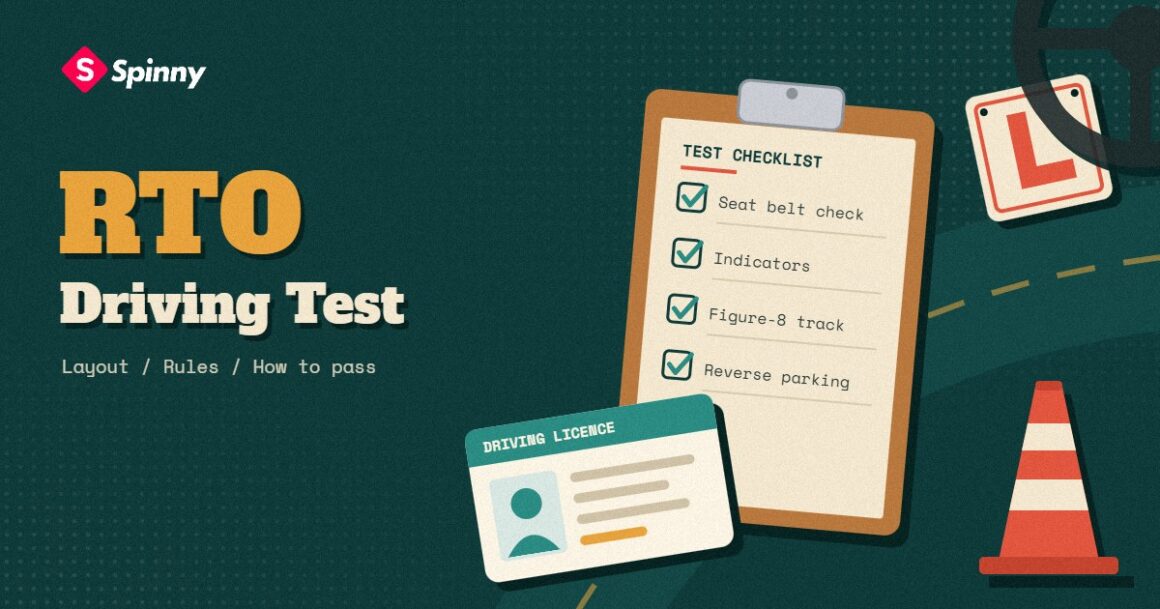
In India, the RTO conducts driving tests either on a manual course or, in some places, on automated tracks with sensors. The test assesses your control of the vehicle, your adherence to safety procedures, your compliance with road rules and your ability to perform specific manoeuvres as directed by the testing officer. The standard test ground layout includes a figure-8 loop and an S-curve or H-track. These tracks test your skills in gradient stops, reversing, driving in straight lines and parallel parking. This blog explains the test ground layouts used in India, the rules to keep in mind during the RTO driving test, and some tips to pass the test with flying colours.
Table of Contents
RTO Driving Test Ground Layout and Common Test Tracks
The common layouts at RTO grounds are manual tracks or sensor-monitored automated tracks. Most RTO grounds in India have a manual track, while automated tracks with sensors are more common in metro cities. Either way, the test grounds will have an 8-loop, an S-curve and an H-track, and some have inclines too. Here is what these tracks are for:
- The 8-loop has marked boundaries and is mainly used for two-wheelers. It tests your control over the vehicle. You must ride through the loop at low speed, keeping your feet off the ground throughout, without stopping or stalling.
- Two-wheelers also use a straight track where you must take controlled turns while using the indicators when needed. These tracks are usually 25 m x 4 ft.
- Some four-wheeler tracks also have an 8-loop or an S-curve, where you must drive the car without crossing the boundaries or touching the sensor poles installed along the track.
- The H-track tests your skills in reversing, driving in straight lines and using your mirrors properly. You must not cross the boundaries or hit the poles here either.
- On the incline, you must stop and then move off slowly and smoothly without rolling back. On automated tracks, even a slight rollback of more than 30 cm can cause you to fail the test.
- Parallel parking is another part of the test ground layout. Here, you reverse the car into the designated space using controlled steering and proper mirror use.
Not all test grounds have the same layout. You can get details of your local RTO office test ground from the driving school where you train. Moreover, a hatchback is more convenient for the ground test because of its compact size and easier control, especially on the 8-loop or S-curve.
Also Read: Complete Guide to Driving Licence Test
Driving Test for Cars: Tasks and Manoeuvres to Know
The driving test for cars evaluates your control over the car, your road awareness and your ability to perform core manoeuvres safely. The exact tracks differ from ground to ground. Here are some key manoeuvres you may need to perform on the ground or on the road:
- Curves: On an S or 8 track, drive the car slowly and smoothly, without stalling or stopping, and stay within the boundaries.
- Hill start or incline: Stop, hold the car steady and then move forward slowly without rolling back. If the car does roll back, it shouldn’t be more than 30 cm.
- H-track: This tests how you take corners and use your mirrors while doing so. Turns must be controlled and within the boundary, and the car should stay steady and straight wherever possible.
- Braking: Brakes must be applied firmly, safely and on cue when the testing officer asks. Even emergency stops must be controlled.
Also Read: Types of Driving Licences in India
Two-Wheeler Driving Test: Track Layout and Requirements
For two-wheeler driving tests, there will be an infinity (figure-8) loop and a straight line or path, and some grounds also have a zig-zag path. The exact layout varies from one ground and RTO to another.
- Infinity loop: Manoeuvre the bike slowly without stopping or touching the ground with your feet even once.
- Straight line: This tests how well you can keep the bike on the designated line.
- Turns: Use the turn indicators properly.
- Zig-zag path: Ride in a controlled manner, using indicators where needed.
Also Read: Driving Licence: MCWG Full Form
Eligibility and Documents Required for the RTO Driving Test
Below are the eligibility criteria and documents required to appear for an RTO driving test in India.
Eligibility Criteria
The primary requirement is that you must be at least 18 years old to drive a geared two-wheeler or a light motor vehicle such as a car. The minimum age for driving commercial vehicles varies with the state rules. In addition, you must have passed the learner’s licence test at least 30 days before the driving test. A learner’s licence is valid for 6 months, so you must book your RTO driving test slot within this period. To pass, you must clear both the track test and the on-road test. If you fail either, you must apply for a retest.
Documents Required
- Original learner’s licence with at least 30 days validity
- Printout of the driving licence application form
- Acknowledgement of the test slot booking
- ID and address proof such as Aadhaar card, passport or voter ID
- Recent passport-size photographs, as many as required, plus a few extras
- Medical fitness certificate (Form 1A) covering physical and eye health, for applicants above 40
Also Read: Complete Guide to Learners Driving Test Questions in India
How to Prepare for and Pass the RTO Driving Test
The first step is to pass the learner’s licence test and book the driving test slot. You can schedule the test slot online and print the receipt. Don’t worry if you fail on the first attempt; you can book a retest after 7 days, as long as your learner’s licence is still valid.
For two-wheelers, practise the figure-8 and any zig-zag path at low speed. The aim is to control the vehicle without putting your feet down. Wear closed-toe shoes for the test.
For four-wheelers, practise low-speed control, reversing, parking in designated spots, taking curves and inclines, and, if possible, sharp turns to mimic the H-track. Once you pass, if you’re buying your first car, used hatchback cars are a practical pick, and a used car loan can spread the cost.
Tips to Avoid Driving Test Failure
- Before you start the car, adjust the seat, seat belt, rear-view mirror and side mirrors to a comfortable position.
- Always look around the vehicle before you move it.
- When changing lanes, check your mirrors and turn your head to check traffic.
- Avoid sudden braking or acceleration. Jerky inputs make your driving look poor.
- Know the speed limits in the test area, obey traffic rules and follow signals; the same habits will keep you clear of a traffic challan later.
- Pull over only in designated areas and check oncoming traffic before you move.
Also Read: How to Track Application for Licence, Permits, or RC in Real-Time
FAQs About RTO Driving Test
Q. What is the RTO driving test procedure in India?
In India, you take the RTO driving test at a designated ground with tracks for two-wheelers and four-wheelers. You must have passed the learner’s licence test at least 30 days earlier and take the test within 180 days of it. Book a slot and appear with the required documents. You will take a ground test and an on-road test, and you will be told the result shortly after.
Q. How many attempts are allowed for the driving test?
The number of attempts depends on state rules. All attempts must be within 180 days of the learner’s licence being issued.
Q. Is reverse parking part of the car driving test?
Reverse parking is usually part of the driving test. You can use your own vehicle or one provided by your driving school.
Q. Can I use my own car for the RTO driving test?
Yes, you can use your own car as long as it has a valid RC (you can check its RC status online), valid car insurance and a valid PUC certificate, and a licensed driver brings it to and from the test ground.
Q. What happens if I fail the RTO driving test?
If you fail the driving test, you can apply for a retest after 7 days and pay the applicable retest fee.
Q. How long does it take to get a driving licence after passing?
Once you clear the driving test, you can see the digital copy on DigiLocker or the mParivahan app in 1-2 days. The printed licence is sent by post within 1-4 weeks, or within 30 days.