
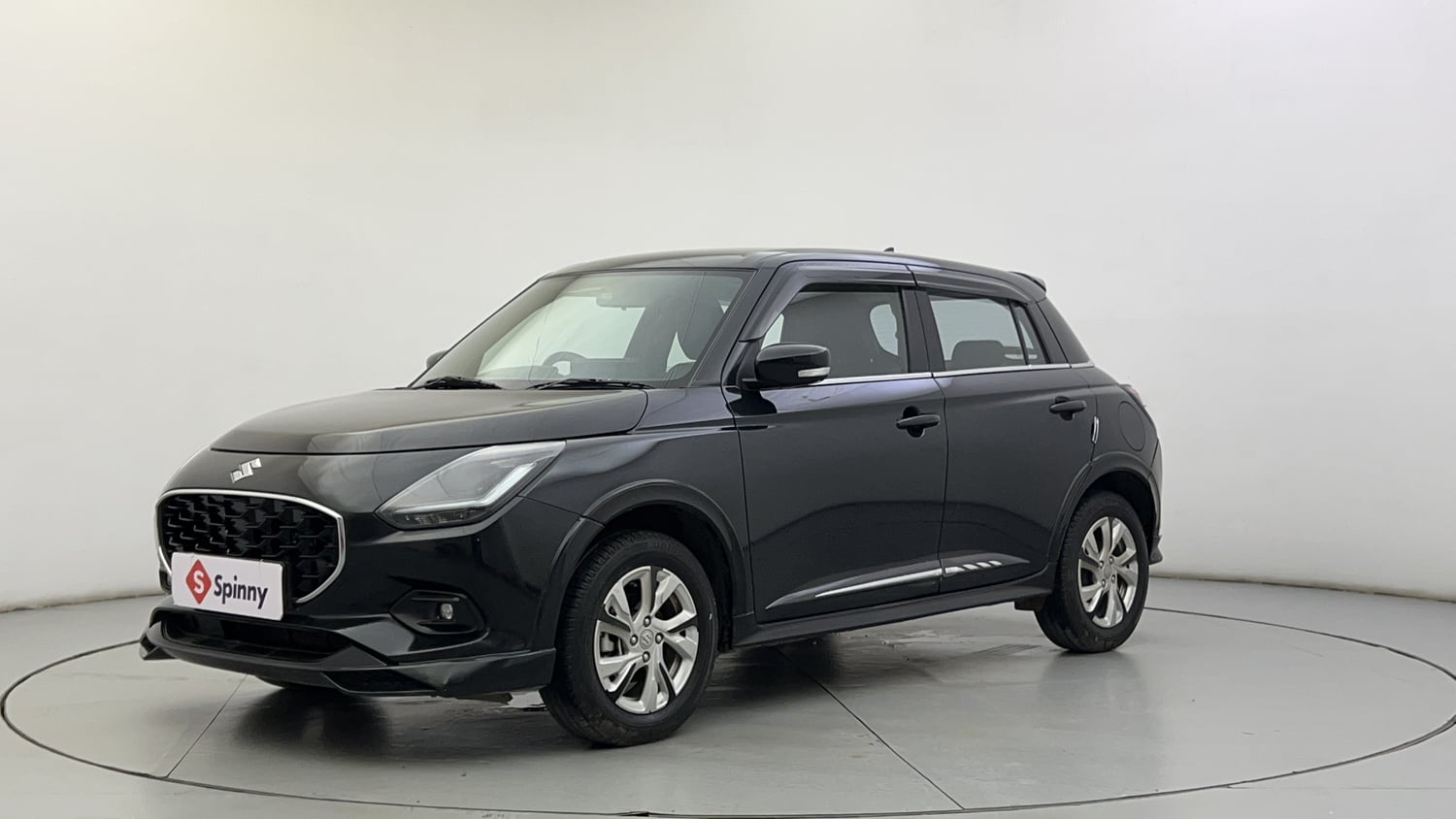
The Maruti Suzuki Swift has long been known for combining enjoyable handling with low fuel consumption. The current model is available with petrol manual, petrol AMT and factory-fitted CNG powertrains.
The petrol manual offers greater control, while the AMT is more convenient in traffic. The CNG version provides the lowest fuel cost but produces less power and requires access to filling stations. This guide compares the Swift’s claimed mileage, tested city and highway efficiency, running costs and suitability for different buyers.
Table of Contents
Maruti Suzuki Swift Engine and Transmission Options
The current Swift uses a 1.2-litre Z-Series three-cylinder petrol engine. It produces approximately 82 PS and 112 Nm.
Petrol buyers can choose between a five-speed manual gearbox and a five-speed automated manual transmission. Maruti Suzuki refers to the AMT system as Auto Gear Shift or AGS.
The CNG version uses the same basic engine but produces approximately 69 PS and 102 Nm while running on gas. It is available only with the five-speed manual transmission.
| Powertrain | Transmission | Maximum Power | Maximum Torque |
| 1.2-litre petrol | 5-speed manual | Around 82 PS | 112 Nm |
| 1.2-litre petrol | 5-speed AMT | Around 82 PS | 112 Nm |
| 1.2-litre CNG | 5-speed manual | Around 69 PS | 102 Nm |
The petrol Swift has a 37-litre fuel tank. Its engine also uses an automatic idle stop-start system to reduce fuel consumption while the car is stationary.
Maruti Suzuki Swift Claimed Mileage
The petrol manual has a certified mileage of 24.80 kmpl. The AMT is slightly more efficient on paper, with a claimed figure of 25.75 kmpl.
The Swift S-CNG delivers a claimed 32.85 km/kg. This makes it the most efficient version in the range.
| Fuel Type | Transmission | Claimed Mileage |
| Petrol | 5-speed manual | 24.80 kmpl |
| Petrol | 5-speed AMT | 25.75 kmpl |
| CNG | 5-speed manual | 32.85 km/kg |
The AMT’s higher claimed figure does not mean it will always outperform the manual in everyday driving. Traffic conditions, driving style and gearbox behaviour can create a larger difference in the real world.
Also Read: Maruti Swift Mileage Comparison: Petrol vs CNG
Maruti Suzuki Swift Claimed vs Real-World Mileage
Independent testing shows that the Swift does not usually reach its certified mileage during normal driving.
Autocar India recorded 14 kmpl in the city and 19 kmpl on the highway from the petrol manual. The AMT returned 12.7 kmpl in the city and 19.1 kmpl on the highway during the same testing process.
A separate CarDekho test produced better AMT figures. It recorded 15.84 kmpl in the city and 22.13 kmpl on the highway. The calculated efficiency for an equal mixture of city and highway driving was 18.46 kmpl.
The Swift CNG returned 21.28 km/kg in city conditions and 35.01 km/kg on the highway during CarWale’s test.
| Version Tested | City Mileage | Highway Mileage |
| Petrol manual | 14 kmpl | 19 kmpl |
| Petrol AMT, Autocar test | 12.7 kmpl | 19.1 kmpl |
| Petrol AMT, CarDekho test | 15.84 kmpl | 22.13 kmpl |
| CNG manual | 21.28 km/kg | 35.01 km/kg |
The difference between the two AMT tests shows why a single real-world figure should not be treated as a guarantee.
The testing routes, average speeds, traffic, weather and driving patterns were different. Owners may therefore experience results above or below these figures.
Swift Petrol Manual Real-World Mileage
The petrol manual is the most engaging Swift to drive. It gives the driver complete control over gear selection and engine speed.
Autocar India recorded 14 kmpl during its city test. The test was conducted at an average speed of approximately 18 km/h with the air-conditioning and other electrical equipment in use.
City mileage can fall further in severe congestion. Frequent clutch use, rapid acceleration and long periods of idling increase fuel consumption.
On the highway, the manual returned 19 kmpl. The engine operates at approximately 2,600 rpm while cruising at 100 km/h in fifth gear. Moderate cruising speeds can therefore provide better efficiency than frequent high-speed overtaking.
The manual is suitable for buyers who:
- Prefer direct control over gear changes.
- Regularly drive on open roads.
- Want a lower purchase price.
- Do not mind using the clutch in traffic.
- Want predictable performance during overtaking.
Swift Petrol AMT Real-World Mileage
The AMT uses the same five-speed gearbox as the manual. However, electronic actuators operate the clutch and select gears automatically.
This makes the Swift easier to drive in traffic. The system can feel less smooth than a conventional torque-converter or dual-clutch automatic, especially during low-speed gear changes.
Autocar India recorded 12.7 kmpl in the city and 19.1 kmpl on the highway. CarDekho recorded 15.84 kmpl and 22.13 kmpl under its own testing conditions.
Based on these tests, buyers can expect the following broad range:
| Driving Condition | Tested AMT Mileage Range |
| Congested city driving | 12.7 to 15.84 kmpl |
| Open highway driving | 19.1 to 22.13 kmpl |
| Mixed driving | Approximately 15 to 19 kmpl |
The AMT does not always deliver better real-world mileage than the manual, despite its higher certified figure.
Automatic gear selection can support economical driving when throttle inputs are gentle. However, repeated low-speed shifts and hard acceleration can reduce efficiency.
Swift CNG Real-World Mileage
The Swift CNG is the least expensive version to run regularly.
During CarWale’s test, it covered 79.8 km in the city while consuming 3.75 kg of CNG. This resulted in an efficiency of 21.28 km/kg.
On the highway, the car travelled 119.4 km using 3.41 kg of gas. The resulting mileage was 35.01 km/kg.
The high highway result was achieved under a specific testing process. Buyers should not assume that every highway journey will return more than 35 km/kg.
A more practical mixed-use expectation would be approximately 25 to 29 km/kg. Heavy traffic, a full passenger load and continuous air-conditioning can lower this figure.
The CNG version also produces less power than the petrol Swift. The difference becomes more noticeable when carrying several passengers or climbing steep roads.
Maruti Suzuki Swift City Mileage Comparison
Petrol Manual in the City
The manual delivered 14 kmpl in Autocar India’s city test.
It can be economical when the driver changes gears early and maintains smooth acceleration. However, constant clutch operation can become tiring in severe congestion.
Petrol AMT in the City
The AMT provides greater convenience. Tested city mileage ranged from 12.7 to 15.84 kmpl.
Its efficiency depends heavily on traffic movement and throttle inputs. Allowing the car to build speed gradually can help the gearbox shift earlier.
Swift CNG in the City
The CNG version returned 21.28 km/kg during city testing.
Its lower fuel price can reduce the cost per kilometre substantially. However, owners must consider refuelling queues and local station availability.
Also Read: Maruti Suzuki Swift Warranty Explained
What Affects Swift Mileage in City Driving?
Traffic Congestion
Repeated acceleration and braking use more fuel than maintaining a steady speed.
Driving Style
Hard acceleration makes the engine consume more fuel. Smooth throttle inputs are particularly important in the AMT.
Air-Conditioning
Continuous AC use places an additional load on the engine. The effect becomes more noticeable during slow journeys.
Journey Length
Very short trips usually produce lower mileage because the engine does not reach an efficient operating temperature.
Idling
The idle stop-start system can reduce fuel use at traffic signals. However, long periods of stationary running still lower overall efficiency.
Vehicle Load
Additional passengers and luggage make the engine work harder, particularly in CNG mode.
Tyre Pressure
Underinflated tyres increase rolling resistance and fuel consumption.
Maruti Suzuki Swift Highway Mileage Comparison
The Maruti Suzuki Swift performs more efficiently when driven at a consistent speed.
The petrol manual returned 19 kmpl in Autocar India’s highway test. The AMT recorded 19.1 kmpl in the same test.
CarDekho’s AMT test produced a stronger result of 22.13 kmpl.
The CNG version returned 35.01 km/kg during CarWale’s highway test. Its lower power output is less noticeable once the car reaches a stable cruising speed.
| Version | Tested Highway Mileage |
| Petrol manual | 19 kmpl |
| Petrol AMT | 19.1 to 22.13 kmpl |
| CNG manual | 35.01 km/kg |
Maintaining speeds between approximately 80 and 100 km/h generally provides better efficiency than repeated high-speed acceleration.
Mileage will fall when the car carries several occupants, encounters strong headwinds or travels through hilly areas.
Also Read: Ultimate Guide to Selling Your Maruti Suzuki Swift
Maruti Suzuki Swift Driving Range
The petrol Swift uses a 37-litre fuel tank.
Using Autocar India’s tested results:
- The manual could theoretically cover around 518 km in city conditions.
- The manual could theoretically cover around 703 km on the highway.
- The AMT could theoretically cover around 470 km in city conditions.
- The AMT could theoretically cover around 707 km on the highway.
Actual usable range will be lower because drivers rarely use every litre in the tank.
The CNG-only range depends on how much gas enters the cylinder during each refill. Filling quantity changes with pump pressure and temperature. The car can continue running on petrol when its CNG supply is depleted.
Maruti Suzuki Swift Running Cost Comparison
The following example assumes:
- Monthly driving of 1,500 km
- Petrol manual mixed mileage of 16 kmpl
- Petrol AMT mixed mileage of 16.5 kmpl
- CNG mixed mileage of 26.5 km/kg
- Petrol price of ₹100 per litre
- CNG price of ₹80 per kg
The mileage assumptions are representative figures based on the available real-world tests. Fuel prices are illustrative and vary between cities.
| Expense | Petrol Manual | Petrol AMT | CNG Manual |
| Approximate cost per kilometre | ₹6.25 | ₹6.06 | ₹3.02 |
| Estimated monthly fuel cost | ₹9,375 | ₹9,091 | ₹4,528 |
| Estimated annual fuel cost | ₹1,12,500 | ₹1,09,091 | ₹54,340 |
| Estimated five-year fuel cost | ₹5,62,500 | ₹5,45,455 | ₹2,71,698 |
Under these assumptions, the CNG version could save approximately ₹2.91 lakh over five years compared with the petrol manual.
It could save around ₹2.74 lakh compared with the petrol AMT.
This comparison does not include differences in purchase price, insurance, financing, maintenance or resale value.
When Does the Swift CNG Make Financial Sense?
The CNG version becomes easier to justify when monthly driving is high.
A buyer covering 1,500 km every month could save approximately ₹4,500 to ₹4,800 in fuel compared with the petrol versions under the assumptions above.
The saving may offset the higher purchase price within a few years. The exact break-even period depends on the selected variants and local fuel prices.
CNG may not be worthwhile when annual driving is low or filling stations are inconvenient.
Buyers should also consider the reduced performance and the luggage-space restrictions created by the CNG cylinder.
Also Read: How to Improve Maruti Suzuki Swift Reliability: Maintenance Tips
Maruti Suzuki Swift Mileage Compared with Rivals
The Swift competes with hatchbacks offering petrol, AMT and CNG powertrains.
| Model | Petrol Mileage | CNG Mileage |
| Maruti Suzuki Swift | Up to 25.75 kmpl | 32.85 km/kg |
| Maruti Suzuki Celerio | Around 26 kmpl | 34.43 km/kg |
| Maruti Suzuki Wagon R | Up to 25.19 kmpl | Up to 34.05 km/kg |
| Maruti Suzuki Baleno | Up to 22.94 kmpl | 30.61 km/kg |
| Tata Tiago | Up to around 19.28 kmpl | Up to 28.06 km/kg |
The Celerio is more fuel-efficient on paper, with petrol mileage of around 26 kmpl and a CNG figure of 34.43 km/kg.
The Wagon R also exceeds the Swift’s CNG figure, while its 1.0-litre AMT delivers up to 25.19 kmpl.
The Baleno is less efficient but offers a larger cabin and boot. Its petrol AMT delivers up to 22.94 kmpl, while the CNG version is rated at 30.61 km/kg.
The Tiago offers petrol and CNG manual and AMT options. Tata lists figures of up to approximately 19.28 kmpl for petrol and 28.06 km/kg for CNG.
The Swift’s main advantage is its balance of fuel efficiency, performance and handling rather than having the highest mileage in every category.
Which Maruti Suzuki Swift Should You Choose?
Choose the Petrol Manual If:
- You enjoy controlling gear changes.
- Your annual driving is moderate.
- You regularly travel on highways.
- You want a lower purchase price.
- You do not want to depend on CNG stations.
Choose the Petrol AMT If:
- Most journeys involve city traffic.
- Convenience is more important than complete gearbox control.
- Multiple family members will drive the car.
- Your annual usage is low to moderate.
- You want an affordable automatic hatchback.
Choose the Swift CNG If:
- You cover substantial distances every month.
- CNG stations are easily accessible.
- Minimum fuel expense is the priority.
- You are comfortable using a manual gearbox.
- Reduced power and luggage capacity are acceptable.
The petrol manual provides the best balance for drivers who enjoy driving. The AMT is better for congested cities, while CNG is the most economical option.
How to Improve Maruti Suzuki Swift Mileage
Accelerate gently and avoid unnecessary high engine speeds.
Shift the manual version early without making the engine struggle in a high gear.
Use light throttle inputs in the AMT. This helps the gearbox complete smoother and earlier upshifts.
Anticipate traffic ahead and avoid repeated braking and acceleration.
Check tyre pressure regularly. Use the pressure recommended by Maruti Suzuki.
Avoid carrying unnecessary luggage. Additional weight increases fuel consumption.
Do not idle the engine for extended periods. Allow the automatic stop-start system to operate normally.
Keep the engine, air filter, spark plugs and fuel system properly maintained.
Use the fuel grade recommended in the owner’s manual. Premium petrol is not automatically required and should not be promoted as a guaranteed mileage improvement.
Summary
The Maruti Suzuki Swift petrol manual has a claimed mileage of 24.80 kmpl. Independent testing recorded 14 kmpl in the city and 19 kmpl on the highway.
The AMT is rated at 25.75 kmpl. Tested results ranged from 12.7 to 15.84 kmpl in the city and 19.1 to 22.13 kmpl on the highway.
The Swift CNG delivers a claimed 32.85 km/kg. It returned 21.28 km/kg in city testing and 35.01 km/kg on the highway.
The CNG version has the lowest fuel cost, while the AMT provides the greatest convenience. The petrol manual remains the most engaging option.
Actual mileage depends on traffic, speed, air-conditioning, vehicle load, tyre pressure and driving style.
FAQs About Maruti Suzuki Swift Real-World Mileage
Q. What is the real-world mileage of the Swift petrol manual?
Autocar India recorded 14 kmpl in city conditions and 19 kmpl on the highway.
Q. What is the real-world mileage of the Swift AMT?
Independent tests recorded 12.7 to 15.84 kmpl in the city and 19.1 to 22.13 kmpl on the highway.
Q. What is the real-world mileage of the Swift CNG?
The real-world mileage of the Swift CNG is recorded as 21.28 km/kg in the city and 35.01 km/kg on the highway.
Q. Is the Swift AMT more fuel-efficient than the manual?
The AMT has a higher claimed figure. However, independent testing shows that either transmission may perform better depending on traffic and driving style.
Q. Which Swift version has the lowest running cost?
The CNG manual generally has the lowest cost per kilometre. It is most suitable for high-mileage users with convenient access to CNG stations.