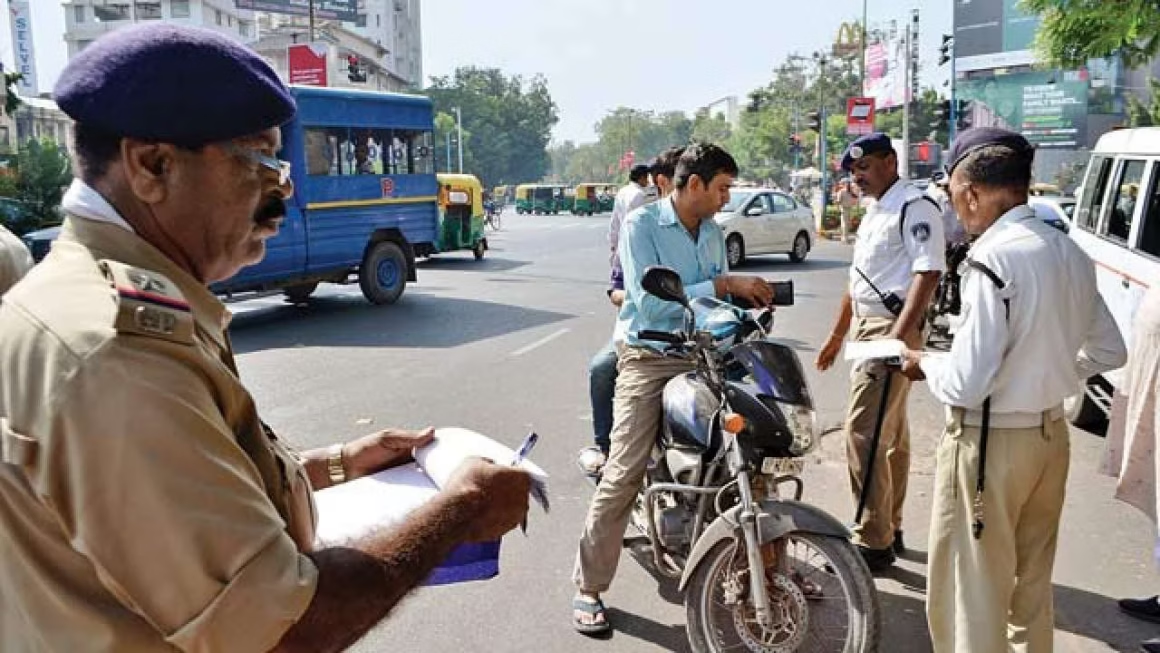
A two-wheeler traffic challan is issued as per the Motor Vehicles Act when there are traffic violations or missing documents involved. It is either issued on the spot by the traffic police or digitally, after detection via CCTV, Automated Number Plate Recognition (ANPR) cameras or speed sensors, etc. The penalty amount depends on the state and the city, as governments often modify them. Common traffic violations include improper headgear or no helmet, carrying more than one pillion rider, not having valid insurance, overspeeding, dangerous driving, jumping the signal, riding on the wrong side of the road, using a phone while riding or lack of documents such as insurance, RC, PUCC, etc.
The digital challans are issued via SMS or email, and can also be seen on the eChallan portal or the mParivahan app. There, you can check the challans by entering the registration number of the bike, driving licence number, etc. Payment can also be done digitally through authorised channels and apps. Unpaid challans can be escalated and can lead to court cases, enforcement and even licence suspension, depending on the severity. Under the amended Rule 167 of the Central Motor Vehicles Rules (in force since 21 January 2026), you have 45 days from the date of issue to pay or contest a challan.
Table of Contents
How to Check Bike Challan Online in 2026
Checking your bike challan online in India is easiest through the mParivahan app or the eChallan portal.
- Visit the eChallan portal or launch the mParivahan app.
- Enter your bike’s registration number, the challan number (if you have received an SMS or email already) or your driving licence number. You may also be asked to enter the last 5 digits of the chassis or engine number of the bike.
- Complete the captcha and, where asked, the OTP verification.
- Now, you can see the challans, if any, issued along with the details of the offence, the date it occurred, the location and the fine due.
Alternatively, you can check the challan status via the Spinny portal. At the same time, do not blindly trust any third-party website unless you can verify its authenticity.
It is not advised to click on the link provided in the SMS regarding the traffic challan. Fraudulent links are common in this regard. So instead of clicking on the link in the SMS, it is better to visit the official portal to check the challans.
Two-Wheeler Traffic Fine List in India 2026
As mentioned, the two-wheeler traffic fines are issued as per the Motor Vehicles Act framework. Since states can set their own compounding amounts, the penalty amount may vary, but the sections under which the challan is issued remain the same.
| Violation | MV Act Section | Penalty Amount (approx.) |
| No helmet / unfastened or non-BIS helmet | Sec. 194D | ₹500 to ₹1,000, plus possible 3-month licence disqualification |
| Triple riding | Sec. 194C / 128(1) | ₹500 to ₹1,000 |
| No valid driving licence | Sec. 3/181 | ₹5,000 |
| No valid insurance | Sec. 146/196 | ₹2,000 (1st violation) / ₹4,000 (repeated offence) |
| Overspeeding (2W) | Sec. 112 r/w 183 | ₹1,000 to ₹2,000 |
| Using a mobile phone while riding | Sec. 184 | ₹1,000 to ₹5,000 (1st violation) / up to ₹10,000 (repeated offence) |
| Not giving way to an emergency vehicle | Sec. 194E | ₹10,000 |
| Racing/speed trials | Sec. 189 | ₹5,000 (1st violation) / ₹10,000 (repeated offence) |
| Drunken driving | Sec. 185 | Up to ₹10,000 and/or imprisonment (1st offence); up to ₹15,000 (repeat), decided by court |
| Red-light jump / dangerous / wrong-side driving | Sec. 184 | ₹1,000 to ₹5,000 (1st violation); may be sent to court |
The Motor Vehicles Act sets the penalty for each offence, and state governments can fix lower compounding amounts for many of them. Most often, the state penalty can be lower than the amount in the Act.
Why There Are State-Wise Differences in Bike Challan Amounts
While the bike challan is issued under the Motor Vehicles Act by the central government, states can set their own compounding amounts for many offences. It is not necessary that the states follow the same amounts. The norm is that the states cannot exceed the penalty that the Centre has decided. Under Section 200 of the Act, the state can issue gazette notifications to set the compounding amount for several offences. Many states have also used this provision and have lowered the penalty amount for traffic violations.
In Karnataka, the helmet fine has been reduced to ₹500 from ₹1,000. The penalty for dangerous driving is up to ₹5,000 under the Act, but Karnataka has reduced it to ₹1,500. Similarly, Gujarat has also exercised the same power to reduce the no-helmet penalty to ₹500 and the penalty for riding without a licence to ₹2,000. At the same time, severe violations such as drunk driving are not compoundable by the police and must be settled in court, so state reductions don’t apply to them.
How to Pay a Bike Challan Online and Offline
The safest ways to pay the bike challan online are to use the mParivahan app or the eChallan portal. You can also use state portals such as KarnatakaOne.
- Go to any of these portals and enter the registration number, driving licence number or challan number to find the challan.
- Enter the OTP sent to your registered mobile number.
- Select the mode of payment, like UPI, net banking or cards.
- Finish the transaction, and you are done.
If you want to make payment offline, you can visit the nearest traffic police station or RTO with the challan details and your documents, like your driving licence and RC. If you have a court challan, you have to settle it through the court system.
What Happens If You Do Not Pay a Bike Challan?
If you don’t pay a bike challan in India, it will remain active and attached to the vehicle until the due amount is paid. Under the amended Rule 167, if you neither pay nor contest it within 45 days, the challan is treated as accepted. This is an issue when you want to sell the bike and transfer the RC to the buyer, as pending challans can block the RC transfer until they are cleared.
Sometimes, the non-payment of long-standing challans can be escalated to court. This can lead to a long legal tangle, and you have to pay the penalty via court rather than online or through other offline modes. It can also lead to the suspension of your licence, and under the 2026 rules, five or more offences in a year can also lead to action against your licence.
How to Dispute an Incorrect Two-Wheeler Challan
In case you are issued an incorrect two-wheeler challan where you have not committed the offence, you can contest it through the Parivahan eChallan portal within 45 days of issue. There, you need to give proper details and proof of why the challan is incorrect and file the complaint. For this, you may need the following documents.
- Details of the challan with the number, date, time, location, and the type of violation.
- Clear pictures of the vehicle registration number, the make and colour, and documents such as insurance, RC and PUC as applicable, to show how it was wrongly issued under your name.
- Location history, parking receipts, toll or travel records, etc., to show that you or the two-wheeler were elsewhere at the date and time of the alleged offence.
Once you submit the complaint, save the reference or ticket number and use it to follow up. In the meantime, do not pay the penalty amount, as payment would be treated as accepting the offence. If your challenge is rejected, you can pay within 30 days or approach the court after depositing 50% of the challan amount.
Summary
A bike challan can be issued on the spot or through cameras, and the fine depends on the offence and the state you’re riding in. You can check it in minutes on the eChallan portal, the mParivahan app or Spinny using your registration number, licence number or challan number, but avoid clicking links in challan SMS messages. Under the 2026 rules, you have 45 days to pay or contest a challan, after which it is treated as accepted, and repeated violations can affect your licence. If a challan is wrong, contest it online with clear proof instead of paying it. Checking regularly and clearing valid fines on time keeps your record clean and makes selling or transferring your bike hassle-free.
Related Blogs:
Riding Without Helmet Fine
Most Common Traffic Challans in India and How to Avoid Them
FAQs about Bike Challan and Two-Wheeler Fine
Q. Can I check two-wheeler challans using my mobile number?
You cannot check the two-wheeler challan only using your mobile number. You will also need the registration number of the bike, or driving licence or the challan number.
Q. How long does an online bike challan take to appear?
Under the amended Rule 167, an e-challan is meant to reach you within 3 days of the violation being recorded, and a physical challan within 15 days. Offences caught on camera usually appear quickly, while on-the-spot challans may take a little longer to update online.
Q. Can I ride my bike if I have an unpaid challan?
Having a traffic challan issued does not automatically ban you from riding your bike. You can still take it out, but the penalty stays active until you pay it off. However, the offence will be attached to the vehicle and sometimes can even drag you to court, especially if there are severe violations involved. It can also cause you trouble in case of police checks. In those cases, you may have to pay the penalty on the spot to avoid further action as per the rules. Under the 2026 rules, you have 45 days from the date of issue to pay or contest a challan.
Q. Can the traffic police officer issue multiple challans for the same violation?
In case you have an unpaid challan and you keep on committing the offence, the police can book you for multiple challans for the same offence. But if a duplicate challan is issued for the same offence, you need not pay for both and you can contest the duplicate with proper documents as proof.