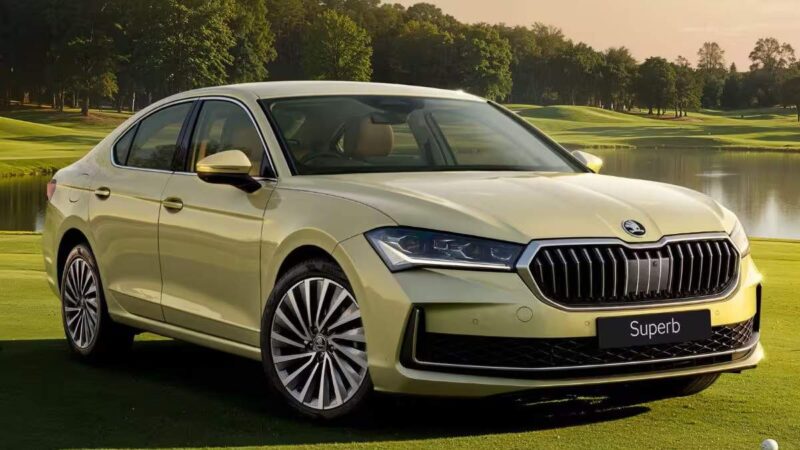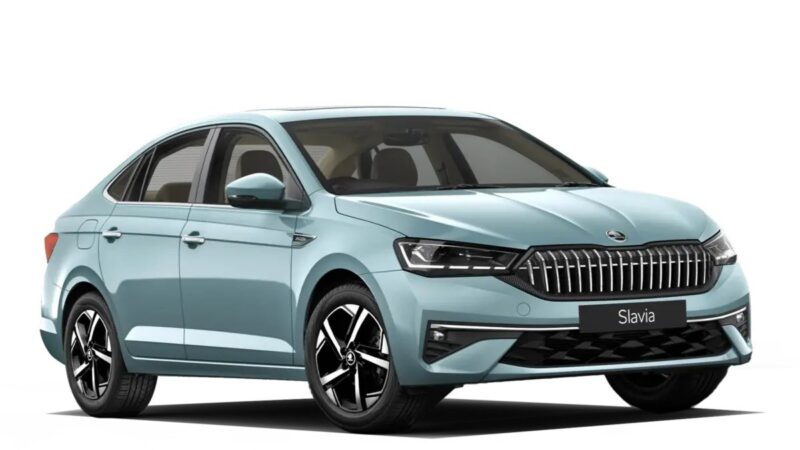
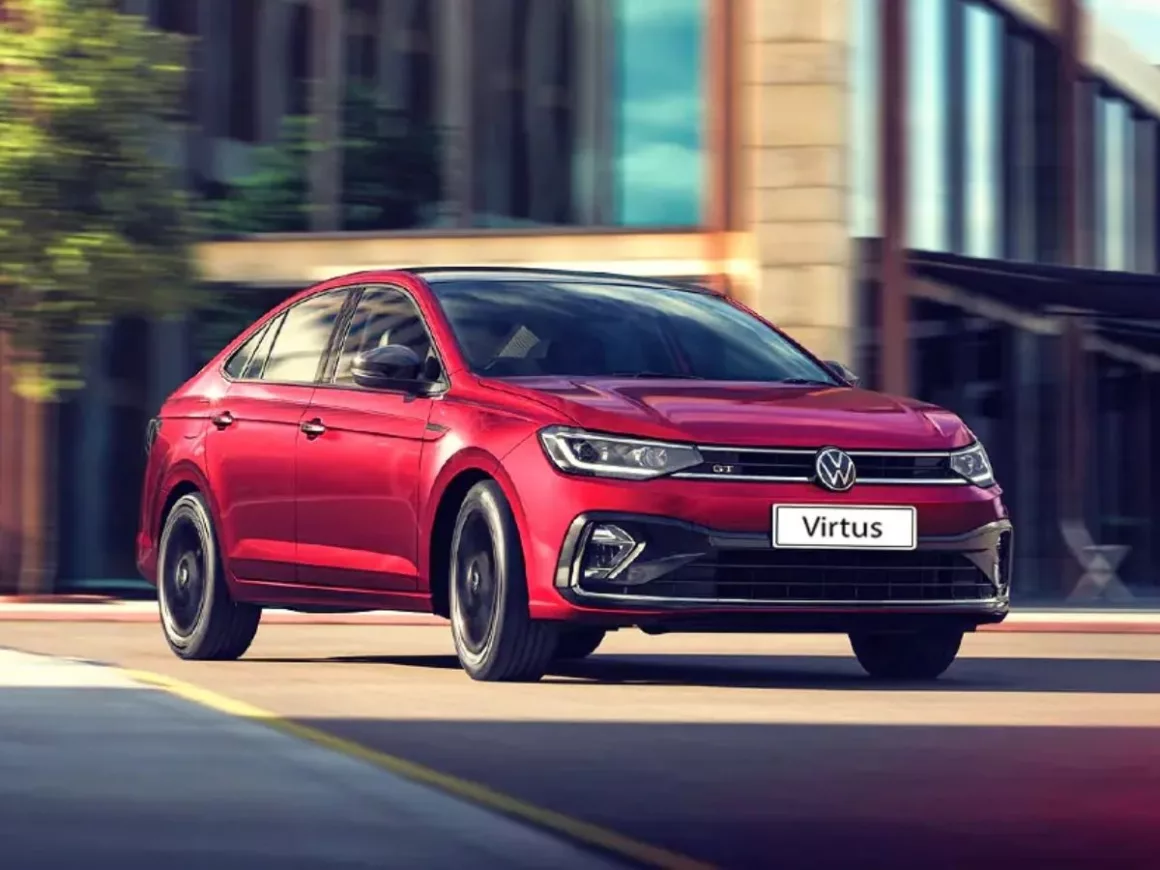
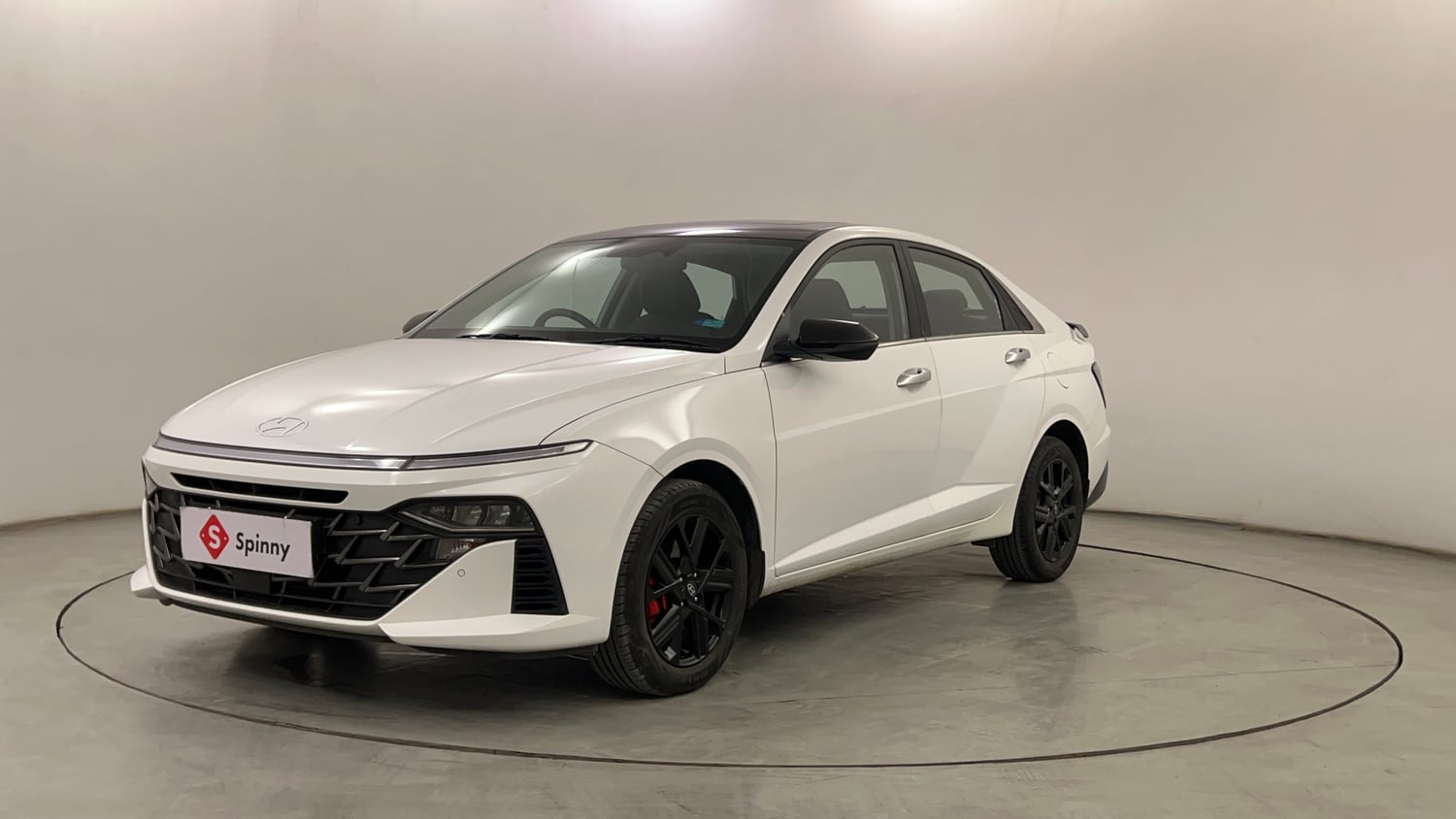
Hyundai Verna and Volkswagen Virtus are among the leading midsize sedans in India, and they’re great choices for buyers looking for a blend of performance, comfort, premium features, and solid highway manners. The Hyundai Verna is popular for its feature-rich cabin, smooth petrol engines, and powerful 1.5-litre turbo petrol engine. At the same time, the Volkswagen Virtus is known for its great handling, European feel, spacious cabin, and efficient TSI petrol engines. These two sedans are petrol-only and are offered with manual and automatic transmission options, while the Virtus 1.5 TSI is currently available only with the 7-speed DSG transmission.
Mileage matters in this segment because these sedans are often used for a mix of office commutes, city driving, and long highway runs. On paper, the Virtus 1.0 TSI manual has an advantage over the regular Verna 1.5 MPi manual, while the Verna Turbo DCT claims slightly better efficiency than the Virtus 1.5 TSI DSG. However, claimed mileage and real-world mileage can differ considerably depending on traffic, gearbox, driving style, speed, and road conditions. In this comparison, we look at the mileage of the Hyundai Verna and Volkswagen Virtus across their main powertrains and also calculate how these figures affect monthly and long-term fuel costs.
Table of Contents
Hyundai Verna vs Volkswagen Virtus Specs
The table below highlights the main specifications of the Hyundai Verna and Volkswagen Virtus:
| Specification | Hyundai Verna | Volkswagen Virtus |
| Engine options | 1.5-litre MPi petrol; 1.5-litre Turbo GDi petrol | 1.0-litre TSI petrol; 1.5-litre TSI EVO petrol |
| Displacement | 1497 cc / 1482 cc | 999 cc / 1498 cc |
| Power | 115 PS / 160 PS | 115 PS / 150 PS |
| Torque | 143.8 Nm / 253 Nm | 178 Nm / 250 Nm |
| Transmission | 6-speed MT, IVT, 7-speed DCT | 6-speed MT, 6-speed AT, 7-speed DSG |
| Drive layout | Front Wheel Drive (FWD) | Front Wheel Drive (FWD) |
| Fuel tank capacity | 45 litres | 45 litres |
| Length | 4565 mm | 4561 mm |
| Wheelbase | 2670 mm | 2651 mm |
The Hyundai Verna car comes with a 1.5-litre naturally aspirated petrol engine, while the entry-level variant of the Virtus has a smaller 1.0-litre turbocharged TSI engine. Even though both engines boast a power output of 115 hp, the Virtus produces more torque of 178 Nm, making it feel more powerful in the mid-range. On the other hand, the Verna engine delivers power progressively.
The performance versions are closely matched. The Verna 1.5 Turbo produces 160 PS and 253 Nm, while the Virtus 1.5 TSI produces 150 PS and 250 Nm. Both use 7-speed dual-clutch automatic gearboxes and have 45-litre fuel tanks, so differences in tank range largely come down to efficiency.
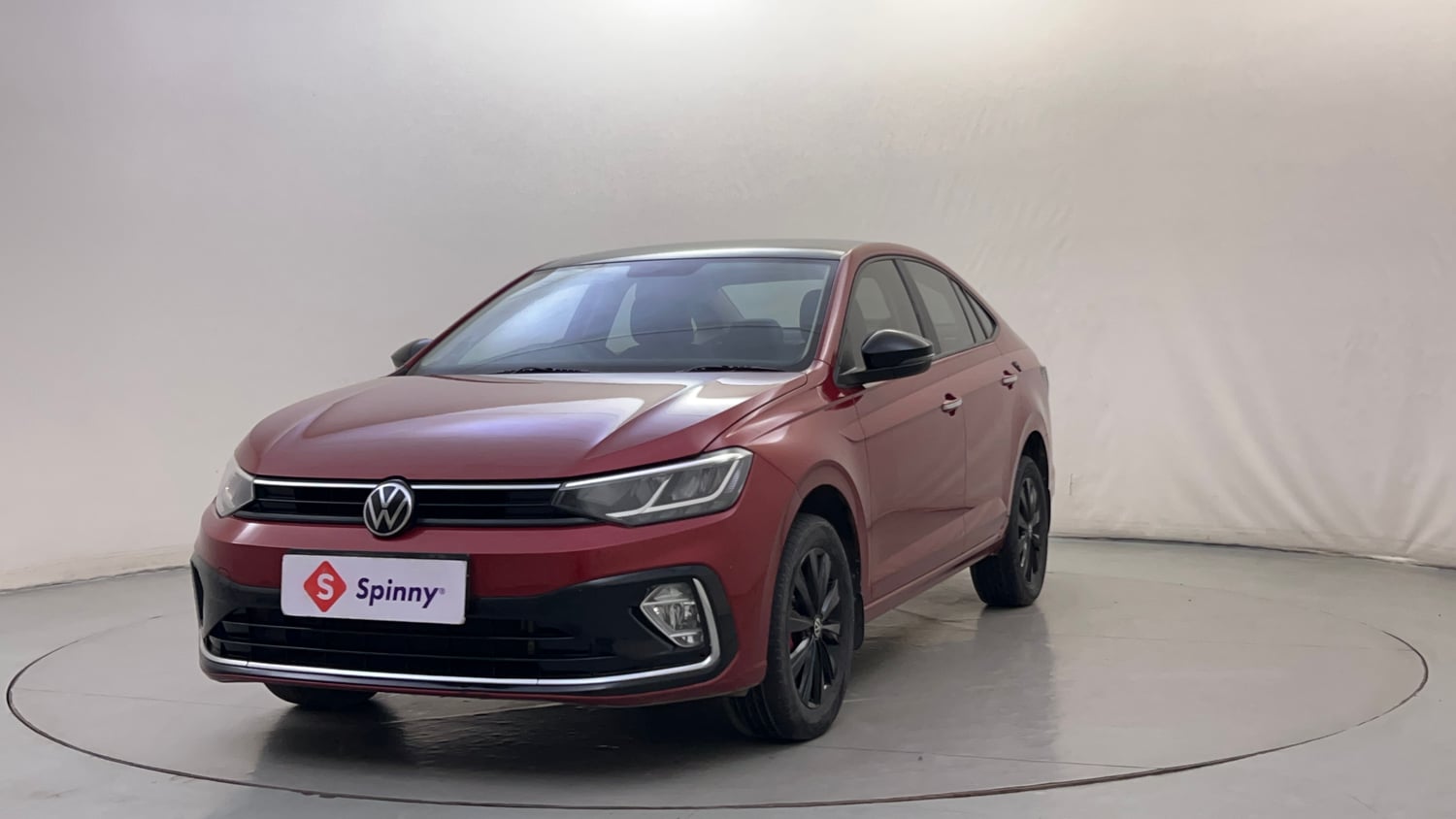
Hyundai Verna vs Volkswagen Virtus: ARAI Mileage Figures
While both models claim good fuel economy figures, the advantage changes with engine and transmission combinations.
| Engine & Transmission | Hyundai Verna – Claimed Mileage | Volkswagen Virtus – Claimed Mileage |
| 1.5 MPi MT / 1.0 TSI MT | 18.6 km/l | 20.19 km/l |
| 1.5 MPi IVT / 1.0 TSI AT | 19.6 km/l | 18.70 km/l |
| 1.5 Turbo MT | 20.0 km/l | – |
| 1.5 Turbo DCT / 1.5 TSI DSG | 20.6 km/l | 19.62 km/l |
The manual Virtus 1.0 TSI has the best fuel economy claim and is rated at 20.19 km/l, giving it a good lead over the Verna 1.5 MPI manual variant. When you compare the automatic variants, the story changes. The Verna 1.5 MPI IVT is rated at 19.6 km/l, whereas the automatic Virtus 1.0 TSI claims 18.70 km/l, which makes the Verna better.
The Verna Turbo also performs strongly on paper. Its 1.5-litre Turbo GDi manual claims 20 km/l, while the DCT version goes up to 20.6 km/l. The Virtus 1.5 TSI DSG is rated at 19.62 km/l. So, while both cars post competitive claimed numbers, the Verna has an advantage in the automatic variants, whereas the Virtus 1.0 TSI manual leads among the lower-powered manual cars.
Hyundai Verna vs Volkswagen Virtus: Real World Fuel-Efficiency
The difference in real-world fuel economy between the two cars means more for users. Many factors, including traffic conditions, throttle application, air conditioning use, route length, and cruising speed, can influence mileage numbers.
For the regular engines, real-world tests and owner reports usually place the Verna 1.5 MPi in the low-to-mid teens in city driving and considerably higher on open highways. The Virtus 1.0 TSI shows a similar pattern, although its turbocharged engine can be more sensitive to aggressive throttle inputs in stop-go traffic.
| Driving Condition | Hyundai Verna 1.5 MPi | Volkswagen Virtus 1.0 TSI |
| City | Around 11-14 km/l | Around 9-12 km/l |
| Highway | Around 16-18 km/l | Around 14-20 km/l |
| Typical combined range | Around 13-15 km/l | Around 12-16 km/l |
| Tank capacity | 45 litres | 45 litres |
The Verna 1.5 MPi offers predictability, as its naturally aspirated engine delivers a progressive supply of power. The Virtus 1.0 TSI is efficient, especially on the highway at constant speeds, where less pressure is put on its turbocharged petrol engine. However, speeds and acceleration can greatly affect fuel consumption in heavy traffic.
A direct real-world comparison of the performance automatic variants gives an even clearer picture:
| Driving Condition | Hyundai Verna 1.5 Turbo DCT | Volkswagen Virtus 1.5 TSI DSG |
| City | 10.7 km/l | 9.3 km/l |
| Highway | 16.0 km/l | 15.6 km/l |
| Average | 13.35 km/l | 12.45 km/l |
| Approx. tank range | 601 km | 560 km |
In the test, the Verna Turbo DCT delivered better mileage in both city and highway tests, registering 10.7 km/l in the city against the Virtus’ 9.3 km/l. On the highway, both cars gave similar figures, with the Verna registering 16 km/l against the Virtus’ 15.6 km/l.
The Virtus 1.5 TSI uses Active Cylinder Technology, which can shut down two cylinders under light loads to save fuel. Even then, the Verna returned a slightly better overall economy in this test. Therefore, among these performance automatics, the Verna Turbo DCT has a measurable real-world mileage advantage.
Also Read: How to Increase Hyundai Verna Mileage
Hyundai Verna vs Volkswagen Virtus: Fuel Cost Comparison
We can compare the fuel expenses of the given models, assuming monthly running of around 1500 km. For estimation, we will use a petrol price of around ₹112.40 per litre in Pune. Since reliable mileage figures are available for the Verna Turbo DCT and the Virtus 1.5 TSI DSG, the following table presents their mileage.
| Cost Parameter | Verna Turbo DCT | Virtus 1.5 TSI DSG |
| Monthly running | 1500 km | 1500 km |
| Average real-world mileage | 13.35 km/l | 12.45 km/l |
| Monthly fuel use | 112.36 litres | 120.48 litres |
| Average monthly fuel cost | ₹12,629 | ₹13,542 |
| Average yearly fuel cost | ₹1.52 lakh | ₹1.63 lakh |
| 5-year fuel cost | ₹7.58 lakh | ₹8.13 lakh |
At this mileage, the Verna Turbo DCT consumes about 8 litres of petrol monthly, which amounts to savings of about ₹900 per month, or nearly ₹11000 per year. Over five years, that difference can reach over ₹50000 if fuel prices and driving conditions stay roughly the same.
These calculations are estimates. Highway-heavy use can improve the mileage of either car, while congested city driving and frequent hard acceleration can raise fuel expenses.
Also Read: Volkswagen Virtus Mileage Comparison: 1.0L TSI vs 1.5L TSI
Hyundai Verna vs Volkswagen Virtus Price
| Model | Variant Range | Approx. Ex-Showroom Price |
| Hyundai Verna | HX2 to HX10 | ₹10.99 lakh to ₹18.41 lakh |
| Volkswagen Virtus | Comfortline to GT Plus / special editions | ₹10.71 lakh to ₹19.20 lakh |
Both cars cost almost the same, so we can use mileage to differentiate between models with similar automatic and performance versions. The Virtus price is slightly lower than the Verna’s, although its upper versions and limited editions can cost more than the Verna’s top-end version. However, the final price will depend on the version, city, registration costs, and dealer discounts.
Summary
The Hyundai Verna and Volkswagen Virtus are both efficient by midsize sedan standards, but their mileage advantages depend on the powertrain. The Virtus 1.0 TSI manual has a better claimed figure than the Verna 1.5 MPi manual and can return impressive highway mileage when driven steadily. The Verna 1.5 MPi, however, offers predictable efficiency and its IVT version has a stronger claimed figure than the Virtus 1.0 automatic.
Of all the performance models, the Verna Turbo DCT scored best in the actual test conducted for comparison. The report showed that the Verna delivered 10.7 km/l in the city and 16 km/l on the highway, compared with the Virtus 1.5 TSI DSG, which scored 9.3 km/l in the city and 15.6 km/l on the highway. Therefore, Verna is preferred for mileage among the automatic variants and the Virtus 1.0 TSI manual; however, it remains a viable option for those who do more highway riding.
Related Reads:
Hyundai Creta vs Kia Seltos Real World Mileage Comparison
Hyundai Venue vs Kia Sonet Real World Mileage Comparison
Honda City vs Volkswagen Virtus Real World Mileage Comparison
FAQs About Hyundai Verna vs Volkswagen Virtus Mileage
Q. Hyundai Verna vs Volkswagen Virtus: Which car gives better real-world mileage?
The answer depends on the variant. The Virtus 1.0 TSI manual can be very efficient on highways, while the Verna 1.5 MPi delivers competitive city and mixed-use economy. In the direct comparison of the performance automatics, the Verna Turbo DCT returned better real-world mileage than the Virtus 1.5 TSI DSG.
Q. What is the claimed mileage of the Hyundai Verna?
The Verna 1.5 MPi manual claims around 18.6 km/l, while the IVT claims 19.6 km/l. The 1.5 Turbo manual is rated at 20 km/l and the Turbo DCT at up to 20.6 km/l.
Q. What is the claimed mileage of the Volkswagen Virtus?
The Virtus 1.0 TSI manual is rated at around 20.19 km/l, while the 1.0 TSI automatic is rated at around 18.70 km/l. The current 1.5 TSI DSG claims around 19.62 km/l.
Q. Which car gives better highway mileage, Verna or Virtus?
The Virtus 1.0 TSI manual is particularly efficient on highways and can deliver strong figures at steady speeds. However, in the direct test of the performance versions, the Verna Turbo DCT returned 16 km/l compared to 15.6 km/l for the Virtus 1.5 TSI DSG.
Q. Which is more fuel-efficient, Verna Turbo DCT or Virtus 1.5 TSI DSG?
In a direct real-world mileage comparison, the Verna Turbo DCT averaged 13.35 km/l, whereas the Virtus 1.5 TSI DSG averaged 12.45 km/l. This gives the Verna a slight but useful advantage in overall fuel efficiency.