
The way Hyundai Bayon and Jeep Compass look at SUV ownership is fairly different. The Bayon brings with it a petrol engine for those on a tighter budget while offering its more expensive variants with ample tech. The Compass, on the other hand, makes customers pay more for an efficient diesel engine and also for four-wheel drive, optional on some variants.
Their prices overlap in one interesting place. Around ₹18 lakh ex-showroom, you can choose between a flagship Bayon automatic and an entry-level Compass manual. That makes this a decision about what you value, rather than a straightforward upgrade from one SUV to another.
Here’s how the current Indian models perform with respect to pricing, performance, practicality, and ownership.
Table of Contents
Hyundai Bayon vs Jeep Compass: Quick Comparison
| Detail | Hyundai Bayon | Jeep Compass |
| Starting ex-showroom price | ₹9,99,900 | ₹17,99,000 |
| Engine | 1.5-litre naturally aspirated petrol | 2.0-liter turbo-diesel |
| Quoted power | 115PS | 170hp |
| Torque | 143.8Nm | 350Nm |
| Manual gearbox | 6-speed | 6-speed |
| Automatic gearbox | iVT | 9-speed automatic |
| Drive layout | Front-wheel drive | Front-wheel drive or four-wheel drive |
| Seating capacity | Five | Five |
| Main attraction | Lower cost and extensive cabin technology | Diesel pulling power and available 4×4 capability |
Information checked in November 2026. Power units follow the respective manufacturers’ published specifications. Features and drivetrain availability depend on the variant.
Hyundai Bayon vs Jeep Compass: Price Comparison
The gap in terms of starting price is nearly ₹8 lakh. This means that the two SUVs effectively belong to completely different price categories, even if the higher and lower versions of some of these models are somewhat similar.
| Model and variant | Ex-showroom price |
| Hyundai Bayon HX2 manual | ₹9,99,900 |
| Hyundai Bayon HX5 manual | ₹12,44,900 |
| Hyundai Bayon HX5 iVT | ₹13,84,800 |
| Hyundai Bayon HX6 iVT | ₹14,96,800 |
| Hyundai Bayon HX10 iVT | ₹17,99,900 |
| Jeep Compass Sport manual | ₹17,99,000 |
| Jeep Compass Sport 9-speed automatic | ₹21,99,000 |
Bayon prices shown are for single-tone versions. Prices exclude registration, insurance, and optional equipment.
There’s not much to choose between the Bayon HX10 iVT model and the Compass Sport in the price department because they’re separated by a thin margin of just Rs 900. Even so, the Hyundai model comes with an automatic gearbox and premium features,s while the Jeep gets you the diesel engine in its base version.
Automatic buyers face a wider gap. The Compass Sport automatic, introduced in October 2026, costs ₹3,99,100 more than the Bayon HX10 iVT. Compared with the entry Bayon automatic, the difference reaches ₹8,14,200.
Thus, the Compass should justify its greater price by providing features over and above a longer list of equipment. If you need only an auto gearbox, a sunroof and a modern cabin, then the Bayon should be your first choice.
Dimensions, Cabin Space and Practicality
| Dimension | Hyundai Bayon | Jeep Compass |
| Length | 4,245mm | 4,405mm |
| Width | 1,810mm | 1,818mm |
| Height | 1,605mm, with roof rails | 1,640mm |
| Wheelbase | 2,600mm | 2,636mm |
| Fuel-tank capacity | 43 litres | 60 litres |
The Jeep Compass measures longer than the Rock Creek edition by 160mm, but only wider by 8mm. Its wheelbase has an increase of 36mm. The differences are not enough to make us think that, due to these figures, the Jeep will be spacious even for three adults in the rear.
Check both with the front seat adjusted for your usual driver. Rear-seat cushioning, foot space, door openings and the ease of getting in and out are more useful than the exterior measurements alone.
Hyundai claims that the Bayon has a boot capacity of 505 litres, which includes a tyre mobility kit. Before considering this data, make sure to check how the tyre is positioned in the car. It is better to take your suitcases with you to the car showroom if you are interested in a spacious cabin.
The Compass’s larger fuel tank is useful for longer journeys, although actual distance between stops depends on consumption. The Bayon’s shorter body is easier to accommodate where parking-space length is limited.
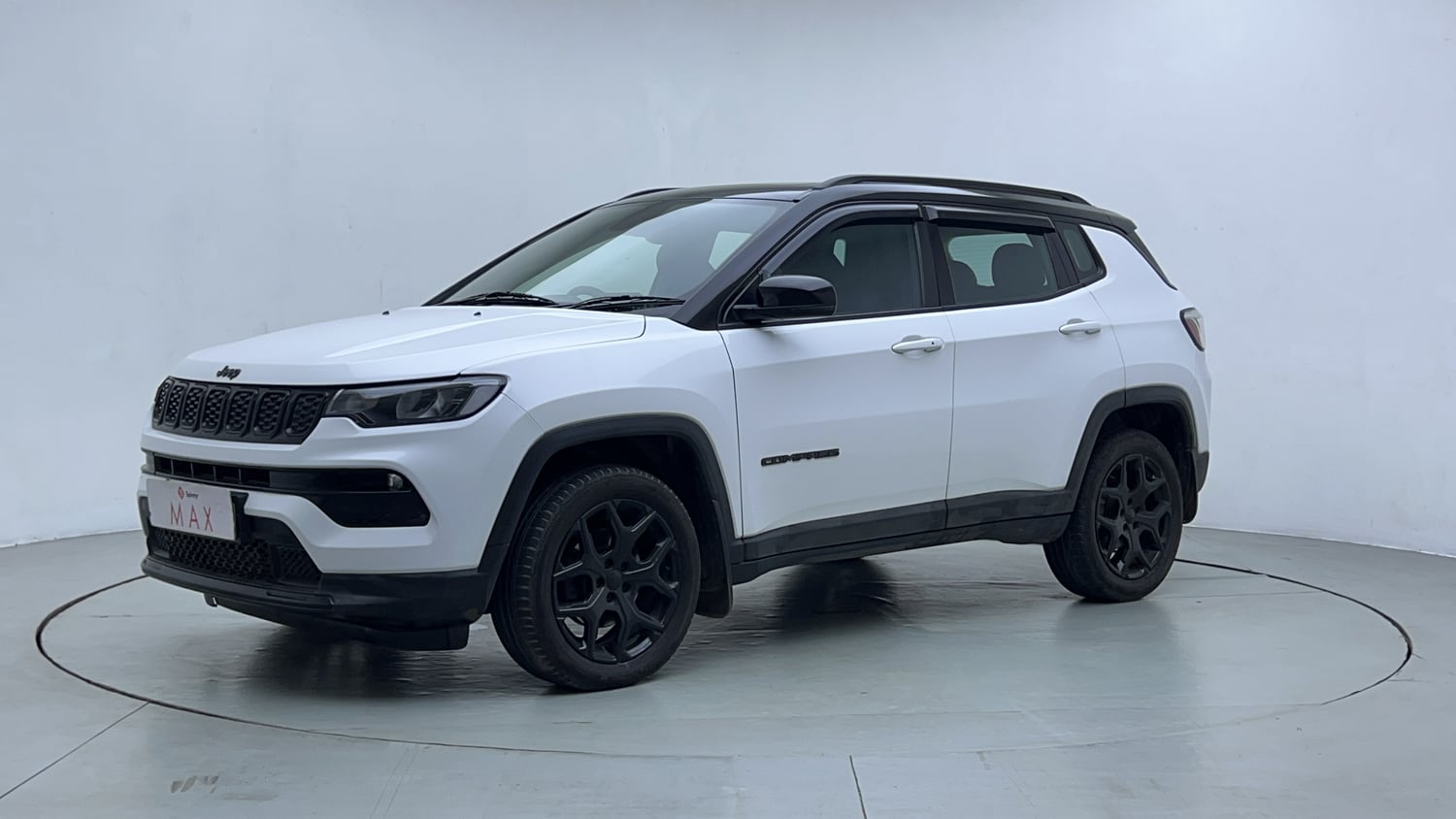
Engines and Performance: A Clear Difference in Priorities
The petrol engine on the Bayon has a capacity of 1.5 litres and is able to deliver a power of 115PS and a torque of 143.8 Nm, while, on the other hand, the Compass has a diesel engine with a capacity of 2.0 litres that produces power of 170hp and torque of 350 Nm, which is more than double what the Hyundai produces.
That difference matters if you regularly travel with passengers and luggage or drive on routes with frequent climbs. The Compass reaches its peak torque between 1,750rpm and 2,500rpm, giving it a clear specification advantage for pulling power.
The Bayon provides an uncomplicated option: it features the same petrol engine, but with either a manual or iVT automatic gearbox. This option caters to buyers who prefer a petrol vehicle without the high cost of diesel or four-wheel drive capability.
However, higher output does not tell you everything about everyday driving. Test accelerator response, visibility and low-speed control in both cars. The Compass’s stronger engine is a reason to shortlist it, but it should not outweigh how comfortably you manage the car on your usual roads.
Automatic Gearboxes and Four-Wheel Drive
The Bayon features an infinitely variable transmission, whereas the Compass has a nine-speed automatic system that is based on fixed ratio settings. Both types of transmissions mean that there is no need for clutch work when driving, but the way that they react when accelerating will not be the same.
Try a slow parking manoeuvre, crawling traffic and an open-road overtake during the test drive. The number of gears alone does not establish which automatic will suit you better. At the prices here, choosing the Jeep automatic also involves a substantial increase in spending.
The choice of four-wheel-drive is separate and distinct. Certain models of the Compass have Jeep’s Active Drive system and Selec-Terrain functions as an available option. The Bayon does not offer anything in terms of a four-wheel-drive option, and thus the Compass is undoubtedly the choice here if dealing with rough or slippery surfaces is an essential factor.
Check the exact variant before booking. The entry Compass Sport, including the new automatic, is front-wheel drive. Buying a Jeep badge does not mean you are buying a 4×4.
Ride and Everyday Driving
The Compass features independent rear suspension systems with frequency-selective damping. On the other side, the Bayon boasts a coupled torsion beam rear scheme. This is a substantial mechanical difference, with the disclaimer meaning that suspension data alone does not tell you which model will let you experience preferable rides.
For a useful comparison, drive both over the same broken stretch of road and a few speed breakers. Include a rear-seat passenger, since a car that feels comfortable from the driver’s seat may produce a different impression from the back.
The Compass is worth paying attention to in case one puts the focus on its suspension equipment and diesel efficiency. The Bayon, on the contrary, is worthy of consideration if you take routine journeys and try to save costs. Neither conclusion means that it is required to believe that all consumers are supposed to buy the more expensive automobile.
Features: Does Paying More Get You More?
Both ranges offer premium equipment, but the price at which you get it differs considerably.
| Feature | Hyundai Bayon | Jeep Compass |
| Largest infotainment touchscreen | 12.3-inch | 10.1-inch |
| Panoramic sunroof | Available | Available |
| Ventilated front seats | Available | Available |
| Powered driver’s seat | Available | Available |
| Wireless phone charging | Available | Available |
| Surround-view camera | Available | Available |
| Dual-zone automatic climate control | Not listed | Available |
| Powered tailgate | Not listed | Available |
These features are available on selected variants and are not standard throughout either range.
The two displays measuring 12.3 inches each and Bose audio system make the Bayon HX10 a good car in terms of technology offerings, and as the Bayon price is close to the starting price of the Compass as well, it makes the comparison of technology features crucial.
The Compass offers useful conveniences such as dual-zone climate control and a powered tailgate on selected trims. However, those should not be assumed to come with the entry Sport simply because it costs around the same as a flagship Bayon.
With a maximum budget close to ₹18 lakh, the Bayon should be said to be a more value-for-money option for those who pay more attention to the cabin hardware than to the engine and the car’s mechanical parts, while of course, the Compass makes more sense if you need its specific engine and mechanical solutions.
Safety and Driver Assistance
The Bayon provides six airbags, electronic stability control, hill-start assistance and tire-pressure monitoring as standard. Its HX10 adds Hyundai’s Level 2 Pro driver-assistance package.
The new Compass Sport with an automatic transmission comes with 6 airbags in addition to features like Auto Hold and cruise control. The equipment differs across different versions of the Compass, so please check the specification sheet of the exact car you want to buy.
There is an important distinction around Jeep’s optional Sport accessory pack. Its dashcam offers predictive safety features, but it should not be treated as equivalent to an integrated Level 2 system that can assist with vehicle control.
Likewise, Hyundai’s claim that the Bayon conforms to five-star Indian safety standards is not a crash test result in the public domain. When comparing the information, make sure to differentiate the actual equipment from the safety performance which is claimed.
Running Costs, Warranty and Resale
A diesel engine does not automatically make the more expensive Compass cheaper to own. Any fuel saving needs to be considered alongside the purchase-price difference, insurance, maintenance and replacement parts.
To work out the fuel cost per kilometre, check local prices and actual consumption for your route, and then multiply the difference by your yearly mileage. That way, you will know whether the savings in fuel have a large enough impact on the purchase decision and avoid unnecessary influence by diesel’s image.
The Bayon has a three-year, unlimited-kilometre standard warranty. Jeep’s published basic limited warranty covers three years or 1,00,000km, whichever comes first, with separate limits for certain components.
Another unique offer from Jeep is the Confidence 7 ownership package, which has extended warranty periods and various other perks. Since the package is an agreement with various terms and conditions, check everything regarding costs, coverage, and terms instead of assuming the package comes with default seven years of warranty coverage.
For resale, avoid fixed predictions. The India-spec Bayon is new, while the Compass’s future value will depend on condition, mileage, variant, and demand. For either car, check nearby authorised workshop access before buying.
Hyundai Bayon vs Jeep Compass: Which Should You Buy?
For buyers who are concerned primarily with purchase price, ease of use in terms of their car’s powertrain setup, and the amount of equipment in the cabin, the Bayon is the better choice. Its better pricing applies almost throughout its range and enables you to purchase an automatic at the same price as a basic manual Compass.
The Compass is worth considering when you specifically want its stronger diesel engine, suspension package, or available four-wheel drive. Those are meaningful differences, but they come with a higher bill.
For around ₹18 lakh, our top recommendation will be the Bayon HX10 iVT for a customer who doesn’t need a diesel car. If driving dynamics are more relevant to you than the additional features of the Hyundai, then go with the Compass Sport manual after a test drive.
You can also explore used SUVs on Spinny. A used Compass may fit a different budget, but compare its age, service history, drivetrain, and ownership costs alongside the asking price.
Related Reads:
Complete Buying Guide: Hyundai Bayon
Hyundai Bayon vs Creta: Which Hyundai SUV Offers More Value?
Hyundai Bayon Alternatives: Competitors of Hyundai
FAQs About Hyundai Bayon vs Jeep Compass
Q. Which is cheaper, the Bayon or Compass?
The Bayon starts at ₹9,99,900 ex-showroom, while the Compass starts at ₹17,99,000. Their entry prices differ by almost ₹8 lakh, before on-road costs.
Q. Does the Jeep Compass offer a petrol engine?
The current Indian Compass range is diesel-only. Petrol examples may be available in the used market, but they should not be confused with the current new-car range.
Q. Is the Hyundai Bayon available with four-wheel drive?
No. The India-spec Bayon is front-wheel drive. Selected Compass variants offer four-wheel drive, but the entry Sport versions do not.
Q. Which SUV has more pulling power?
The Compass develops 350Nm, compared with the Bayon’s 143.8Nm. That gives the Jeep a substantial torque advantage for loaded journeys and climbs.
Q. What is the cheapest Compass automatic?
The Sport front-wheel-drive automatic, launched in October 2026, is priced at ₹21.99 lakh ex-showroom. It combines the 2.0-litre diesel engine with a nine-speed automatic gearbox.
Q. Do both SUVs offer panoramic sunroofs?
Yes, on selected variants. The Bayon offers a panoramic sunroof from HX6. Check the exact Compass variant, as the feature is not standard across its range.
Q. Does the Compass come with a seven-year standard warranty?
No, Its basic limited warranty is three years or 1,00,000km, subject to terms. Longer coverage is available through eligible extended-warranty and ownership packages.
Q. Which offers better value around ₹18 lakh?
The Bayon HX10 iVT offers an automatic gearbox and flagship equipment. The similarly priced Compass Sport manual offers the stronger diesel engine. Choose according to which benefit you will use more.