
Hyundai Alcazar and Tata Safari are three-row SUVs designed for Indian families, but they differ significantly in size, weight, and engine type. The Alcazar, being a lighter and smaller SUV, offers a 1.5-litre turbo-petrol engine and a 1.5-litre diesel engine. In contrast, the Safari is bigger and heavier and offers Tata’s 1.5-litre Hyperion turbo-petrol engine along with its 2.0-litre Kryotec diesel engine. The SUVs are offered with manual and automatic options, along with six-seat and seven-seat layouts on some variants.
These differences directly affect fuel consumption. The Alcazar’s lower weight and smaller diesel engine help it deliver better mileage, especially in city driving. The Safari counters with greater diesel torque, a roomier cabin and stronger highway performance, but it generally requires more fuel. This comparison examines their specifications, claimed efficiency, practical city and highway mileage, tank range and periodic fuel costs to determine which SUV is more economical in everyday use.
Table of Contents
Hyundai Alcazar vs Tata Safari Specs
The table below analyses the most significant mechanical specs when looking at the mileage capability of Hyundai Alcazar and Tata Safari.
| Specification | Hyundai Alcazar | Tata Safari |
| Petrol engine | 1.5-litre Turbo GDi | 1.5-litre Hyperion Turbo GDi |
| Diesel engine | 1.5-litre U2 CRDi | 2.0-litre Kryotec turbo-diesel |
| Displacement | Petrol: 1,482 cc; Diesel: 1,493 cc | Petrol: 1,498 cc; Diesel: 1,956 cc |
| Power | Petrol: 160 PS; Diesel: 116 PS | Petrol: 170 PS; Diesel: 170 PS |
| Torque | Petrol: 253 Nm; Diesel: 250 Nm | Petrol: 280 Nm; Diesel: 350 Nm |
| Transmission | Petrol: 6-speed MT/7-speed DCT; Diesel: 6-speed MT/6-speed AT | Petrol and diesel: 6-speed MT/6-speed torque-converter AT |
| Drive layout | Front-wheel drive | Front-wheel drive |
| Kerb weight | Approximately 1,435–1,500 kg | Approximately 1,825 kg |
| Fuel tank capacity | 50 litres | 50 litres |
In terms of diesel power, the Safari performs better thanks to its 2.0-litre engine, which offers 170 PS and 350 Nm, compared to the Alcazar diesel with 116 PS and 250 Nm. The extra power may come in handy under full-load conditions and on uphill drives because the heavier engine must propel about 300 kg extra in body weight. As a result, the Alcazar requires less energy to perform acceleration and, in many cases, uses less diesel during start-stop operation.
The petrol comparison is closer. The Safari makes 10 PS and 27 Nm more than the Alcazar, while both use direct injection and turbocharging. However, the Alcazar remains lighter and uses a quick-shifting DCT, whereas the Safari automatic uses a conventional torque converter. Both cars have 50-litre tanks, so the SUV returning the higher real-world average will also travel farther between fuel stops. Passenger load matters here because carrying six occupants and luggage can reduce the mileage of either vehicle.

Hyundai Alcazar vs Tata Safari: ARAI Mileage Figures
Different certification results have become available for the Alcazar through the years. The results for the Safari diesel have always been available; however, the ratings for the recently launched Safari petrol may differ. This means the petrol figures should be estimated rather than treated as definite unless proven otherwise.
| Engine and Transmission | Fuel Type | Hyundai Alcazar Mileage | Tata Safari Mileage |
| Petrol manual | Petrol | 17.5 km/l | Approximately 16–16.8 km/l |
| Petrol automatic | Petrol | 18.0 km/l | Approximately 15–16 km/l |
| Diesel manual | Diesel | 20.4 km/l | 16.3 km/l |
| Diesel automatic | Diesel | 18.1 km/l | 14.1 km/l |
The Alcazar seems to win every direct comparison on paper. The highest number from the diesel manual version is 20.4 km/l, whereas the Safari diesel manual falls behind with slightly more than 4 km/l.
The same trend can be observed with diesels that have automatic transmission, and, interestingly, the Alcazar petrol DCT has a slightly higher rating than the manual because its seven-speed gearbox can select ratios more efficiently.
Claimed figures should only be used as a common benchmark. Certification does not recreate crawling traffic, short journeys, steep gradients, full passenger loads or continuous air-conditioning use. Turbo-petrol engines can also show a particularly large difference between gentle test-cycle driving and aggressive real-world acceleration. Practical figures offer a better indication of what an owner will spend.
Hyundai Alcazar vs Tata Safari: Real World Fuel-Efficiency
Real-world mileage differs based on driving habits, routes travelled, and seasons. The figures provided here are based on road tests and common user experience, considering the use of the air conditioner in the vehicles.
| Driving Condition | Alcazar Petrol MT | Alcazar Petrol DCT | Safari Petrol MT/AT |
| City | 10–12 km/l | 9–11 km/l | 9–11 km/l |
| Highway | 14–16 km/l | 13.5–15 km/l | 13–16 km/l |
| Mixed average | 12–13 km/l | 11–12.5 km/l | 11–13 km/l |
| Approximate tank range | 600–650 km | 550–625 km | 550–650 km |
| Driving Condition | Alcazar Diesel MT | Alcazar Diesel AT | Safari Diesel MT | Safari Diesel AT |
| City | 14–16.5 km/l | 12.5–14 km/l | 11–13 km/l | 10–12 km/l |
| Highway | 18–20 km/l | 16–18 km/l | 15–17 km/l | 13.5–15 km/l |
| Mixed average | 16–18 km/l | 14–16 km/l | 13–15 km/l | 12–13.5 km/l |
| Approximate tank range | 800–900 km | 700–800 km | 650–750 km | 600–675 km |
When compared to the petrol version, the two SUVs perform equally poorly in congested situations. The Alcazar is known to get 9 to 11 km/l in the city, while a road test showed about 10.4 km/l. The Safari also shows similar, if not higher, figures due to its higher weight. However, at highway speeds both cars do much better and can show numbers up to 14-16 km/l as far as the Alcazar is concerned, while the Safari can reach a similar number of 15-16 km/l occasionally.
The diesel comparison produces a clearer winner. The Alcazar diesel manual can deliver 18–20 km/l on relaxed highway runs, whereas the Safari diesel manual generally returns 15–17 km/l. Automatic versions use more fuel in traffic, but the Alcazar AT still maintains an advantage. A tested Safari diesel automatic returned about 11 km/l in the city and 14 km/l on the highway, for a mixed average of around 12.4 km/l. The Alcazar diesel automatic has recorded roughly 12.5 km/l in the city and 16.3 km/l on the highway under comparable test conditions.
Also Read: What are the Best Gearing Practices For More Mileage
Hyundai Alcazar vs Tata Safari: Fuel Cost Comparison
The calculation below assumes monthly running of 1,500 km. Petrol has been priced at ₹112.04 per litre and diesel at ₹98.68 per litre in Pune. We used mixed real-world averages, rather than manufacturer claims.
| Powertrain | Mileage Used | Monthly Fuel Use | Monthly Cost | Yearly Cost | Five-Year Cost |
| Alcazar petrol DCT | 11.75 km/l | 127.66 litres | ₹14,303 | ₹1.72 lakh | ₹8.58 lakh |
| Safari petrol AT | 11 km/l | 136.36 litres | ₹15,278 | ₹1.83 lakh | ₹9.17 lakh |
| Alcazar diesel MT | 17 km/l | 88.24 litres | ₹8,707 | ₹1.04 lakh | ₹5.22 lakh |
| Alcazar diesel AT | 14.5 km/l | 103.45 litres | ₹10,208 | ₹1.22 lakh | ₹6.12 lakh |
| Safari diesel MT | 14 km/l | 107.14 litres | ₹10,573 | ₹1.27 lakh | ₹6.34 lakh |
| Safari diesel AT | 12.5 km/l | 120 litres | ₹11,842 | ₹1.42 lakh | ₹7.10 lakh |
Based on these numbers, the Alcazar petrol DCT costs around ₹1000 less per month than the Safari petrol automatic. The difference becomes more evident for the diesel versions, as the Alcazar diesel manual saves ₹1,866 per month on average. Over five years, it can reach more than ₹1.1 lakh if fuel prices and mileage don’t change.
The Alcazar diesel manual is the most economical option in the table, while the Safari petrol automatic is the costliest. However, choosing an engine only through fuel bills can be misleading. Diesel variants usually cost more upfront, and buyers must also consider service requirements, usage patterns and restrictions applicable in their city. High-mileage highway users benefit most from diesel, whereas low annual running may not recover the purchase premium quickly.
Also Read: Hyundai Alcazar Mileage Comparison: Petrol vs Diesel
Hyundai Alcazar vs Tata Safari Price
| Model | Variant Range | Price, Ex-showroom |
| Hyundai Alcazar | Executive to Signature/Signature Knight | ₹14.51 lakh–₹21.25 lakh |
| Tata Safari | Smart to Accomplished Ultra Stealth | ₹13.40 lakh–₹26.76 lakh |
The Safari features a lower starting cost because of its basic petrol manual version, but the higher-priced diesel and Stealth versions cost more. The Alcazar, however, is priced within a tighter range and has petrol and diesel variants available across its major trims. On-road prices will vary based on registration costs, insurance, seating configuration, colour, and any extra options chosen.
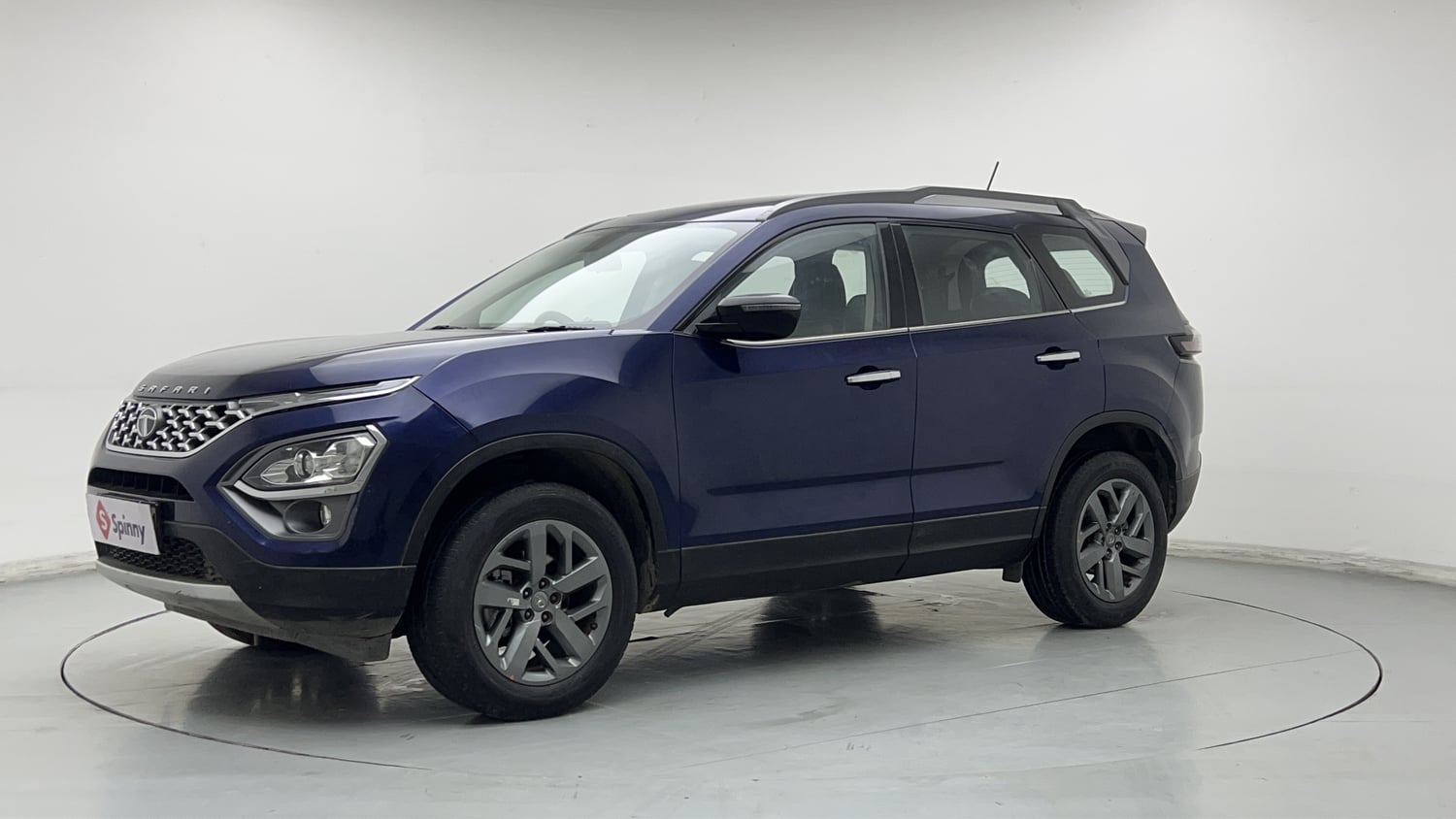
Summary
The Hyundai Alcazar is the stronger choice if mileage is the main priority. Its lower weight helps both engines in city traffic, while the diesel manual delivers the best overall real-world efficiency. The Alcazar diesel automatic also offers a useful balance between convenience and running cost. In petrol form, the contest is closer, although the Alcazar generally retains a small advantage.
The Tata Safari is less economical but offers much better diesel performance, improved cabin space, and a better overall full-size SUV driving experience. The diesel manual is better, as it is more fuel-efficient than the automatic. However, those with little yearly mileage will prefer the petrol model. Considering fuel efficiency only, the Alcazar wins, but the Safari makes sense if size and road presence matter more than fuel cost.
Related Blogs:
Skoda Kushaq vs Volkswagen Taigun: Real-World Mileage Comparison
Tata Safari vs Mahindra XUV700: Real World Mileage Comparison
Tata Harrier vs Tata Safari: Real World Mileage Comparison
FAQs About Hyundai Alcazar vs Tata Safari Mileage
Q. Which offers better real-world mileage, the Hyundai Alcazar or Tata Safari?
The Hyundai Alcazar delivers better mileage overall. Its lighter construction and smaller diesel engine help it outperform the Safari in city, highway and mixed driving, especially when comparing diesel variants.
Q. What is the real-world mileage of the Hyundai Alcazar diesel?
The manual diesel generally returns 14–16.5 km/l in the city and 18–20 km/l on highways. The automatic typically delivers 12.5–14 km/l in the city and 16–18 km/l on highways.
Q. What is the real-world mileage of the Tata Safari diesel?
The Safari diesel manual usually returns 11–13 km/l in the city and 15–17 km/l on highways. The automatic produces around 10–12 km/l in urban conditions and 13.5–15 km/l on open roads.
Q. Which petrol SUV is more fuel-efficient?
The Alcazar petrol normally has a slight real-world advantage because it is considerably lighter. Both SUVs can return around 9–11 km/l in city traffic, but the Alcazar is generally more consistent in mixed driving.
Q. Which SUV is better for high monthly running?
The Alcazar diesel manual is the most economical choice for frequent highway travel. The Safari diesel offers stronger performance and more space, but its greater weight leads to higher fuel consumption and higher running costs.