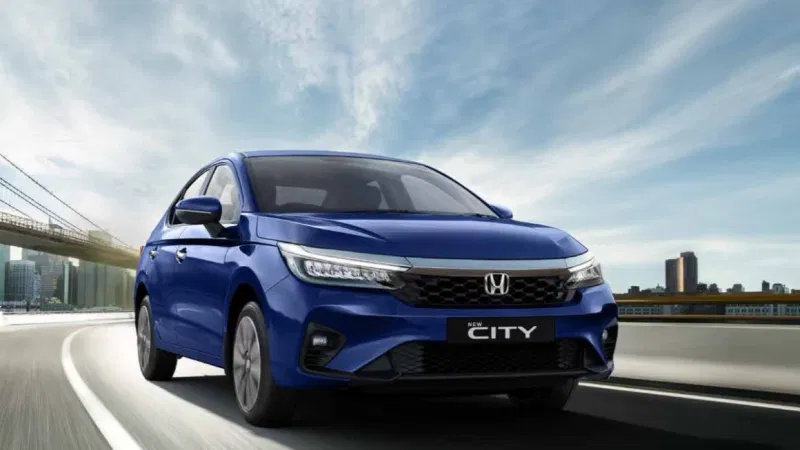
The Honda City is rated at 17.77 km/l for petrol manual transmission, 17.97km/l for petrol CVT and 27.26 km/l for Honda City e:HEV hybrid. However, real-world mileage is affected by factors such as traffic, air-conditioning, driving habits and average speed.
Instrumented testing of the fifth-generation City returned around 11.5 km/l city and 17.7 km/l highway for the manual, while the CVT delivered 12 km/l and 16.4 km/l respectively. The City e:HEV’s previous full real-world test returned around 19.8 km/l in the city and 22.5 km/l on the highway, making the hybrid comfortably the most efficient City.
Table of Contents
Honda City Mileage at a Glance
| Honda City Powertrain | Certified Mileage | Real-World City Benchmark | Real-World Highway Benchmark |
| 1.5L Petrol Manual | 17.77 km/l | 11.5 km/l | 17.7 km/l |
| 1.5L Petrol CVT | 17.97 km/l | 12.0 km/l | 16.4 km/l |
| 1.5L e:HEV Hybrid | 27.26 km/l | 19.8 km/l* | 22.5 km/l* |
*The hybrid city and highway figures originated from an instrumented test of the prior facelift that used the same e:HEV powertrain system. The total equivalent instrumented test of the May-2026 facelift is still anticipated.
Honda City Claimed vs Real-World Mileage
Certified mileage is useful for comparison, but it is not the exact figure every owner will achieve. Stop-start traffic, repeated acceleration and low average speeds pull the regular petrol City below its official figures, while steady highway cruising allows it to operate much closer to its most efficient range.
Hybrid vehicles have a distinct advantage over traditional ones since they can recuperate energy during deceleration and utilise electric propulsion more often on the road. Hence, the difference between the proclaimed fuel economy and the actual one differs depending on the types of engines and the sort of driving, instead of being constant.
Also Read: How to increase Honda City mileage
What Changed for the Honda City?
Honda refreshed the fifth-generation City in May 2026, but the core petrol and strong-hybrid powertrains remain familiar. The 1.5-litre naturally aspirated petrol continues with a 6-speed manual or CVT, while the e:HEV continues with Honda’s two-motor strong-hybrid system. The main mileage update is therefore the new certified figures rather than an entirely different mechanical package.
This is significant when older instrumented tests are utilised as a reference point. The petrol manual along with CVT can still be relevant, because the engine and transmission configurations have not changed over the years, while the hybrid’s values of 19.8 km/l in the city and 22.5 km/l on the highway come from the previous facelift that also has the old e:HEV technology. Until a proper 2026 instrumented test is done, these figures may be the best reference point available rather than providing definitive results on new cars.
Honda City Petrol Manual Real-World Mileage
The City continues with Honda’s familiar 1.5-litre naturally aspirated i-VTEC petrol engine, producing around 121 PS and 145 Nm. With the 6-speed manual gearbox, instrumented testing of the same fifth-generation petrol powertrain returned approximately 11.5 km/l in city driving and 17.7 km/l on the highway.
The manual performs especially well in open road situations. At constant highway speeds, the sixth gear is able to put the engine in the zone of most efficient work, whereas constant clutching, along with driving in the city, pulls the efficiency levels down to a few single digits. This vehicle is for those drivers who love driving and constantly travel long distances.
Honda City CVT Real-World Mileage
The petrol CVT uses the same 1.5-litre naturally aspirated engine but pairs it with Honda’s continuously variable transmission. Its certified mileage is 17.97 km/l, marginally higher than the manual.
The instrumented tests done with the CVT showed that the model could achieve approximately 12 km/l in the city and 16.4 km/l on the highway. This is especially important, since it challenges one of the myths about the automatic version of the City being less fuel efficient than its manual competitor.
The CVT actually performed slightly better in urban conditions because it can keep the engine within an efficient operating range. On the highway, the manual takes the lead because sixth gear helps the engine cruise more efficiently.
Why the CVT Can Beat the Manual in City Traffic
The Honda City CVT has a continuously variable transmission, which simplifies the process of providing a highly predictable experience for the driver. The automatic transmission is equipped with an ECON driving mode, which means that the vehicle will work efficiently to avoid too much energy consumption.
The tested CVT returned around 12 km/l in the city, marginally ahead of the manual’s 11.5 km/l. The difference is small enough that traffic conditions, route and driving style can easily reverse it, but choosing the automatic does not automatically mean worse urban mileage.
Why the Manual Does Better on the Highway
Driving on the highway suits the strengths of the manual. The sixth gear makes cruising easier, and that is why the manual achieves a fuel consumption of 17.7 km/l compared to 16.4 km/l of the CVT.
For buyers who regularly cover long highway distances and are comfortable with a manual, the MT offers the stronger economy case. It also gives drivers more direct control over gear selection when overtaking or driving on gradients.
Honda City Hybrid Real-World Mileage
The efficiency rating of the Honda City e:HEV is another level. The model introduced in May 2026 has a fuel consumption of 27.26 km/l, which is high compared to the regular petrol model’s fuel consumption.
A previous full instrumented test of the City e:HEV returned approximately 19.8 km/l in the city and 22.5 km/l on the highway, giving an average of roughly 21.15 km/l. During early drives of the updated car, trip-computer efficiency around the 20 km/l mark has also been observed.
Achieving 20 km/l on average in real driving conditions is therefore a much more realistic goal than expecting every car owner consistently to be able to obtain the certified figure of 27.26 km/l.
Why the City Hybrid Saves More Fuel in Traffic
The hybrid’s biggest advantage over the regular petrol City becomes most obvious in urban driving. The petrol versions manage roughly 11.5 to 12 km/l in dense city conditions, while the hybrid has demonstrated close to 20 km/l.
The e:HEV system is capable of overcoming some of the most unfavourable situations encountered by a conventional gasoline automobile. It can work on the electric motor drive at low speeds, recover energy after deceleration due to regenerative braking and deactivate the petrol motor at proper stops. Therefore, it has a substantial advantage over the traditional petrol City model in stop-and-go traffic.
How the Honda City e:HEV System Works
Honda’s strong-hybrid system automatically switches between three operating modes: EV Drive, Hybrid Drive and Engine Drive. In EV Drive, the battery powers the traction motor while the petrol engine can remain off, which is especially useful during low-speed urban driving.
In Hybrid Drive, the petrol engine acts as an electric generator and the electric traction motor moves the vehicle. In Engine Drive, the clutch connecting the petrol engine lets the engine propel the car directly during certain conditions of highway driving.
The hybrid’s e-CVT should therefore not be confused with the conventional CVT fitted to the regular petrol City, even though both are automatic.
Honda City City Mileage Comparison
If you are primarily driving in heavy traffic in busy cities, it will be easier to see the distinction between the different powertrains.
| Powertrain | Real-World City Benchmark |
| Petrol Manual | 11.5 km/l |
| Petrol CVT | 12.0 km/l |
| Hybrid | 19.8 km/l |
Though the advantage of a CVT over a manual transmission is minimal, the hybrid system has proved to be far more efficient. If most of your driving involves being stuck in traffic, the hybrid will be your best option as it provides the greatest fuel savings and aims to attract urban commuters.
Honda City Highway Mileage Comparison
The picture changes on the highway.
| Powertrain | Real-World Highway Benchmark |
| Petrol Manual | 17.7 km/l |
| Petrol CVT | 16.4 km/l |
| Hybrid | 22.5 km/l |
The most fuel-efficient option is the hybrid version, but manual variants are very close to it and happen to be a very good choice for highway users. This is also the place where the regular petrol City approaches its certified figures.
Also Read: Should You Buy a Used Honda City
Honda City Fuel Cost Per Km
Mileage becomes easier to understand when converted into actual fuel cost. Using petrol priced at approximately ₹94.77 per litre as a reference and the mixed real-world benchmarks, the manual works out to around ₹6.49 per kilometre, the CVT to around ₹6.67 per kilometre and the hybrid to around ₹4.48 per kilometre.
| Powertrain | Approx. Mixed Mileage | Approx. Fuel Cost/km |
| Petrol Manual | 14.6 km/l | ₹6.49/km |
| Petrol CVT | 14.2 km/l | ₹6.67/km |
| Hybrid | 21.15 km/l | ₹4.48/km |
Petrol cost varies by city, but the comparison shows that a hybrid would save about ₹2 per km under the same conditions.
Monthly Fuel Cost for 50 km Per Day
A driver covering 50 km a day travels roughly 1,500 km per month. At the same petrol-price and mileage assumptions, the manual would cost around ₹9,735 per month in fuel, the CVT around ₹10,005 and the hybrid approximately ₹6,720.
This indicates that the hybrid can potentially lead to savings of approximately ₹3,000 to ₹3,300 each month at this usage level, although the purchase cost is quite high. Here again, the fuel savings should be analysed along with the initial cost differential.
Is the Honda City Hybrid Worth the Extra Price?
The City ZX+ CVT is priced at roughly ₹17.15 lakh, while the City ZX+ e:HEV costs around ₹21 lakh ex-showroom. That leaves a difference of approximately ₹3.85 lakh.
Considering fuel cost savings of about ₹2.19/km compared to the CVT unit, it would take approximately 1.75 lakh km to recover the cost difference entirely. If the distance covered is around 15,000 km in a year, this comes out to more than ten years.
So the common advice that anyone driving more than 15,000 km per year should automatically buy the hybrid is too simplistic. The e:HEV makes the strongest case for buyers who value lower fuel consumption, smoother electric-assisted driving and stronger low-speed response together. On fuel savings alone, the payback can take a long time.
Factors That Affect Honda City Mileage
City mileage is influenced by traffic density, average speed, trip duration and driving style. Aggressive acceleration and operating a vehicle constantly in high revs hamper performance, while smooth operation of the gas pedal and stable speed improve performance.
Air-conditioning, tyre pressure, vehicle load and maintenance condition matter too. Underinflated tyres increase rolling resistance, while carrying additional passengers and luggage requires more energy. The hybrid can regenerate energy and use electric drive, but aggressive driving will still reduce its efficiency.
How to Improve Honda City Mileage
Optimising city mileage does not necessitate driving at an unusually low speed. By gradually increasing speed, staying relatively constant in terms of the speed travelled, and braking sparingly, one can improve City mileage. Keeping the tyre pressure at the required levels, maintaining the vehicle engine on time, and minimising the extra weight also enhances mileage.
ECON mode can be useful when efficiency is the priority. In the hybrid, smoother deceleration gives regenerative braking more opportunity to recover energy, so anticipating traffic rather than braking hard at the last moment can improve efficiency.
Which Honda City Powertrain Should You Buy?
The petrol manual is the right option for people who love driving and would like to take advantage of a lower price. According to the data obtained, it offers good highway mileage, thus being considered one of the most interesting vehicles to drive.
The petrol CVT makes more sense for buyers who spend most of their time in urban traffic and prioritise convenience. It can match or even slightly outperform the manual in city efficiency while removing the effort of constant clutch and gear use.
The City e:HEV could be a good option if you are a consumer looking for optimum fuel economy and a more relaxed driving experience. Although this is the most fuel-efficient City model, do not forget that its advanced technology comes at a higher price as well.
Also Read: Complete Guide to Buying a Honda City
Summary
The Honda City has certified mileage figures of 17.77 km/l for the petrol manual, 17.97 km/l for the petrol CVT and 27.26 km/l for the e:HEV hybrid.
Testing in real conditions of the fifth-generation petrol engines showed that the manual gearbox got approximately 11.5 km/l in the city and 17.7 km/l on highways. The results of the CVT estimates were around 12 km/l in the city and 16.4 km/l on highways. The earlier hybrid technology tests showed results of approximately 19.8 km/l in urban conditions and around 22.5 km/l in highway conditions.
The CVT is therefore not automatically less efficient than the manual. It can perform slightly better in urban conditions, while the manual is stronger on highways. The hybrid remains the clear mileage winner, but its higher purchase price means buyers should consider performance, refinement and ownership priorities alongside fuel savings.
FAQs About Honda City Mileage
Q. What is the mileage of the Honda City?
The certified mileage is 17.77 km/l for the petrol manual, 17.97 km/l for the petrol CVT and 27.26 km/l for the City e:HEV.
Q. What is the real-world mileage of the Honda City petrol manual?
Instrumented testing returned approximately 11.5 km/l in the city and 17.7 km/l on the highway.
Q. What is the real-world mileage of Honda City CVT?
The petrol CVT returned approximately 12 km/l in city driving and 16.4 km/l on the highway.
Q. What is the real-world mileage of Honda City Hybrid?
A previous full instrumented test of the City e:HEV returned approximately 19.8 km/l in the city and 22.5 km/l on the highway. The facelift retains the same basic hybrid architecture but carries a higher 27.26 km/l certified figure.
Q. Is the Honda City manual more fuel-efficient than CVT?
Not in every situation. The CVT performed slightly better in city testing, while the manual returned better highway mileage.
Q. Which Honda City gives the best mileage?
The Honda City e:HEV hybrid is comfortably the most fuel-efficient version, both in certified figures and in real-world testing.
Q. Is Honda City Hybrid worth buying for mileage?
The hybrid saves substantially on fuel, but its higher purchase price means fuel savings alone can take many years to recover the premium. It makes more sense if you also value the hybrid’s smoothness, performance and refinement.
Q. Which Honda City is best for highway driving?
The petrol manual is particularly efficient on highways and returned around 17.7 km/l in instrumented testing, while the hybrid remains more efficient overall.
Q. In India, does a used hybrid or a used petrol car save more money?
A hybrid saves more on fuel if you drive a lot, especially in city traffic. For low daily use, a petrol car is cheaper overall because it costs less to buy.