Purchasing an electric vehicle can make commuting much more convenient, including not needing to stop for petrol on the way to work, enjoying a quieter drive, and making charging at home part of your everyday routine. Buying used electric vehicles (EVs) can also help make the initial purchase more affordable.
The financing decision needs a little more thought, though. Alongside the interest rate and EMI, you’ll want to understand the battery’s condition, remaining warranty and charging arrangements. Those details affect what the car will cost to own.
At Spinny, we assist you with financing your vehicle while you are searching for one, and this guide will explain how to apply for a used EV loan as well as what to verify before applying, and how to build your budget around more than simply repaying the monthly payment.
Table of Contents
Can You Finance a Used Electric Car?
Yes, financing may be available for a pre-owned electric car, subject to the lender accepting the vehicle and approving your application.
The basic concept is familiar to everyone. You will pay any amount not covered by your loan to the dealer and will then pay interest and the amount that was borrowed through EMIs (Equated Monthly Instalments).
Suppose a used EV costs ₹10 lakh and you contribute ₹2.5 lakh. You would need ₹7.5 lakh in financing, assuming the lender approves that amount. Insurance, loan fees and charging setup may need separate payment.
It is essential that you check the specifics of the vehicle. Just because an EV loan or green loan is advertised does not mean that the advertised vehicle is a qualified used car.
What Loan Options Can You Explore?
Used Car Financing Through Spinny
When purchasing a used EV from Spinny, you can discuss financing with our team. We help you understand available options for your profile and selected car, and guide you through the documentation.
The finance partner decides whether to approve the application and determines the final loan amount, rate and tenure.
Financing From Your Own Lender
You can also arrange financing independently for a car purchased through Spinny.
When preparing to buy a pre-owned electric vehicle (EV), it’s important to research whether your financial institution has lending products for EVs. Ask your financial institution if they have lending products for pre-owned vehicles, any age limit on the vehicles, the criteria for determining whether your vehicle qualifies for funding and if there are any discounts available for your purchase.
Compare that offer with the financing available through Spinny using the same borrowing amount and repayment period where possible.
An attractive headline rate is useful only if you qualify for it and the full terms suit your budget.
Also Read: Best Electric Cars in India
Choose the EV Around Your Actual Driving
Before comparing loans, work out what you need from the car.
Start with your usual daily distance, parking arrangements and occasional longer trips. You may not need the largest battery available if most journeys are short and charging is convenient.
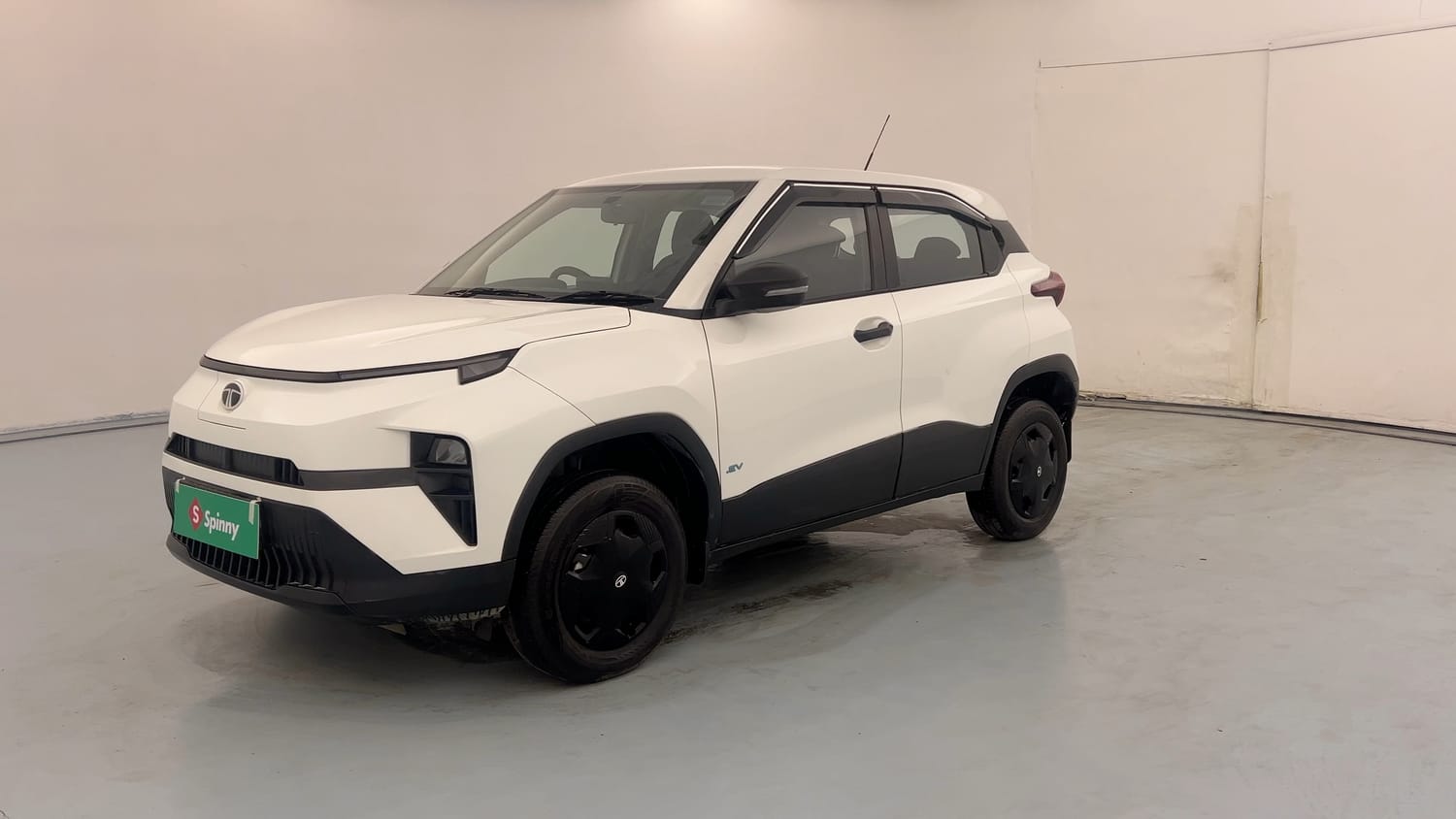
Some examples of pre-owned electric vehicle models are the Tata Nexon EV, MG ZS EV and the Hyundai Kona Electric. These models are available in the pre-owned vehicle market; however, these models also vary when it comes to battery size, charging capabilities and features based on the generation and model type.
Look at the exact car being offered. Don’t use specifications from the latest version to judge an older example.
Make sure you test drive the vehicle to find out about the seating comfort, visibility, brake feel and cargo capacity. Talk about the available vehicle/service history with your team so you can determine which electric vehicle fits best into your daily life and how much money you want to borrow.
Check Battery Condition Before Committing to a Loan
The high-voltage battery deserves particular attention because it stores the energy used to drive the car.
As batteries age and see more use, their capacity will decrease. Just because you find an EV with a depleted battery does not necessarily mean you should avoid purchasing it; however, you will want to understand the current state of the battery and whether it meets your needs.
Ask About Battery Health Information
Ask what battery condition information is available and whether a manufacturer-authorised diagnostic assessment can be obtained.
When looking at EVs, you may come across a term called “State of Health”, or SoH for short, which indicates how much of the battery’s stored energy is still available to be used after its initial use. Inquire about who performed the assessment of the battery, when they conducted this assessment, and what those results mean for that particular EV model.
Avoid treating one percentage as a universal pass or fail mark for every EV.
Don’t Confuse Charge Level With Battery Health
A dashboard showing 100% charge means the battery is fully charged to its current available capacity. It does not prove that the battery retains 100% of its original capacity.
Similarly, the displayed range is an estimate. Driving conditions and recent energy consumption can change it.
Review Repairs and Service History
Find all records related to technicians performing servicing in an effort to repair, replace, and/or diagnose issues with batteries through the charging systems. If work was performed, request documentation or proof that the battery system remains under warranty and/or is covered by the current work order.
A low kilometre reading alone cannot establish battery condition. Consider the records and assessment together.
Also Read: EV Car Brands with Longest Battery Warranty
Verify the Battery Warranty for Your Ownership
Battery warranties vary by manufacturer, model, registration date and ownership conditions.
Do not assume that a manufacturer’s lifetime warranty that a manufacturer places on their vehicle when purchased continues unchanged through the transfer of ownership. Many manufacturers have provisions that limit coverage to the original owner and/or add specific limitations to subsequent owners.
Ask the manufacturer or authorised service centre to confirm the cover for the individual car. Check:
- The remaining time and kilometre limits.
- Whether ownership transfer needs to be notified.
- Which faults or capacity-loss conditions are covered.
- Service requirements and exclusions.
In general, the warranty continues under the original conditions. If you buy a pre-owned vehicle, this does not reset the warranty to a new term period.
Also distinguish the manufacturer’s battery warranty from any retailer warranty. Confirm what each covers rather than assuming they are interchangeable.
Work Out Where You Will Charge
Charging access should be part of your buying decision, not something you figure out after delivery.
Home or Apartment Charging
If you plan to charge at home, check parking access, permissions and installation requirements. Obtain a quote for the appropriate setup, including any electrical work.
Verify the type of charging equipment included with the pre-owned vehicle. It is important to determine if a wall-mounted charging device previously located at the seller’s residence will fit in your current situation and whether or not it will be included in the sale.
Follow the manufacturer’s installation guidance and use an appropriately qualified installer.
Public Charging
Educate yourself about available charging options where you live, work, and travel, as well as the access and hours of operation, fees and payment methods available for these chargers.
A nearby charging point is more useful if you can reliably reach it and the car supports the charging method offered. Not every EV or variant supports the same charging speed.
Longer Journeys
To ensure that you have adequate time to make longer trips using highway travel as a charging option, establish a realistic distance range based on vehicle use and where compatible charging stations exist, allowing for an allowance for additional detours and unexpected energy usage.
Speed, weather, terrain and cabin cooling can affect range. Choose a car that gives you a comfortable margin rather than planning every journey around the maximum advertised figure.
Also Read: Most Affordable Electric Cars in India
Build a Budget Beyond the EMI
Electric vehicles can provide lower electricity costs than equivalent gasoline vehicle travel; however, your savings will depend on the specific vehicle you own, how often you charge, the percentage of your charging you do at home or through public stations, etc.
For illustration, suppose your monthly charging draws 180 kWh from the electricity supply. At an assumed ₹8 per kWh, the electricity cost would be ₹1,440.
The figures mentioned above are examples and do not represent either a guaranteed fuel cost or forecasted mileages. Forecast your distance travelled, your current estimate of kWh usage per mile, and/or your average rate for electricity in order to provide you with an estimate based on that data.
Your ownership budget should also include:
- Insurance and renewals.
- Tyres, servicing and repairs.
- Parking and tolls.
- Charger installation or replacement equipment.
- Any battery rental or separate battery payments.
Additionally, electric vehicles will still require maintenance, including tyres, brake pads, suspension systems, etc. Therefore, while you won’t be needing routine oil changes on an electric vehicle, you should still plan to set aside money for vehicle maintenance in your annual budget.
Treat potential running-cost savings as part of the calculation, while keeping enough room for unexpected expenses.
Choose Your Down Payment and Loan Tenure Together

A larger down payment reduces the amount you borrow. For the same interest rate and tenure, that lowers both the EMI and total interest.
While preserving funds for your charges, insurance, and emergencies is important, it is worth considering that the appraised value will not always equal what you actually pay for the financing. The difference between these values affects your contributions required toward the purchase of your vehicle.
Tenure is the period over which you repay the loan. A longer tenure usually lowers the EMI but increases total interest for the same borrowing amount and rate.
Here’s an example for a ₹7.5 lakh loan at 13.5% annual interest:
| Loan tenure | Approximate monthly EMI | Approximate total interest |
| 3 years | ₹25,451 | ₹1,66,253 |
| 4 years | ₹20,307 | ₹2,24,748 |
| 5 years | ₹17,257 | ₹2,85,443 |
The calculations here use a monthly repayment method on a reducing balance basis, and they do not include any fees. They provide examples only, and they are not offers for loans issued by Spinny.
The five-year plan lowers the EMI considerably, but adds around ₹1,19,190 in interest compared with the three-year plan.
You can use Spinny’s loan calculator to determine an idea of the amount that you will need to repay each month. Remember to factor in how long you expect to have the vehicle, its current state and warranty left when you look at the monthly payment.
Compare Rates and Charges Carefully
There is no single interest rate for every used EV. Your credit profile, income, existing obligations, selected vehicle and lender requirements influence the offer.
When applying for a loan through Spinny, make sure to know the actual interest rate for your application and whether it is a fixed or floating interest rate. Additionally, ask how the lender calculates interest.
Review the lender’s Key Facts Statement, which summarises the important loan terms. Compare the Annual Percentage Rate, or APR, as well as the interest rate. APR reflects interest and applicable borrowing charges.
If applicable to your application, check for processing, documentation and valuation fees, plus information on late-payment and early-repayment policies.
Do not build your budget around a subsidy, tax benefit or promotional concession until you have confirmed that it applies to your specific used-car purchase.
Keep Your Eligibility and Documents Ready
Salaried and self-employed buyers can apply, subject to lender criteria. Your age, income, employment or business stability, banking history, existing debts and credit profile can affect eligibility.
The vehicle must also meet the lender’s requirements.
Spinny’s commonly requested financing documents include:
- PAN card and Aadhaar card.
- Address proof.
- Six months of bank statements.
- Income proof, such as salary slips or income tax returns.
Additional employment, business or financial records may be requested depending on your circumstances.
Review the documents that contain information about the vehicle. This includes the registration certificate, insurance documents, the ownership history and current finance status, as well as any warranties and service history applicable to your electric vehicle (EV).
How to Apply for Financing With Spinny
1. Shortlist a Suitable Used EV
Choose around your purchase budget, daily travel and charging access. Review the car’s details, take a test drive and discuss the available records.
Spinny Assured vehicles are put through a rigorous 200-point inspection and come with Fixed Price Assurance. If you have questions about the EV-specific condition report for your selected Spinny Assured vehicle, please contact your Spinny Specialist.
2. Check Your Eligibility
Begin with our online eligibility check, which does not affect your credit score. Final loan approval remains subject to the finance partner’s assessment.
3. Submit Your Documents and Review the Offer
Upload the requested documents and provide the information needed for verification.
Check the pre-approved amount, your initial deposit, interest rates, EMIs, tenures & fees. Verify if insurance/charging station costs are incorporated in the device pricing or if they are charged separately.
4. Complete Approval and Disbursal Formalities
After approval, complete the agreement, repayment mandate and remaining requirements. Once payment and documentation are completed, our team coordinates the next steps for your purchase and delivery.
Timelines depend on verification and completion of the formalities.
Buying an EV With a Battery Rental Arrangement?
A number of EV ownership plans permit the vehicle’s initial payment to be distinct from payments associated with the use of batteries through what is commonly termed Battery-as-a-Service (BaaS). There are various financial arrangements available through BaaS providers.
If the used car was bought under such a programme, establish what the seller owns and which obligations remain.
Inquire about the possibility of continuing with the same arrangement, whether it has to be ended or a new agreement has to be signed. Ask about the provider’s terms and conditions, such as minimum charges for non-usage, as well as exit fees, if applicable.
Battery payments are separate from the electricity used to charge the car. Include both, along with any vehicle EMI, in your monthly budget.
Do not assume a low vehicle-only price includes outright battery ownership, or that every BaaS programme is available through Spinny.
Bring Home an EV That Fits Your Life
A used EV loan works best when the car, charging routine and repayment plan make sense together.
Check the battery’s condition and warranty, make arrangements for reliable recharging, and compare all costs associated with borrowing the vehicle prior to signing. Lastly, establish which items come with the vehicle and what steps must be completed to have access to any connected services before receiving the vehicle.
Our team can help you understand financing options for your selected car. With the details settled, you can enjoy the quieter commute without leaving important costs to guesswork.
Also Read: Used Car Loan: Complete Guide to Financing a Pre-Owned Car in India
FAQs About EV Loan Guide
Q. Can I get a loan for a used electric car through Spinny?
You can explore financing when purchasing a used EV from Spinny. Availability, approval and terms depend on your profile, the selected vehicle and the finance partner’s requirements.
Q. Are used EV loan rates lower than other used car rates?
Not automatically. Some lenders advertise EV-specific products, but you must confirm whether they cover pre-owned cars. Compare the actual offers available for your application rather than assuming a concession applies.
Q. Can I finance the full price of a used EV?
Eligible applicants may receive financing covering up to 100% of the car’s price. This depends on the lender, vehicle and credit profile. Confirm whether other costs require separate payment.
Q. Will a used EV’s battery warranty transfer to me?
It depends on the manufacturer and the specific warranty. Subsequent-owner coverage can differ, and notification may be required. Confirm remaining protection for the individual vehicle before purchasing.
Q. Does 100% charge mean the battery is in perfect health?
No. Charge level shows how full the battery is at that moment. Battery health concerns its condition and remaining capacity. Ask about an appropriate diagnostic assessment rather than relying solely on the dashboard.
Q. Can charger installation be included in the loan?
This depends on the lender’s funding policy and purchase arrangement. Confirm whether equipment and installation are covered. If they are not, include them in your upfront budget.
Q. Does battery rental include the cost of charging?
Do not assume so. Battery-related payments and electricity charges are separate costs. Review the specific agreement, including usage charges and any minimum monthly commitment, before budgeting.
Q. Is comprehensive insurance required for a financed used EV?
Yes, comprehensive insurance is required for used cars financed through Spinny. Review the policy’s EV-related cover, exclusions and excesses rather than assuming every battery issue is covered.