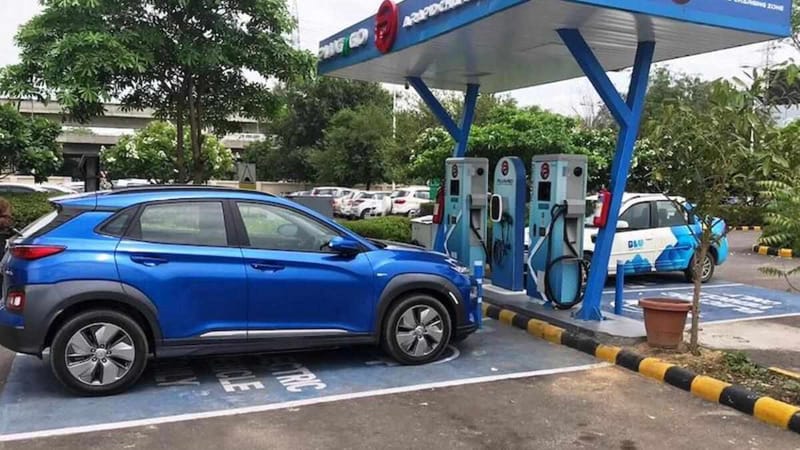
Electric Vehicles (EVs) are becoming the go-to mode of transportation for Indians. Better environmental awareness, government initiatives, and, most importantly, the rising fuel price, all have played their part in making EVs popular. As the number of sales of EV increase, there is an equal need for more reliable electric vehicle charging stations.
Having an understanding of different types of EV charging stations before buying an EV is important. An EV charging station is the electric setup to recharge an EV, at home, office or in any public area. It is the equivalent of the fuel pumps. Such infrastructure is essential for EV mobility.
Table of Contents
Importance of Electric Vehicle Charging Stations
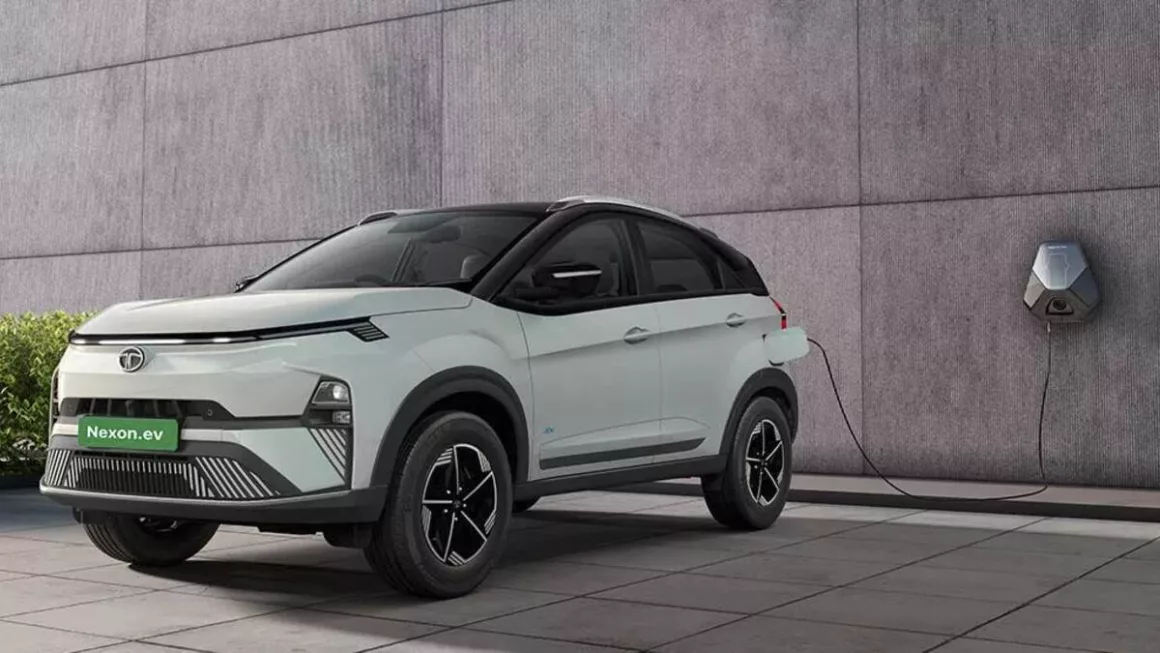
As a conventional vehicle depends on fuel stations, an EV relies on electric car charging stations to replenish energy in its battery. However, unlike the fuel cars, EVs cannot be recharged in a matter of minutes. It takes at least 20-30 minutes for the EV battery to be ready to run. The speed of recharge of EVs mainly depends on the type of chargers and their availability in charging stations. This is why EV charging stations are crucial. They must also be available at regular distances for easy access, and have compatible chargers to suit different cars.
Types of EV Charging Stations and Electric Vehicle Chargers in India
The charging stations that are seen in homes, offices, and hotels, where the cars are likely to be parked for longer durations, are slow charging. Such electric vehicle chargers are categorised under Level 1 and 2. In public places, the cars are likely to be parked for a shorter duration, and therefore, the charging must be done quickly. The charging stations that are open for public would be different and are quick. They come under Level 3 charging. The different levels of EV charging stations are explained below.
AC Level 1 EV Charger (Home Charging Station)
The common household EV charger in India belongs to AC (Alternating Current) charging. The AC from the power outlet is converted into DC (Direct Current) by the built-in converter in the EV. The EV battery requires DC to be charged. This conversion makes the charging pace slow.
An AC Level 1 EV charger uses a 240V power outlet available at home or office. The power output it uses for charging is less than or equal to 3 kW. The usual charging of this level 1 is slow, taking 8-12 hours for a full recharge. This duration may be prolonged based on the type of battery used in the car.
- Advantages: Suitable for overnight charging and for low-range vehicles.
- Disadvantages: Not suitable for quick charging for long-distance travel.
AC Level 2 EV Charger and Level 2 Charging Station
The AC Level 2 charging station works almost the same as a Level 1 EV charger. The main difference is the power outlet. The Level 2 can use a power outlet of 380-400V. It uses a power output of 3 kW to 22 kW. Due to this increased power output, the charging duration is reduced to 4-6 hours for a full recharge. This is most suitable as a home EV station and at offices and stopovers. The work mechanism of such chargers is the same as Level 1, where the AC is converted into DC.
- Advantages: Ideal for homes with three-phase power, and are available in most EV stations in India.
- Disadvantages: Still not sufficient for a quick 1-2 hour charging.
DC Fast Charger and Public Fast Charging Stations
The DC charging bypasses the converter inside the EV. Instead, it directly provides DC to charge the battery. As there is no time lost in conversion, the battery is charged quickly and can be recharged up to 80% within 20-40 minutes. Such DC fast chargers use a power output of up to 350 or 400 kW to enable a quick pace. These fast chargers are widely seen at public EV charging stations where quick recharging is required. It is also found in charging stations attached to cafes, restaurants, on highways or in commercial places.
- Advantages: Saves time in charging and is reliable for long-distance journeys.
- Disadvantages: Not suitable for homes as it requires special equipment and a higher power supply.
AC vs DC Charging Stations: EV Charger Power Output Compared
You can customise both AC and DC electric vehicle chargers in terms of their power outputs. In other words, you may choose to have them with a higher power output to quicken the charging speed. The AC electric vehicle chargers can be customised to have 7kWh, 11kWh, or 22kWh. Depending on the power output, the charging could suit a distance of 40, 60, or 120 km per one hour of charging. You can customise your home charging station according to such needs.
On the other hand, DC fast electric vehicle chargers are used at public EV station. They can also be customised to get 50-350kW as per requirement. The higher the power output, the faster the charging and the lower the time required. Such fast charging enables cars to have a higher range of 100-300 km with just 15-30 minutes of charging.
While AC chargers are suitable for both domestic and public accessibility, DC chargers are only suitable for public and commercial use. In addition, the installation cost for an AC charger is much lower when compared to the high-cost of DC charger installation.
How to Choose an EV Charging Station or EV Charger
Choosing the right charging station makes your EV more efficient. There are a few factors that influence your choice, and they are mentioned below.
Choose the Level 1 EV charger if,
- You take power from the home or office outlets
- You travel shorter distances daily and have time for overnight charging
- Looking for lower EV charger installation cost and affordability
Choose the Level 2 EV charger if,
- You need faster charging
- Setting up an EV charging station in an office or commercial space
- Need charging for longer ranges
- Have a provision for a higher voltage power outlet
Choose a Level 3 DC fast charger if
- You intend it for a public charging station
- Have a provision to provide specific power outlets
- Can afford the higher installation charges
- Looking for rapid charging
Conclusion
Once you understand the different levels of EV charging, it is easier to make the transition to an electric vehicle. The Level 1and 2 are basic charging stations that are most suitable for domestic use. Level 3 DC chargers are rapid chargers only seen in public charging stations. It is suitable for quick charging on long drives. The choice of an EV charging station depends on your lifestyle, the distance to cover, and the power outlets. Choosing the right charging station is essential for the smooth operation of electric mobility. Cost follows the same split: EV charging stations cost roughly Rs 8 to Rs 15 per unit on AC and Rs 15 to Rs 28 per unit on DC, which is worth weighing against how long you actually plan to stop.
Related Blogs:
How To Install an EV Charger at Home?
Fast EV Charging Stations in India
How To Properly Charge Your EV: Complete Guide
FAQs About Types of EV Charging Stations
Q. Are EV charging stations free to use?
Most private EV charging stations seen in offices are free to use for the employees. The public charging stations open to the public are chargeable. The same applies to the charging stations attached to commercial spaces such as malls, restaurants, etc. The cost will be based on how much electricity is consumed for the charging. The DC charging costs much more than AC charging. However, there might be some rare cases where commercial establishments offer free charging as part of promotions, and it may not be common.
Q. What is the EV charging cost at public charging stations?
Charging at public EV charging stations can cost Rs. 11 to Rs. 16 per kWh in commercial spaces for the AC charging. The fast DC charging costs much higher at a rate of Rs. 18 to Rs. 24 per kWh. Domestic charging may cost Rs. 4 – 7 on average. Thus, the overall charging may cost around Rs. 160 for domestic charging, Rs. 400 for AC public charging and Rs. 600-1000 for DC fast charging. The actual cost differs with the power output and how much electricity your EV consumes for charging.
Q. How long does it take to charge my EV?
The charging time depends on the type of charging level, the battery capacity, and the power output selected. The higher power outputs, as seen with DC chargers, will require just 20-60 minutes for charging 80% of the battery. The AC charging may take 8-12 hours or more for Level 1 and 4-6 hours for Level 2 full charging. The charging duration also depends on your requirement. If you intend to drive for up to 120 km, then AC charging for 6 hours may be sufficient. DC fast charging for an hour is preferred for longer distances. You can choose slow charging for longer hours for a full charge.
Q. Are different EV charging stations available in rural areas in India?
Yes, different EV charging stations are available in rural areas of India, but they are still rare and not enough. It may be available in towns and semi-urban areas, but may not be available in village areas. It is more frequent in tier-2 cities and near highways as well. People in rural and semi-urban areas still rely mainly on their domestic charging stations rather than the public charging stations. However, if you are on any major highways, you are likely to find charging stations at regular intervals, even in remote areas.
Q. Can I use any charger for my EV?
While you may choose any charging station for your EV, you may not be able to use any charger, as there will be compatibility issues. Just like a smartphone, EVs also have different connectors, such as Type 2 for AC charging and CCS2 for DC charging. You cannot use one connector for the other one. So it is important that you check the compatibility before heading towards the charging station. Most DC charging providers will have a mobile app through which you will be able to check the compatibility.
Q. How do I find an EV charging station near me in India?
Open a network app such as Statiq, Jio bp pulse, ChargeZone, Tata Power EZ Charge or Ather Grid and filter by your connector type. Each lists every EV station the operator runs with live plug status. PlugShare and Google Maps give a wider view of public electric vehicle chargers near you, but confirm availability inside the operator app before you drive there.
Q. What do EV charging stations cost in India?
Public EV charging stations cost roughly Rs 8 to Rs 15 per unit on AC chargers and Rs 15 to Rs 28 per unit on DC fast chargers. Rates vary by operator, state and site, and some locations add a parking or idle fee on top, so check the tariff in the app before you plug in.
Q. Which EV charger should I use at an EV station near me?
Match the charger to the stop, not just to the car. An AC EV charger of 3.3 kW to 7.4 kW is right for an overnight or multi hour halt. A DC electric vehicle charger of 30 kW or more is right for a short highway break, since it can take most cars from 20 to 80 percent in about 30 to 60 minutes.