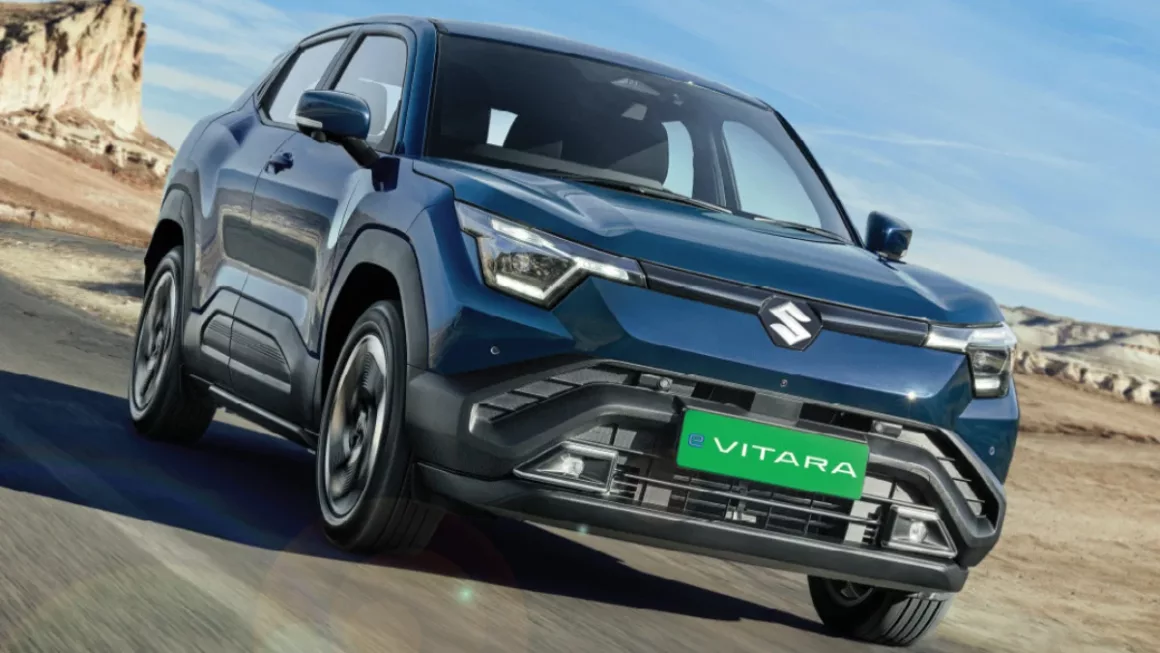
India’s midsize electric SUV market is expanding fast, and two names that stand out for very different reasons are the Maruti Suzuki e Vitara and the MG Windsor EV.
The new e Vitara is Maruti Suzuki’s first all-electric SUV and is positioned as an alternative to the increasingly popular petrol and diesel SUVs of similar size from manufacturers such as Kia and Mahindra. This new electric vehicle features an SUV-style design and offers impressive ranges that are more than enough for most families on long trips. In addition, this electric car provides a number of safety features that should help put any safety-conscious family members at ease.
The MG Windsor EV approaches the same problem from a slightly different angle. It has a more compact footprint, striking design elements, and an interior rich with features. Instead of packing in the largest battery and claiming the highest range, it offers a balanced mix of usability, tech ambience, and budget positioning.
The following comparison will analyse how both of these EV SUVs perform in actual conditions (as opposed to just numbers) by examining their dimensions, battery and performance, features and comfort, safety, and price points to give you the information you need to make an informed decision.
Table of Contents
Maruti Suzuki e Vitara vs MG Windsor EV: Dimensions
| Specification | Maruti Suzuki e Vitara | MG Windsor EV |
| Length | 4,275 mm | 4,295 mm |
| Width | 1,800 mm | 1,850 mm |
| Height | 1,635 mm | 1,677 mm |
| Wheelbase | 2,700 mm | 2,700 mm |
| Ground Clearance | 185 mm | 186 mm |
| Boot Space | 310 litres | 579 to 604 litres |
From a top-down view, the MG Windsor EV appears wider and taller, giving it a stronger road presence. Its overall proportions translate into a more spacious cabin feel, especially for passengers, while also reinforcing its urban-focused design.
The Maruti Suzuki e Vitara and MG Windsor EV have the same wheelbase, but the overall dimensions of each vehicle lead to differing experiences in the cabin. The MG Windsor’s slightly larger footprint makes it feel more spacious, light and airy inside, especially regarding headroom and overall cabin width. Passengers will appreciate this difference when using the vehicles in an urban environment on an everyday basis and during long drives.
The e Vitara, on the other hand, follows a more traditional SUV packaging approach. While it offers a comfortable cabin with practical space for passengers, it doesn’t feel as expansive as the Windsor EV, especially in the second row. That said, its proportions are well-balanced, which contributes to a more controlled and stable feel on the road.
The Windsor EV’s stand-out feature is its cargo capacity; it is substantially larger than the e Vitara’s boot and offers much more flexible options for transporting things like luggage to and from the airport, groceries, or weekend travel bags. The e Vitara has usable storage but emphasises balance and comfort instead of maximising cargo space.
Both vehicles have very similar ground clearance, with a slight advantage going to the Windsor EV. In real-world conditions, both cars are capable of driving smoothly on urban roads and on the occasional rough terrains without any major challenges.
In terms of usability, the Windsor EV leans towards buyers who value cabin space, practicality, and ease of use in city environments. The e Vitara, meanwhile, feels slightly more compact and easier to manage in tighter spaces, which can make a difference in dense urban traffic and parking situations.
Overall, if space and cargo flexibility are your priorities, the Windsor EV has the edge. If you prefer a more balanced SUV that is easier to manoeuvre while still offering good comfort, the e Vitara remains a solid choice.
Maruti Suzuki e Vitara vs MG Windsor EV: Battery & Performance
| Specification | Maruti Suzuki e Vitara | MG Windsor EV |
| Battery Options | 49 kWh / 61.1 kWh | 38 kWh / 52.9 kWh |
| Claimed Range | Up to 543 km | Approx. 332 km / 449 km |
| Motor Output | Up to 172 bhp | 136 PS |
| Torque | Approx. 192 Nm | 200 Nm |
| Drivetrain | Front-wheel drive | Front-wheel drive |
| DC Fast Charging | Supported | Supported |
| AC Charging | Supported | Supported |
The Maruti Suzuki e Vitara offers two battery options, including a larger 61.1 kWh pack that can deliver a claimed range of up to 543 km. This makes it well-suited for longer highway trips, where fewer charging stops are needed, and drivers have more flexibility in planning journeys.
The MG Windsor EV is primarily created for city driving; however, it may be configured in a couple of different ways. The model’s base configuration has a 38 kWh battery that can travel about 331 km on average. However, the car also offers a 52.9 kWh battery pack that offers a range of 449 kms. This gives you an option to choose between an economical city-friendly setup and a car that is more suited for longer drives, depending on your requirements.
For daily commuting, office runs, and predictable usage patterns, the smaller battery feels easy to live with, especially if you have access to regular home charging. At the same time, the availability of a higher-capacity battery option ensures the Windsor EV can stretch beyond purely urban use when needed.
Performance metrics reflect each car’s intended use. The MG Windsor EV provides seamless and predictable acceleration appropriate for city driving with 136 PS and 200 Nm of output, making it a very responsive vehicle, allowing the user to merge into traffic without using excessive throttle and be able to pass other vehicles within city limits and go up short inclines without difficulty.
The Maruti Suzuki e Vitara adds more outright performance, with up to 172 bhp and stronger power delivery that feels more confident at higher speeds. This makes it better suited for highway driving, where sustained performance and overtaking ability matter more.
Both the SUVs offer universal charging options: AC home charging and DC fast charging, making day-to-day usability convenient regardless of which one you choose. That said, the Windsor EV’s broader battery options allow buyers to choose between a city-focused setup and a version better suited for longer drives.
Overall, the Windsor EV is designed for people who drive mostly around cities but occasionally plan to take shorter road trips. In contrast, the e Vitara will be the better option for anyone who has more frequent long-distance trips and requires greater performance on longer journeys.
Maruti Suzuki e Vitara vs MG Windsor EV: Features & Comfort
| Feature | Maruti Suzuki e Vitara | MG Windsor EV |
| Infotainment System | 10.1-inch touchscreen | 10.1-inch touchscreen |
| Instrument Cluster | Fully digital | Digital cluster |
| Climate Control | Automatic | Automatic |
| Rear AC Vents | Yes | Yes |
| Ventilated Seats | Yes | Yes |
| Sunroof | Panoramic | Panoramic glass roof |
| Powered Driver Seat | Yes | Yes |
| Infotainment Features | Modern connected features | Connected tech + large display |
| Drive Modes | Multiple | Multiple |
While both the e Vitara & Windsor EV have similar performance metrics such as contemporary styling, luxurious amenities and advanced connectivity capabilities, they each provide their own unique experience through their design.
The MG Windsor EV stands out with its large 10.1-inch infotainment display. This screen dominates the dashboard and gives the cabin a feel that’s very modern and expressive. Connected features, navigation, music streaming, and vehicle information are all presented crisply on this display, which tends to feel more immersive than traditional screens.
With an approach that is more understated, the Maruti Suzuki e Vitara features a large 10.1-inch touchscreen that prioritises function. The touchscreen has been designed to have integrated controls and easy-to-read menus. The e Vitara’s touchscreen may not have the “flash” of the Windsor EV’s; however, it was designed to be user-friendly, easy to use, and with less visual clutter. This has significant meaning to a large number of buyers who want to enjoy technology without distractions.
Both cars offer fully digital instrument clusters, ventilated seats, sunroofs, and multiple drive modes. Rear AC vents, powered driver seats, and connected car features, such as smartphone connectivity and remote functions, are part of the comfort picture in both SUVs.
If your priority is visual impact and interactive tech, the Windsor EV delivers a compelling cabin experience. If your priority is comfort over long distances and user-friendly interaction, the e Vitara’s layout wins for straightforward usability.
Maruti Suzuki e Vitara vs MG Windsor EV: Safety
| Safety Feature | Maruti Suzuki e Vitara | MG Windsor EV |
| Bharat NCAP Rating | 5-star | Not yet officially rated |
| Airbags | 6 | 6 |
| Electronic Stability Control | Yes | Yes |
| Traction Control | Yes | Yes |
| Hill Hold Assist | Yes | Yes |
| ISOFIX Child Seat Anchors | Yes | Yes |
| ADAS | Level 2 | Level 2 |
Safety absolutely matters to most SUV buyers, especially families with kids. A five-star Bharat NCAP rating confirms that the Maruti Suzuki e-Vitara has passed numerous crashes in both grades of protection for its occupants (adults and children). Therefore, you can feel confident when driving either on city streets or highways.
The MG Windsor EV also offers a strong safety suite, including six airbags, electronic stability control, traction control, hill hold assist, ISOFIX child seat anchors, and Level 2 ADAS features like adaptive cruise control, lane keep assist, and emergency braking. However, it hasn’t yet been officially rated under Bharat NCAP at the same time as the e Vitara.
Simply stated, buyers will find both SUVs fully loaded with contemporary active and passive safety systems designed to protect the occupants of these vehicles as well as help the driver do their job safely.
If verified, crash performance is a top priority; the e-Vitara has an edge. If you prioritise comprehensive active safety equipment, both deliver a strong package that aligns with the latest safety expectations in India.
Maruti Suzuki e Vitara vs MG Windsor EV: Price Comparison
| Variant Level | Maruti Suzuki e Vitara (Ex-showroom) | MG Windsor EV (Ex-showroom) |
| Base Variant | ₹10.99 Lakh | ₹13.99 Lakh |
| Mid Variant | ₹11.99 Lakh | ₹15.52 Lakh |
| Top Variant | ₹14.50 Lakh | ₹16.52 Lakh |
Price plays a big role in deciding between these two electric cars.
The MG Windsor EV is now available in India, with pricing ranging from ₹13.99 lakh to ₹16.52 lakh (ex-showroom). It positions itself as a well-equipped electric SUV with a strong focus on features, cabin tech, and practicality, offering good value within its segment.
The Maruti Suzuki e-Vitara that starts at ₹10.99 lakh and goes as high as ₹14.50 lakh (ex-showroom). Despite the lower cost, the e Vitara offers a balance between performance, usability and brand trust.
The e Vitara clearly stands out as the more budget-friendly option, making it appealing for first-time EV buyers or those prioritising affordability. The Windsor EV, while priced higher, justifies its positioning with a larger feature set, a more spacious cabin feel, and greater cargo capacity.
The mid-range versions of both SUVs have a lot in common; they even overlap in the ₹13 – 15 lakh range. In this price range, buyers can compare both SUVs on all of the aspects that really matter to them, including price, features, space, or driving requirements.
Summary: Maruti Suzuki e Vitara vs MG Windsor EV
When comparing the Maruti Suzuki eVitara and the MG Windsor Electric SUVs, you need to first determine how you’re planning to use your car.
Thanks to competitive pricing, city-friendly characteristics, and unique cabin tech at a very attractive starting price point, the MG Windsor Electric is the way to go. It has a range of 331 km, making it an ideal daily driver and also suitable for weekend trips.
The Maruti Suzuki e Vitara wins by extending your electric driving horizons with higher claimed range, better rear-seat comfort, verified crash safety, and SUV proportions that make long trips and family travel more comfortable and confidence-inspiring.
If your priorities include budget constraints, city driving and high-tech interiors, go with the Windsor EV. However, if you want to make a larger investment and have a vehicle that has better range, more room for a family, as well as performance for long-distance travel, choose the e Vitara.
FAQs: Maruti Suzuki e Vitara vs MG Windsor EV
Q. Which electric SUV has better range: Maruti Suzuki e Vitara or MG Windsor EV?
The Maruti Suzuki e Vitara offers up to 543 km of claimed range, while the MG Windsor EV is listed with around 331 km.
Q. Which SUV is better for rear passengers: Maruti Suzuki e Vitara or MG Windsor EV?
The e Vitara feels more spacious for rear passengers due to its longer wheelbase and SUV proportions.
Q. Which electric SUV is more budget-friendly: Maruti Suzuki e Vitara or MG Windsor EV?
The MG Windsor EV starts significantly lower, making it more affordable for entry-level EV buyers.
Q. Which SUV has a verified safety rating: Maruti Suzuki e Vitara or MG Windsor EV?
The Maruti Suzuki e Vitara has a verified five-star Bharat NCAP rating, while the MG Windsor EV matches it in safety features but does not yet have an official Bharat NCAP result.
Q. Which electric SUV should I buy: Maruti Suzuki e Vitara or MG Windsor EV?
Choose the MG Windsor EV for city driving, strong tech features, and value pricing. Choose the Maruti Suzuki e Vitara for longer range, family comfort, and SUV-oriented space.