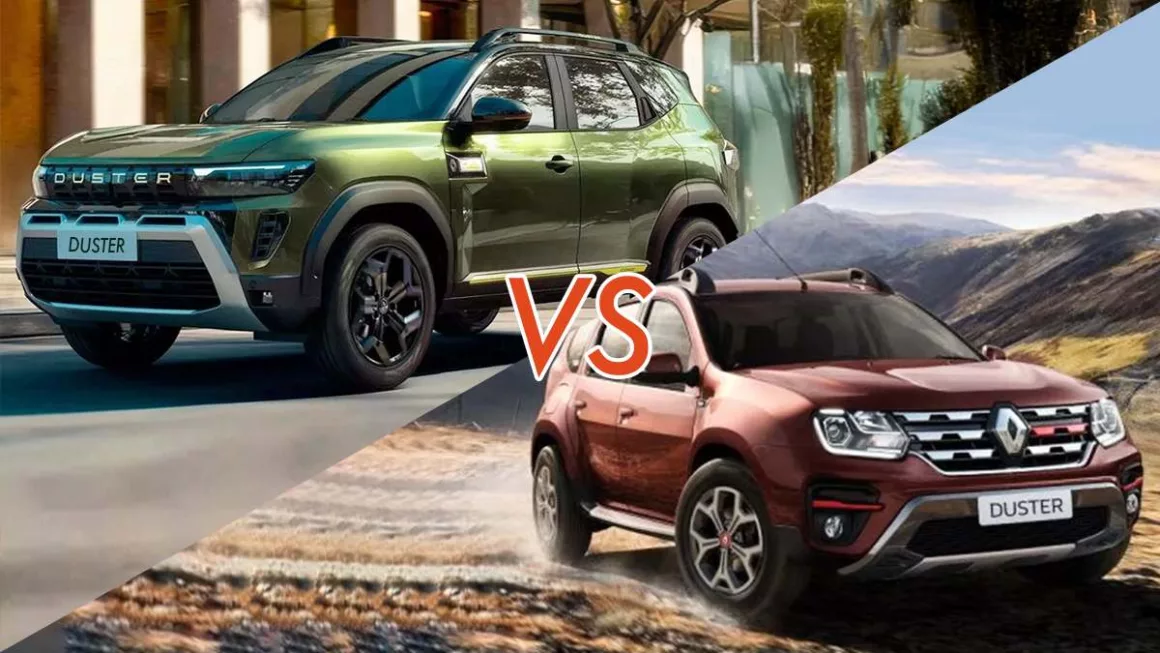
Renault recently sent ripples through the Indian car market by launching the new Renault Duster. The Duster is not just another mid-size SUV. In fact, it is the Duster that gave birth to the monocoque mid-size SUV segment when it was first launched in 2012. In its 10-year run, before its discontinuation in 2022, the first-gen Duster had sold over 2 lakh units. All the same, the new Duster that the French carmaker has unveiled is its third-gen model. Not only does the new Duster look a lot different, but it is a far more equipped Duster than the first-gen model. In this article, we compare the old Renault Duster and the new Duster to see how much the superstar model from the French carmaker has evolved.
New Renault Duster vs Old Renault Duster: Dimensions & Design
| New Renault Duster | Old Renault Duster | |
| Length | 4,343 mm | 4,360 mm |
| Width | 1,813 mm | 1,822 mm |
| Height | 1,659 mm | 1,695 mm |
| Wheelbase | 2,657 mm | 2,673 mm |
| Ground Clearance | 212 mm | 205 mm |
| Boot Space | 518 litres | 475 litres |
In contrast to usual generational changes, where a car gets larger with time, the new Renault Duster is slightly smaller than the old Renault Duster. All the same, in terms of the cabin’s overall spaciousness, there is no major difference. The cabin space of the new Duster is not class-leading; three adults sitting abreast in the rear seat might feel it to be a slightly tight fit, while some other cars in the segment offer more space in the rear seat, for example, Tata Sierra and Kia Seltos.
Design is where the Duster has seen the biggest change. The new Duster looks nothing like the old one; it looks bolder, more muscular, and has a stronger physical appeal.

On the old Duster, the grille was larger and had horizontal chrome slats with a big ‘Renault’ logo in the centre. Flanking the grille were two conventionally-designed pentagon headlamp clusters, consisting of LED projector lights and L-shaped DRLs. Lower down, the bumper was a blacked-out air dam, flanked by fog lamps. In comparison, the new Duster features a more upright and sturdier-looking front end. It features a gloss-black grille section with ‘DUSTER’ lettering embossed on it, and flanked by the headlamp’s assemblies consisting of LED projector headlamps and eyebrow-shaped LED DRLs that double up as turn indicators. Like the old Duster, the bumper is blacked out, but is designed differently.
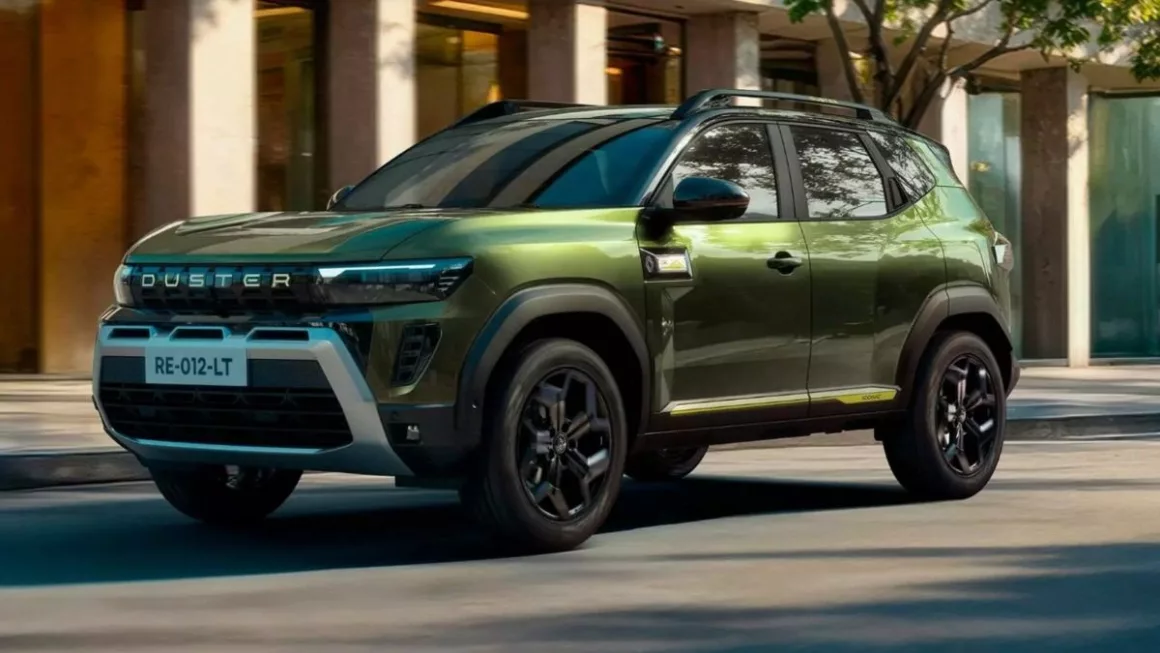
Side profiles are where the new Duster and old Duster are the most similar. While both the new Duster and the old Duster have three window glasses, the old Duster had a larger window glass area and a lower window line. Moreover, the old Duster rode on 16-inch alloy wheels, while the new Duster rides on more stylish 18-inch alloy wheels. Other differentiating qualities of the new Duster include the blacked-out body cladding, squarish wheel arches, and C-pillar-mounted rear door handles, instead of the conventional flip-type ones that were there on the old Duster.
At the rear, the old Duster features a flattish boot lid and vertically placed tail lamps, while the new Duster features connected tail lights, a sleeker spoiler, and a rugged skid plate. Like the old Duster, the new Duster has a large rear windshield in addition to a wiper, washer, and defogger.
The new Renault Duster is slightly smaller than the old Renault Duster; however, there is no major difference in the interior space. As far as design is concerned, the new Renault Duster looks more dominant and sportier than the old Renault Duster.
New Renault Duster vs Old Renault Duster: Engine & Transmission
| New Renault Duster | Old Renault Duster | |
| Engine | 1-litre litre turbo petrol engine 1.3 litre turbo petrol engine 1.8-litre strong hybrid engine | 1.5-litre petrol engine 1.3 litre turbo engine |
| Power | 100 PS (1-litre turbo) 163 PS (1.3-litre turbo) 160 PS (strong hybrid) | 106 PS (NA petrol) 156 PS (turbo petrol) |
| Torque | 160 Nm (1-litre turbo) 280 Nm (1.-litre turbo) 172 Nm (strong hybrid) | 142 Nm (NA petrol) 254 Nm (turbo petrol) |
| Transmission | 6-speed manual with 1-litre turbo and 1.3-litre turbo engines 6-speed DCT automatic with 1.3-litre turbo engine DHT with a strong hybrid engine | 5-speed manual with NA petrol 6-speed manual and 7-step CVT automatic with turbo petrol |
| Mileage | Up to 16.5 km/l |
The 2020-model of the Renault Duster was powered by a 1.5-litre naturally aspirated petrol engine and a 1.3-litre turbo petrol engine, which is the same engine offered with the new Renault Duster, but it produces more power now. Before the enforcement of the BS VI norms in 2020, the Duster offered a 1.5-litre K9K diesel engine in two states of tune – 85 PS and 110 PS. The 110 PS diesel engine was also available with an all-wheel-drive setup. The diesel engine of the old Duster was its best-selling engine. In addition to its capable diesel engine, what made the Duster a legendary SUV was its driving dynamics. Its rides were almost flat, as its suspension absorbed the worst of blows with ease. Duster owners would not hesitate to take it on bad stretches for the confidence they had in its suspension. This suspension would also offer commendable stability and minimal body roll. While the Duster was not as peppy as its Korean rivals – Hyundai Creta and Kia Seltos were, it was more enjoyable to drive and to be driven in. The old Duster’s suspension was an independent front suspension with McPherson struts and a semi-independent rear suspension with a torsion beam axle.
The new Duster is expected to deliver the same ride comfort and driving dynamics as it comes with the same suspension as the old Duster. All the same, the new Duster will go one step ahead of the old one, as it features an electric power steering, instead of an electro-hydro steering, which the old Duster offered and would lack enough feedback from the steering.
As the new Duster has come in at a time when diesel engines are being phased out, instead of a diesel engine, it offers a strong-hybrid powertrain that consists of a 1.8-litre petrol engine connected with a 49 PS-producing electric motor and a 20 PS-producing hybrid starter generator (HSG), backed by a 1.4kWh (280 V) battery. This strong-hybrid set-up is far superior to the strong-hybrid powertrain of the Maruti Grand Vitara, Toyota Hyryder, and Maruti Victoris. Moreover, Renault claims that 80 percent of urban driving can be done in EV mode.
Last but not least, as mentioned, the old Duster was not among the most powerful cars in its segment. However, the 1.3-litre turbo petrol engine of the new Duster is the most powerful engine in its segment, and is expected to deliver an entertaining drive, complemented by its capable suspension setup.
New Renault Duster vs Old Renault Duster: Features & Comfort
| New Renault Duster | Old Renault Duster | |
| Infotainment system | 10.1-inch touchscreen infotainment system | 8-inch touchscreen infotainment system |
| Music system | 6-speaker Arkamys sound system | 4-speaker 2 DIN sound system |
| Climate control | Dual-zone Automatic | Automatic |
| Ventilated seats | Front ventilated seats | Not available |
| Adjustable steering | Tilt and Telescopic adjust | Tilt adjust |
| Drive modes | Available | Not available |
| Instrument cluster | 10.25-inch digital instrument cluster | Not available |
| Sunroof | Panoramic sunroof | Not available |
| Adjustable seats (manual or electric) | 6-way powered driver and front passenger seats | Not available |
| Rear AC vents | Available | Available |
| 60:40 rear seat split | Available | Available |
| Cruise control | Available | Available |
On the inside, the old Duster has a simple and functional interior, but as far as the premium quotient was concerned, it was at all missing. It had big, rounded AC vents on the side, big trapezoidal AC vents on the centre of the dashboard, an 8-inch touchscreen integrated on the centre console, a bulky three-spoke steering wheel, chunky rotary knobs for AC, and an analogue instrument cluster. There was no soft material across the cabin, and even the dashboard was all hard plastic. It was one of its key drawbacks compared to the Hyundai Creta and Kia Seltos.
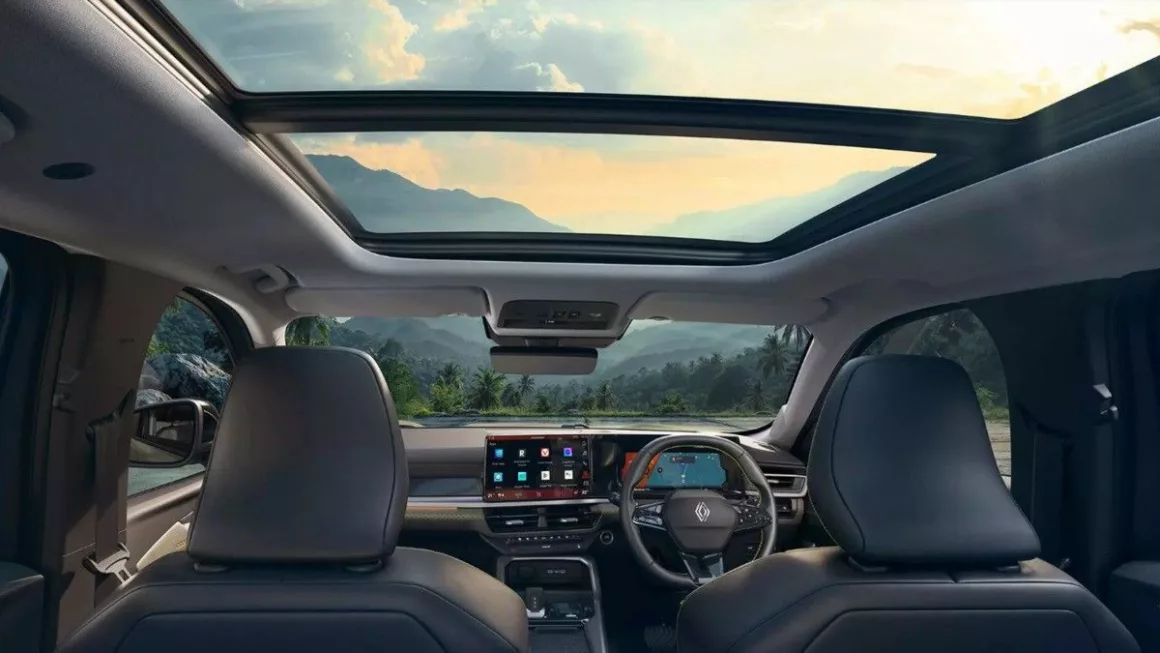
In the new Duster, while the premium quality of the interior is not class-leading, it is more than satisfactory. And compared to the old Duster, it looks and feels generations superior. The materials that have been used are richer and more premium, especially on the dashboard. Moreover, the carbon fibre finish on the layered dashboard, the squarish chunky steering wheel, and the driver-centric centre console and touchscreen make for a sporty atmosphere. All the same, like the old Duster, Renault has equipped the new Duster with physical buttons for most functions. Buttons are designed and placed differently and are smaller compared to the ones on the old Duster. The New Duster also features a front armrest, which the old Duster did not. Moreover, the old Duster had a brown and grey interior theme, while the new Duster gets an all-black interior theme with green stitching and accents on some parts.
Feature-wise, the new Duster is far more loaded than the old Duster. The old Duster offered an 8-inch touchscreen (on the top variant) with wired smartphone connectivity, automatic climate control, cruise control, powered ORVMs, and more. Whereas the new Duster offers a 10.1-inch touchscreen infotainment system with wireless Android Auto and Apple CarPlay, a 10.25-inch digital instrument cluster, dual-zone climate control, a panoramic sunroof, 6-way powered and ventilated front seats, a powered tail gate, and more.
New Renault Duster vs Old Renault Duster: Safety Features
| New Renault Duster | Old Renault Duster | |
| NCAP Safety Rating | Not tested | Not tested |
| Airbags | Six | Two |
| ABS with EBD | Yes | Yes |
| ESC | Yes | Yes |
| Traction Control | Yes | Yes |
| Automatic headlamps | Yes | Yes |
| Rain-sensing Wipers | Yes | Yes |
| Hill hold assist | Yes | Yes |
| Hill descent control | No | No |
| Rear sensors | Yes | Yes |
| Rear parking camera | 360-degree camera | Rear view camera |
| ISOFIX Child seat anchor points | Yes | Yes |
| ADAS | Level-2 ADAS features | No available |
As far as passenger safety is concerned, the old Duster was a robustly built SUV to safeguard the passengers in an unfortunate accident, as is the new Duster.
For the safety equipment, the old Duster offered two airbags, a reverse parking camera, ABS with EBD, and some other safety essentials. The New Duster offers six airbags as standard, rain-sensing wipers, a 360-degree camera, front and rear parking sensors, a tyre pressure monitoring system (TPMS), disc brakes on all four wheels, an electronic parking brake with auto hold, a Level-2 ADAS safety suite, and more. Notably, the Renault Duster is the first Renault car in India to be equipped with a Level-2 ADAS safety suite. However, while the old Duster was not tested by any NCAP, Renault claims the new Duster is certain to score a full 5-star rating in the NCAP safety test.
New Renault Duster vs Old Renault Duster: Price comparison
| New Renault Duster | Old Renault Duster (last recorded price) | |
| Base variants (Ex-Showroom) | Rs. 10.49 lakh | Rs. 8.59 – 11.27 lakh |
| Mid variants (Ex-Showroom) | Rs. 11.69 – 14.49 lakh | Rs. 9.30 – 11 lakh |
| Upper mid variants (Ex-Showroom) | Rs. 13.49 – Rs. 16.69 lakh | Rs. 12.05 – 13.65 lakh |
| Top variant | Rs. 16.99 – 18.49 lakh | Rs. 12.15 – 14.25 lakh |
New Renault Duster vs Old Renault Duster: FAQs
Is the new Renault Duster larger than the old Renault Duster?
The new Renault Duster is 4,343 mm long, 1,813 mm wide, 1,659 mm tall, and has a wheelbase of 2,657 mm. The old Renault Duster was 4,360 mm long, 1,822 mm wide, 1,695 mm tall, and had a wheelbase of 2,673 mm. So, essentially, the new Duster is slightly smaller than the old Duster; however, there is not much difference in the space offered inside their cabins.
Is the new Renault Duster more powerful than the old Renault Duster?
The new Renault Duster offers three engines: a 1.0-litre turbo petrol engine, which produces 100 PS power and 160 Nm peak torque, a 1.3-litre turbo petrol engine, which produces 163 PS power and 280 Nm peak torque, and a 1.8-litre strong hybrid engine, which produces 160 PS power and 172 Nm peak torque. Whereas the old Renault Duster offered two engines: a 1.5-litre NA petrol engine, which produced 106 PS power and 142 Nm peak torque and a 1.3-litre turbo petrol engine, which produced 156 PS power and 254 Nm peak torque. Therefore, the new Renault Duster is more powerful than the old Renault Duster.
Does the new Renault Duster have an all-wheel-drive drivetrain?
No, the new 2026 Renault Duster does not offer an all-wheel-drive drivetrain.
Does the new Renault Duster have a diesel engine?
No, the new 2026 Renault Duster does not offer a diesel engine.