The GST 2.0 announcement has shaken India’s auto industry, and for Volkswagen, that is revolutionary. As of September 22, 2025, a GST regime without tax slabs, offering substantial savings on cars of varying sizes and powers, comes into effect.
Previously, cars were taxed with a gamut of taxes: 28% GST and another cess ranging from 1% to 22%, depending on the vehicle’s size and engine. This resulted in effective tax rates ranging from approximately 29% to around 50%. Now, GST 2.0 simplifies things and makes them friendlier for consumers:
- Small cars (under 4 metres, ≤1200cc petrol / ≤1500cc diesel) → 18% GST
- All other cars and SUVs → 40% GST
The Volkswagen price reduction for its customers means humongous reductions across its Indian range. The three cars on offer, Virtus, Taigun, and Tiguan R-Line, all get cheaper, by anywhere between ₹66,900 on the Virtus to a staggering ₹3.27 lakh on the Tiguan R-Line.
This comes at a very opportune time. The “India 2.0” strategy has enabled Volkswagen India to expand its presence in a market dominated by leaders such as Maruti, Hyundai, and Tata. The GST 2.0 has brought down costs, and Volkswagen has a far greater hand to play at a time when demand is high, i.e., the festival season.
Table of Contents
GST 2.0 Impact on Volkswagen Cars up to 1200cc and up to 4000mm
Volkswagen has no “budget” hatchbacks characteristic of some rivals. Still, two of its fundamental offerings, the Virtus sedan and Taigun SUV, are in the segment for cars with engines up to 1500cc and just over 4,000 mm in length. They were previously taxed at 45%, which made them pricier than others. GST 2.0 downsizes them to the 40% slab, thus immediately benefiting buyers.
What This Means for Virtus and Taigun Buyers
The Virtus, Volkswagen’s fashionable mid-size sedan that competes against the Honda City, Hyundai Verna, and Skoda Slavia, becomes less expensive by up to ₹66,900. That’s no meagre cut, it brings Virtus’ prices on par with the Verna, against which Hyundai has thus far been holding a lead.
On the other hand, the Taigun, VW’s subcompact SUV and cousin to the Skoda Kushaq, gets a slight boost of ₹68,400. Being a segment that’s razor-tight on prices, vying for supremacy alongside the Hyundai Creta, Kia Seltos, and Maruti Grand Vitara, the discount could tip the balance in Volkswagen’s favour. Between the two, the Taigun offers the better savings, and the Virtus has the least benefit in Volkswagen’s line-up. However, both are noteworthy within competitive segments where customers scrutinise every feature and every rupee.
Volkswagen Cars under 1200cc and up to 4000mm
| Car | Price Before GST Update | Price After GST Update | Difference |
| Volkswagen Virtus | ₹11,30,000–₹15,90,000 | ₹10,70,000 –₹15,25,000 | ₹55,000–₹66,900 |
| Volkswagen Taigun | ₹11,80,000 – ₹18,10,000 | ₹11,10,000 – ₹17,45,000 | ₹58,000–₹68,400 |
Market Dynamics in This Segment
The savings may not be huge in absolute terms against Maruti’s ₹1 lakh-plus offers, but they count in that context. Buyers who consider mid-size sedans and SUVs and weigh cars with on-road costs very closely are influenced by a ₹60,000–₹70,000 difference.
- Reduce EMI burdens by ₹1,500–₹2,000 per month on a 5-year loan.
- Allow buyers to upgrade to higher trims with more features.
- Influence cross-shopping decisions between Volkswagen, Skoda, Hyundai, and Kia.
The biggest win here is psychological. Volkswagen’s cars, often criticised as expensive compared to their peers, suddenly feel more accessible without compromising on their premium image.
GST 2.0 Impact on Volkswagen Cars with engines more than 1200cc and more than 4000mm
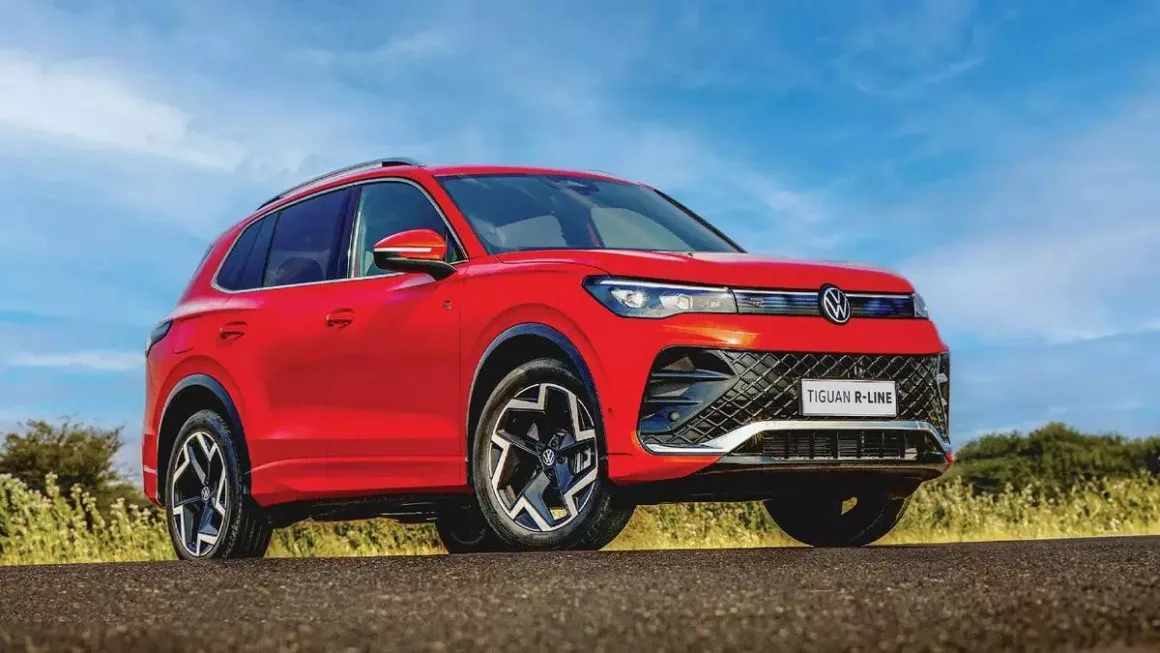
The actual fireworks are in Volkswagen’s flagship SUV, the Tiguan R-Line. Large SUVs (over 4m, >1500cc) were nearly 50% tax in the old regime. GST 2.0 brings that rate down to 40%, and that is a humongous push for the Tiguan.
The Tiguan’s ₹3.27 Lakh Advantage
The Tiguan R-Line now gets cheaper by ₹3,26,900. That’s nearly five times the benefit offered on the Taigun and Virtus, and it changes how the Tiguan stacks up against rivals like:
- Toyota Fortuner (₹3.49 lakh GST cut)
- Skoda Kodiaq (similar tax benefit, as part of VW Group)
- Hyundai Tucson and Jeep Compass (mid-to-premium SUVs) are also affected by GST cuts.
For a buyer in the ₹40–50 lakh bracket, a reduction of over ₹3 lakh is a strong motivator. It can make the difference between choosing a mid-trim or splurging on the fully loaded variant.
Volkswagen Cars over 1200cc and more than 4000mm
| Car | Price Before GST Update | Price After GST Update | Difference |
| Volkswagen Tiguan R-Line | ₹35,50,000–₹38,50,000 | ₹32,30,000 – ₹35,40,000 | ₹3,00,000 – ₹3,26,900 |
Broader Impact on Volkswagen’s Premium Strategy
The Tiguan has always been promoted as a luxury alternative to Toyota’s muscular Fortuner. Cost-sensitive consumers often preferred Toyota while appreciating Volkswagen’s elegance. Now that both SUVs benefit similarly from GST, the Tiguan appears a better value-driven option for urban families who appreciate elegance over muscularity.
Summary: How has the GST update affected Volkswagen cars
The GST 2.0 update has tilted the scales in Volkswagen’s favour across all three of its current models in India.
- Virtus sedan: Cheaper by up to ₹66,900, making it more competitive against the Honda City and Hyundai Verna.
- Taigun SUV: Gets a reduction of up to ₹68,400, helping Volkswagen claw back ground in India’s hottest segment, the mid-size SUV category.
- Tiguan R-Line: The biggest gainer with a price cut of up to ₹3.27 lakh, dramatically improving its appeal in the premium SUV market.
For consumers, that means improved value for money across Volkswagen’s range. For the company, it offers the promise of higher sales momentum during the festival season, higher competitiveness vis-à-vis established rivals, and a way to shed the “slightly overpriced” tag that clings to its products.
Overall, GST 2.0 is a boon for Volkswagen, as it makes its automobile offerings cheaper. It favours aligning its prices globally with the brand image of supplying sturdy, high-end quality automobiles.
FAQs about GST Impact on Volkswagen Cars
Q. What is the GST 2.0 impact on Volkswagen cars?
Under GST 2.0, Volkswagen cars are now taxed at 40% instead of 45–50%. This has made the Virtus, Taigun, and Tiguan R-Line significantly cheaper.
Q. Which Volkswagen car gets the biggest price cut?
The Tiguan R-Line gets the largest benefit, with prices reduced by up to ₹3,26,900.
Q. How much cheaper are the Volkswagen Virtus and Taigun?
The Virtus is cheaper by up to ₹66,900, and the Taigun by up to ₹68,400, making both models more competitive in their respective segments.
Q. When will the new GST prices for Volkswagen cars come into effect?
The revised GST prices are effective from September 22, 2025, across all Volkswagen dealerships in India.
Q. Will Volkswagen sales improve after GST 2.0?
Most likely, yes. By making its cars more affordable, especially the premium Tiguan, Volkswagen stands to gain stronger demand in both mid-size and premium categories.
Q. Does GST 2.0 apply to all variants of Volkswagen cars?
Yes. While the exact benefit may vary slightly depending on variant and trim, all models, Virtus, Taigun, and Tiguan R-Line are covered under GST 2.0 benefits.