One of the most crucial factors influencing your car insurance premium and claim settlement is the Insured Declared Value or IDV. Yet, many car owners aren’t fully aware of what IDV actually means and how it affects their policy. If you’re wondering why your premium differs from others or what your insurer might pay in case of a total loss, IDV holds the answer.
In this blog, we will decode IDV meaning, the concept of IDV in car insurance, how it is calculated, and why it plays a vital role in your coverage.
What Does IDV Mean?
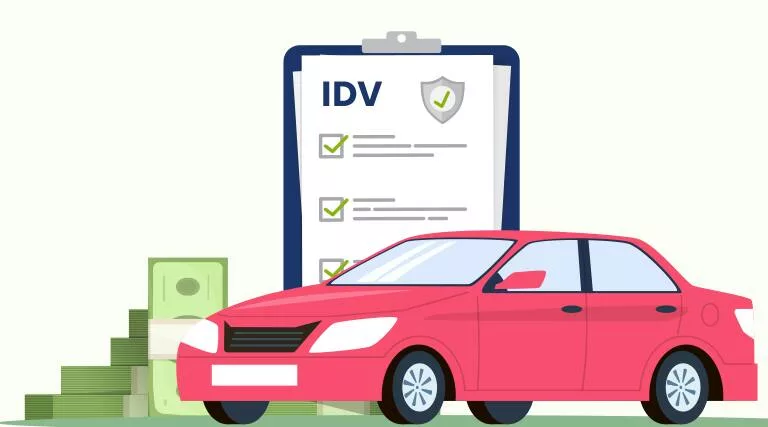
IDV, or Insured Declared Value, is the maximum amount your insurance provider will pay if your car is stolen or declared a total loss due to an accident. Simply put, it is the current market value of your car, excluding registration costs and insurance. IDV represents the value mutually agreed upon between you and your insurer at the beginning of the policy. It is not a fixed number but decreases over time due to depreciation.
For instance, if your car is insured for an IDV of INR 5 lakh, and it is stolen or completely damaged beyond repair, the insurer will reimburse up to INR 5 lakh (after applicable deductions). Thus, IDV directly impacts both your premium and your potential payout.
How IDV is Calculated
The calculation of IDV is straightforward but varies slightly depending on whether your vehicle is brand new or used. For new vehicles, the IDV is generally based on the manufacturer’s listed price for the model (excluding registration and taxes). For older vehicles, depreciation plays a significant role. The insurer uses standard depreciation rates based on the car’s age:
- Up to 6 months: 5%
- 6 months to 1 year: 15%
- 1 to 2 years: 20%
- 2 to 3 years: 30%
- 3 to 4 years: 40%
- 4 to 5 years: 50%
For cars older than 5 years, IDV is usually agreed upon mutually between the policyholder and insurer after inspecting the vehicle’s condition.
Example: If the ex-showroom price of your car was INR 8 lakh and it is now 2.5 years old, a 30% depreciation would apply. Your current IDV would be INR 5.6 lakh (8 lakh – 30%).
Insurers may also consider factors such as:
- Model and variant
- City of registration
- Mileage and condition (in case of inspection)
- Fitted accessories (OEM and aftermarket)
Role of IDV in Premium Calculation
IDV is one of the primary determinants of your car insurance premium, especially for comprehensive policies. The higher the IDV, the higher your premium, and vice versa. This is because a higher IDV increases the insurer’s liability in the event of total loss or theft.
Formula: Premium for Own Damage cover = (IDV*Rate) + Add-on Costs – Applicable Discounts
Note that third-party insurance premiums are regulated by IRDAI and are not affected by IDV.
In other words, if you declare a lower IDV, your premium will reduce, but so will your coverage amount. This may lead to financial strain in case of a major mishap. Hence, balancing the right IDV and premium is key.
High vs Low IDV – Pros and Cons
Choosing a high or low IDV has trade-offs. Let’s explore both sides:
High IDV
Pros:
- Better claim payout in case of total loss or theft
- Peace of mind
Cons:
- Higher premium cost
Low IDV
Pros:
- Lower premium
Cons:
- Reduced payout at claim time
- Higher out-of-pocket expenses
It may be tempting to lower your IDV to save on premiums, but doing so might backfire if your vehicle suffers major damage. On the flip side, an unrealistically high IDV might unnecessarily inflate your insurance cost.
IDV for New vs Used Cars
The impact of IDV is different depending on the age of your car.
For New Cars:
- IDV is based on the ex-showroom price.
- Lower depreciation (5% to 15%) means higher IDV
- Insurers often provide the highest claim coverage.
For Used Cars:
- IDV is calculated after factoring in depreciation.
- After 5 years, IDV is negotiated based on vehicle condition.
- Accessories, modifications, and wear-and-tear play a role.
Owners of used cars often face challenges in setting a reasonable IDV. A very low IDV may reduce the claim payout significantly, especially if the vehicle has been well maintained.
Can You Modify IDV?
Yes, insurers typically offer a range within which you can choose your IDV at the time of purchasing or renewing your policy. This allows some flexibility based on your premium budget and coverage expectations.
- Increase IDV: For better claim coverage (higher premium)
- Decrease IDV: To reduce premium (lower claim payout)
However, the allowed variation is usually limited to a 10% range (up or down) from the insurer’s calculated IDV. Modifying IDV too drastically may lead to rejection during claim settlement or scrutiny.
IDV in Case of Theft or Total Loss
IDV becomes extremely crucial when your car is stolen or declared a total loss (repair cost is greater than 75% of IDV).
Theft Scenario:
- File an FIR immediately
- Submit insurance claim
- If the car is not recovered within a stipulated time (usually 90 days), the insurer settles the claim for the IDV amount minus deductibles
Total Loss Scenario:
- A surveyor inspects and assesses the damage
- If repair cost is more than 75% of IDV, the vehicle is declared a total loss
- Consider clarifying: “minus deductibles and depreciation on non-OEM parts or accessories.
In both cases, IDV is the ceiling on what you can claim, making it a vital part of your policy’s value proposition.
Conclusion
Understanding IDV in car insurance is not just about knowing your premium, it’s about ensuring you’re adequately protected in worst-case scenarios. IDV determines your payout in case of theft or total loss, and balancing it correctly with your premium is essential for optimal coverage.
Whether you drive a brand-new sedan or a five-year-old hatchback, the right IDV can make a big difference in your insurance experience. So next time you renew your policy, take a few extra minutes to understand and customize your IDV wisely.
Also Read: Everything You Need To Know About Car Insurance Premium
FAQs
Q1. Is IDV the same as resale value?
No, IDV (Insured Declared Value) is not the same as the resale value of your car. IDV refers to the maximum amount your insurer will pay you in case your car is stolen or completely damaged beyond repair. It’s calculated based on the car’s age and depreciation—not on market demand or buyer sentiment. In contrast, the resale value is what you may get when you sell your car in the second-hand market, and it may be higher or lower than the IDV depending on various factors.
Q2. What happens if I set a lower IDV?
Setting a lower IDV can help you save on your insurance premium, as the amount insured is less. However, this also means that your compensation will be lower if your car gets stolen or faces total damage. So, while the premium may look cheaper, you might end up with a reduced claim amount when you need it most. It’s important to strike the right balance and avoid underinsuring your vehicle.
Q3. Can I negotiate the IDV with my insurer?
Yes. Most insurers allow some room to negotiate the IDV at the time of buying or renewing your policy. Generally, you can adjust it within a 10% range (either up or down) of the IDV suggested by the insurer. If you feel your car is in excellent condition or has modifications, you may request a slightly higher IDV. But remember, a higher IDV means a higher premium.
Q4. Does IDV affect third-party insurance?
IDV has no role in third-party insurance. A third-party policy is meant to cover any liability arising due to damage caused to another person or property. It doesn’t offer any coverage for your own car, so the concept of IDV is only relevant if you are purchasing your own damage or comprehensive policy.
Q5. Is it mandatory to have an IDV in car insurance?
Yes, IDV is mandatory if you are buying a comprehensive or standalone own damage insurance policy. It serves as the declared value of your vehicle and forms the basis for compensation in case of theft or total loss. However, if you’re opting only for a third-party insurance policy, then IDV is not required, as the policy doesn’t cover damages to your own car.