Have you ever seen a driver pressing a car’s accelerator hard and wondered why the car is not moving? It is because the driver has not engaged any gear. A gearbox or transmission system is what connects the engine to the wheels of the car, and until a gear is engaged, the car does not move, no matter how hard you press the accelerator. The gears differ in size and are designed for different ranges of the car’s speed, so they are required to be engaged accordingly. While the job of every gearbox or transmission system is to transmit the mechanical energy produced in the engine to the wheels, there are different types of transmission systems that cars are equipped with.
Sequential Manual Transmission (SMT)
Sequential manual transmission is commonly used in race cars, motorcycles, and sports vehicles. The transmission type does not use the traditional H-pattern gear shift. Rather, the gears are switched in sequence — either upward or downward — via a lever or paddle shifters.
Though it’s comparable to manual car transmission in that it involves the use of a clutch and gears, the SMT does not accommodate skipping the gears (shifting from 1st to 3rd, say). Rather, you shift from gear to gear in sequence. This configuration is well suited to racing environments where rapid, accurate shifts are paramount. Though not found in typical passenger vehicles, SMTs are evidence of how diverse and mission-specific a car gear system can be.
Hydrostatic Transmission
A hydrostatic transmission system employs hydraulic fluid to pass power from the engine to the wheels. In contrast with a mechanically based car transmission, it does not use a series of gears. Rather, it controls speed and torque by fluid dynamics.
This vehicle transmission is commonly found on tractors, lawnmowers, and heavy-duty vehicles in the construction industry because of its stepless and smooth operation. Although not found in standard passenger vehicles, it is still used as an important category of car transmission in automotive technology, in particular applications where precision and handling are valued more than speed or mileage.
Infinitely Variable Transmission (IVT)
An Infinitely Variable Transmission (IVT) is a more specialised form of the Continuously Variable Transmission (CVT). While CVTs provide very broad gear ratios, IVTs take it to the next level by enabling the possibility of a gear ratio of zero. This allows the engine of the car to continue to rev with the wheels not moving.
This transmission car configuration makes smooth acceleration and optimal efficiency possible. IVTs are more commonly located in industrial machinery or highly efficient hybrids, but are still a niche example within the vast world of transmission types.
Multimode Manual Transmission (MMT)
The Multimode Manual Transmission (MMT) is how Toyota has interpreted integrating manual and automatic technology into a car transmission. It keeps the standard gearstick but takes the clutch operation out of the equation, so drivers don’t have to press down on the clutch pedal to shift the gears.
This type of transmission gives you the efficiency of a manual transmission in car design, but with the ease of an automatic. It is particularly advantageous to those who like manual control of the gear shifts but don’t want to deal with the physical inconvenience of having to use a clutch. MMTs solve the problem many consumers face, saying, “What type of transmission should I choose for both efficiency and ease?”
Hybrid Transmissions (eCVT)
Electronic Continuously Variable Transmissions (eCVTs) are special vehicle transmission systems found in hybrid and electric vehicles. Although based on the same principle as in a normal CVT, eCVTs consist of a highly intricate set of planetary gearsets and electric motors.
Such transmission systems are programmed to provide optimal performance of both the electric motor and the internal combustion engine with smooth gear shifting and enhanced fuel efficiency. If you are looking into what is transmission in a car with futuristic or environmentally friendly considerations, eCVTs are the best example of how transmission types are changing.
Manual Transmission

Manual transmission is the oldest and most basic type of transmission. That is not to say it is outdated. Even today, cars with manual transmissions sell far more than cars with other types of transmissions. This is because of some solid reasons. Firstly, with the manual transmission, one can make their car deliver the best of its fuel efficiency. Next, manual transmissions are the simplest and most affordable to maintain. Moreover, manual transmissions are the favourite of those who want maximum engagement with their cars. Driving a manual transmission is a skill that needs to be learnt and practised to understand how to get the most efficiency, power, and acceleration from the car.
The construction of a manual transmission consists of several gears (usually 4 to 6). These gears are designed and fitted to mesh with the crankshaft, which is connected to the wheels. A clutch is used to engage and disengage the gearbox with the crankshaft. When the driver presses the clutch pedal, it disengages the gearbox from the crankshaft. Then, the driver selects the required gear with a gear stick and releases the clutch pedal to reengage the gearbox with the crankshaft.
Intelligent Manual Transmission or iMT
Also known as ‘Clutch-less manual transmission,’ the intelligent manual transmission is almost similar to the manual transmission. However, in an iMT, there is no clutch pedal as the clutch is automatically operated by the electronic control unit (ECU) with the help of sensors and actuators. While the clutch is automatically worked by the ECU, the regular H gearbox with a gearstick is there for you to change gears. While iMTs have been used globally for a long time, Hyundai and Kia are the only manufacturers to offer them in India.
Automatic Transmission
As the name suggests, an automatic transmission is a system that shifts gears automatically. The automatic transmission uses sensors to monitor the vehicle’s speed as well as the engine’s RPM (Revolutions Per Minute) and switch the gear ratio with the help of an electronic control unit (ECU). The automatic transmission can be further categorised into a few types.
Automated Manual Transmission
The Automated Manual Transmission, aka AMT, is an advanced version of the manual transmission. Like a traditional manual transmission, the AMT has gears that are engaged and disengaged with the crankshaft via the clutch. What makes the AMT different from the manual transmission is that the clutch work and gear shifting are automatically handled by an electronic control unit (ECU). For this purpose, gear ratios are pre-calibrated on the ECU and work within the preset RPM range. When the sensors of the ECU gauge optimum RPMs, the ECU activates the actuators which work the clutch and gearbox. AMTs are the most affordable automatic transmissions. In India, many cars come equipped with AMTs, for example, the Maruti Alto, Maruti Wagon R, Tata Tiago, Maruti Swift, Hyundai Grand i10 Nios, Tata Nexon, and more.
Torque Converter Transmission
The torque converter is the oldest and most time-tested kind of automatic transmission. In a torque converter automatic, two turbines are present instead of the clutch plate. One is connected to the engine and the other to the transmission. A specific fluid between both the turbines transfers power from the turbine located on the engine side to the one located on the transmission and thus induces vehicular movement. Torque converters are fuel-efficient but, due to their engineering complexity, are costlier than automated manual transmissions. In India, many cars offer torque converter automatics, for example, the Maruti Brezza, Kia Sonet, Kia Syros, Hyundai Creta, Tata Harrier, and more.
Continuously Variable Transmission
Continuously variable transmission essentially means a transmission in which gear ratios are continuously varying. This happens because of a continuously variable transmission, aka CVT, which works on a pulley system instead of a gearbox. One pulley is connected to the engine and another to the differential that rotates the wheels. Two cones at each pulley are connected via a chain belt, and these cones can move to increase or decrease the belt diameter to change gear ratios. This property of CVT allows it to have infinite gear ratios that the transmission can quickly shift into based on the car’s requirements.
The main advantage of a CVT transmission is that it can maintain constant engine RPMs while the vehicle moves at different speeds. This maximises fuel economy and gives a smooth driving experience. A CVT automatic transmission is one of the more affordable automatic gearboxes available but is expensive to repair. In India, cars equipped with a CVT include the Hyundai i20, Hyundai Creta, Renault Kiger, Honda Amaze, Honda City, Honda Elevate, and more.
Dual-Clutch Transmission
Also known as a Direct Shift Gearbox (DSG), a dual-clutch transmission has two clutches and two gear sets that are placed in odd and even groups, for example, 1-3-5 and 2-4-6. Both sensor-based clutches are respectively linked to two cylindrical shafts, which are placed concentrically (one encases another) and are independent of each other. One clutch engages the odd-numbered set of gears, while the other engages the even-numbered set. The mechanism is such that when a car is running at a particular gear, the next and previous gears already remain engaged by the other clutch.
For example, if the car is running in 3rd gear, the sensor-linked computer will predict the next needed gear that could be either 4th or 2nd on the subsequent shaft. If the car accelerates, the computer will automatically disengage the clutch connected to the shaft with odd-numbered gears (3rd) and engage the clutch connected to the shaft with even-numbered gears, on which it had already kept the 4th gear preselected. All the same, due to complex construction, the dual-clutch transmission is the most expensive of all automatic transmissions. A few examples of cars with dual-clutch transmissions are the Tata Nexon, Tata Curvv, Hyundai Creta, Kia Seltos, and Kia Sonet.
Tiptronic Transmission
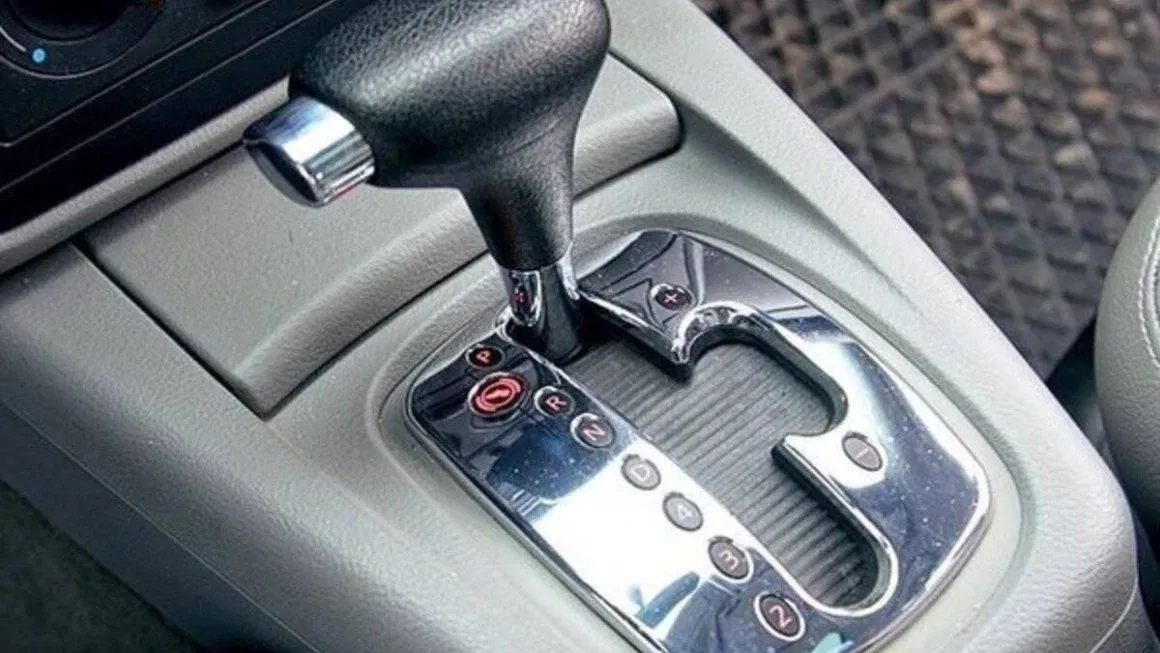
Also referred to as ‘Sportmatic’ and ‘Steptronic,’ the Tiptronic transmission is a type of automatic transmission which has a manual gear-shifting mode. To put it in simpler words, with the Tiptronic transmission, the driver has the option to manually shift the gears whenever needed. The cars with Tiptronic transmission come with either a gear lever behind the steering wheel or a second gear panel to the right of the original gear stick plate or paddle shifters. The Tiptronic transmission differs from a semi-automatic transmission as it uses a torque converter instead of a clutch to shift gears.
The appearance of a Tiptronic transmission arrangement varies from car to car. However, the standard form is the ‘+’ and ‘-‘ symbols at two ends of the Tiptronic lever’s column, where ‘+’ stands for ‘upshift’ and ‘-‘ stands for ‘downshift.’ You need to push the lever forward for an upshift and pull the lever back for a downshift. The same can be done with paddle shifters (if available). In the Tiptronic mode, gear shifts must be done in order of the gears, which means the driver cannot omit any gears from the sequence; for example, the driver cannot shift from first gear to third gear. Most cars with Tiptronic transmission will still automatically shift gears to protect the engine, even when the driver is driving in manual mode.
Functions of a Transmission
So, what is transmission in a car actually supposed to do? It’s not merely about shifting gears; the transmission system is responsible for how your car performs, drives, and reacts on the road. Here’s a more detailed overview of the important functions of a car transmission:
1. Power Transfer from Engine to Wheels
A vehicle transmission’s primary role is to spread the mechanically generated power from the engine to the wheels that are driven. Without the transmission car configuration, the car would not budge regardless of how hard you press the acceleration pedal.
2. Controlling Speed and Torque
One of the primary roles of the car gear system is to balance speed and torque. Lower gears give more torque in order to propel the car from rest, but higher gears enable more speed with less engine effort. This power shift maintains smooth acceleration and braking.
3. Enhancing Fuel Efficiency
A well-functioning transmission in a car keeps the engine operating in its optimal RPM range, which offers better economy. Manual, CVT, and dual-clutch transmission types achieve this differently, yet to the same end: get the best out of each drop of fuel.
4. Ensuring Engine Longevity
By keeping the engine from operating at too high RPMs, the transmission system also spares it from excessive wear and overheating. Accurate gearing ratios minimise the load on engine parts and thereby increase the life of your car.
5. Providing Driving Comfort and Control
Whether you’re going uphill, on the freeway, or in downtown traffic, the type of transmission you have impacts how responsive and comfortable your ride is. Automatics provide smooth changes, and manuals provide more control.
Location of the Transmission
The location of the transmission in a car will vary with the drivetrain layout. In the majority of front-wheel-drive vehicles, the transmission car unit is positioned in the engine compartment, adjacent to the engine. In this space-saving design, the transmission and differential are united into one unit, which is referred to as a transaxle.
The transmission system in rear-wheel-drive vehicles tends to be placed behind the engine and attached to the back axle by a driveshaft. This configuration gives the weight distribution a more balanced feel and is typical in sports vehicles and SUVs.
Irrespective of the design, all car gear systems are directly connected to the engine and are an indispensable part of the drivetrain. Knowing the location of your car transmission is not mere trivia; it is useful in identifying problems, estimating repair costs, or simply knowing how your vehicle transmission operates.
Transmissions in cars such as contemporary EVs and hybrids might appear different or be built into electric motors, but they serve the same fundamental task of providing efficiency and reliability in power transfer.
How Does a Manual Transmission Work?
A manual transmission is the most driver-interacting transmission car system. It gives the driver direct control of how power from the engine is transferred to the wheels. So, how does this car transmission work exactly?
When you push down on the clutch pedal in a manual vehicle transmission, you’re separating the engine from the car’s gear system. This is the momentary separation that allows you to shift into gear with the gear lever without damaging the gears or grinding them. When you release the clutch, the engine is connected back to the wheels, and your car will move.
Each gear is intended to accommodate a certain range of speeds. Lower gears are used to provide more torque to accelerate from a standing position or to climb hills, and the higher gears decrease engine work when cruising. The driver is responsible for actively timing the gear changes to provide smooth and efficient operation. That’s why driving a manual transmission system is more engaging and frequently more enjoyable to drivers who like to be in control.
If you want to know what type of transmission is best in terms of either skill-based operation or gas mileage, the manual remains in the running.
How Does a Car Transmission Work?
Manual or automatic, the work of any transmission in car is the same — to send engine power to the wheels in an efficient and controlled way. But what happens under the hood?
A car’s transmission has multiple (series of) gears (or pulleys, in the case of CVT) that shift the engine’s torque and speed output. The transmission is attached to the crankshaft on one end and the driveshaft or the differential on the other. The transmission system selects the appropriate ratio of gears depending on how fast the vehicle is moving and how hard the engine is operating.
In manual vehicle transmission, the driver operates the gear himself/herself by utilising a clutch and gear lever. In automatic configurations like AMT, CVT, torque converter, or DCT, the system is dependent on sensors and electronic control units (ECUs) to make these choices on your behalf.
Regardless of what type of transmission your car is fitted with, its fundamental job is to ensure that the engine is able to work effectively and the drive is smooth. It acts as a link between engine power and wheel rotation and your car would be nothing more than a clunky, stationary object if it didn’t exist.
What Does a Transmission Do?
If you’re wondering what does a transmission do, here’s a simple explanation: it connects the engine to the wheels and controls how power is delivered. In short, a car transmission allows your engine to operate within an optimal RPM range while giving you the speed and torque needed to drive under different conditions.
Whether you drive a manual transmission car or an automatic one, the transmission system plays a vital role in how the vehicle accelerates, cruises, and climbs. By adjusting gear ratios based on speed and load, the vehicle transmission ensures a balance between performance and fuel efficiency.
Without the car gear system, the engine would either stall at low speeds or overwork itself at high speeds. So, no matter what type of transmission your car has, AMT, CVT, DCT, or a traditional manual, it’s essential for smooth and controlled driving.
How to Keep the Transmission of Your Car Healthy?
Having a healthy transmission system is essential to a smooth and enduring drive. Whether you have a luxury automatic or a basic manual transmission car, some care is enough. Here’s how to take care of it:
- Check and Replace Transmission Fluid: Like engine oil, transmission fluid should be checked and replaced according to your car’s maintenance schedule. Dirty or low fluid can cause overheating and gear slippage, especially in car transmission systems.
- Avoid Aggressive Driving: Sudden acceleration, hard braking, and missing gears can harm your car’s gear system in the long term. Drive smoothly and shift gears softly, particularly in manual vehicles, to prolong the life of your transmission in car.
- Don’t Ignore Unusual Sounds or delays: Grinding sounds, rough gear shifts, or delayed responses are all signs of a problem with your vehicle transmission. Have it repaired right away before things get any worse.
- Use the Right Gear for the Situation: Refrain from operating in higher gear when proceeding slowly, and keep your foot off the clutch pedal in manual vehicles. In automatic vehicles, don’t shift from ‘Drive’ to ‘Reverse’ with the car still in motion — it strains transmission car parts.
- Keep Up With Regular Maintenance:Adhere to your manufacturer’s maintenance schedule and get your transmission types checked under maintenance. Preventive maintenance is always more cost-effective than big repairs.
By taking these simple steps, your transmission system will be able to work smoothly and last longer, no matter what kind of transmission you have.
Types of Car Transmissions: Summary
A car’s transmission is what connects and channels the engine’s power to the wheels, which eventually makes the vehicle drive. Broadly, there are two types of car transmissions: Manual Transmission and Automatic Transmission. Automatic transmissions can be further categorised into several types: Automated manual transmission, Torque converter, Continuously variable transmission, Dual-Clutch transmission, and Tiptronic transmission. There is another special type of transmission known as an Intelligent manual transmission, which hits the middle point between a manual transmission and an automatic transmission.
FAQs
Which types of car transmissions are available in India?
The car transmissions available in cars in India are manual gearbox, Intelligent manual transmission, Automated manual transmission, Torque converter automatic transmission, Continuously variable transmission, Dual-clutch automatic transmission, and Tiptronic transmission.
Which automatic car transmissions are available in cars under Rs 10 lakh?
The automatic cars under Rs 10 lakh mostly have automated manual transmissions or continuously variable transmissions.
Which is the best-selling car transmission in India?
The manual transmission is the best-selling car transmission in India.
Which type of car transmission is best?
The selection of a transmission depends mainly on the budget and choice of the individual wanting to buy a vehicle. A manual transmission offers a deeper connection with the car while automatics offer more driving convenience. If you are unfamiliar with a manual transmission, we would recommend you go for a semi-automatic transmission or an automatic transmission but if you really want to relish driving then CVT and DCT transmissions, although expensive, are the ones to choose from.
Which Indian car has a semi-automatic option?
Hyundai’s iMT and Maruti Suzuki’s Auto Gear Shift (basically an AMT) is a fully semi-automatic transmission systems. There is no clutch but you do get a manual gear shifter stick. These kinds of transmissions are less expensive than their fully automatic counterparts but partly offer the convenience they have.
What is Automated Manual Transmission?
The AMT is a kind of semi-automatic transmission where the engine performs the manual shifting of gears. The Automated Manual Transmission system though a fully automatic gear shifting system also offers a ‘manual mode’ which involves nudging the drive mode gear lever to increase and decrease gears.