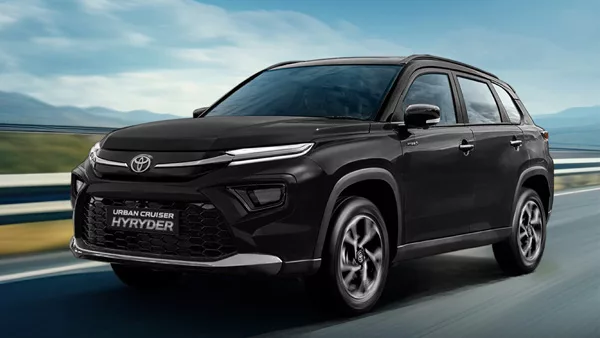
The Toyota Urban Cruiser Hyryder and the Volkswagen Taigun belong to the mid-size SUV segment, but their designs differ markedly because they prioritise different things. The focus of the Hyryder is on fuel efficiency, which means it is available with petrol, strong-hybrid and CNG powertrains. The Taigun, on the other hand, while being petrol-powered only, puts a higher emphasis on its turbocharged performance with its 1-litre and 1.5-litre TSI engines. It goes without saying that there is a big difference in figures, with the Hyryder strong-hybrid delivering 27.97 km/l while the best-performing Taigun is rated at 19.98 km/l.
Real-world testing reinforces that gap. The Hyryder strong hybrid has returned more than 20 km/l in both city and highway conditions, while the Taigun 1.5 DSG trades efficiency for significantly more power and torque. The comparison becomes much closer if you remove the strong hybrid and look only at conventional petrol versions, but for buyers primarily concerned about mileage and running costs, the Toyota has a clear advantage.
Table of Contents
Toyota Hyryder vs Volkswagen Taigun Specs
The Toyota Hyryder is available with three powertrain options. The NeoDrive petrol of 1.5 litres produces around 103PS and 136.8Nm of torque with both manual and 6-speed automatic transmissions. The strong hybrid features a combination of a 1.5-litre Atkinson cycle petrol drive and an electric motor for a total power of 115.56PS. It benefits from eCVT and is capable of functioning solely on electric power for limited distances. In addition, the manufacturer offers a factory CNG version capable of producing around 87.8PS and 121.5Nm.
The Volkswagen Taigun keeps things simpler. Its 1.0-litre TSI produces 115PS and 178Nm and is available with a 6-speed manual or newer 8-speed automatic. The stronger 1.5-litre TSI produces 150PS and 250Nm and is paired with a 7-speed DSG. Unlike the Hyryder, the Taigun does not offer hybrid, diesel or CNG powertrains.
| Specification | Toyota Hyryder | Volkswagen Taigun |
| Base petrol | 1.5L, ~103PS / 136.8Nm | 1.0L TSI, 115PS / 178Nm |
| Stronger powertrain | 1.5L strong hybrid, 115.56PS combined | 1.5L TSI, 150PS / 250Nm |
| CNG | 1.5L factory CNG | Not available |
| Transmission | 5MT / 6AT / e-CVT | 6MT / 8AT / 7DSG |
| Drive layout | FWD / AWD on select petrol | FWD |
| Fuel tank | 45 litres | 50 litres |
There is no doubt that the Taigun wins in the performance stakes, especially in the version with the 1.5 TSI engine. Nevertheless, the Hyryder has more appealing powertrain options and is primarily focused on low fuel consumption.
Toyota Hyryder vs Volkswagen Taigun Claimed Mileage

The Hyryder’s regular petrol manual is rated at 21.12 km/l, while the automatic claims 20.58 km/l. The AWD petrol version is slightly lower at 19.39 km/l. The strong hybrid is the standout at 27.97 km/l, while the factory CNG version is rated at 26.6 km/kg.
While the current version of the Taigun 1.0 TSI manual gets a claim of 19.98 km/l, the latest 8-speed automatic version claims 19.54 km/l. The 1.5 TSI DSG claims to get a mileage of 18.85 km/l. These statistics may seem impressive for a turbo-petrol SUV, but they still fall short of the regular petrol figures of the Hyryder and are way behind the hybrid.
| Car | Engine & Transmission | Fuel Type | Claimed Mileage |
| Toyota Hyryder | 1.5 petrol MT | Petrol | 21.12 km/l |
| Toyota Hyryder | 1.5 petrol AT | Petrol | 20.58 km/l |
| Toyota Hyryder | 1.5 petrol AWD | Petrol | 19.39 km/l |
| Toyota Hyryder | Strong Hybrid e-CVT | Petrol-hybrid | 27.97 km/l |
| Toyota Hyryder | CNG MT | CNG | 26.6 km/kg |
| Volkswagen Taigun | 1.0 TSI MT | Petrol | 19.98 km/l |
| Volkswagen Taigun | 1.0 TSI 8AT | Petrol | 19.54 km/l |
| Volkswagen Taigun | 1.5 TSI DSG | Petrol | 18.85 km/l |
In terms of official numbers, the Hyryder tops in all key comparisons on efficiency; its ordinary petrol manual is also rated higher than the most fuel-efficient Taigun.
Also Explore: Toyota Hyryder Image Gallery: Interior and Exterior
Toyota Hyryder vs Volkswagen Taigun Real-World Fuel Efficiency
The Hyryder strong hybrid has returned approximately 20.28 km/l in city driving and 22.85 km/l on highways in instrumented testing. That gives a simple combined reference of around 21.57 km/l. What makes this particularly impressive is how little the mileage drops in traffic, where conventional petrol SUVs usually suffer the most.
The Taigun 1.5 TSI DSG achieved an efficiency of approximately 8.66 km/l in urban conditions and 16.98 km/l while driving on highways, averaging a mixed figure of about 12.82 km/l. While this is an acceptable performance for a 150PS turbo-petrol SUV, it is still far from the performance of the Toyota hybrid.
| Hyryder Strong Hybrid | Taigun 1.5 DSG | |
| City | 20.28 km/l | 8.66 km/l |
| Highway | 22.85 km/l | 16.98 km/l |
| Combined reference | ~21.57 km/l | ~12.82 km/l |
| Fuel tank | 45L | 50L |
| Approx. mixed range | ~971 km | ~641 km |
Despite having a smaller fuel tank, the Hyryder achieves better efficiency in real conditions; this results in a much longer theoretical driving range.
Why Is the Hyryder Hybrid So Efficient in the City?
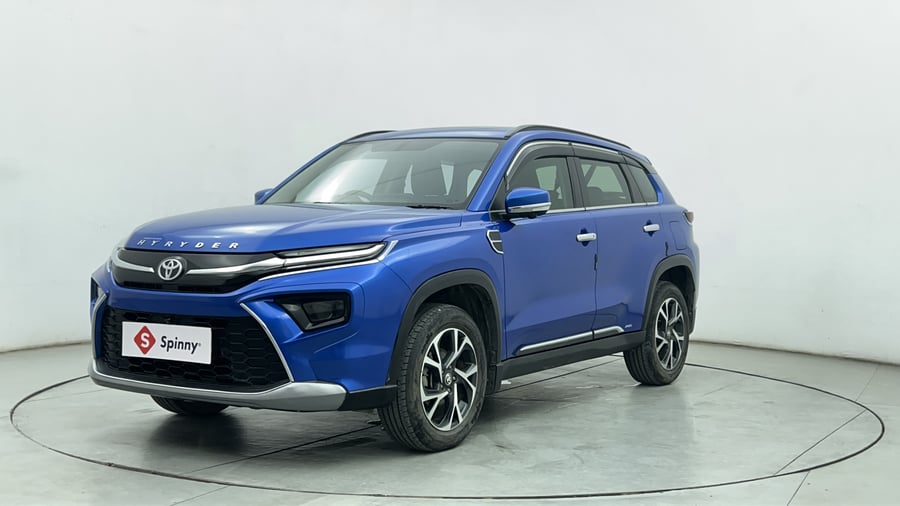
The strong-hybrid system works especially well in stop-start traffic. At low speeds, the Hyryder can move using electric power alone for short periods, allowing the petrol engine to remain switched off. It can also recover energy during braking and deceleration and reuse that stored energy during acceleration.
This means that the Hyryder does not experience the typical urban mileage penalty associated with standard petrol SUVs Its city figure over 20 km/l is comparable to its highway mileage, which is unexpected for vehicles of this capacity.
The Taigun 1.5 TSI works differently. Its turbocharged engine is built to deliver strong acceleration, and repeated boost and acceleration in city traffic increase fuel consumption. The Volkswagen rewards the driver with much stronger performance, but that performance has a clear fuel-efficiency cost.
Also Explore: Volkswagen Taigun Image Gallery: Interior and Exterior
Regular Hyryder Petrol vs Taigun 1.0 TSI
The similarity is far more accurate when the strong hybrid variant, the Hyryder, is eliminated from the comparison. The basic NeoDrive petrol manual has registered a figure of about 10.83 km/l in the city, while it achieved 15.67 km/l on highways during the tests. The overall figure obtained is slightly below 13.25 km/l.
The current Taigun 1.0 TSI automatic has returned around 13.94 km/l on a long highway run, while broader tested references place overall economy around the low teens depending on conditions. Because these figures come from different test formats, it would be misleading to declare an exact real-world winner between the regular petrol versions.
Officially, though, the Hyryder maintains the lead: 21.12 km/l for the petrol manual versus 19.98 km/l for the Taigun 1.0 TSI manual. The Taigun, though, has the advantage of significantly higher torque; hence, it is stronger when it comes to overtaking or driving under load.
Toyota Hyryder CNG Mileage

The Hyryder gives buyers another low-running-cost option through its factory CNG powertrain. Toyota rates it at 26.6 km/kg, while output drops to around 87.8PS and 121.5Nm.
Since there is no equally robust current instrumented Hyryder CNG test for an accurate real-world comparison with the Taigun, it is safer not to craft a fuel costs table based on an estimated CNG figure.
What is clear is that the Taigun has no equivalent CNG option. Buyers looking specifically for lower fuel costs without paying for the strong hybrid therefore have an additional choice in the Hyryder range.
Also Read: Toyota Hyryder Mileage Comparison: Petrol vs CNG vs Strong Hybrid
Toyota Hyryder vs Volkswagen Taigun Fuel Cost Comparison
To simplify the comparison of ownership costs of two vehicles, the Hyryder Strong Hybrid and the Taigun 1.5 DSG, let’s begin with the assumption that we drive 1,500 km monthly, which amounts to 18,000 km annually, while petrol is priced at ₹102.12 per litre in New Delhi in September 2026.
| Hyryder Strong Hybrid | Taigun 1.5 DSG | |
| Reference Mileage | 21.57 km/l | 12.82 km/l |
| Monthly Fuel Use | ~69.5L | ~117.0L |
| Monthly Fuel Cost | ~₹7,102 | ~₹11,949 |
| Annual Fuel Cost | ~₹85,200 | ~₹1.43 lakh |
| 5-Year Fuel Cost | ~₹4.26 lakh | ~₹7.17 lakh |
The Hyryder strong hybrid is a more economical option than the Taigun 1.5 DSG at the same mileage. It can save ₹4,850 every month in the city, which translates to ₹58,000 in a year, and more than ₹2.9 lakh over five years of usage covering 18,000km annually.
That is a major ownership-cost gap. The Taigun is much quicker and more powerful, but buyers covering large annual distances will spend considerably more on petrol.

Performance vs Efficiency
The power figures for the Taigun 1.5 TSI DSG are 150PS and 250Nm; the Hyryder strong hybrid, on the other hand, produces around 115.56PS in total. The difference can be clearly felt in the performance during acceleration as well as highway overtaking.
The Taigun also uses Active Cylinder Technology. Under light load, the engine can shut down two cylinders to reduce fuel consumption. This helps it produce strong highway mileage for a turbo-petrol SUV, even though it cannot match the Toyota’s hybrid system.
The strength of the Hyryder is not its power but its fuel economy. The vehicle has been built to lessen fuel consumption in day-to-day urban traffic, while the Taigun is made to provide great performance and a fun driving experience.
Also Read: Volkswagen Taigun Alternatives: Competitors of Volkswagen Taigun
Toyota Hyryder vs Volkswagen Taigun Price
The current Hyryder starts at approximately ₹11.31 lakh ex-showroom and goes up to around ₹19.99 lakh for the top strong-hybrid variant. Hybrid versions start considerably higher than the regular petrol models, so buyers have to pay more upfront to access the lowest running costs.
While the Taigun starts at around ₹11 lakh and goes up to around ₹19.30 lakh for the 1.5 DSG, it indicates that both the SUVs fall into a similar price range, although their costliest variants are aimed at serving completely different purposes.
| Model | Variant / Powertrain | Approx. Ex-showroom Price |
| Toyota Hyryder | E NeoDrive MT | ₹11.31 lakh |
| Toyota Hyryder | S Hybrid e-CVT | ₹17.18 lakh |
| Toyota Hyryder | G(O) Hybrid e-CVT | ₹19.24 lakh |
| Toyota Hyryder | V Hybrid e-CVT | ₹19.99 lakh |
| Volkswagen Taigun | Comfortline 1.0 MT | ₹11.00 lakh |
| Volkswagen Taigun | Highline 1.0 AT | ~₹13.80 lakh |
| Volkswagen Taigun | Highline Plus 1.0 AT | ~₹15.45 lakh |
| Volkswagen Taigun | Topline 1.0 AT | ~₹17.18 lakh |
| Volkswagen Taigun | GT Plus Chrome 1.5 DSG | ~₹19.00 lakh |
| Volkswagen Taigun | GT Plus Sport 1.5 DSG | ~₹19.30 lakh |
Though the starting prices are similar, buyers who wish to compare the higher-end variants will need to choose between Toyota’s hybrid economy and the performance provided by Volkswagen’s turbocharged engines.
Summary
The Toyota Hyryder is the clear mileage winner. Its strong-hybrid version returns around 20.28 km/l in the city, 22.85 km/l on highways and approximately 21.57 km/l combined in real-world testing. That is substantially better than the Taigun 1.5 DSG’s roughly 12.82 km/l combined reference.
The Volkswagen Taigun comes armed with an acclaimed 1.5 TSI engine which produces 150PS and 250Nm; this simply means that the performance possibilities it has win over those of the Toyota Hyryder hybrid. Hence, those interested in turbo-petrol vehicles may even want to ignore the fact that their fuel costs will rise.
Overall, choose the Toyota Hyryder if mileage, city efficiency, lower fuel costs or CNG availability are your priorities. Choose the Volkswagen Taigun if stronger performance, turbocharged torque and driving involvement matter more. For outright fuel economy and long-term running cost, the Hyryder strong hybrid wins comfortably.
Related Blogs:
Kia Seltos vs Toyota Hyryder Real-World Mileage Comparison
Maruti Grand Vitara vs Toyota Hyryder Real World Mileage Comparison
Comparison: Skoda Kushaq vs Volkswagen Taigun
Volkswagen Taigun Alternatives: Competitors of Volkswagen Taigun
FAQs about Toyota Hyryder and Volkswagen Taigun Mileage
Q. Which has better mileage, Toyota Hyryder or Volkswagen Taigun?
The Toyota Hyryder has better mileage, especially in strong-hybrid form. It claims 27.97 km/l and has returned around 21.57 km/l in real-world testing.
Q. What is the real-world mileage of the Toyota Hyryder strong hybrid?
The Hyryder strong hybrid has returned around 20.28 km/l in city driving and 22.85 km/l on highways, giving a combined reference of approximately 21.57 km/l.
Q. What is the real-world mileage of the Volkswagen Taigun 1.5 DSG?
The Taigun 1.5 DSG has returned around 8.66 km/l in the city and 16.98 km/l on highways, producing a mixed reference near 12.82 km/l.
Q. Which is cheaper to run, Hyryder hybrid or Taigun 1.5 DSG?
The Hyryder hybrid is significantly cheaper to run. At 1,500km per month, its estimated petrol cost is roughly ₹7,100 compared with around ₹11,950 for the Taigun 1.5 DSG.
Q. Does the Toyota Hyryder offer CNG?
Yes. The Hyryder has a factory CNG option rated at 26.6 km/kg. The Taigun does not offer a CNG powertrain.
Q. Which is better for performance?
The Volkswagen Taigun 1.5 DSG is the stronger performance option, producing 150PS and 250Nm compared with the Hyryder hybrid’s efficiency-focused 115.56PS combined output.