
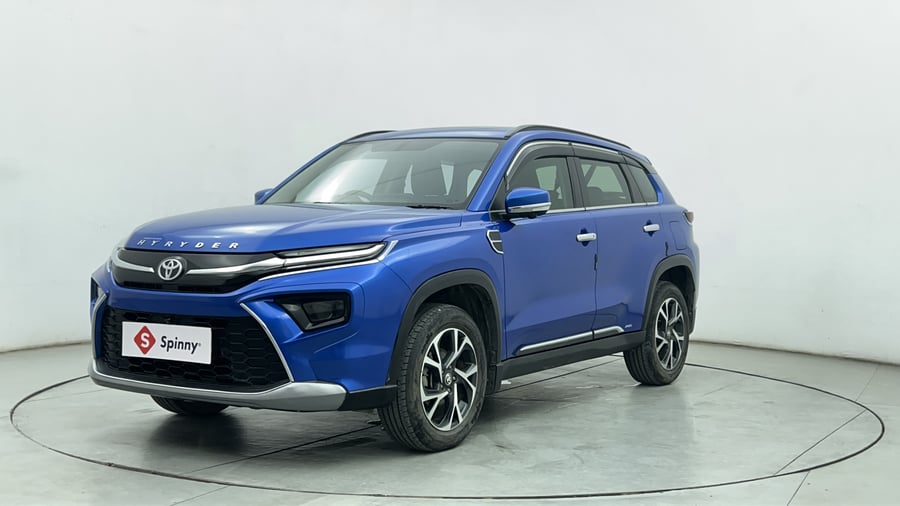
The Toyota Urban Cruiser Hyryder and the Renault Duster take conflicting approaches to the midsize SUV concept. While the Hyryder offers its regular petrol engine, strong hybrid, and factory-fitted CNG choices, the Duster currently relies on turbo-petrol engines such as the 1.3-litre engine generating 163hp and 280Nm. The powertrain of the Hyryder strong hybrid is capable of achieving 27.97 km/l as opposed to the best-in-class figure of only 19.41 km/l put forth by the current Duster.
Real-world testing widens that gap. The Hyryder strong hybrid has returned more than 20 km/l in both city and highway driving, while the Duster’s turbo-petrol engines use considerably more fuel, particularly in urban conditions. Even the regular non-hybrid Hyryder petrol performs better than the entry-level Duster 1.0 turbo in available instrumented tests. The Duster’s strengths lie elsewhere: stronger performance, more torque and a lower starting price.
Table of Contents
Toyota Hyryder vs Renault Duster Specs
The Toyota Hyryder provides the option of three powertrains, where its regular 1.5-litre NeoDrive petrol gives an output of approximately 103PS and 136.8Nm and can be achieved using either manual or 6-speed automatic transmission. The powertrain of the strong hybrid combines the 1.5-litre engine with the electric motor, giving a total output of around 115.56PS through the use of an e-CVT automatic transmission. Toyota also has a factory CNG option that is able to produce approximately 89PS and 121.5Nm.
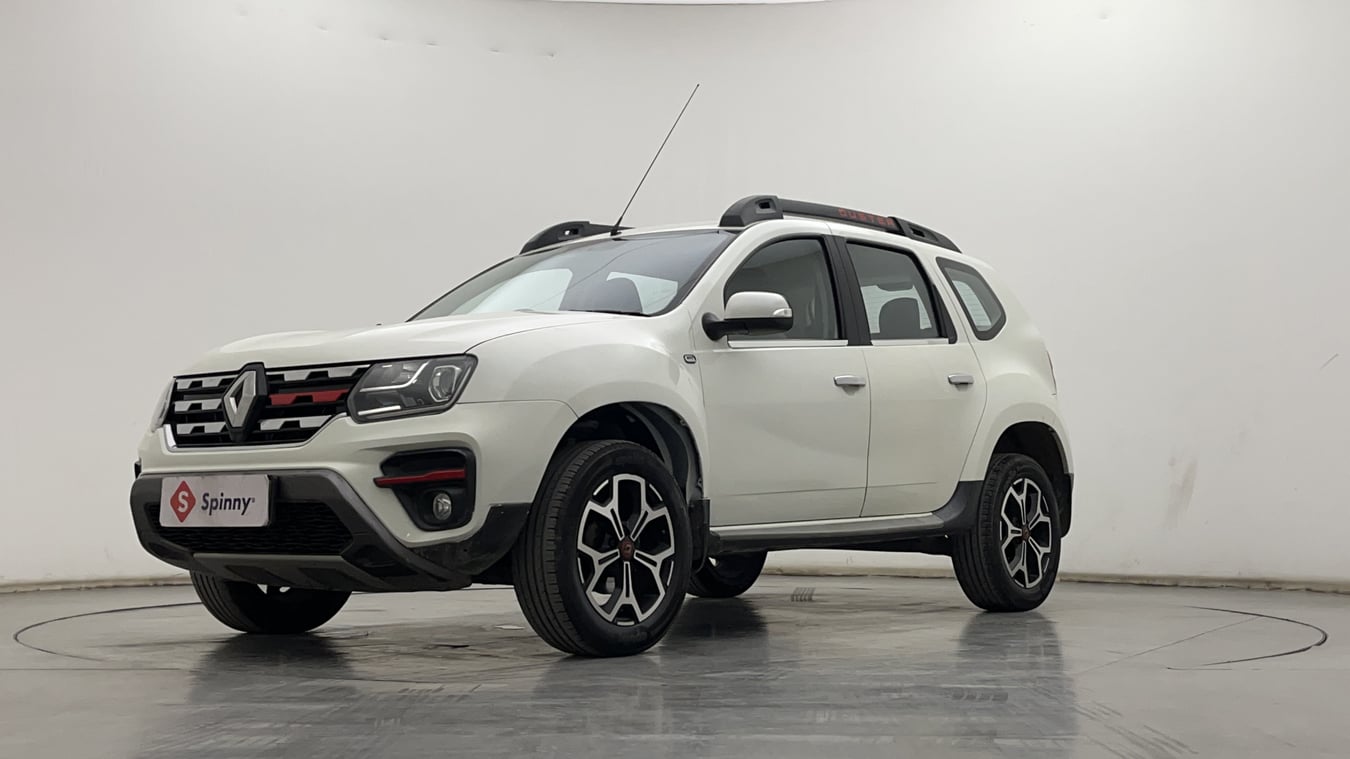
The Renault Duster currently has two turbo-petrol engines. Its 1.0-litre turbo produces 100hp and 166Nm with a 6-speed manual, while the 1.3-litre turbo produces 163hp and 280Nm with either a 6-speed manual or 6-speed DCT.
| Specification | Toyota Hyryder | Renault Duster |
| Base petrol engine | 1.5L NeoDrive petrol | 1.0L turbo-petrol |
| Base petrol output | ~103PS / 136.8Nm | 100hp / 166Nm |
| Stronger powertrain | 1.5L strong hybrid | 1.3L turbo-petrol |
| Stronger output | 115.56PS combined | 163hp / 280Nm |
| CNG | Factory CNG available | Not available |
| Transmission | MT / 6AT / e-CVT | 6MT / 6DCT |
| Fuel tank | 45 litres | 50 litres |
The Duster performs better when it comes to overall performance, while the Hyryder has much more powertrain options and requires less fuel consumption.
Toyota Hyryder vs Renault Duster ARAI Mileage Figures
The Hyryder NeoDrive petrol manual is rated at 21.12 km/l, while the automatic claims 20.58 km/l. The AWD version drops to 19.39 km/l. The strong hybrid leads the range at 27.97 km/l, while the factory CNG version is rated at 26.6 km/kg.
The rated mileage for the Duster’s 1.0 turbo manual is 19.41 km/l. Duster’s 1.3 turbo manual delivers 17.75 km/l, and the Duster’s DCT is rated at 18.45 km/l.
| Car | Engine & Transmission | Fuel Type | Claimed Mileage |
| Toyota Hyryder | 1.5 petrol MT | Petrol | 21.12 km/l |
| Toyota Hyryder | 1.5 petrol AT | Petrol | 20.58 km/l |
| Toyota Hyryder | 1.5 petrol AWD | Petrol | 19.39 km/l |
| Toyota Hyryder | Strong Hybrid e-CVT | Petrol-hybrid | 27.97 km/l |
| Toyota Hyryder | CNG MT | CNG | 26.6 km/kg |
| Renault Duster | 1.0 turbo MT | Petrol | 19.41 km/l |
| Renault Duster | 1.3 turbo MT | Petrol | 17.75 km/l |
| Renault Duster | 1.3 turbo DCT | Petrol | 18.45 km/l |
On official figures alone, the Hyryder has the advantage, particularly in strong-hybrid form.
Also Read: Toyota Urban Cruiser Hyryder Alternatives: Competitors of Toyota Urban Cruiser Hyryder
Toyota Hyryder vs Renault Duster Real-World Fuel Efficiency
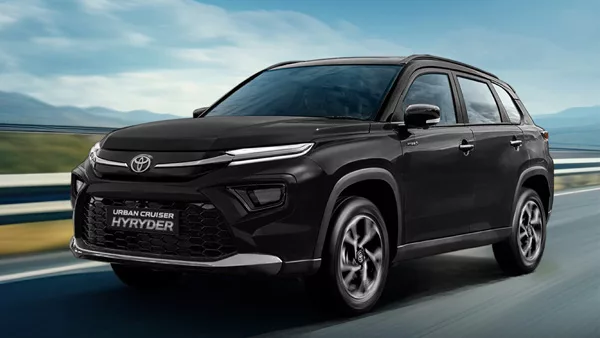
The hybrid version of the Hyryder has achieved around 20.28 km/l in city drives and 22.85 km/l on highways, giving a combined figure of around 21.57 km/l. The Toyota does not suffer from the regular city mileage issues since it is capable of low-speed operations via electric motors while the petrol engine is off.
The Duster 1.3 DCT has returned around 6.47 km/l in city conditions and 13.47 km/l on highways, giving an overall tested figure close to 9.97 km/l. The Duster test was conducted in particularly hot weather, which increased air-conditioning load and affected efficiency, but the gap remains substantial.
| Hyryder Strong Hybrid | Duster 1.3 DCT | |
| City | 20.28 km/l | 6.47 km/l |
| Highway | 22.85 km/l | 13.47 km/l |
| Combined reference | ~21.57 km/l | ~9.97 km/l |
| Fuel tank | 45L | 50L |
| Approx. mixed range | ~971 km | ~499 km |
Despite having a smaller fuel tank, the Hyryder, by virtue of its superior efficiency, has a longer range, theoretically speaking.
Regular Hyryder Petrol vs Duster 1.0 Turbo
The strong hybrid is not the only efficient Hyryder. The regular NeoDrive petrol manual has returned around 10.83 km/l in city conditions and 15.67 km/l on highways, resulting in a simple average near 13.25 km/l.
According to testing, the Duster 1.0 turbo manual delivers around 7.98 km/l in cities and 13.98 km/l on highways, producing a total average of around 10.95 km/l. The figures show that the regular petrol variant of Hyryder fetches better mileage.
| Hyryder NeoDrive MT | Duster 1.0 MT | |
| Claimed mileage | 21.12 km/l | 19.41 km/l |
| City | 10.83 km/l | 7.98 km/l |
| Highway | 15.67 km/l | 13.98 km/l |
| Combined reference | ~13.25 km/l | ~10.95 km/l |
Nonetheless, the Duster 1.0 generates more torque, which is 166 Nmm, while the Toyota Hyryder’s is lower at 136.8 Nm, enabling it to deliver better low-end speed response.
Also Read: Renault Duster Alternatives: Competitors of Renault Duster
Why Is the Hyryder Strong Hybrid So Efficient?
The Hyryder’s strong-hybrid system works particularly well in stop-start traffic. At low speeds, the electric motor can move the vehicle without constantly running the petrol engine. It also recovers energy during braking and deceleration and reuses that stored energy during acceleration.
The petrol engine is optimised for efficiency, and the e-CVT keeps it functioning properly. Therefore, the Toyota achieves its efficiency level of over 20 km/l, even in urban driving conditions.
The Duster’s turbo engines are designed around stronger performance. The 1.3-litre unit delivers 280Nm, but repeatedly calling on that torque in traffic inevitably uses more fuel. Performance is Renault’s strength; economy is Toyota’s.
Toyota Hyryder vs Renault Duster Fuel Cost Comparison

To keep things simple in our cost analysis, we can assume that we are travelling 1,500 km each month or 18,000 km annually. In addition, the price of petrol in New Delhi in September 2026 is around ₹102.12 per litre.
| Hyryder Strong Hybrid | Duster 1.3 DCT | |
| Reference Mileage | 21.57 km/l | 9.97 km/l |
| Monthly Fuel Use | ~69.5L | ~150.5L |
| Monthly Fuel Cost | ~₹7,100 | ~₹15,360 |
| Annual Fuel Cost | ~₹85,200 | ~₹1.84 lakh |
| 5-Year Fuel Cost | ~₹4.26 lakh | ~₹9.22 lakh |
If this trend continues, then the Hyryder hybrid can result in a saving of about ₹8,260 per month. In a year, the total savings become about ₹99,000, and in five years, the total distance travelled of 18,000km each year can lead to savings of around ₹5 lakh.
Actual Duster figures may improve in lighter traffic, but the Hyryder hybrid’s advantage remains substantial.
Regular Petrol Fuel Cost Comparison
The fuel consumption of the Hyryder NeoDrive is about 13.25 km/l on average, meaning that 1,500km is around 113.2 litres of petrol, and the monthly fuel expenditure becomes approximately ₹11,560.
The Duster 1.0 turbo, at 10.95 km/l, requires around 136.6 litres of petrol for the same distance, which works out to roughly ₹13,950 per month. That means the Hyryder can save about ₹2,400 every month even without the strong-hybrid system.
In a year, the difference is nearly ₹29,000, which in five years can reach ₹1.43 lakh if fuel costs and engine consumption remain the same.
Also Read: Toyota Hyryder Mileage Comparison: Petrol vs CNG vs Strong Hybrid
What About the Duster 1.3 Manual?
The 1.3 turbo manual produces the same 163hp and 280Nm as the DCT but does not deliver a dramatic mileage improvement. Available testing places it around 8.04 km/l in the city and 13.24 km/l on highways, giving a mixed reference close to 10.64 km/l.
This performance is hardly an improvement over the DCT, thereby indicating that the manual gearbox option is recommended primarily due to driver involvement or its relatively lower cost.
Toyota Hyryder CNG Mileage
Toyota also offers a factory CNG version rated at 26.6 km/kg. It produces less power than the petrol and hybrid variants but gives buyers another route to reducing running costs.
Current instrumental data for the CNG is not sufficient for reliable computations of real fuel expense rates; thus, the stated data should not be regarded as equal to regular petrol consumption rates. A considerable advantage of the Duster today is the fact that there is no factory-produced CNG version available.
Also Explore: Renault Duster Image Gallery: Interior and Exterior
Toyota Hyryder vs Renault Duster Price
The Hyryder currently starts at around ₹11.31 lakh ex-showroom, while strong-hybrid variants begin at roughly ₹17.18 lakh. The top hybrid costs around ₹19.99 lakh. The Duster starts lower at approximately ₹10.49 lakh and stretches to around ₹18.69 lakh for higher 1.3 DCT variants.
| Model | Variant / Powertrain | Approx. Ex-showroom Price |
| Toyota Hyryder | E NeoDrive MT | ₹11.31 lakh |
| Toyota Hyryder | S CNG MT | ~₹13 lakh |
| Toyota Hyryder | S Hybrid e-CVT | ₹17.18 lakh |
| Toyota Hyryder | G(O) Hybrid e-CVT | ₹19.24 lakh |
| Toyota Hyryder | V Hybrid e-CVT | ₹19.99 lakh |
| Renault Duster | Authentic 1.0 MT | ₹10.49 lakh |
| Renault Duster | Evolution 1.0 MT | ₹11.69 lakh |
| Renault Duster | Evolution 1.3 DCT | ₹14.49 lakh |
| Renault Duster | Techno+ 1.3 MT | ₹15.29 lakh |
| Renault Duster | Techno+ 1.3 DCT | ₹16.69 lakh |
| Renault Duster | Top 1.3 DCT | ~₹18.69 lakh |
Although the hybrid Hyryder is pricier initially, it becomes more beneficial in the long run in terms of lower fuel expenses as the driving distance accumulates.
Summary
The Toyota Hyryder is the clear mileage winner. Its strong hybrid returns around 20.28 km/l in the city, 22.85 km/l on highways and roughly 21.57 km/l combined. The Duster 1.3 DCT, by comparison, has returned around 9.97 km/l overall in current testing.
When analysed against regular petrol manuals, the Hyryder triumphs once again. Its NeoDrive variant provides an approximate fuel consumption of 13.25 km/l according to the available data, while the Duster 1.0 turbo achieves only 10.95 km/l.
Overall, choose the Toyota Hyryder if mileage, city efficiency, lower fuel costs, strong-hybrid technology or factory CNG are your priorities. Choose the Renault Duster if stronger turbo-petrol performance, higher torque and a lower starting price matter more. Among the models available today, the Hyryder is comfortably the more economical SUV.
Related Blogs:
Kia Seltos vs Toyota Hyryder Real-World Mileage Comparison
Maruti Grand Vitara vs Toyota Hyryder Real World Mileage Comparison
Kia Seltos vs Renault Duster Real-World Mileage Comparison
FAQs about Toyota Hyryder and Renault Duster Mileage
Q. Which has better mileage, Toyota Hyryder or Renault Duster?
The Toyota Hyryder has better mileage. Its strong-hybrid version claims 27.97 km/l and returns around 21.57 km/l in real-world testing.
Q. What is the real-world mileage of the Toyota Hyryder strong hybrid?
The Hyryder strong hybrid has returned around 20.28 km/l in city driving and 22.85 km/l on highways, giving a combined reference close to 21.57 km/l.
Q. What is the real-world mileage of the Renault Duster 1.3 DCT?
The Duster 1.3 DCT has returned around 6.47 km/l in the city and 13.47 km/l on highways, with an overall tested reference of approximately 9.97 km/l.
Q. Which regular petrol SUV is more economical?
The regular Hyryder NeoDrive is more economical based on available tests. It returns around 13.25 km/l combined compared with approximately 10.95 km/l for the Duster 1.0 turbo.
Q. Which is cheaper to run, the Hyryder hybrid or the Duster 1.3 DCT?
At 1,500km per month, the Hyryder hybrid costs roughly ₹7,100 in petrol compared with about ₹15,360 for the Duster 1.3 DCT using the tested mileage references.
Q. Is the Renault Duster hybrid available now?
No. A strong-hybrid Duster is expected later in 2026, but its final India price and certified mileage have not yet been announced.