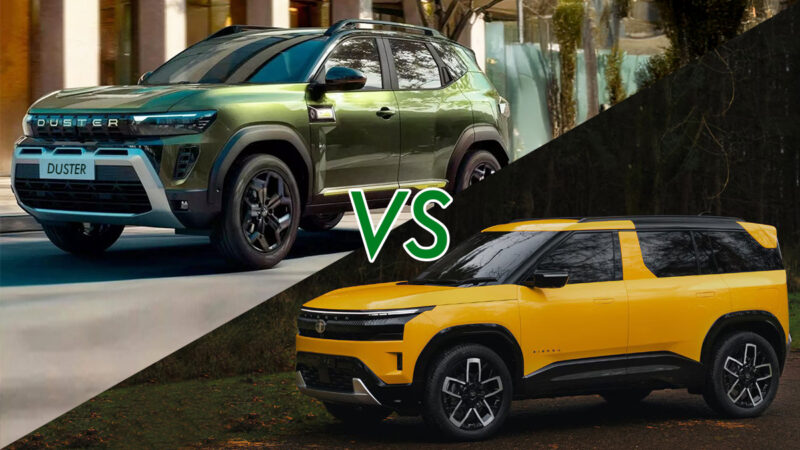
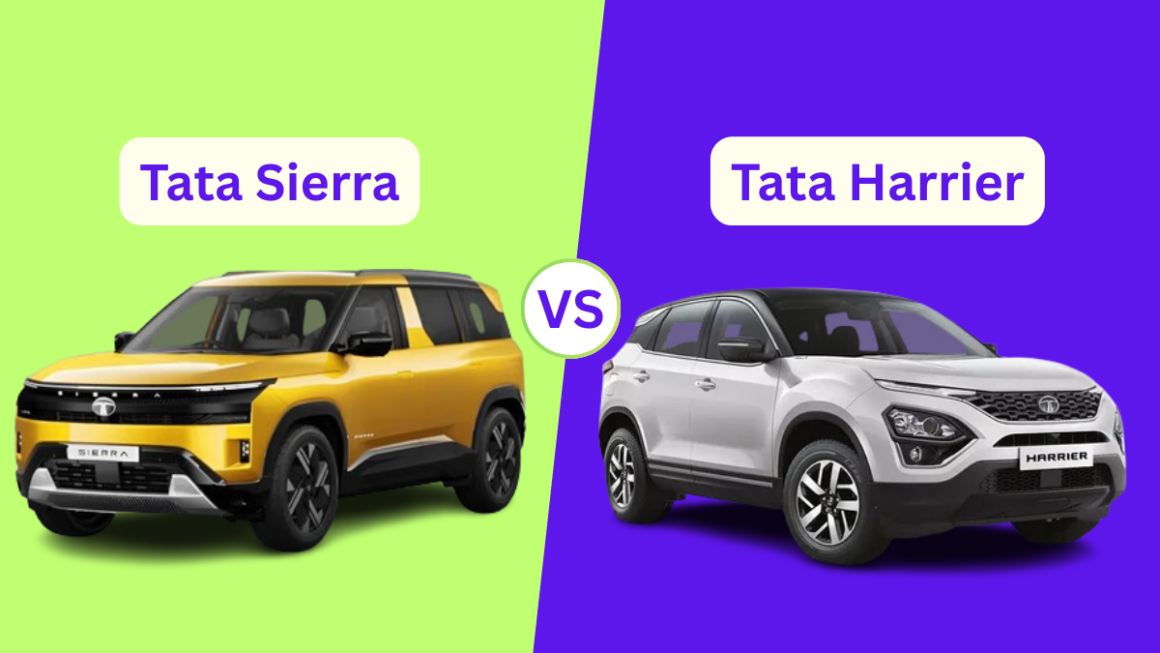
If you are shopping for a Tata SUV in India, the Sierra and the Harrier can look like they sit close on paper, but they are built for slightly different buyers. The Sierra brings a fresher, lifestyle-led package with a strong focus on cabin tech and everyday usability. The Harrier is the more established, larger SUV choice with a bigger-road presence and a powertrain that has already earned a reputation for long-distance comfort.
Below is a practical, spec-led comparison so you can decide what makes more sense for your garage.
Table of Contents
Tata Sierra vs Tata Harrier: Dimensions
Before we jump into numbers, here is why this section matters. A longer and wider SUV usually feels more planted on highways and offers more shoulder room, but can be trickier in tight parking spots. Boot space also changes how convenient weekend travel feels when the car is full.
| Dimension | Tata Sierra | Tata Harrier |
| Length | 4340 mm | 4605 mm |
| Width | 1841 mm | 1922 mm |
| Height | 1715 mm | 1718 mm |
| Wheelbase | 2730 mm | 2741 mm |
| Boot space | 622 litres | 445 litres |
| Ground clearance | 205 mm | 205 mm |
What the numbers mean in real life:
- The Harrier is clearly the larger SUV. That extra length and width translate into a more substantial road presence and typically a roomier feel across the cabin.
- The Sierra is noticeably shorter and narrower, which generally makes it easier to place in city traffic, squeeze into tighter parking, and handle narrow lanes.
- Boot space is a big Sierra win on paper. If you do frequent airport runs, weekend trips, or carry bulky luggage, that larger boot can genuinely reduce daily friction.
- Ground clearance is identical, so rough roads, speed breakers, and broken patches are not a deciding factor between the two.
The Harrier feels like the bigger SUV on the road, while the Sierra counters with a more city-friendly footprint and a notably larger boot.
Tata Sierra vs Tata Harrier: Engine & Transmission
Powertrain choices affect everything: how relaxed the SUV feels at highway speeds, how effortless overtakes are, and how stress-free the car feels when fully loaded. It also impacts running costs, especially if your monthly mileage is high.
Here is the key powertrain comparison in one place.
| Powertrain detail | Tata Sierra | Tata Harrier |
| Engine options | 1.5L Revotron naturally aspirated petrol; 1.5L Hyperion Turbo-Petrol; 1.5L Kryojet Diesel | 2.0L turbo diesel; 1.5L direct-injection turbo petrol (new/announced) |
| Transmission options | Manual and automatic options depending on engine and variant | Manual and automatic options depending on engine and variant |
| Power (claimed) | NA petrol: 106 PS; turbo petrol: 160 PS; diesel: 118 hp | Diesel: 170 PS (approx 168 bhp); petrol (new/announced): around 170 hp |
| Torque (claimed) | NA petrol: 145 Nm; turbo petrol: 255 Nm; diesel: up to 280 Nm (variant dependent) | Diesel: 350 Nm; petrol (new/announced): around 280 Nm |
| Mileage | Variant-wise figures differ; check official figures for the exact variant you shortlist | Diesel is widely quoted up to 16.8 kmpl (certified figure varies by source/variant); petrol figures depend on the final spec |
How they are likely to feel to drive:
- Harrier (diesel) is the torque-rich highway cruiser here. 350 Nm makes overtakes and long gradients feel easy, especially with passengers and luggage.
- Sierra’s turbo-petrol is tuned for strong mid-range pull, and its automatic setup is designed to feel smooth during daily driving. If your usage is mixed city plus highway, it can be a sweet spot.
- If your running is high (frequent long trips, intercity travel), diesel still tends to make the most sense for many Indian users, and both SUVs offer a diesel option. The Harrier’s diesel is notably stronger in output.
- If you want petrol for lower noise, better refinement, and city comfort, the Sierra’s petrol range gives you more choice right now.
For effortless highway torque, Harrier diesel leads, while the Sierra offers a broader engine variety and a strong turbo-petrol option for mixed use.
Tata Sierra vs Tata Harrier: Features & Comfort
Features are not just about a long checklist. What matters is how much of the premium experience you actually feel daily: screen quality, cabin ergonomics, comfort in summer traffic, and the kind of convenience that reduces fatigue on longer drives. Here is a quick, feature-to-feature view:
| Feature | Tata Sierra | Tata Harrier |
| Infotainment system | Large touchscreen; higher variants also add a passenger display | Large 12.3-inch touchscreen on higher variants (variant dependent) |
| Music system | Premium multi-speaker system; higher variants highlight Dolby Atmos support | JBL-branded multi-speaker setup (variant dependent) |
| Climate control | Automatic climate control; higher variants offer dual-zone | Automatic climate control; dual-zone available on higher variants |
| Sunroof | Panoramic sunroof (variant dependent) | Panoramic sunroof (variant dependent) |
| Seat ventilation | Ventilated front seats (variant dependent) | Ventilated front seats (variant dependent) |
| Driver seat adjustment | Powered seat features on higher variants | Powered driver seat on higher variants (variant dependent) |
| Rear AC vents | Yes | Yes |
| 60:40 rear seat split | Yes | Yes |
| Cruise control | Yes | Yes |
What this means for day-to-day comfort:
- If cabin tech is your priority, the Sierra’s triple-screen-style approach (on higher trims) and the overall “new-gen” cabin vibe will feel more futuristic.
- The Harrier’s cabin experience is now very premium too, especially in higher trims, with a large screen, panoramic sunroof, ventilated seats, and a strong audio setup.
- In practical comfort, both do the basics well: rear AC vents, cruise control, and split-fold rear seats are available, making both viable for family use.
If you want the most tech-forward cabin feel, Sierra pulls ahead, while Harrier matches strongly on comfort when you pick the right variant.
Tata Sierra vs Tata Harrier: Safety Features
Safety is one area where it helps to separate “features” from “crash-test performance”. ADAS and cameras can help avoid an incident, but crash-test ratings matter for what happens if the worst occurs.
Before the table, keep this in mind: if a car has a strong, proven crash-test rating, that should weigh more than simply adding extra airbags on paper.
| Safety item | Tata Sierra | Tata Harrier |
| NCAP safety rating | Not officially rated in public NCAP tests yet (as commonly reported) | 5-star ratings reported across major NCAP programs for Harrier |
| Airbags | 6 airbags are commonly listed as standard (variant dependent across sources) | 6 airbags commonly listed as standard; some sources list up to 7 airbags on higher variants |
| ABS with EBD | Yes | Yes |
| Rear parking sensors | Yes | Yes |
| Rear parking camera | Yes (variant dependent) | Yes (variant dependent) |
| ISOFIX child seat mounts | Yes | Yes |
| ADAS | Level 2 ADAS available on higher variants | Level 2 ADAS available on higher variants |
How to read this:
- The Harrier has a clearer advantage in proven crash-test performance because widely reported ratings exist for it.
- The Sierra looks well-equipped with modern active-safety tech and core safety hardware, but if you want a safety decision anchored in public crash-test results, the Harrier is the safer bet today.
- If you do a lot of highway driving, ADAS can help reduce fatigue and support safer cruising, but it should complement, not replace, strong crashworthiness.
For safety credibility based on widely reported crash-test results, Harrier has the stronger case, while Sierra focuses on strong feature-led safety equipment.
Tata Sierra vs Tata Harrier: Price Comparison
Price is not just about the entry figure; it is also about what you get at the variant you can realistically afford. A lower starting price can look attractive, but value depends on whether the features you care about show up in your target trim.
Here is a clean ex-showroom snapshot using commonly listed variants and price bands.
| Price (ex-showroom) | Tata Sierra | Tata Harrier |
| Base variant | 11.49 lakh (Smart+) | 14.00 lakh (Smart) |
| Mid variant | 12.99 lakh (Pure) | 17.00 lakh (Pure X) |
| Upper-mid variant | 15.29 lakh (Adventure) | 17.96 lakh (Adventure X) |
| Top variant | Up to 18.49 lakh (Adventure+) | Up to 25.25 lakh (Fearless X Plus Stealth AT) |
Value perspective:
- Sierra is the more accessible SUV here on price, especially if you want a feature-rich experience without stretching into the mid-20s.
- Harrier costs more, but you are also paying for a larger SUV format, a more powerful diesel setup, and the reassurance of widely reported crash-test results.
- If your budget is capped around the mid-teens, Sierra will typically let you reach a higher trim level than Harrier for similar money.
If you are value-driven and want a newer cabin experience at a lower entry price, Sierra makes a strong case, while Harrier justifies its premium with size, output, and proven safety credentials.
Summary
Choose the Tata Sierra if you want a newer-age SUV feel with strong cabin tech, a large boot, and a lower entry price that can get you into higher trims sooner. Choose the Tata Harrier if you want a bigger SUV with stronger highway presence, higher diesel output, and a safety story backed by widely reported crash-test ratings. For heavy highway use and long-distance touring, Harrier remains the more traditional, confidence-first pick, while Sierra is the smarter choice for tech-first, city-plus-weekend usage.
FAQ about Tata Sierra vs Tata Harrier
Q. Which is bigger: the Tata Sierra or the Tata Harrier?
The Harrier is larger overall (longer and wider), while the Sierra is more compact and easier to manage in tighter city conditions.
Q.Which has more boot space?
The Sierra offers a larger boot capacity on paper (622 litres) compared to the Harrier (445 litres).
Q. Which one is safer based on crash-test ratings?
The Harrier has widely reported 5-star NCAP ratings, while the Sierra is commonly reported as not having a public NCAP rating yet, so the Harrier is the safer pick if ratings are your priority.
Q. Which is better for highway driving?
For relaxed highway cruising and strong overtakes, the Harrier’s 2.0 diesel with high torque is the more proven setup, especially with full load.
Q. Which one offers better value for money?
If your budget is limited and you want more features for the price, Sierra usually delivers better value because its pricing starts lower and reaches feature-rich trims sooner.