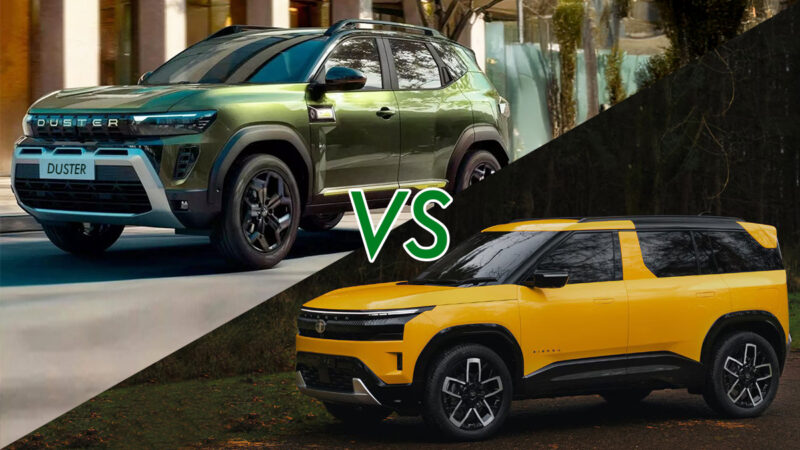
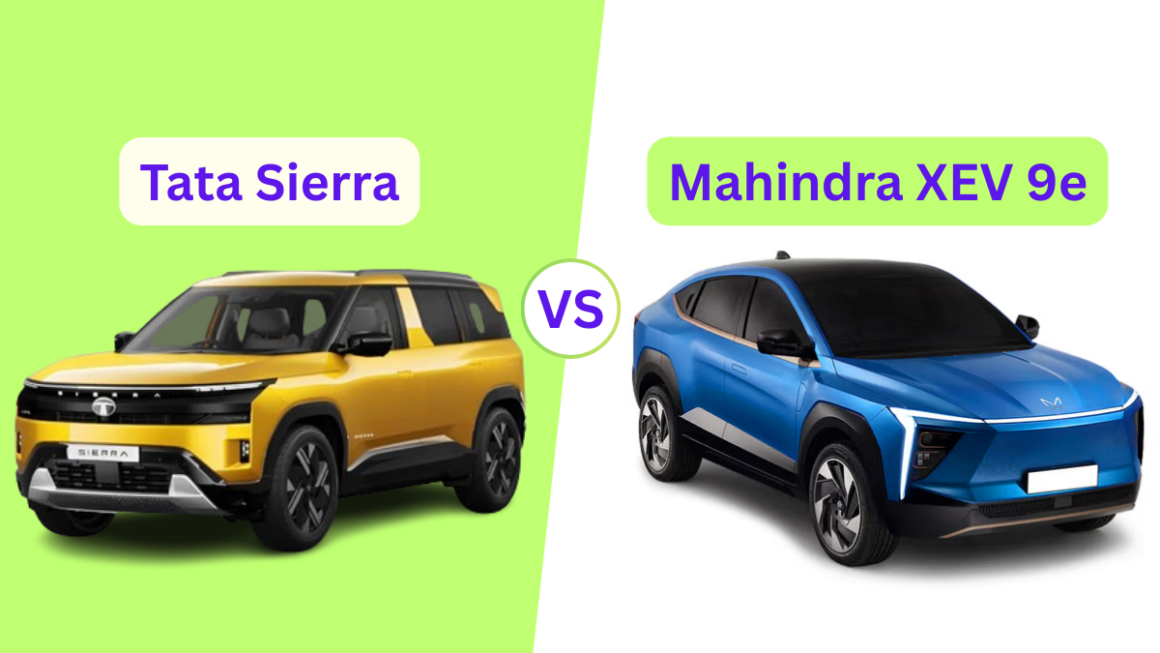
The Tata Sierra and the Mahindra XEV 9e sit in two different worlds, even though both look like premium SUVs. The Sierra is a petrol and diesel SUV built for buyers who still want the flexibility of an ICE powertrain, fast refuelling, and wide service coverage. The XEV 9e is a born-electric SUV that’s clearly positioned as a premium, tech-heavy product with the instant response and refinement you expect from an EV.
If you’re deciding between them, start with your usage. Lots of long highway runs without planned stops, intercity travel in remote areas, or unpredictable driving schedules usually favour the Sierra. Daily city driving, predictable routes, the ability to charge at home or at work, and a preference for a smoother, quieter drive usually favour the XEV 9e.
Table of Contents
Tata Sierra vs Mahindra XEV 9e: Dimensions
Dimensions tell you how easy a car will be in the city and how roomy it will feel on long drives. A longer wheelbase often helps rear-seat comfort. Boot space changes your travel experience more than you’d think, especially for families. Ground clearance matters on bad roads, steep ramps, and aggressive speed breakers. Here’s a look at how the two compare on paper:
| Dimension | Tata Sierra | Mahindra XEV 9e |
| Length | 4340 mm | 4789 mm |
| Width | 1841 mm | 1907 mm |
| Height | 1715 mm | 1694 mm |
| Wheelbase | 2730 mm | 2775 mm |
| Boot space | 622–1257 litres | 663 litres |
| Ground clearance | 205 mm | 207 mm (unladen) |
In real life, the difference in length is massive. The XEV 9e is a much larger SUV, which usually means a bigger road presence and a more “big-car” feel on highways. The Sierra, being notably shorter, should feel easier to place in tight lanes and parking spots.
Boot space is interesting here because both are strong. The Sierra’s big advantage is flexibility: fold the rear seats, and you unlock a huge cargo bay, which is ideal if you frequently carry bulky luggage or road-trip gear. The XEV 9e’s boot is large even with the rear seats up, which is great for everyday practicality without needing to fold seats.
One-line takeaway: XEV 9e feels like the bigger SUV on the road, while Sierra is easier to live with in tight spaces and offers more cargo flexibility when you fold the rear seats.
Tata Sierra vs Mahindra XEV 9e: Engine & Transmission
This is the make-or-break section because you’re comparing two different powertrain philosophies. With the Sierra, you’re choosing between petrol and diesel and deciding what balance you want between performance, fuel efficiency, and running costs. With the XEV 9e, you’re choosing battery size and living with charging, while getting instant torque and smooth performance as standard.
Before the table, a quick perspective: “mileage” and “range” are not the same measure. ICE mileage depends heavily on traffic and driving style. EV range depends on speed, temperature, terrain, and how much you use AC. Treat both as planning numbers, not guarantees.
| Powertrain detail | Tata Sierra | Mahindra XEV 9e |
| Engine options | 1.5L NA petrol, 1.5L turbo petrol, 1.5L diesel | Electric motor (variant-wise battery packs) |
| Transmission options | Manual and automatic options (variant-wise) | Single-speed automatic |
| Power | Up to 160 PS (engine and variant-wise) | Up to 210 kW (282 bhp) |
| Torque | Up to 280 Nm (engine and variant-wise) | 380 Nm |
| Mileage/range | Mileage varies by engine and transmission | Certified range up to 656 km (battery and variant-wise) |
On the road, the XEV 9e will feel effortless in the city because EVs deliver torque instantly and don’t need gear changes. That typically makes stop-and-go traffic far less tiring. It also helps in quick gaps and overtakes at urban speeds because the response is immediate.
The Sierra’s advantage is freedom. You can refuel quickly, you don’t have to plan charging stops, and you can choose the flavour that suits you. The turbo-petrol is the option for buyers who want stronger performance, while the diesel is usually the pick for high running and a more relaxed highway feel. If your usage includes long, unplanned highway drives, the Sierra’s convenience is hard to beat.
One-line takeaway: XEV 9e delivers smoother, quicker-feeling everyday performance, while Sierra wins on refuelling convenience and long-distance flexibility.
Tata Sierra vs Mahindra XEV 9e: Features & Comfort
This is where the “premium” story really shows. Both SUVs are positioned as feature-rich, but the focus is different. The Sierra leans into a modern, family-friendly cabin with lots of tech and comfort features at a more accessible starting price. The XEV 9e leans into a more luxury-forward, cinematic, software-defined experience.
A reminder before the table: features can vary a lot by variant, so always compare trim-to-trim, not base-to-top, across brands.
| Feature | Tata Sierra | Mahindra XEV 9e |
| Infotainment system | Large touchscreen with multi-screen dashboard layout (variant-wise) | Multi-screen “cinemascope” dashboard layout (variant-wise) |
| Music system | Premium audio (variant-wise) | Premium multi-speaker branded audio (variant-wise) |
| Climate control | Manual or automatic climate control (variant-wise) | Automatic climate control (variant-wise) |
| Ventilated seats | Available on higher variants | Available on higher variants |
| Adjustable steering | Tilt and telescopic | Tilt and telescopic |
| Drive modes | Available (variant-wise) | Available (variant-wise) |
| Instrument cluster | Digital cluster (variant-wise) | Digital cluster (variant-wise) |
| Sunroof | Panoramic sunroof (variant-wise) | Panoramic roof (variant-wise) |
| Adjustable seats (manual or electric) | Powered driver seat (variant-wise) | Powered seat functions (variant-wise) |
| Rear AC vents | Yes | Yes |
| 60:40 rear seat split | Yes (variant-wise) | Yes (variant-wise) |
| Cruise control | Yes (variant-wise) | Yes (variant-wise, often paired with ADAS in higher trims) |
If you love tech, the XEV 9e is designed to feel like a step into a more premium, software-first cabin. The driving experience is also helped by EV refinement: less vibration, less noise, and smoother progress, which makes the cabin feel more expensive even at the same speed.
The Sierra’s appeal is value-led comfort. You still get the big-ticket features buyers expect in this space, and the Sierra’s packaging (especially boot flexibility) makes it a practical daily SUV. For families who want a feature-rich SUV without stepping into a higher price bracket, this can be the more sensible approach.
One-line takeaway: XEV 9e feels more luxury-tech focused, while Sierra feels more value-focused and practical without feeling bare.
Tata Sierra vs Mahindra XEV 9e: Safety Features
Safety isn’t only about the number of airbags. A verified crash-test rating matters more, and active safety tech like ESC and ADAS matters because it helps you avoid accidents in the first place. In this comparison, the XEV 9e has a clear advantage on the “verified rating” front. Here’s a look at equipment and ratings.
| Safety item | Tata Sierra | Mahindra XEV 9e |
| Bharat NCAP safety rating | Not published yet | 5-star Bharat NCAP (published) |
| Airbags | 6 airbags | 7 airbags |
| ABS with EBD | Yes | Yes |
| ESC | Yes | Yes |
| Traction control | Yes | Yes |
| Automatic headlamps | Available (variant-wise) | Available (variant-wise) |
| Rain-sensing wipers | Available (variant-wise) | Available (variant-wise) |
| Hill hold assist | Yes (variant-wise) | Yes (variant-wise) |
| Hill descent control | Available (variant-wise) | Available (variant-wise) |
| Rear sensors | Yes | Yes |
| Rear parking camera | Yes (360 camera on higher variants) | Yes (360 camera on higher variants) |
| ISOFIX child seat anchor points | Yes | Yes |
| ADAS | L2+ ADAS on higher variants | L2+ ADAS on higher variants |
The Sierra’s safety equipment list is strong, especially with L2+ ADAS available on top variants. But until a published Bharat NCAP rating is available, it’s difficult to compare crash performance in a way that’s backed by a formal score.
The XEV 9e is in a stronger position here because its Bharat NCAP rating is already published, and it also offers a comprehensive safety suite including ADAS and multiple airbags.
One-line takeaway: XEV 9e has the stronger safety argument today because its crash rating is officially published.
Tata Sierra vs Mahindra XEV 9e: Price Comparison
Price is where these two split sharply. The Sierra starts in a much lower bracket, which makes it accessible to a wider audience. The XEV 9e is a premium EV, and its pricing reflects the battery, the architecture, and the tech positioning.
Also note that Sierra prices can be variant-dependent, with some trims announced earlier than others, so always verify the exact variant price at the time of purchase.
| Price (ex-showroom) | Tata Sierra | Mahindra XEV 9e |
| Base variants | From Rs 11.49 lakh | From Rs 21.90 lakh |
| Mid variants | Around Rs 12.99–17 lakh (variant-wise) | Around Rs 24.90–27.25 lakh (variant-wise) |
| Upper mid variants | Around Rs 15.29–18.49 lakh (variant-wise) | Around Rs 27.90–31.25 lakh (variant-wise) |
| Top variant | Prices can vary by trim announcement and configuration | Around Rs 31.25 lakh (variant-wise) |
If you want maximum SUV for your money, the Sierra offers a lot of space, features, and flexibility at a much lower entry point. The XEV 9e demands a significantly higher spend, but it gives you the EV experience: quietness, smoothness, instant response, and a premium-tech cabin with a strong safety rating.
One-line takeaway: Sierra is the value-heavy pick, XEV 9e is the premium EV pick with a much higher entry price.
Summary
Choose the Tata Sierra if you want a feature-rich SUV with petrol and diesel options, easier long-distance usability, and a significantly lower starting price. It makes the most sense for buyers who travel frequently, cannot rely on charging access, or want a practical 5-seater with strong boot flexibility.
Choose the Mahindra XEV 9e if you want a premium electric SUV experience with a published 5-star Bharat NCAP rating, a large-SUV road presence, and the refinement that comes naturally with an EV. It suits buyers who can charge conveniently and prefer a more luxury-tech oriented cabin.
FAQ about Tata Sierra vs Mahindra XEV 9e
Q. Which one is better for city driving every day?
The XEV 9e, because EVs are smoother in stop-go traffic and feel effortless at low speeds, assuming you have convenient charging.
Q. Which one is better for frequent long highway trips?
The Sierra is usually easier for frequent long trips because refuelling is quick and route planning is simpler.
Q. Does the Mahindra XEV 9e have an official Bharat NCAP rating?
Yes, the XEV 9e has a published 5-star Bharat NCAP rating.
Q. Does the Tata Sierra have ADAS?
L2+ ADAS is available on higher Sierra variants.
Q. Is the price gap between them worth it?
It can be, if you value EV refinement, premium tech, and the published crash rating and you can charge easily. If you mainly want value and long-distance flexibility, the Sierra makes more financial sense.