
Tata Harrier was always an innovator in its mid-size SUV category, and it was always praised for its distinctive commanding road presence, robust construction, and a five-star Global NCAP rating. Harrier now boasts an all-new variant, having also embraced the electric revolution, which offers an electric variant alongside its proven diesel titan. This gives customers a spontaneous, powerful alternative between two very disparate yet equally compelling technologies. The ultimate decision for most customers hinges on real-world Harrier mileage and long-term cost of ownership, which requires a head-to-head comparison.
This in-depth 2025 buyer’s guide is tailored to steer you through this complex decision. We’ll be carefully dissecting official statistics, evaluating what proprietors are finding on the roads, and explaining performance refinements, cost of running, and real-world practicality differences between variants. As an urban buyer who values the ultimate cost of running or a high-mileage highway user who requires a consistent range, comprehension of each power variant’s real essence holds the key to a rewarding ownership experience.
Understanding the Harrier’s Powertrains
The Harrier’s strength lies in its ability to offer two distinct technologies, each with its own character and purpose.
2.0-litre Kryotec Diesel
This is the Tested and Proven Heart of the Harrier, a 2.0L Turbocharged, Four-Cylinder Fiat-sourced Engine. This is a Workhorse that is Famous for its Solid Power and Outstanding Efficiency, Especially on Highway Cruising. It produces a Resounding 170 PS and a Segment-Best 350 Nm of Torque. Its Torque prowess makes it Perfectly Suitable for Highway Cruising and Climbing Up Slopes without any Trouble. It comes with both a 6-speed Manual Transmission and a 6-speed Torque Converter Automatic Transmission.
Harrier EV
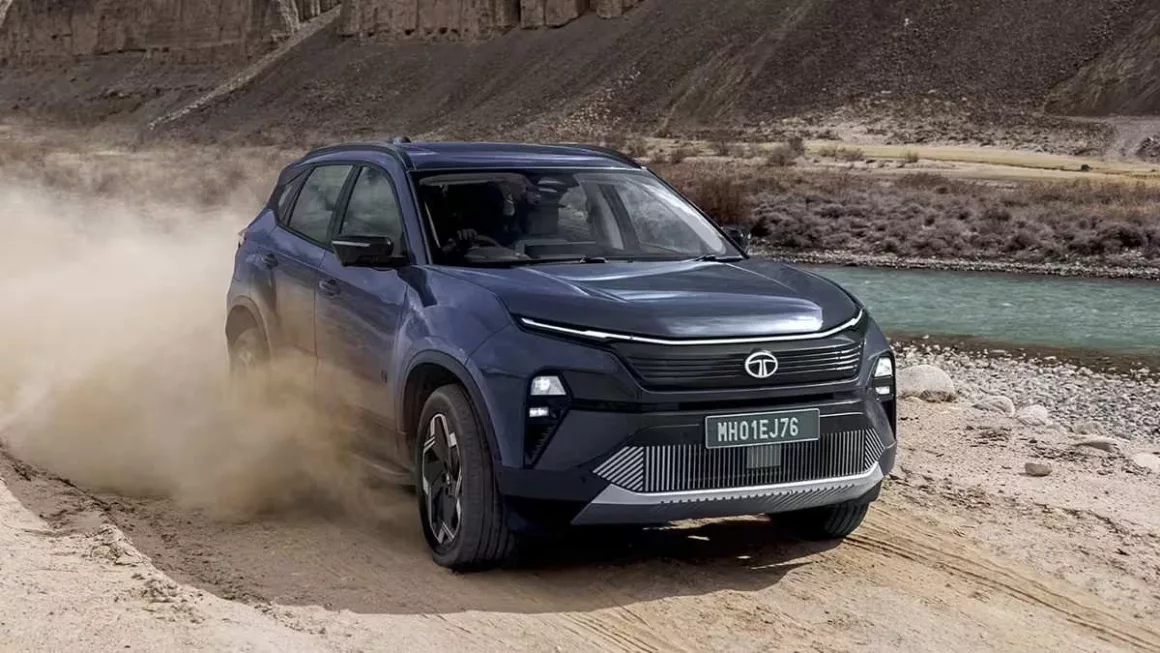
Harrier EV is all-electric and a game-changer. It is constructed upon a high-tech platform that provides a silent, powerful, and zero-emission drive. It has two battery variants: a 65 kWh battery, which provides a claimed 538 km of range, and a large 75 kWh one that provides a claimed 627 km of range. With instant torque and a variety of future-ready features like its All-Wheel Drive variant, the Harrier EV is a future-ready purchase for today’s buyers.
Official vs. Real-World Mileage/Range (as of 2025)
The ARAI figures provide a standardized benchmark, but real-world performance is what truly matters. The figures below are a compilation of owner feedback and professional tests.
| Variant | ARAI Mileage/Range | Real-World City | Real-World Highway | Combined Average |
| Diesel Manual | 16.8 km/l | ~12-14 km/l | ~16-18 km/l | ~15 km/l |
| Diesel Automatic | 16.8 km/l | ~11-13 km/l | ~14-16 km/l | ~13 km/l |
| Harrier EV (65 kWh) | 538 km | ~380-420 km | ~350-380 km | ~400 km |
| Harrier EV (75 kWh) | 627 km | ~450-500 km | ~420-470 km | ~470 km |
The diesel variant offers respectable Harrier mileage for a big SUV, with its manual variant being even more fuel-efficient. Harrier EV’s real-world range is an important detail. Though it is a huge dip from the claimed figures, a real-world range above 400 km in the base version is well enough for the majority of city commutes and even inter-city travel. Something worth remembering about an EV is that its range can dip much further on highways compared to city roads due to steady high speeds, which reduces the battery’s range more quickly.
Financial Breakdown: Cost per Km and Break-Even Analysis
The most crucial part of the comparison is the long-term running cost. Let’s use approximate mid-2025 fuel and electricity prices in Delhi.
- Fuel Prices:
- Diesel: ₹87.67/litre
- Electricity: ₹8/kWh (home charging)
- Cost per Km (Based on Real-World Averages):
- Diesel Manual: ₹87.62 / 15 km/l = ₹5.84/km
- Diesel Automatic: ₹87.62 / 13 km/l = ₹6.74/km
- Harrier EV (65 kWh): (65 kWh * ₹8/kWh) / 400 km = ₹1.30/km
- Harrier EV (75 kWh): (75 kWh * ₹8/kWh) / 470 km = ₹1.28/km
The Harrier EV is the clear winner in running costs, with a cost that is a fraction of its diesel counterparts.
Now, let’s consider the initial purchase price, which is a major factor in the break-even analysis.
- Price Premium (Ex-showroom, approximate): The Harrier EV’s base version costs approximately ₹21.49 lakh, whereas an equivalent version with a diesel engine is approximately ₹18 lakh. The cost premium is about ₹3.49 lakh. For a high-end version, this difference can be even higher.
The break-even point is the distance you must travel to offset the higher initial cost through fuel savings.
- Harrier EV (65 kWh) vs Diesel (Manual):
- Price Gap: ₹3.49 lakh
- Savings per km: ₹4.54
- Kilometers to Break Even: ~77,092 km. This is a very achievable number for a high-mileage driver, especially considering the long-term benefits of lower maintenance and government incentives.
Performance, Practicality, and the Driving Experience
Diesel
The 2.0L diesel motor is renowned for its powerful, linear power output and is an excellent all-rounder regardless of any driving scenario. Its high torque ensures that you get an effortless high-speed cruiser on highways. The Harrier diesel boasts a spacious 445-litre boot space, which offers plenty of space for your luggage. The latest refinements have considerably enhanced the NVH (Noise, Vibration, and Harshness) of the engine, ensuring a much better in-cabin environment than before. The presence of an actual torque converter automatic and the universal, predictable refueling infrastructure are key practical plus points.
Electric
Harrier EV provides silent, instant power that no diesel can match. The gearless drive is ideal for urban traffic, offering a completely effortless drive that’s wonderful. Harrier EV also provides a spacious 502-litre boot, and certain trims even get a tiny frunk to stow your charging cables in. With its AWD as an option, Harrier EV provides that additional capability when you need it. In addition, EV comes with smart features like Vehicle-to-Load (V2L) capability, allowing you to power devices outside, such as camping gear, and over-the-air updates for vehicle software, making this car future-proof.
The Verdict: Which Harrier is for You?
For the Long-Distance Highway Traveler:
- Best Pick: Tata Harrier Diesel.
- Why: With its good highway miles, healthy torque, and uncompromised boot room, the diesel Harrier is ideal for those who frequently make long, high-mileage trips. Access to simple refueling anywhere in the country is a significant convenience factor, providing comfort during cross-country trips where EV recharging remains a challenge. It’s a proven workhorse that appeals to tradition and tried performance.
For the Urban Dweller & Forward-Thinker:
- Best Pick: Tata Harrier EV.
- Why: EV is the future. It provides unmatched running expenses, a quiet and luxurious drive, and is ideal for day-to-day urban commutes. The real-world mileage is well over enough to suit urban and semi-urban usages, and your break-even is soon enough to be worth that additional upfront cost. The cost of ownership over time is significantly reduced due to low maintenance, and that additional government incentive just seals it as an even better deal. It’s an option for someone who desires a high-tech, environmentally friendly, and powerful SUV.
Harrier diesel is a workhorse that performs on long hauls and provides traditional convenience. Harrier EV is a contemporary, high-tech, and affordable solution for those who are ready to embrace electric mobility.
FAQs about Tata Harrier
Q. What is the real-world range of the Harrier EV?
The 65 kWh variant typically gives a range of ~538 km, while the 75 kWh variant gives ~627 km. This depends on driving conditions and AC usage.
Q. How does the diesel’s performance compare to the EV’s?
The diesel engine has strong torque for effortless highway cruising. However, the EV offers instant torque from a standstill, providing a silent and more responsive acceleration, especially in city traffic.
Q. What is the boot space of the Harrier EV compared to the diesel?
The Harrier EV has a larger boot space of 502 litres compared to the diesel’s 445 litres.
Q. Is the EV’s highway range significantly lower?
Yes, an EV’s range is generally lower on the highway than in the city due to consistent high speeds, which deplete the battery faster. Regenerative braking in the city helps to conserve charge.
Q. How long does it take to charge the Harrier EV?
With a standard 7.2 kW AC charger, a full charge can take around 10.7 hours. A DC fast charger can charge the battery from 20 to 80% in about 25 minutes.
Q. Does the Harrier EV have an All-Wheel Drive (AWD) option?
Yes, the Harrier EV is available with a dual-motor, all-wheel-drive powertrain, making it a capable and versatile option for different terrains.