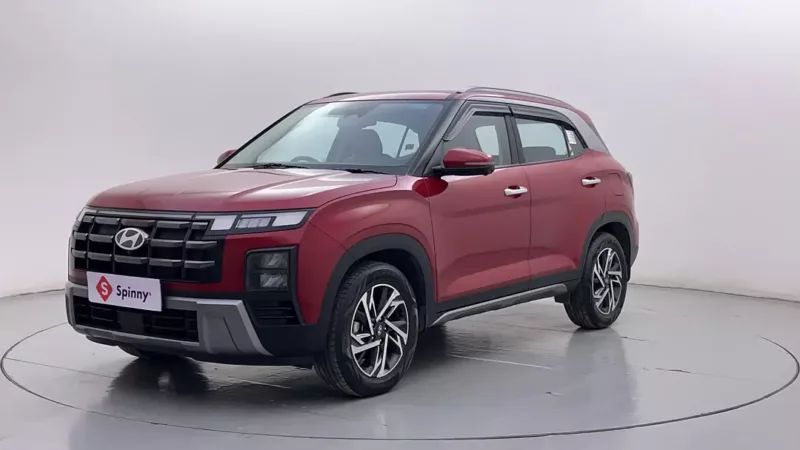

The MG Astor has become a niche vehicle within the extremely popular compact SUV genre, with its attractive design, high-quality interior, and impressive array of features, including an AI assistant. As a petrol-exclusive model, the decision for a future buyer frequently hinges upon the transmission. The Astor comes with a 1.5-litre naturally aspirated powerplant that can be paired with either a 5-speed manual transmission or a smooth CVT automatic.. This decision between manual and automatic transmission is an important one, not just affecting how you drive your vehicle, but also determining your real-world Astor mileage and long-term expenses.
This comprehensive 2025 guide is designed to prepare you to make this decision with confidence. We’ll delve beyond the ARAI-certified figures to provide you with a transparent, factual assessment of each variant’s real-world fuel efficiency. We’ll pit the long-term cost of running, the price premium over manual, and each powertrain’s real-world practical benefits and drawbacks against each other. As someone who is concerned with fuel efficiency in city traffic, or someone who enjoys an automatic ‘coast and cruise’ experience in traffic, you need to understand each transmission’s true nature to enjoy your ownership experience thoroughly.
Table of Contents
The Engines & Transmissions: A Closer Look
The MG Astor is offered with two different petrol engines and distinct transmission combinations.
1.5-litre VTi-TECH Petrol (Manual)
This 1498cc, four-cylinder, normally aspirated engine is the cheapest variant. It generates 108.49bhp of power and 144 Nm of torque, which is more than enough for city usage and comfortable cruising on highways. Its 5-speed manual transmission provides complete control of gear engagement to the driver. This combination usually proves to be the most fuel-efficient in real-world usage, if driven by a disciplined driver.
1.5-litre VTi-TECH Petrol (CVT Automatic)
You get the same 1.5L engine with a smooth 8-step CVT automatic transmission as well. A CVT stands for Continuously Variable Transmission, which works without any fixed gears, and it delivers power linearly and smoothly. This is an ideal choice for city commuters who need an easy-to-drive vehicle without the annoyance of frequent gear changing in traffic.
Official vs. Real-World Mileage (as of 2025)
The ARAI figures provide a standardised benchmark, but real-world performance is what truly matters. The figures below are a compilation of owner feedback and professional tests.
| Variant | ARAI Mileage | Real-World City | Real-World Highway | Combined Average |
| 1.5L Manual | 15.43 km/l | ~11-13 km/l | ~15-17 km/l | ~14 km/l |
| 1.5L CVT | 14.82 km/l | ~10-12 km/l | ~14-16 km/l | ~13 km/l |
The 1.5L manual is even more fuel efficient on paper and in practice. The CVT is a close second with a slight decrease in efficiency due to its transmission nature.
Financial Breakdown: Cost per Km and Break-Even Analysis
The most crucial part of the comparison is the long-term running cost. Let’s use approximate mid-2025 petrol prices in Pune for our calculations.
- Fuel Price: Petrol: ₹104.83/litre
- Cost per Km (Based on Real-World Averages):
- 1.5L Manual: ₹104.83 / 13.1 km/l = ₹8.00/km
- 1.5L CVT: ₹104.83 / 12.6 km/l = ₹8.32/km
The running cost difference is palpable. The 1.5L manual is the least costly to run, followed by the CVT.
We now look at the original cost of purchase, which is a key component of the break-even analysis.
- Price Premium (Ex-showroom, approximate):
- 1.5L CVT vs 1.5L Manual: The automatic variant is typically priced around ₹1.2 lakh higher.
The break-even point is the distance you need to drive to recover the higher upfront cost through fuel savings.
- 1.5L CVT vs 1.5L Manual:
- Price Gap: ₹1.2 lakh
- Savings per km: ₹0.32
- Kilometers to Break Even: ~3,75,000 km. This shows that the premium for the automatic is a trade-off for convenience, not for financial savings.
Decision-making in this situation is purely an exercise of choosing performance over economy.
Performance, Practicality, and the Driving Experience
1.5L Manual
The manual model provides a complete and fun experience behind the wheel. Its smooth transmission and light clutch provide an attractive appeal for someone who enjoys being in control of their shift. Not being a powerful engine, it’s responsive and perfect for a leisurely drive.
1.5L CVT Automatic
The CVT offers silky smooth and seamless motoring. In stop-start city traffic, this is a blessing, as no jerks and lurches are transmitted. But during hard acceleration, the engine scream can climb without a corresponding climb in rpm, an effect that is said to be “rubber band effect.”
The Verdict: Which Astor is for You?
For the Budget-Conscious Commuter:
- Best Pick: MG Astor 1.5L Manual.
- Why: If your key priorities are a cheap purchase price and minimizing running expenses, this manual version is your only rational choice. It provides an excellent all-rounder proposition with respectable mileage and fun-to-drive qualities.
For the Urban Driver Who Values Convenience:
- Best Pick: MG Astor 1.5L CVT Automatic.
- Why: If you regularly drive in city traffic and do not mind paying a premium for a smooth, worry-free ride, opt for the CVT. The slight loss in mileage is a worthwhile compromise for the additional comfort.
FAQs
Q. Is the MG Astor’s 1.5L manual difficult to drive in city traffic?
A. The clutch is light and the gearbox is smooth, making it relatively easy to drive in city traffic compared to other manual SUVs.
Q. Is the CVT automatic reliable?
A. The CVT transmission is a proven technology known for its reliability and smooth operation, making it a great choice for long-term, hassle-free ownership.
Q. How big is the boot space of the MG Astor?
A. The MG Astor has a boot space of 448 litres across all variants.
Q. Why does the manual variant have better mileage than the automatic?
A. A skilled driver can often achieve better fuel economy with a manual transmission by optimizing gear shifts. In an automatic, especially a torque converter, there are some efficiency losses.