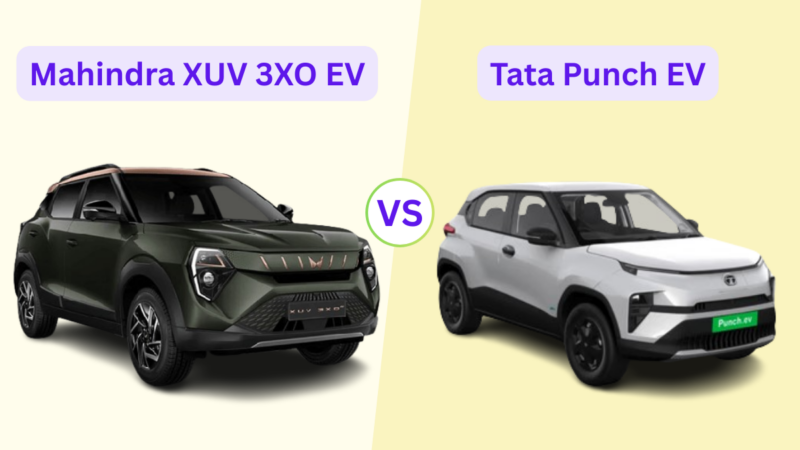
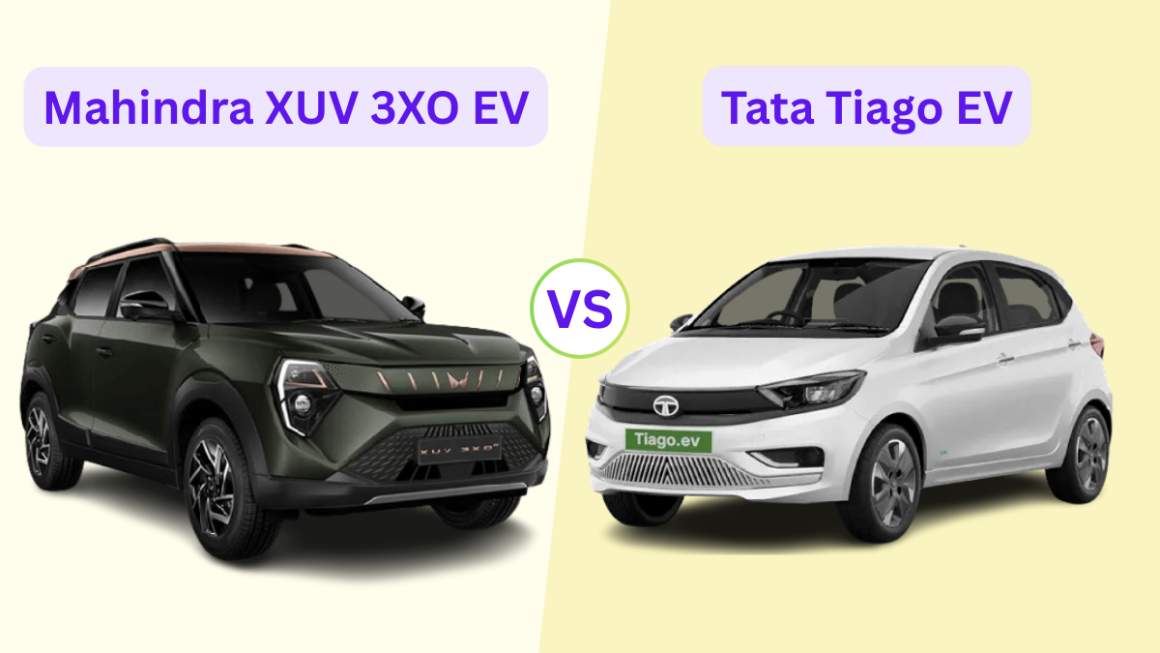
If you’re considering an EV upgrade in India right now, the XUV 3XO EV and Tiago EV sit at two very different ends of the “everyday electric” spectrum. The XUV 3XO EV is a compact electric SUV built to feel premium, punchy, and feature-rich. The Tiago EV, on the other hand, is an electric hatchback that prioritises affordability, ease of city use, and low running costs.
So the real question isn’t “which is better?”, it’s “which one fits your life?” This comparison breaks it down across dimensions such as performance, features, safety, and price, so you can pick based on your use case.
Table of Contents
Mahindra XUV 3XO EV vs Tata Tiago EV: Dimensions
Dimensions matter more than people admit, because they decide how easy the car is to park, how comfortable the rear seat feels, and how practical your boot is for daily errands or weekend luggage.
| Dimension | Mahindra XUV 3XO EV | Tata Tiago EV |
| Length | 3,900 mm | 3,769 mm |
| Width | 1,821 mm | 1,677 mm |
| Height | 1,617 mm | 1,536 mm |
| Wheelbase | 2,600 mm | 2,400 mm |
| Boot Space | 364 L | 240 L |
| Ground Clearance | 190 mm | 166 mm |
What it means in real life
- Road presence and cabin feel: The XUV 3XO EV is noticeably wider and has a longer wheelbase. That typically translates to a more SUV-like stance, stronger high-speed stability, and a cabin that feels more “open” (especially shoulder room).
- City manoeuvrability: The Tiago EV’s smaller footprint is a genuine advantage in tight lanes, crowded parking spots, and daily stop-and-go traffic.
- Boot practicality: This is a big separator. The XUV 3XO EV’s 364L boot is far more usable for airport runs, family grocery hauls, or weekend luggage than the Tiago EV’s 240L.
- Bad-road confidence: Ground clearance also tilts towards the XUV 3XO EV, which will feel less anxious over tall speed breakers and broken patches.
Mahindra XUV 3XO EV vs Tata Tiago EV: Engine & Transmission
Both are EVs, so the “engine” comparison is really battery + motor output. Here, the XUV 3XO EV is tuned like a stronger, more performance-oriented EV, while the Tiago EV is tuned like a practical city EV with two battery choices.
| Spec | Mahindra XUV 3XO EV | Tata Tiago EV |
| Engine options | Electric motor | Electric motor |
| Transmission options | 1-speed automatic | 1-speed automatic |
| Power | 147.5 bhp | Up to 73.75 bhp (LR) |
| Torque | 310 Nm | 114 Nm (LR) |
| Mileage / Range | 456 km (claimed) | Up to 315 km (claimed, LR) |
Driving experience: what you’ll actually feel
- Acceleration & overtakes: On paper, it’s not close; the XUV 3XO EV’s torque figure is in a different league. That usually shows up as stronger roll-on acceleration and easier overtakes, especially with 2–3 adults onboard and AC running.
- Tiago EV’s strength is predictability: The Tiago EV is designed to feel light, easy, and “no-drama” in city traffic. It’s quick enough for urban use, but it won’t deliver the SUV-like surge you’d expect from the XUV 3XO EV.
- Range expectations: Claimed numbers clearly favour the XUV 3XO EV. That said, the Tiago EV’s range can still be perfectly fine for most city routines (especially if you can charge at home or office).
- Official “real-world” positioning: Mahindra positions the XUV 3XO EV with a real-world range estimate and quick 0–100 claim, reinforcing that it’s built to feel fast and usable beyond short city loops.
Mahindra XUV 3XO EV vs Tata Tiago EV: Features & Comfort
Features shape your daily ownership satisfaction, screens, cabin cooling, driver aids, and “premium touches” that make the car feel worth it every time you sit inside.
| Feature | Mahindra XUV 3XO EV | Tata Tiago EV |
| Infotainment system | 10.25-inch infotainment + 10.25-inch driver display | 10.25-inch touchscreen |
| Music system | 7-speaker Harman Kardon + Dolby Atmos | 4 speakers |
| Climate control | Dual-zone auto AC | Automatic climate control available |
| Ventilated seats | Yes (variant-dependent) | Not listed as a Tiago EV feature highlight |
| Adjustable steering | Yes (variant-dependent, typical across trims) | Yes (varies by variant) |
| Drive modes | Yes (multiple modes) | Not a primary highlight (focus is comfort + cruise) |
| Instrument cluster | 10.25-inch digital driver display | Digital cluster (variant-dependent) |
| Sunroof | Panoramic sunroof | No sunroof |
| Adjustable seats | Trim-dependent | Manual adjust (variant-dependent) |
| Rear AC vents | Trim-dependent | No rear vents typical for this segment |
| 60:40 rear seat split | Trim-dependent | Variant-dependent |
| Cruise control | Included; adaptive cruise as part of Level-2 ADAS on higher trim | Cruise control available |
Which one feels nicer every day?
- Premium cockpit experience: The XUV 3XO EV’s dual-screen layout, premium audio branding, panoramic sunroof, and dual-zone climate control create a “bigger segment” feel.
- Tiago EV keeps it smart, not flashy: You still get modern essentials like a large touchscreen plus conveniences like cruise control on certain variants, but it’s still a hatchback experience, not a premium cockpit.
- Feature value: Tiago EV is excellent if you want “enough tech without paying SUV money.” But if you care about screen layout, cabin ambience, and premium touches, the XUV 3XO EV is the one that will feel more special.
Mahindra XUV 3XO EV vs Tata Tiago EV: Safety Features
Safety should always be a priority, and NCAP credibility matters more than “just more airbags.”
| Safety Item | Mahindra XUV 3XO EV | Tata Tiago EV |
| NCAP Safety Rating | 5-star Bharat NCAP for XUV 3XO (ICE platform) | No Bharat NCAP rating listed for Tiago EV; Tiago/Tigor platform scored 4-star Adult and 3-star Child in Global NCAP (2020) |
| Airbags | Up to 6 airbags on higher variants (as listed by car portals) | Dual airbags commonly listed on Tiago EV safety summaries |
| ABS with EBD | Yes (variant-dependent) | Yes |
| ESC | Included with safety suite emphasis (variant-dependent) | Not consistently highlighted as standard across all variants |
| Traction control | Available (variant-dependent) | Not consistently highlighted |
| Automatic headlamps | Available | Available on some variants (feature listings) |
| Rain-sensing wipers | Available | Highlighted in Tiago EV feature summaries |
| Hill hold assist | Available (variant-dependent) | Not consistently highlighted |
| Hill descent control | Variant-dependent | Not typically positioned for this segment |
| Rear sensors | Yes | Yes (commonly listed) |
| Rear parking camera | 360-degree camera mentioned; rear camera included | Rear camera available on select variants (commonly listed) |
| ISOFIX | Available | Not consistently stated as standard across variants |
| ADAS | Level-2 ADAS mentioned (higher trims) | Not positioned as ADAS-equipped |
Safety verdict
- If you want a safety story backed by Bharat NCAP recognition, the XUV 3XO nameplate has a clear advantage because Bharat NCAP ratings are available for it.
- The Tiago EV does not have a widely cited Bharat NCAP rating, but the Tiago/Tigor platform has a historical Global NCAP result. Treat this as an indicator, not a direct EV rating, because variant specs can change.
Mahindra XUV 3XO EV vs Tata Tiago EV: Price Comparison
This is where the decision becomes very clear: the Tiago EV is built to be India’s accessible EV, while the XUV 3XO EV is priced like a premium compact electric SUV.
| Price (Ex-showroom) | Mahindra XUV 3XO EV | Tata Tiago EV |
| Base variants | ₹13.89 lakh (AX5) | ₹7.99 lakh (XE MR) |
| Mid variants | ₹14.96 lakh (AX7L) | ₹8.99 lakh (XT MR) |
| Upper mid variants | – | ₹10.14 lakh (XT LR) |
| Top variant | ₹14.96 lakh (AX7L) | ₹11.14 lakh (XZ+ Tech LUX LR) |
Which one delivers better value?
- Tiago EV is the value champion: If your priority is “get into an EV with minimal spend,” Tiago EV is hard to beat, especially for city usage where you don’t need a big boot or SUV stance.
- XUV 3XO EV is expensive for a reason: You’re paying for SUV proportions, stronger performance, premium cabin tech, and ADAS positioning, basically a “more car” experience in daily life.
- Don’t ignore charger costs: Mahindra’s pricing communication and coverage often mention charger considerations (standard vs optional higher capacity), so check what’s included with your purchase quote.
Summary
If your daily driving is mostly city commuting, your parking space is tight, and you want the lowest barrier to EV ownership, the Tiago EV is the straightforward choice. It’s priced far lower, is easy to manoeuvre, and still offers modern conveniences like a large touchscreen and cruise control on select variants.
But if you want an EV that feels like a “proper upgrade” in performance, cabin experience, space, and premium tech, and you have the budget, the XUV 3XO EV is in a different class. It offers an SUV stance, a far bigger boot, significantly higher torque, a dual-screen cabin layout, a panoramic sunroof, and Level-2 ADAS positioning on higher trim.
Overall: Tiago EV is the best entry EV, while XUV 3XO EV is the better overall EV if you want a premium, powerful, family-friendly upgrade.
FAQs about Mahindra XUV 3XO EV vs Tata Tiago EV
Q. Which is better for a first-time EV buyer?
If you’re entering EV ownership for the first time and want to keep the budget under control, the Tiago EV makes more sense because the starting price is significantly lower.
Q. Which one is better for family use and weekend trips?
XUV 3XO EV is better suited because it offers more boot space, more ground clearance, and a more SUV-like cabin feel for longer drives.
Q. Which one feels quicker in real-world driving?
XUV 3XO EV, its torque and power figures indicate a much stronger acceleration experience than the Tiago EV.
Q. Which one is safer to choose based on NCAP visibility?
XUV 3XO has a clear Bharat NCAP presence, making it easier to buy with confidence from a formal rating standpoint.
Q. Should I pick Tiago EV or stretch to XUV 3XO EV?
Pick Tiago EV if your driving is mostly city and you want maximum value. Stretch to XUV 3XO EV if you want stronger performance, more space, and a premium feature set you’ll feel every day.