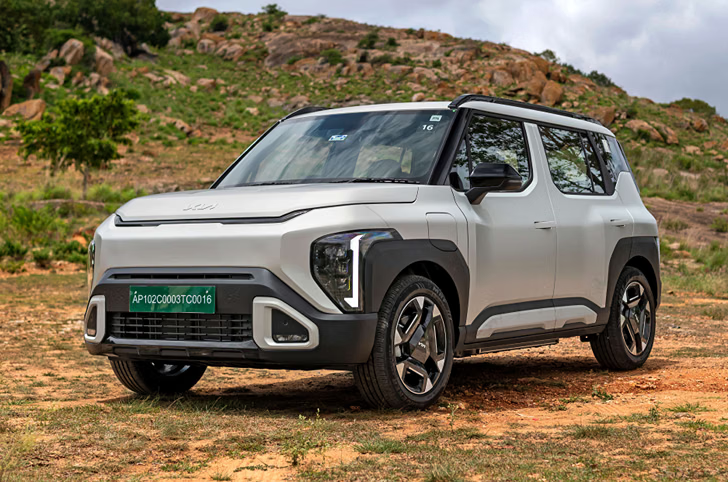
If you’re thinking about making the switch to an electric SUV, the Kia Syros EV and the Tata Nexon EV are two names you’ll come across very quickly. The Nexon EV has long been the bestseller in its segment and is often the first electric car many Indian families consider. The Syros EV is Kia’s smallest electric offering, bringing a distinctive boxy design, a roomy cabin and a bigger battery to the fight.
For most EV buyers, though, one question matters more than any other: how far will it really go on a full charge? Claimed range figures are a useful starting point, but they’re recorded under ideal conditions that rarely match daily driving with the AC on and traffic all around. In this Kia Syros EV vs Tata Nexon EV comparison, we look at the long-range versions of both, the Syros EV 51.4 kWh and the Nexon EV 45 kWh. We’ll go through their specifications, claimed range, real-world range in the city and on the highway, charging and running costs, and prices.
Table of Contents
Kia Syros EV vs Tata Nexon EV: Specifications
Both electric SUVs are offered with two battery sizes. The Syros EV comes with a 42 kWh or a 51.4 kWh pack, while the Nexon EV is available with a 30 kWh or a 45 kWh pack. Comparing the larger versions, the Syros EV carries 6.4 kWh more battery capacity, and its motor is also more powerful, producing 27 hp and 40 Nm more than the Nexon EV’s.
| Specification | Kia Syros EV (51.4 kWh) | Tata Nexon EV (45 kWh) |
| Battery capacity | 51.4 kWh | 45 kWh |
| Battery options | 42 kWh, 51.4 kWh | 30 kWh, 45 kWh |
| Motor | Single motor | Single motor |
| Power | 171 hp | 144 hp |
| Torque | 255 Nm | 215 Nm |
| Drivetrain | Front-wheel drive | Front-wheel drive |
| Drive modes | Eco, Normal, Sport | Eco, City, Sport |
| Regen levels | L0 to L3, plus i-Pedal | L0 to L3 |
There’s one small but useful difference in how they drive. The Syros EV adds an i-Pedal mode, which lets you speed up and slow down using mostly the accelerator, a handy feature in heavy traffic. The Nexon EV’s Eco mode, meanwhile, limits torque to 70 percent and also caps the top speed to help save energy, while the Syros EV’s Eco mode doesn’t impose any such limits.
Also Read: Comparison: New Tata Nexon EV vs Used Tata Nexon EV
Kia Syros EV vs Tata Nexon EV: Claimed Range (MIDC)

Electric cars in India are rated using the MIDC test cycle, which is the EV equivalent of a claimed mileage figure. With its larger battery, the Syros EV 51.4 kWh has a claimed range of up to 526 km, which is 37 km more than the Nexon EV 45 kWh’s claimed 489 km.
| Version | Battery capacity | Claimed MIDC range |
| Kia Syros EV | 51.4 kWh | 526 km |
| Tata Nexon EV | 45 kWh | 489 km |
Both EVs promise close to or more than 500 km on a full charge. As with fuel economy figures, though, real-world range tends to be quite a bit lower once you factor in traffic, highway speeds and the air-conditioning running constantly.
Kia Syros EV vs Tata Nexon EV: Real World Range
To find out how far each EV really goes, both were tested with a full battery on a fixed route through Mumbai’s city traffic and along the adjoining state highway. The AC was set to 22°C in full-auto mode throughout, and both cars were driven in Eco mode. On the highway, both used the lightest regen setting (L1), while in the city, the Syros EV was set to L3 and the Nexon EV to L2.
In the city, the Syros EV was the clear winner, delivering an estimated range of 489 km against the Nexon EV’s 355 km. On the highway, however, the tables turned, with the Nexon EV managing 345 km while the Syros EV covered 316 km.
| Condition | Kia Syros EV 51.4 kWh | Tata Nexon EV 45 kWh |
| City range | 489 km | 355 km |
| Highway range | 316 km | 345 km |
| Average real-world range | 402 km | 350 km |
| Claimed MIDC range | 526 km | 489 km |
Looking at efficiency tells the story behind these numbers. The Syros EV covered 9.52 km for every kWh in the city, compared to the Nexon EV’s 7.90 km/kWh. Out on the highway, the Nexon EV was the more efficient of the two at 7.67 km/kWh, while the Syros EV dropped to 6.14 km/kWh, likely because its tall, boxy shape has to push through more air at speed.
| Efficiency | Kia Syros EV | Tata Nexon EV |
| City | 9.52 km/kWh | 7.90 km/kWh |
| Highway | 6.14 km/kWh | 7.67 km/kWh |
Overall, the Syros EV’s larger battery gives it a 52 km higher average real-world range. If most of your driving is in the city, it pulls well ahead. If you regularly drive long distances on the highway, the Nexon EV holds its own and can even go a little further on a full charge.

Kia Syros EV vs Tata Nexon EV: Charging and Running Cost
One of the biggest reasons people move to an EV is the low running cost, so let’s put some numbers to it. We’ve assumed 1,000 km of driving a month, split evenly between city and highway, which adds up to 12,000 km a year. For electricity, we’ve used ₹8 per kWh for home charging and ₹20 per kWh for public fast charging as simple reference rates, since actual tariffs vary from city to city.
| Version | Mixed efficiency | Monthly cost (home, ₹8/kWh) | Yearly cost (home) | Monthly cost (fast charging, ₹20/kWh) | Yearly cost (fast charging) |
| Kia Syros EV 51.4 kWh | 7.47 km/kWh | ₹1,072 | ₹12,859 | ₹2,679 | ₹32,148 |
| Tata Nexon EV 45 kWh | 7.78 km/kWh | ₹1,028 | ₹12,334 | ₹2,570 | ₹30,835 |
Here’s an interesting twist. Even though the Syros EV offers more range, the Nexon EV is very slightly more efficient over an even mix of city and highway driving, thanks to its stronger highway showing. In practice, the difference is tiny, at around ₹50 a month with home charging.
What really matters is how cheap both are to run compared to a petrol car. Charging at home, either EV costs roughly ₹1 per km, while a petrol compact SUV can easily cost ₹8,000 to ₹10,000 a month in fuel for the same distance. If you have access to home charging, the savings add up very quickly.
Also Read: Tata Nexon EV: Price, Specifications, Images
Kia Syros EV vs Tata Nexon EV: Price Comparison
The Nexon EV is the more affordable of the two. Its range starts at around ₹12.49 lakh, with the long-range 45 kWh versions priced between ₹14.34 lakh and ₹17.69 lakh. The Syros EV starts at about ₹13.50 lakh, and its 51.4 kWh versions sit between roughly ₹17 lakh and ₹20 lakh (all prices ex-showroom).
| Car | Starting price | Long-range battery versions |
| Kia Syros EV | From ₹13.50 lakh | ₹17 lakh to ₹20 lakh (51.4 kWh) |
| Tata Nexon EV | From ₹12.49 lakh | ₹14.34 lakh to ₹17.69 lakh (45 kWh) |
Comparing the long-range versions, the Syros EV costs about ₹2.66 lakh more at the base level and around ₹2.31 lakh more at the top end. For that extra money, you get a bigger battery, a more powerful motor, more city range and a spacious, tech-rich cabin. The Nexon EV, on the other hand, offers strong value, a slightly better highway range and the reassurance of being one of the most widely used EVs in the country.
Buying used? The Nexon EV has been on sale since 2020, so you’ll find a good selection of pre-owned examples on Spinny, often at a fraction of the new price. The Syros EV is much newer, so used examples are still rare. When buying a used EV, pay close attention to the battery’s health and charging history, check that the warranty is still valid and can be transferred, and make sure the charging cable and accessories are included. Spinny Assured cars are put through a 200-point inspection and come with a 1-year warranty, fixed pricing and a 5-day money-back guarantee.
Summary
In this Kia Syros EV vs Tata Nexon EV real-world range comparison, the Syros EV comes out ahead overall, with an average range of about 402 km against the Nexon EV’s 350 km. Its bigger 51.4 kWh battery and impressive city efficiency make it especially well suited to daily urban driving, where it can cover close to 490 km on a single charge. The Nexon EV, however, is far from outclassed. It’s the more efficient of the two on the highway, slightly cheaper to run over a mixed routine and noticeably more affordable to buy. If most of your driving involves long highway stretches, or if you’d like to keep your budget in check, the Nexon EV remains a very sensible choice. If you spend most of your time in the city and want the extra range, power and space, the Syros EV is well worth the additional spend.
Related Blogs:
Comparison: Kia Syros EV vs Tata Nexon EV
Kia Syros Buying Guide: Price, Features, Variants
FAQs about Kia Syros EV and Tata Nexon EV Range Comparison
Q. What is the real-world range of the Kia Syros EV?
The Syros EV with the 51.4 kWh battery delivered an estimated range of about 489 km in the city and 316 km on the highway in real-world testing, giving an average of around 402 km. That’s lower than its claimed 526 km, which is normal for any EV in everyday conditions.
Q. What is the real-world range of the Tata Nexon EV 45 kWh?
The Nexon EV 45 kWh managed roughly 355 km in the city and 345 km on the highway, for an average real-world range of about 350 km. Its range stays remarkably consistent between city and highway driving.
Q. Why does the Syros EV lose so much range on the highway?
The main reason appears to be its tall, boxy design. At higher speeds, a shape like this has to push through more air, which uses more energy. In the city, where speeds are lower, this matters far less, which is why the Syros EV shines in urban driving.
Q. Does the Nexon EV’s Eco mode feel restrictive?
In Eco mode, the Nexon EV limits torque to 70 percent of its maximum and caps the top speed to save energy. That’s perfectly fine for relaxed city driving, but you may want to switch to City or Sport mode for quick overtakes on the highway. The Syros EV’s Eco mode doesn’t impose such limits.
Q. How often would I need to charge each EV for a 50 km daily city commute?
Going by the real-world city figures, a fully charged Syros EV could last around nine days of 50 km commutes, while the Nexon EV would last about seven. Most owners prefer to top up at home overnight, though, so you’ll rarely need to run the battery down that far.
Q. What about the smaller-battery versions of these EVs?
The Syros EV 42 kWh and the Nexon EV 30 kWh weren’t part of this test, so we don’t have real-world range figures for them yet. With less battery capacity, they’ll naturally offer less range, which makes them better suited to buyers who mostly drive within the city.