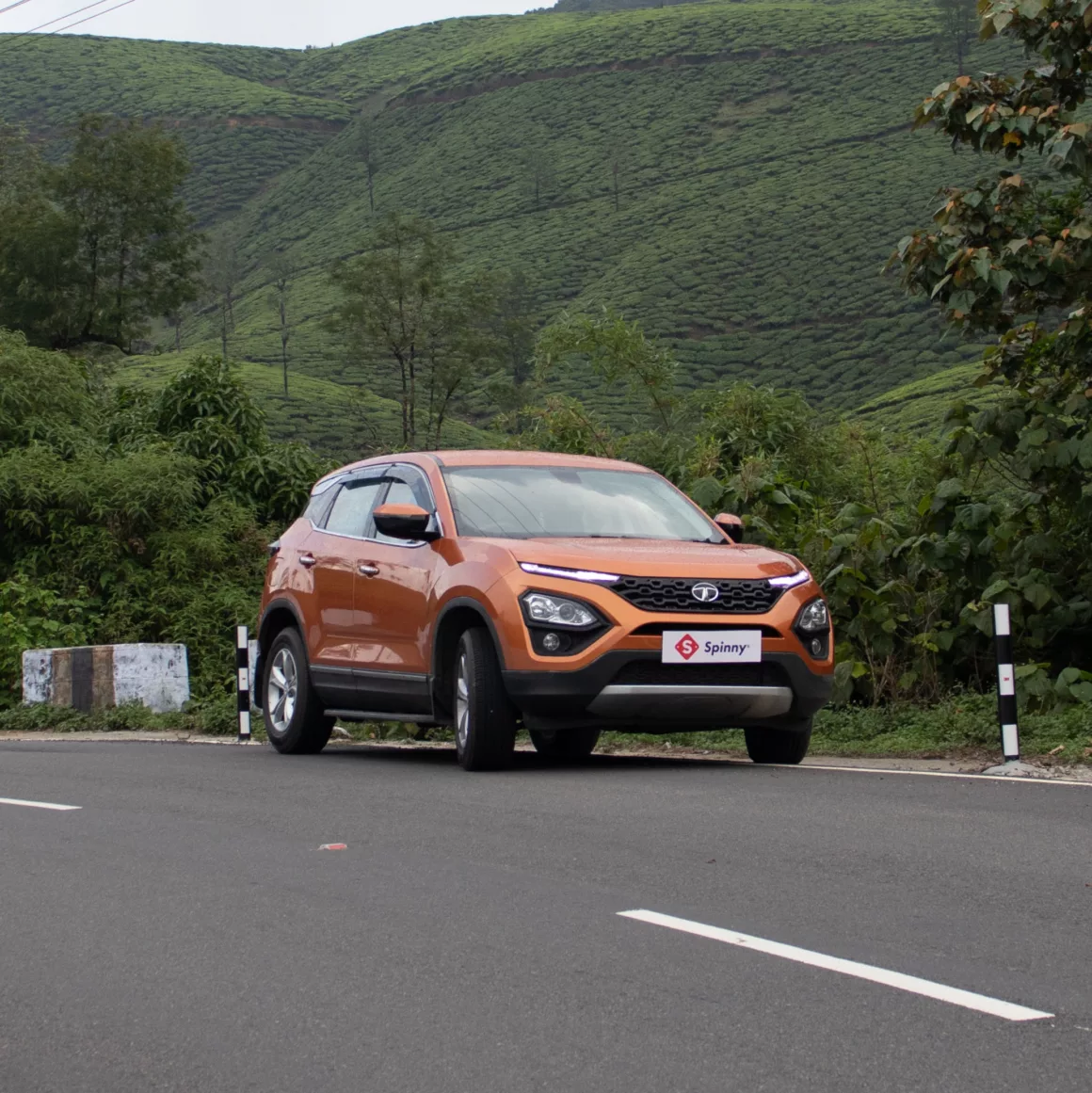
Launched in 2019, the Tata Harrier marked Tata Motors’ bold entry into the premium SUV segment. Built on Land Rover’s D8-derived Omega Arc platform, the Harrier quickly gained popularity for its commanding road presence, robust build, and a diesel-only drivetrain that appealed to highway users and enthusiasts alike. With multiple feature updates over the years, including a major facelift in 2023, the Harrier has become one of the most aspirational homegrown SUVs in India.
If you’re looking to buy a used Tata Harrier, you’re likely aiming for a powerful, spacious SUV with a rugged character. This blog will help you evaluate which model year to consider, which variant offers the best value, what the ownership costs are like, and what upgrades can enhance your experience, all with verified and practical insights.
Best Age of Used Tata Harrier to Buy
Since its introduction in 2019, the Tata Harrier has won credence for its muscular design, robust diesel engine, and premium feel built on the Omega Arc platform. The Harrier saw its first major facelift in 2023, adding features like a panoramic sunroof, ADAS, and refreshed styling
Depreciation Overview
- As per market valuation trends:
- Vehicles typically lose 18-20% in the first year
- Another 10-15% by years two and three
- By year five, most retain only about 55-60% of their ex-showroom value
For example, a Harrier purchased at around ₹17-18 lakh on-road could sell for ₹9-10 lakh after four to five years.
Ideal Model Years to Target
- A 2-4-year-old Harrier (model years 2020-2022) offers the best value. These cars benefit from:
- 2020 updates including a panoramic sunroof, infotainment upgrade, and powertrain tweaks
- The latest safety kit with six airbags, ESC, and ABS as standard
- Potential extended warranty and well-preserved components
Earlier models (2019) lack many modern refinements, while the freshly launched 2023 facelift versions have yet to see meaningful depreciation.
Best Age of Used Tata Harrier to Buy
Launched in October 2018, the Tata Harrier went through meaningful updates in February 2020, adding panoramic sunroof, enhanced safety kit, and infotainment upgrades, and again in February 2023 with ADAS, 10.25″ touchscreen, and 360° camera
Depreciation Trend
- Year 1: 18-20% drop in value
- Years 2-3: 10-15% further depreciation
- By Year 5: Retains roughly 55-60% of its ex-showroom value
For example, a Harrier bought at ₹17-18 lakh may drop to around ₹9-10 lakh in the 4-5 year-old range.
Sweet Spot: 2-4-Year-Old Models (2020-2022)
- This age bracket offers excellent value:
- These include major mid-cycle updates (sunroof, better infotainment, refined interiors)
- Safety tech like six airbags, ESC, and parking sensors became standard post-2020
- Many units may still be covered by extended warranties or dealer service plans
- Fewer mechanical issues are expected compared to earlier models
While first-year models from 2019 may lack some of these refinements, and the 2023 facelift models are too new to have depreciated meaningfully.
Best Used Tata Harrier Variant to Buy
Tata has positioned the Harrier with thoughtfully tiered trims, ranging from basic to feature-rich editions. In the used market, certain trims offer significantly better value without steep premiums.
Top Pick for Value: XZ or XZ+ (2020-2022 Models)
For most buyers, the XZ (diesel manual) or XZ+ (higher-spec) trims deliver the best mix of luxury, practicality, and cost-effective ownership:
Key Features (post-2020 facelift):
- Panoramic sunroof, projector headlamps, LED DRLs
- 7-inch touchscreen with Android Auto/Apple CarPlay
- Reverse camera and parking sensors
- Alloy wheels and electric-folding mirrors
- Six airbags, ESC, ISOFIX, hill-hold
- Dual-zone climate control, rear AC vents
Why XZ/XZ+ work well:
Mid-trims like XT lack essential features; top trims (Adventure, Fearless) add premium tech like ADAS and JBL audio but come with steep premiums, even in resale value. The XZ/XZ+ sit in the sweet spot and are widely available.
Used units in the XZ+ trim, including special editions like Dark Edition, continue to be valued highly, signaling strong resale confidence
Best Age of Used Tata Harrier to Buy
The Tata Harrier, launched in 2018, received significant updates in 2020 (sunroof, upgraded infotainment, safety enhancements) and again in 2023 (ADAS, a 10.25″ touchscreen, 360° cameras, and refreshed styling).
Depreciation Overview
- Year 1: Approximately 20-30% dip
- Years 2-3: An additional drop of 10-15% yearly
After 5 years: Typically value drops to about 50-55% of original ex-showroom pricing
For instance, a Harrier purchased at ~₹17 lakh can depreciate to ₹9-10 lakh in 4-5 years.
Market Reality (2023-2024)
- Pre-facelift models (2018-2019) priced between ₹8-12 lakh
- Facelift units (2020-2022) typically trade for ₹9-18 lakh depending on variant and condition
- Later facelift units (2022) in good condition held value around ₹15-16 lakh
Ideal Purchase Window
- Target 2-4‑year‑old units, primarily models from 2020-2022, to benefit from:
- Facelift enhancements like sunroof, infotainment, safety upgrades
- Potential remaining warranty coverage
- Avoiding most costly post‑warranty repairs
Vehicles older than four years may begin showing significant wear, while newer 2023 models haven’t yet undergone sizable depreciation.
Used Tata Harrier Manual vs Automatic: Which to Choose?
Unlike many other SUVs in its segment, the Tata Harrier has been offered with only one fuel type, diesel. However, you do get two transmission options: 6-speed manual and 6-speed automatic (torque converter). Both come with their own pros and cons depending on how and where you plan to drive.
Manual Transmission (MT)
- Available from the beginning (2019 onwards)
- Offers better control on highways and hilly terrains
- Slightly better fuel economy than the automatic
- Lower service and repair costs
- Preferred by enthusiasts and those who drive long distances frequently
Automatic Transmission (AT)
- Introduced in early 2020 in partnership with Hyundai for the 6-speed torque converter
- Smoother and easier to drive in city traffic
- Ideal for urban users or those preferring a relaxed drive
- Slightly lower mileage than manual but better convenience
- AT variants usually command a ₹1-1.5 lakh premium, even in the used market
Go for the MT if you prioritize control, better mileage, or frequently drive on mixed terrains, and choose the AT if you mainly drive in cities and prefer convenience over outright efficiency.
Used Tata Harrier Ownership Calculator
Buying a used Tata Harrier is reliable, but it’s smart to consider recurring ownership costs. Here’s a breakdown of typical annual expenses, excluding the purchase:
Annual Service & Maintenance
Tata recommends servicing every 15,000 km or annually. Expect:
- Routine service: ₹13,000-₹15,000 per visit, covering oil, filters, inspection
- Major 75,000 km service: Includes timing belt/coolant, costing around ₹25,000-₹30,000
- Estimated 4-year maintenance total: ₹55,000-₹68,500
Battery Replacement
Typically needed every 3-4 years: ₹6,500-₹9,000 depending on brand (e.g. Exide, Amaron)
Tyre Replacement
- 18-inch tyres run ₹4,300-₹13,000 each; average replacement cost for a full set is ₹18,000-₹25,000
- Tyres usually last 40,000-60,000 km
Wear-and-Tear Items (Approximately)
- Brake pads: ₹2,500-₹4,000 per axle (every 30,000-40,000 km)
- Wiper blades: ₹600-₹1,000 yearly
- Cabin air filter: ₹550 annually
Insurance Renewal
- Third-party cover: ₹3,000-₹5,000
- Comprehensive policy: ₹8,000-₹12,000, depending on variant and IDV
Annual Cost Summary (Excluding Insurance)
| Expense | Petrol/Diesel (₹) |
| Regular service | 13,000-15,000 |
| Battery (amortized) | ~1,500-2,250 |
| Tyres (amortized) | ~4,500-6,250 |
| Wear parts & consumables | ~3,000 |
| Total (excluding insurance) | ₹22,000-₹27,500 |
These estimates apply to a well-maintained vehicle without unexpected repairs. For a 4-year-old Harrier, plan accordingly.
Upgrades for Used Tata Harrier
While the Harrier offers solid features, a few upgrades, especially in older models, can enhance comfort and utility.
Infotainment & Connectivity
- Upgrade to a 10.25″ touchscreen: ₹25,000-₹35,000
- Add reverse or 360° camera: ₹4,000-₹10,000
Tyres & Alloys
- Tyre replacement (full set): ₹20,000-₹25,000
- Alloy upgrade (if needed): ₹25,000-₹35,000
Cabin Comfort
- Seat covers: ₹5,000-₹10,000
- Ambient lighting and soft-touch trims: ₹2,000-₹5,000
Safety & Convenience
- TPMS: ₹3,000-₹5,000
- Dash Cam: ₹3,000-₹8,000
- Blind spot mirrors or upgraded IRVMs
- Ideal upgrade budget: ₹30,000-₹60,000 for a refreshed and more premium experience.
Summary
The Tata Harrier is a strong pick in the used SUV market, offering robust build quality, powerful diesel performance, and a commanding road presence. The best model years to consider are 2020–2022, as these facelifted versions come with improved features and refinement. Opt for the XZ or XZ+ variants for a balanced mix of features and value. Choose the manual transmission if you prefer control and better mileage, or go for the automatic if you mostly drive in urban conditions and want added convenience. Annual ownership costs typically range between ₹22,000–₹27,500 (excluding insurance).
Recommended upgrades such as a touchscreen infotainment system, new tyres, seat covers, a dashcam, and TPMS can further enhance your ownership experience. With the right variant and a few smart upgrades, a used Tata Harrier can feel premium and deliver long-term satisfaction.
FAQs About Used Tata Harrier
Q. Is the Tata Harrier a good car to buy second-hand?
Yes. It’s built on a proven platform, offers solid diesel performance, and comes with strong safety credentials. Models from 2020 onward are especially reliable.
Q. Which variant of the Harrier offers the best value in the used market?
The XZ and XZ+ variants strike the best balance between price and features, offering premium amenities like a sunroof, touchscreen infotainment, and advanced safety features.
Q. What is the real-world mileage of the Tata Harrier?
In practical conditions, expect:
Manual: 14-16 kmpl (city/highway mix)
Automatic: 12-14 kmpl (city/highway mix)Q. Are Tata Harriers expensive to maintain?
Not particularly. Routine service costs around ₹13,000-₹15,000 annually, with additional expenses for tyres and batteries every 3-4 years. The overall upkeep is reasonable for a premium SUV.
Q. Does the Harrier hold resale value well?
Yes. The Harrier has developed strong brand recall and now holds its value better than earlier Tata models, especially post-2020 trims with better equipment and styling.