A car warranty is your safety net against unexpected repairs caused by manufacturing defects. It is especially valuable in the first few years of ownership, when you want predictable running costs and quick support if something goes wrong. In India, where cars face heavy traffic, heat, uneven roads, and monsoon conditions, warranty terms matter as much as features and mileage.
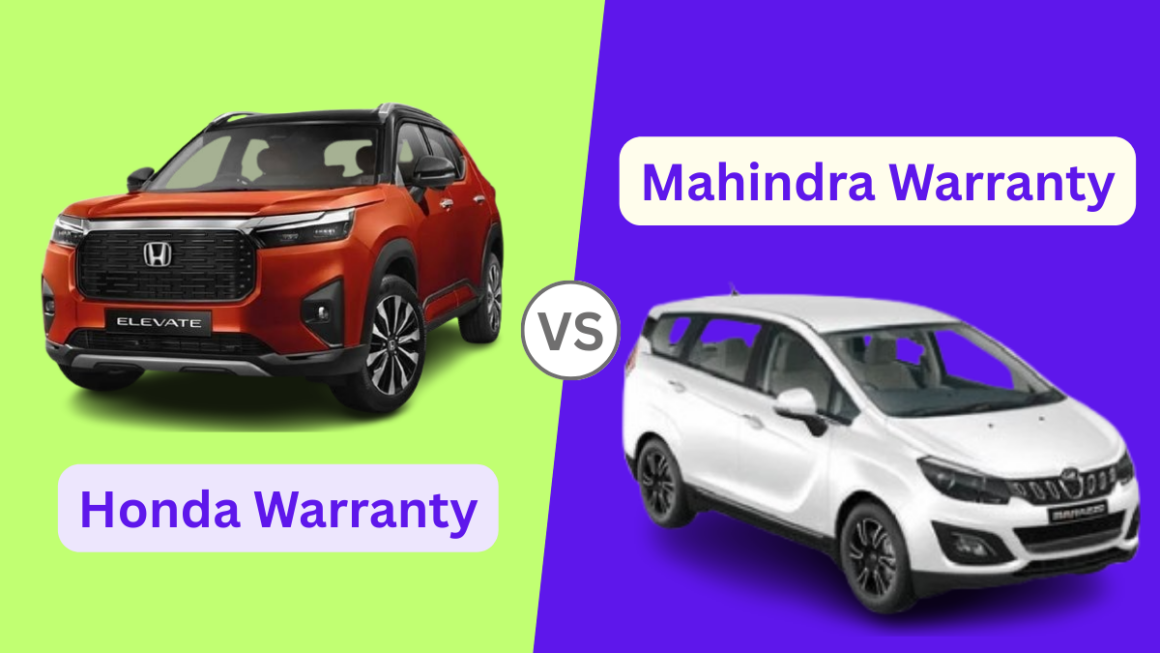
In this car warranty comparison guide for India, we compare Honda’s warranty and Mahindra’s warranty across key parameters that affect real ownership, including coverage type, duration, starting point, transferability, claim process, and service support. Warranty terms can vary by model and the specific plan you choose, so use this as a clear comparison framework to confirm the final terms for your exact vehicle.
Table of Contents
Honda Warranty vs Mahindra Warranty – Overview
Overview Comparison:
| Parameter | Honda Warranty | Mahindra Warranty |
| Coverage Type | Manufacturer warranty for defects in material or workmanship; extended warranty options available on eligible models | Manufacturer warranty for defects in material or workmanship; extended warranty options available on eligible models |
| Coverage Duration | Standard warranty is commonly offered as 3 years with unlimited kilometres on many models; extended tenure options are available on eligible models | Standard warranty is commonly offered as years plus kilometres on many models, whichever comes first; extended warranty options are available with plan-specific limits |
| Starting Point | Typically starts from retail delivery, first sale, or registration date as per the warranty booklet | Typically starts from retail delivery, first sale, or registration date as per the warranty booklet |
| Transferability | Generally transferable to the next owner, subject to process and conditions | Generally transferable to the next owner, subject to process and conditions |
| Claim Process | Claim initiated at the authorised Honda service centre after inspection and diagnosis | Claim initiated at the authorised Mahindra service centre after inspection and diagnosis |
| Support | Authorised network support; outcomes depend on service history and policy compliance | Authorised network support; outcomes depend on service history and policy compliance |
At the fundamentals level, both brands offer the same promise: if a covered component fails due to a manufacturing defect within the warranty period, the authorised service network will repair or replace it as per policy. The main differences show up in how easy the duration is to live with, how the extended warranty is structured, and how well the plan fits your driving pattern.
Honda’s headline advantage for many buyers is the unlimited-kilometre warranty on standard warranty for a large part of its lineup, which removes odometer anxiety for high-mileage users. Mahindra’s strength is its wide product range and established service ecosystem for SUVs, but warranty terms often involve kilometre caps that you need to align with your annual running.
Both warranties offer solid manufacturer-backed protection, but Honda’s mileage-friendly structure tends to feel simpler and more predictable for a wider range of users.
Honda Warranty vs Mahindra Warranty: Coverage Scope (What each Warranty includes)
Coverage Scope Comparison:
| Component/Area | Honda Warranty | Mahindra Warranty |
| Engine and Transmission | Generally covered for manufacturing defects in covered parts, subject to terms and exclusions | Generally covered for manufacturing defects in covered parts, subject to terms and exclusions |
| Electrical Components | Covered for defects in covered electrical parts; exclusions may apply for external damage, accessories, or modifications | Covered for defects in covered electrical parts; exclusions may apply for external damage, accessories, or modifications |
| Suspension | Covered if failure is due to a defect in covered parts; wear-related deterioration is usually excluded | Covered if failure is due to a defect in covered parts; wear-related deterioration is usually excluded |
| Steering System | Covered for defects in covered parts; alignment and adjustments typically excluded | Covered for defects in covered parts; alignment and adjustments typically excluded |
| AC System | Covered for defects in covered parts; gas top-ups and consumables are typically excluded | Covered for defects in covered parts; gas top-ups and consumables are typically excluded |
| Fuel System | Covered for defects in covered components; fuel contamination-related issues are typically excluded | Covered for defects in covered components; fuel contamination-related issues are typically excluded |
| Wear and Tear | Generally not covered (brake pads, clutch wear, tyres, wipers, bulbs, fluids, filters, etc.) | Generally not covered (brake pads, clutch wear, tyres, wipers, bulbs, fluids, filters, etc.) |
Coverage scope is where many buyers form unrealistic expectations. A manufacturer’s warranty is not a maintenance plan. It is primarily defect protection, not a promise to replace parts that wear out through normal use.
Most warranty experiences fall into three buckets:
Defect-related failures are the ones on which warranties are built. If a covered part fails early because of a manufacturing or workmanship issue, it is typically eligible, provided the vehicle is within the coverage period and has been maintained as required.
Wear-and-tear is usually excluded. This includes routine replacement items such as brake pads, clutch friction material, tyres, wiper blades, bulbs, filters, and fluids. Even if a wear item needs replacement earlier than expected, it is typically treated as a usage and maintenance cost.
Honda Warranty vs Mahindra Warranty: Validity & Flexibility
Validity & Flexibility Comparison:
| Parameter | Honda Warranty | Mahindra Warranty |
| Duration | Standard warranty is commonly 3 years with unlimited kilometres on many models; extended options are available on eligible models | Standard warranty often follows years plus kilometres, whichever comes first; extended options available with plan-specific limits |
| Extendability | Extended warranty options available, including longer-tenure plans on eligible models | Extended warranty options available through brand programmes on eligible models |
| Eligibility | Usually depends on model, age, service history, and enrolling within the allowed purchase window | Usually depends on model, age, service history, and enrolling within the allowed purchase window |
| Ownership Transfer | Generally allowed with conditions and documentation | Generally allowed with conditions and documentation |
Validity is where the fine print becomes personal. If you drive 10,000 km a year, you may never come close to kilometre limits in the first few years, so time becomes the main boundary. If you drive 20,000 km a year or more, kilometre caps can become the real limiter and can reduce the practical value of a warranty even if the time period looks long.
Honda’s unlimited-kilometre warranty on standard warranty for many models is a big practical benefit for frequent travellers, long-distance commuters, and owners who rack up mileage quickly. It also helps owners who do not want to constantly track whether they are approaching a kilometre threshold.
Mahindra’s warranty can still be a strong proposition, especially for SUV owners, but you need to match the plan to your driving. If you do heavy highway running, check the kilometre conditions on both standard and extended warranty. A plan that extends time but ends early on kilometres may not deliver the long-term peace of mind you are paying for.
Transferability is useful for resale in both cases. A transferable manufacturer-backed warranty can make a used car easier to sell, but it typically requires proper service records, compliance with scheduled maintenance, and completion of the transfer process as defined by the brand.
For buyers who drive a lot, Honda’s warranty structure usually offers more flexibility and simpler long-term predictability.
Honda Warranty vs Mahindra Warranty: Claim Process & Ease of Service
Claim Process Comparison:
| Parameter | Honda Warranty | Mahindra Warranty |
| Claim Method | Authorised service centre inspection, diagnosis, and warranty validation | Authorised service centre inspection, diagnosis, and warranty validation |
| Process Time | Depends on diagnosis complexity, approvals (if needed), and parts availability | Depends on diagnosis complexity, approvals (if needed), and parts availability |
| Payment Type | Covered repairs are generally processed as warranty; the customer pays for non-covered items and consumables | Covered repairs are generally processed as warranty; the customer pays for non-covered items and consumables |
| Assistance | Service advisor coordinates job card, inspection, and warranty processing | Service advisor coordinates job card, inspection, and warranty processing |
| Documentation | Service history and job card notes are typically required; additional documents may be requested | Service history and job card notes are typically required; additional documents may be requested |
Both brands follow a similar claim flow in practice. You report the issue at an authorised workshop, the vehicle is diagnosed, and if the failed component qualifies as a warranty-covered defect, the repair is processed accordingly.
Claims are usually smooth when the cause is clearly defect-related, and the vehicle has a clean service history. The situations that take longer tend to be borderline cases, such as suspension noises that could be wear or impact-related, electrical faults that could be linked to accessories, or issues following water exposure. In these cases, diagnosis time increases, and approvals can take longer, especially if parts need to be ordered.
Ease of service also depends on your city and the specific service centre’s capability and load. Both Honda and Mahindra have wide networks, but real turnaround times vary by location, season, and parts availability.
Summary
Honda warranty and Mahindra warranty both offer solid manufacturer-backed defect coverage, extended warranty options on eligible models, and transferability under certain conditions. They also share the same broad exclusions in principle, especially wear-and-tear items and damage caused by external factors such as accidents, flooding, and improper modifications.
Overall, Honda’s warranty is the better warranty to consider for most buyers in India because it is typically more mileage-friendly and easier to live with. A standard warranty structure that commonly includes unlimited kilometres on many models is a major advantage for high-mileage users and reduces the chances of the warranty ending early due to kilometres. Honda’s extended warranty options on eligible models also strengthen long-term predictability, which matters for owners who keep cars beyond the early years.
Mahindra warranty remains a strong choice, especially for SUV-focused buyers who choose an extended plan aligned to their needs. But for a broader set of usage patterns, Honda’s simpler mileage framing and long-tenure options tend to offer more practical peace of mind.
FAQ about Honda Warranty vs. Mahindra Warranty
Q. Which is better in this car warranty comparison, India, Honda warranty or Mahindra warranty?
Honda’s warranty is generally the better overall choice for most buyers because its standard warranty on many models is commonly structured with unlimited kilometres, which benefits high-mileage users and improves long-term predictability.
Q. Does the manufacturer’s warranty cover regular service and maintenance?
No. Routine servicing, periodic maintenance, fluids, and consumables are typically not covered. Warranty focuses on defect-related failures of covered parts.
Q. Are wear-and-tear parts covered under the Honda warranty or the Mahindra warranty?
Usually no. Items like brake pads, clutch wear, tyres, wipers, bulbs, filters, and fluids are generally excluded as normal wear.
Q. Can I transfer the Honda warranty or the Mahindra warranty to the next owner?
In many cases, yes, subject to conditions and a transfer process. Proper service records and policy compliance are important.
Q. What can lead to warranty claim rejection?
Common reasons include missed scheduled services, unauthorised repairs, risky electrical modifications, use of non-genuine parts in sensitive systems, and damage linked to accidents, flooding, or fuel contamination.