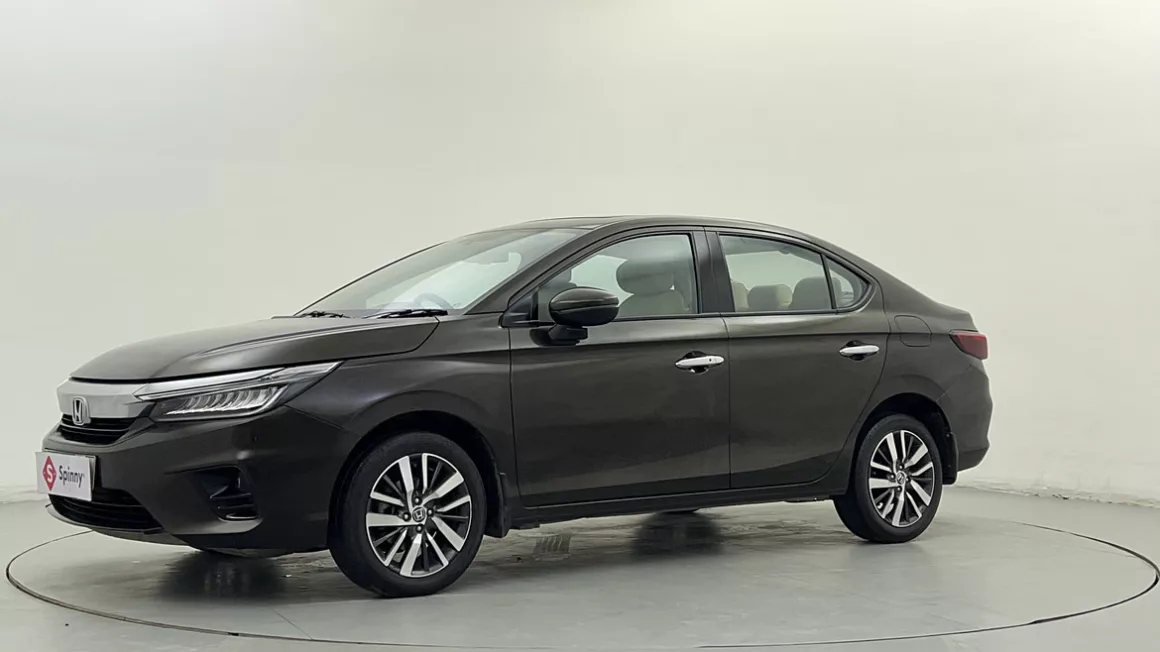
Honda City Mileage Comparison: The Honda City has been one of India’s most popular sedans for a long time, appreciated for its upscale look, comfort, and smooth performance. Since it balances practicality and style, the City has consistently been a favourite among families, professionals, and enthusiasts seeking reliability along with trendy features.
To cater to different driving preferences, Honda offers the City with two main transmission options. For those who value control and engagement, there is the 6-speed manual transmission. At the same time, for convenience and a stress-free drive, most people opt for the smooth CVT automatic, which is ideal for easy city driving and relaxed long trips.
Mileage, however, remains a key priority for most buyers. Since manual and automatic transmissions offer different levels of efficiency, it’s essential to compare them. To provide a clear overview, the authorised ARAI-approved mileage ratings for all Honda City models, whether manual, automatic, or hybrid, are listed below.
Read on to explore the detailed Honda City automatic vs manual mileage comparison and find out which option is most suitable for your needs.
Honda City ARAI Mileage Figures
Honda City offers impressive ARAI-approved mileage across its petrol, automatic, and hybrid models. The official ARAI-approved mileage for the City in all engine and transmission configurations is:
| Engine & Transmission | ARAI Mileage (km/l) |
| 1.5L Petrol Manual | 17.8 km/l |
| 1.5L Petrol CVT (Automatic) | 18.4 km/l |
| Hybrid e-CVT | 27.26 km/l |
Honda City Real-World Mileage vs ARAI Mileage
While ARAI-approved mileage provides a reference point, the actual fuel efficiency of the Honda City varies due to different conditions. In city driving, the petrol manual offers about 13.8 km/l, while the CVT automatic averages 14.0 km/l. On the highway, both models achieve better mileage, ranging from 16 to 19 km/l with steady driving.
Several factors contribute to this gap between ARAI and real-world figures:
- Traffic Conditions: Prolonged idling, stop-and-go movement, and heavy congestion significantly reduce mileage compared to smoother highway runs where the Honda City delivers closer to ARAI expectations.
- Driving Habits: Sudden acceleration, hard braking, or consistently high speeds cause the engine to consume more fuel, resulting in lower efficiency compared to smoother, controlled driving styles.
- Load & AC Usage: Carrying extra passengers, heavy luggage, and running the air-conditioner for extended periods puts additional strain on the engine, leading to increased fuel consumption.
- Vehicle Maintenance: Cleaning air filters, maintaining proper wheel alignment, and performing timely servicing directly impact mileage, ensuring the City performs closer to its rated efficiency.
- Tyre Pressure & Fuel Quality: Underinflated tyres increase rolling resistance, while low-quality fuel reduces combustion efficiency, both of which result in reduced real-world mileage figures.
Overall, the Honda City’s real-world fuel economy is impressive for its class, offering a good balance of efficiency, refinement, and comfort. The manual is slightly more efficient, while the CVT provides a smoother driving experience.
Honda City Fuel Efficiency Comparison: Automatic vs Manual
When comparing fuel efficiency in the Honda City, the manual transmission performs slightly better under ideal conditions, as it gives drivers more control over gear shifts. The CVT automatic, however, ensures smoother cruising and steadier mileage, especially on highways where consistent speeds reduce efficiency gaps.
In city driving, frequent stops, gear shifts, and idling affect both models; however, the CVT’s torque converter slightly reduces efficiency compared to the manual transmission. Nonetheless, the automatic offers ease of use and smooth performance in crowded areas, while the manual delivers marginally better fuel economy for those concerned about efficiency.
Honda City City Fuel Efficiency Comparison
When driving in city conditions, the Honda City offers consistent fuel economy; however, traffic and braking have a different impact on mileage in the automatic (CVT) and manual transmission models. The manual typically averages 12–13.5 km/l, while the CVT manages approximately 10.5–12.5 km/l, making the manual slightly more efficient in busy traffic.
Real-world data shows that the manual usually achieves slightly better city fuel economy, while the CVT provides smoother city driving at a small cost of increased fuel consumption. This makes the manual a practical choice for those looking to save fuel, whereas the CVT is designed for smooth, effortless city driving.
The key reasons for the differences in mileage include:
- Transmission Efficiency: The CVT automatic maintains steady RPM and ensures smooth power delivery, but can consume more fuel during frequent acceleration in city traffic. The manual, with direct power transfer, usually delivers better mileage in urban conditions.
- Driving Conditions: In stop-and-go traffic, manual drivers can optimise gear changes to extract better efficiency. CVT automatics, although convenient, often increase fuel consumption due to constant adjustments at varying speeds and sudden braking.
- Idle and Low-Speed Efficiency: Manual variants generally consume less fuel during prolonged idling or low-speed crawling. The CVT, while smoother, may rev higher under such conditions, resulting in slightly increased fuel consumption compared to the manual transmission.
- Engine Load and Heat Management: The CVT maintains the engine’s optimal operating range during steady-state runs but can generate more load during frequent acceleration. Manuals handle such variations more efficiently, though driver input plays a significant role in fuel usage.
- Maintenance and Wear Impact: Manual cars can sometimes maintain better efficiency if the clutch and gearbox are well-managed. CVTs, on the other hand, maintain consistent performance but may show slightly reduced mileage if not serviced regularly.
- Driving Comfort vs Economy: The CVT prioritises driving comfort, offering seamless gear changes at the cost of minor mileage differences. Manuals provide better control and economy for skilled drivers, but can be tiring in prolonged city traffic.
Honda City Highway Fuel Efficiency Comparison
The petrol manual version of the Honda City strikes an outstanding balance between fuel efficiency and handling, making it ideal for daily commuters who enjoy manual gear shifting. In real-world highway driving, it achieves 17–19 km/l, which is slightly higher than in city driving.
On the other hand, the CVT automatic model emphasises comfort and smoothness, especially for city driving, though it sacrifices some efficiency. On the highway, the CVT achieves 16–18 km/l, which is slightly lower than the manual transmission’s fuel efficiency.
While the difference is minimal, highway commuters aiming to save fuel may prefer the manual transmission, but city drivers may still find the CVT’s convenience worth it. Key factors affecting highway mileage between automatic and manual variants include:
- Cruising Efficiency: The CVT automatic maintains steady RPM at constant speeds, ensuring stable highway fuel economy. Manual variants can deliver comparable mileage, but this requires careful gear changes and throttle control to avoid unnecessary fuel consumption.
- Load and Air-Conditioning Impact: Extra passengers, heavy luggage, or continuous air-conditioning reduce mileage for both variants. Manuals may see slightly higher fuel impact since engine load changes with driver input, while CVTs handle such variations more efficiently under steady highway driving.
- Driving Style: The CVT benefits drivers who maintain a smooth, consistent pace, rewarding them with reliable efficiency and performance. Manual variants can achieve similar results, but frequent gear shifts or sudden braking negatively affect overall fuel economy.
- Terrain and Elevation: On slopes or uneven terrain, the CVT automatically adjusts for efficiency, maintaining balanced performance. Manual drivers get more control, but incorrect gear selection often leads to higher fuel use compared to the CVT’s optimised engine response.
- Fuel Stops and Convenience: Since the CVT maintains steadier efficiency, it typically requires fewer fuel stops on long journeys. Manual efficiency, however, may fluctuate depending on driving discipline, leading to more frequent refuelling breaks.
- Overtaking and Speed Variations: Manual variants often consume more fuel during sudden accelerations or frequent overtaking. The CVT, however, optimises power delivery automatically, providing smoother performance, even under speed variations and higher load conditions.
- Engine Stress and Longevity: The CVT ensures the engine operates within an efficient range, reducing stress during long drives. Manual variants, if driven at consistently high RPMs, may experience increased fuel consumption and engine strain over extended highway use.
Honda City Fuel Cost Comparison: Automatic vs Manual
Choosing between the automatic and manual transmission of the Honda City requires careful consideration of fuel efficiency and running costs. Assuming an average monthly usage of around 1,500 km, this comparison highlights which variant offers better value for money and aligns more closely with your budget.
| Aspects | Manual | Automatic |
| Monthly Running Distance | 1,500 km | 1,500 km |
| Monthly Fuel Use | ~ 84.27 litres | ~ 81.52 litres |
| Average Monthly Fuel Cost | ~ ₹7,986 | ~ ₹7,726 |
| Average Yearly Fuel Cost | ~ ₹95,832 | ~ ₹92,712 |
| 5-Year Fuel Cost | ~ ₹4,79,160 | ~ ₹4,65,560 |
Note: Fuel costs have been calculated considering an average petrol price of ₹94.77 per litre. Actual expenses may vary depending on location, fuel price fluctuations, and driving style.
While both variants deliver competitive efficiency, the manual tends to consume slightly more fuel in the long run, especially during city commutes.
The automatic (CVT) balances comfort with better highway mileage, often resulting in comparatively lower overall running costs.
Honda City Mileage vs Competitors
When comparing mileage to its competitors, the Honda City offers balanced fuel efficiency across both manual and automatic transmission options. Although some rivals have slightly better numbers, the City remains competitive with dependable real-world performance across various driving conditions.
Here’s a breakdown of their official mileage figures:
| Model | Automatic Mileage (km/l) | Manual Mileage (km/l) |
| Honda City | 18.4 km/l | 17.8 km/l |
| Hyundai Verna | 19.6 km/l | 18.6 km/l |
| Skoda Slavia | 18.73 km/l | 20.32 km/l |
| Maruti Ciaz | 20.04 km/l | 20.60 km/l |
Overall, the Honda City strikes a balance between performance and efficiency. Although it isn’t the most fuel-efficient in its class, it offers reasonable mileage, making it a practical choice for buyers seeking comfort with average running costs.
Summary
The Honda City comes in both manual and CVT automatic variants, offering different advantages for drivers. The manual version is more fuel-saving in city conditions, delivering slightly better mileage during stop-and-go traffic.
On the other hand, the CVT automatic ensures smoother performance and stable efficiency on highways, with ARAI ratings of 17.8 km/l (manual) and 18.4 km/l (CVT). In terms of running costs, the manual remains the practical choice for fuel-conscious city drivers, while the CVT is better suited for long highway journeys thanks to its consistent cruising efficiency.
FAQs about Honda City Mileage Comparison
Q. What is the mileage difference between the Honda City manual and automatic variants?
Ans: The manual Honda City delivers slightly better city mileage, while the CVT automatic is more efficient on highways. ARAI tests show that the automatic has a slight overall advantage, although actual mileage can vary significantly depending on driving conditions.
Q. Which Honda City variant is more fuel-efficient for city driving?
Ans: In stop-and-go city traffic, the manual transmission usually provides better fuel efficiency when driven carefully. The CVT automatic offers a smoother ride but often uses slightly more fuel during frequent acceleration and braking in urban commutes.
Q. Is the Honda City automatic worth the higher fuel cost?
Ans: The automatic Honda City generally offers slightly better fuel economy than the manual version, especially on highways. Fuel costs are usually lower with the CVT. With added comfort and convenience, it’s a wise choice.
Q. How do running costs compare between the Honda City automatic and manual?
Ans: The manual model is generally more fuel-efficient in city traffic, making it ideal for daily commutes with frequent stops. However, the automatic offers smoother performance and greater comfort on longer routes, which makes it better suited for highway driving.
Q. Which Honda City variant should I choose for long-distance driving?
Ans: For long highway drives, the CVT automatic is preferable as it ensures smooth gear shifts, steady efficiency, and reduced fatigue. The manual can still perform well, but the automatic offers a more relaxed and consistent cruising experience overall.