
Because the drive is smooth and easy, there are millions of drivers who opt for the automatic over manual gearbox. As demand grows, countless auto manufacturers are offering versions with different kinds of automatic transmissions. One extremely popular transmission system in the new mainstream cars is the Dual-Clutch Transmission, also called the Direct-Shift Gearbox, or DSG. What is a Dual-Clutch Transmission, and how can it benefit us? Let’s get the facts.
What is Dual-Clutch Transmission?
In order to understand the dual-clutch transmission, first, we must also understand a normal manual transmission. The manual transmission works based on the alignment of three shafts, namely, the input shaft (crankshaft), countershaft, and the output shaft (to wheels). The input shaft is turned with the aid of the engine, with the input shaft being connected with the countershaft with the aid of a clutch. The function of the clutch is to join and separate the input shaft and countershaft. The countershaft and the output shaft are provided with a number of gears attached with it, but those are permanently meshed for different gear ratios. Now, the thing is, the countershaft gears are rigidly attached with it, and in the case of the output shaft, the gears are distinct from the shaft. When you press down the clutch pedal, the clutch separates the input shaft from the countershaft, through which you can change the gear ratio. As you release your leg from the clutch pedal, the input shaft again locks with the countershaft, with it working based on the selected gear ratio. For a very short time, when you keep the input shaft disconnected with the countershaft, power is not delivered towards the output shaft, which can deter fuel efficiency.
On the contrary, in a manual, the operation is also similar, yet the dual-clutch is aimed at minimizing the time lag in changing the gears. In the dual-clutch system, there are two electronic clutches placed concentrically, yet these do not demand any manual operation. There is an input shaft/crankshaft, still connected with a single clutch, yet ready to move onto the next. There are two countershafts with concentric cylinder shafts in the same axis; these are non-dependent on one another, yet respectively connected with the two clutches. Both countershafts are composed of gears, yet these are constantly engaged with the non-dependent gears in the output shaft with different gear ratios, similar in a standard transmission. One countershaft is for even-numbered gear ratio, while there is also one for the odd-numbered ones.
When the output shaft is working through a definite gear ratio, the computer estimates the following gear ratio required and keeps it pre-set for the switch, considering acceleration, deceleration, current speed, and RPMs of the engine. Therefore, when you are working the vehicle through 3rd gear (odd figure) through one clutch, the computer keeps either the 4th or the 6th gear for switching on the second clutch. The computer keeps switching the clutches intermittently; there is some overlapping of the clutches, but the whole operation takes place so rapidly there is very little space between the two speeds.
Advantages of Dual-Clutch Transmission
- Lightning-Fast Shifts: IIn a manual, shifting the gears takes the driver half a second or so. In a DCT, the shifting takes approximately 8 milliseconds, giving an extremely smooth and spirited drive.
- Retains Manual Transmission Advantages: DCTs preserve the connected, direct feel of a manual transmission since their configurations are extremely close.
- Improved Fuel Efficiency: By significantly reducing the time lag of changing among gears, DCTs decrease power loss during shifting, thereby making a vehicle highly fuel efficient.
- Enhanced Performance & Driving Engagement: Power-flow shifting and clutch engagement suit DCTs for spirited driving, giving a sporttier experience than other auto transmissions.
DCT vs. Other Automatic Transmissions in India: A Quick Comparison
When choosing an automatic car in India, you’ll encounter a few different transmission types, each with its own characteristics:
| Transmission | How it Works | Pros | Cons | Ideal For |
| DCT/DSG | Two clutches pre-select gears | Fast, smooth shifts; good fuel efficiency; sporty feel | Can be complex; some dry-clutch types might heat in heavy traffic | Enthusiastic drivers, highway cruising, balanced city/highway use |
| AMT | Manual gearbox with automated clutch & gear shifts | Most affordable automatic; relatively fuel-efficient | Jerky shifts; less refined driving experience | Budget-conscious buyers, primarily city driving |
| CVT | Continuously variable ratio via belts/pulleys | Extremely smooth, no shift shock; excellent city fuel efficiency | “Rubber-band effect” (engine revs without immediate speed gain); less engaging | City commuters, focus on comfort and mileage |
| Torque Converter | Fluid coupling transfers power | Very smooth; highly reliable; good for stop-and-go traffic | Less fuel-efficient than DCT/CVT; slower shifts | Comfort-oriented drivers, robust performance |
Popular DCT Automatic Cars in India (Updated for 2025)
Given the Indian demand for DCT automatic vehicles, there are numerous versions with the newest transmission. Such vehicles combine performance, fuel economy, as well as driving pleasure well, making them perfect options for buyers in search of an ultra-smooth yet spirited self-shifting drive. Some popular and leading DCT vehicles in India in the year 2025 are as follows:
Tata Altroz DCA
Tata Altroz DCA is a premium hatchback, the first vehicle in a lower-segment category in India, to offer the smooth wet-clutch DCT technology. It offers very good build quality with a very good feature inventory.
- Engine & Transmission: Powered by a 1.2L Revotron Petrol engine, paired with a 6-speed Wet-Clutch DCA transmission.
- Performance & Mileage: It delivers approximately 88 PS of power and 115 Nm of torque, with a claimed mileage of around 18.1 km/l.
- Key Features: Segment-first wet-clutch DCA, premium cabin, 7-inch touchscreen by Harman with Apple CarPlay and Android Auto, automatic climate control, and a strong 5-star GNCAP safety rating.
Indicative New Car Price Range (Ex-Showroom): ₹8.50 – ₹10.70 Lakhs
Explore Tata Altroz DCA on Spinny: [Add latest starting price]
Tata Nexon DCT
The Tata Nexon sub-four-metre SUV is an extremely appealing DCT offering for consumers looking for a feature-rich, safe automatic SUV. City as well as highways are taken care of when it comes to smooth shifting with its 7-speed DCT.
- Engine & Transmission: Available with a 1.2L Revotron Turbo Petrol engine, mated to a 7-speed DCA transmission.
- Performance & Mileage: Produces 120 PS of power and 170 Nm of torque, offering a claimed mileage of around 17.0 km/l.
- Key Features: Feature-packed compact SUV, digital instrument cluster, ventilated seats, multiple drive modes, electric sunroof, and a 5-star GNCAP safety rating.
Indicative New Car Price Range (Ex-Showroom): ₹10.00 – ₹15.00 Lakhs
Explore Tata Nexon DCT on Spinny: [Add latest starting price]
Hyundai i20 DCT
The Hyundai i20 premium hatch with a DCT transmission is very popular with buyers for its stylish looks, plentiful specification, and smooth performance. Riding in the i20 DCT is comfortable and sporty.
- Engine & Transmission: Features a 1.0L Turbo GDi Petrol engine coupled with a 7-speed DCT.
- Performance & Mileage: Generates 120 PS of power and 172 Nm of torque, with a claimed mileage of approximately 20.0 km/l.
- Key Features: 10.25-inch touchscreen infotainment system, air purifier, electric sunroof, LED headlamps, and up to six airbags.
Indicative New Car Price Range (Ex-Showroom): ₹9.50 – ₹11.90 Lakhs
Explore Hyundai i20 DCT on Spinny: [Add latest starting price]
Hyundai Venue DCT
Hyundai Venue DCT is a highly competitive product within the subcompact SUV segment, well-known for being extremely urbane as well as feature-loaded. Ideal for daily city usage, as well as for long trips, the DCT auto SUV provides a very good performance.
- Engine & Transmission: Comes with a 1.0L Turbo GDi Petrol engine paired with a 7-speed DCT.
- Performance & Mileage: Delivers 120 PS of power and 172 Nm of torque, offering a claimed mileage of around 18.0 km/l.
- Key Features: Electric sunroof, automatic climate control, wireless charger, Electronic Stability Control (ESC), and up to 6 airbags.
Indicative New Car Price Range (Ex-Showroom): ₹10.30 – ₹13.50 Lakhs
Explore Hyundai Venue DCT on Spinny: [Add latest starting price]
Kia Sonet DCT
The Kia Sonet DCT compact SUV stands out with its aggressive styling, premium interior, and a host of connected car features. The Sonet’s DCT gearbox adds to its sporty appeal.
- Engine & Transmission: Equipped with a 1.0L Turbo GDi Petrol engine and a 7-speed DCT.
- Performance & Mileage: Produces 120 PS of power and 172 Nm of torque, with a claimed mileage of around 18.3 km/l.
- Key Features: 10.25-inch infotainment system, ventilated front seats, Smart Air Purifier, Bose sound system, and six airbags.
Indicative New Car Price Range (Ex-Showroom): ₹10.50 – ₹14.80 Lakhs
Explore Kia Sonet DCT on Spinny: [Add latest starting price]
Kia Seltos DCT
A popular mid-size SUV, the Kia Seltos DCT offers a powerful engine option with a smooth DCT transmission, making it a great choice for those seeking performance and refinement.
- Engine & Transmission: Features a 1.5L Turbo GDi Petrol engine paired with a 7-speed DCT.
- Performance & Mileage: Delivers a robust 160 PS of power and 253 Nm of torque, with a claimed mileage of approximately 17.9 km/l.
- Key Features: Panoramic sunroof, ADAS (Advanced Driver-Assistance Systems) features, ventilated seats, head-up display, and an 8-speaker Bose sound system.
Indicative New Car Price Range (Ex-Showroom): ₹15.50 – ₹20.00 Lakhs
Explore Kia Seltos DCT on Spinny: [Add latest starting price]
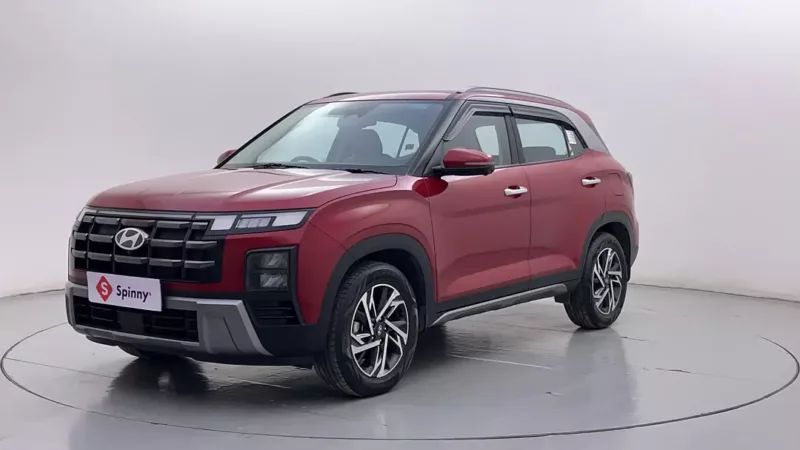
Hyundai Creta DCT
The punchy DCT variant of the best-selling Hyundai Creta combines SUV interior space and comfort with the quick shifting of a dual-clutch ‘box. The Creta DCT is renowned for being well-rounded in performance.
- Engine & Transmission: Powered by a 1.5L Turbo GDi Petrol engine, mated to a 7-speed DCT.
- Performance & Mileage: Generates 160 PS of power and 253 Nm of torque, with a claimed mileage of around 18.4 km/l.
- Key Features: Large 10.25-inch infotainment screen, power-adjustable driver seat, panoramic sunroof, ventilated front seats, and a suite of connected car technologies.
Indicative New Car Price Range (Ex-Showroom): ₹16.00 – ₹20.20 Lakhs
Explore Hyundai Creta DCT on Spinny: [Add latest starting price]
Skoda Kushaq DSG
The Skoda Kushaq, built on the MQB A0 IN platform, offers a refined driving experience with its powerful TSI engine and smooth DSG transmission. The Kushaq DSG is a driver’s delight.
- Engine & Transmission: Comes with a 1.5L TSI Petrol engine paired with a 7-speed DSG.
- Performance & Mileage: Produces 150 PS of power and 250 Nm of torque, offering a claimed mileage of approximately 17.8 km/l.
- Key Features: Robust build quality, strong performance, ventilated front seats, six airbags, and a 10-inch touchscreen infotainment system.
Indicative New Car Price Range (Ex-Showroom): ₹16.00 – ₹20.50 Lakhs
Explore Skoda Kushaq DSG on Spinny: [Add latest starting price]
Volkswagen Taigun DSG
Volkswagen Taigun also shares the same platform as well as DSG transmission with the Kushaq, giving the same fun-to-drive character with Volkswagen design DNA. Taigun DSG is well-known for crisp handling.
- Engine & Transmission: Equipped with a 1.5L TSI Petrol engine and a 7-speed DSG.
- Performance & Mileage: Delivers 150 PS of power and 250 Nm of torque, with a claimed mileage of around 17.8 km/l.
- Key Features: Fun-to-drive dynamics, digital cockpit, ventilated front seats, wireless charging, and six airbags.
Indicative New Car Price Range (Ex-Showroom): ₹16.00 – ₹20.50 Lakhs
Explore Volkswagen Taigun DSG on Spinny: [Add latest starting price]
MG Hector DCT
MG Hector offers a feature-loaded and comfortable experience, and with the DCT trim, a hassle-free as well as comfortable auto option is available in the mid-size SUV segment. Comfortability and connectivity are the main worries for the Hector DCT.
- Engine & Transmission: Features a 1.5L Turbo Petrol engine paired with a 6-speed DCT.
- Performance & Mileage: Generates 143 PS of power and 250 Nm of torque, with a claimed mileage of around 12.0 km/l.
- Key Features: Large touchscreen infotainment system with Hinglish voice commands, panoramic sunroof, ventilated front seats, and connected car technology.
Indicative New Car Price Range (Ex-Showroom): ₹17.00 – ₹22.00 Lakhs
Explore MG Hector DCT on Spinny: [Add latest starting price]
Common Concerns & Maintenance for DCT Cars in India
While DCTs offer an excellent driving experience, it’s essential to be aware of some common concerns and best practices for maintenance, especially in Indian conditions:
Overheating in Heavy Traffic
This was an historical problem, particularly with dry-clutch DCTs. Long-term creeping through bumper-to-bumper traffic can generate too much heat. Latest-gen DCTs, especially wet-clutch ones like Tata’s DCA, are much improved when it comes to thermal management.
- Tip: Try to avoid prolonged “creeping” in traffic. If stuck for a long time, shift to neutral.
Cost of Repairs
Due to their complex mechatronic units and dual-clutch packs, DCT repairs can sometimes be more expensive than simpler automatic transmissions.
- Tip: Adhere strictly to the manufacturer’s recommended service schedule and use genuine parts and fluids.
Driving Style
How you drive can impact the longevity of your DCT gearbox.
- Tip: Avoid holding the car on an incline using only the accelerator (creep). Use the handbrake or hill-hold assist if available. Don’t “launch” the car repeatedly.
Slight Jerkiness at Low Speeds
Some DCTs can exhibit mild jerkiness or hesitation when traveling very slowly, especially when initiating movement after a dead start in commuter-type stop-and-go traffic. This is typically a function of the system learning driving patterns and regulating clutch engagement.
Due to the continuously increasing demand for auto transmissions, many auto transmission cars in the market have been made very popular. Since dual-clutch auto transmissions are fuel-effective and offer a sporty experience, which is the current demand, we can expect many auto transmission cars with DCTs being launched in the near future. Now, since you are a DCT auto transmission fan and wish for a car with a DCT, the above data will help you make a very informed choice.
FAQs about DCT & DSG Cars in India
Q. What is DCT in cars?
A. The DCT full form is Dual-Clutch Transmission. It uses two clutches to pre-select gears, providing smooth and fast shifts compared to manual transmissions.
Q. DCT vs DSG: What’s the difference?
A. DCT and DSG are similar systems. While both are dual-clutch transmissions, DSG full form (Direct-Shift Gearbox) is what Volkswagen and its group brands call it. Both technologies work similarly in reducing shift times.
Q. What is DSG in cars?
A. The DSG gearbox is a type of dual-clutch system primarily used by Volkswagen Group vehicles. It enables quicker gear shifts, enhancing performance and efficiency.
Q. Are DCT cars in India fuel-efficient?
A. Yes, cars with a DCT gearbox generally offer better fuel efficiency due to the reduced time between gear shifts, which minimises power loss. Modern DCTs are highly efficient.
Q. What is DSG transmission used for?
A. DSG transmissions are designed to deliver seamless gear shifts, particularly in performance-oriented cars, making them popular for sporty and engaging driving experiences. They are also widely used in mainstream cars for their balance of performance and efficiency.
Q. Is a DCT car good for city driving in India?
A. Modern DCTs, especially those with wet-clutch designs, are increasingly capable in city traffic. While older dry-clutch DCTs sometimes faced overheating issues in heavy traffic, manufacturers have significantly improved their reliability and thermal management. They offer a good balance of performance and convenience for urban commutes.