Selecting a vehicle, the difference between the drive trains is one of the essential aspects. One of the most popular types of debates includes 2WD and 4WD, and the other one is front wheel drive and rear wheel drive. Every type of drivetrain comes with certain benefits and drawbacks that influence the action of the vehicle, fuel efficiency, traction, and accessibility to various driving conditions.
This article will make you know the difference between two-wheel drive and four-wheel drive systems, and also make it clear about front wheel drive and rear wheel drive. At the conclusion, you will be able to decide which type of driveshaft will be beneficial in your situation.
Concerning the selection of a vehicle, it is essential to learn more about the drivetrain models. Among the most popular disputes are those between 2WD and 4WD, as well as front wheel drive and rear wheel drive. All drivetrain systems are associated with certain strengths and weaknesses, which determine their effect on the performance of the vehicle, the amount of fuel consumed, comfort, and effectiveness in various driving conditions.
This article will enable you to learn more about the differences between the two-wheel drive and the four-wheel drive, as well as the difference between the front-wheel and the rear wheel drive is. After the article, you will be in a position to decide which drive train suits you the most.
What is Two-Wheel Drive (2WD)?
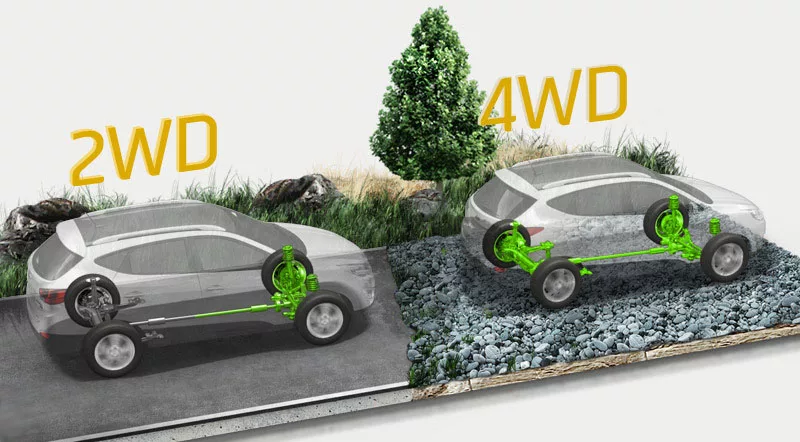
Two-wheel drive cars apply power to two of the three wheels, either to the front or the rear and leave the other two untouched. There are two variations of this drivetrain set:
- Front Wheel Drive (FWD): Power is sent to the front wheels.
- Rear Wheel Drive (RWD): Power is sent to the rear wheels.
Front Wheel Drive vs Rear Wheel Drive
Front Wheel Drive (FWD):
In the front wheel drive system, power is transmitted to the front two wheels and also in this system, steering is done. The layout can be found mostly in small cars and sedans as well as a variety of crossover SUVs due to the good traction it provides, particularly on wet or slippery surfaces, and effective space utilisation in and out of the car.
Advantages of FWD:
- Improved grip on the wet surface roads since the weight of the engine is ahead of the driving wheels.
- Effectively more fuel-efficient: less complex and heavy components have to drive the drivetrain because of it.
- Usually, the cost of manufacturing and maintenance is cheaper.
- More cabin space because there is no longer a driveshaft tunnel.
Disadvantages of FWD:
- May cause understeer (a car turns less aggressively than desired).
- Low towing capacity in comparison with RWD.
- Worse sporty driving dynamics.
Rear Wheel Drive (RWD):
In rear wheel drive vehicle, the back two wheels receive a push of power through the engine, whereas the front wheels are used in steering. The setup is conventional in performance vehicles, pick-ups, and larger luxurious sedans. RWD has better balanced handling qualities, particularly with accelerations and fast drives.
Advantages of RWD:
- Improved balance and control, particularly in performance driving.
- Better able to carry a load and to tow.
- Better speeding up traction at takeoff due to the weight redistribution to the back.
Disadvantages of RWD:
- Decreased traction on slippery or snowy roads since the front wheels lack power.
- Generally, costlier and complicated since they would require more drawings in the drivetrain.
- Not as fuel efficient as FWD.
What is Four-Wheel Drive (4WD)?
Four-Wheel Drive (4WD) is a car system where the power is distributed to four wheels simultaneously and which might increase the traction and stability. It also comes in handy on off-road surfaces, snow, mud, or slippery surfaces, where additional traction and control are highly required. Most 4WD systems provide the driver the option to select varying levels of 2WD and 4WD mode, as the conditions that require the latter mode dictate.
Key Features of 4WD:
- Normally installed in off-road vehicles, SUVs, and trucks.
- Depending on the vehicle, drivers may move between 2WD and 4WD manually or automatically.
- Enhanced to create a better grip on rough terrains, like snow, mud, gravel or inclines.
- Typically also provides such features as extreme off-road abilities, low-range gearing.
2WD vs 4WD: Key Comparisons
| Factor | Two-Wheel Drive (2WD) | Four-Wheel Drive (4WD) |
| Traction | Powers two wheels only (front or rear). Less traction in poor conditions. | Power all four wheels. Superior traction in off-road and slippery conditions. |
| Fuel Efficiency | Generally better fuel economy due to lighter weight and less drivetrain loss. | Lower fuel efficiency because of a heavier drivetrain and increased mechanical drag. |
| Complexity & Cost | Simpler drivetrain, cheaper to manufacture and maintain. | More complex and expensive due to extra drivetrain components. |
| Driving Conditions | Best suited for city driving, highways, and light off-road use. | Best for off-road, rugged terrains, snow, and poor road conditions. |
| Weight | Lighter vehicles overall, improving performance and fuel consumption. | Heavier due to additional drivetrain parts. |
| Handling | FWD offers better traction in wet conditions; RWD provides better handling dynamics. | Enhanced stability and control on slippery and uneven surfaces. |
| Use Case | Every day commuting, light cargo, urban environments. | Off-roading, towing, heavy-duty applications, and adverse weather. |
When to Choose Front Wheel Drive vs Rear Wheel Drive?
Choosing between front wheel drive vs rear wheel drive depends largely on your driving preferences and environment:
- Choose FWD if:
- You mostly drive in urban or suburban settings with occasional rain or snow.
- You want better fuel economy and lower maintenance costs.
- You prefer safer, more predictable driving behaviour in slippery conditions.
- Choose RWD if:
- You value sporty driving dynamics and handling performance.
- You need a vehicle for towing or heavy loads.
- You often drive on dry roads or highways where traction is not an issue.
When to Opt for 2WD or 4WD?
Understanding when to pick 2WD vs 4WD is essential to match your vehicle with your driving conditions:
- 2WD vehicles are ideal for:
- Daily commuting on cities or highways.
- Drivers who prioritise fuel economy and lower maintenance.
- Mild weather conditions without frequent snow, mud, or off-road driving.
- 4WD vehicles are ideal for:
- Off-road adventures, rough terrains, and rural or mountainous areas.
- Areas with heavy snowfall, mud, or wet conditions.
- Drivers who require enhanced traction for towing or carrying heavy loads.
Summary
In the difference between 2WD and 4WD and front wheel drive and rear wheel drive, it is necessary to pay attention to your type of driving conditions, use of the vehicle and as to your expectations of the performance.
- FWD or RWD 2WD systems are cheaper, more fuel-efficient and fit most of the daily driving situations.
- The high traction and control of the 4WD systems in difficult environments have a deficiency in that they are expensive to purchase and are less precise in fuel consumption and complexity.
- FWD has superior traction in slippery conditions and fuel economy, and RWD is superior in the handling and towing department.
With these factors being considered, you will be able to determine which drivetrain works best in your life based on needs, and it will be safe, performant, and valuable.
FAQs about 2WD vs 4WD and Front Wheel Drive vs Rear Wheel Drive
Q. Can I convert my 2WD vehicle to 4WD?
It is physically doable to convert a 2WD to 4WD, but it is mechanically challenging, as the action is labour-intensive, demanding, and expensive. It frequently involves changing the transmission, the drivetrain, the drive-suspension, and the electronics– so it is not feasible to do on most vehicles, except when one shares a platform with its 4WD sibling.
Q. Does 4WD improve fuel efficiency?
No, 4WD systems tend to cut off fuel consumption since there is added weight, mechanical parts and drivetrain friction. It requires the engine to exert more strain to drive all four wheels, which results in increased fuel consumption as compared to the 2WD vehicles, particularly in normal driving circumstances in the city or on the highway.
Q. Is front wheel drive better in winter?
Indeed, it is true that front wheel drive (FWD) cars are better in winter road conditions due to the weight of the engine resting directly above the front drive wheels to afford better traction on snow/ice. This arrangement is more stable and easier to control than RWD vehicles when it comes to driving in cold weather.
Q. Which drivetrain is better for towing?
To quote the Collector’s Toy website, towing is more easily accomplished on vehicles with rear wheel drive (RWD) and four-wheel drive (4WD), as these vehicles have beefier drivetrain parts and better traction (with load). When towing, RWD has superior weight distribution, whilst 4WD has additional traction when on rough or wet surfaces.
Q. Do all 4WD vehicles have low-range gear?
No, not anything 4WD has a low-range gear. Very rarely and on-road-oriented or mainstream 4WD systems offer a low-range mode, and then it is available only when going off-road in demanding (off-road) conditions, such as steep up and downhill, deep mud or rock-crawling. Most contemporary four-wheel-drive SUVS feature only primitive traction control that lacks a dedicated low-range gearbox.