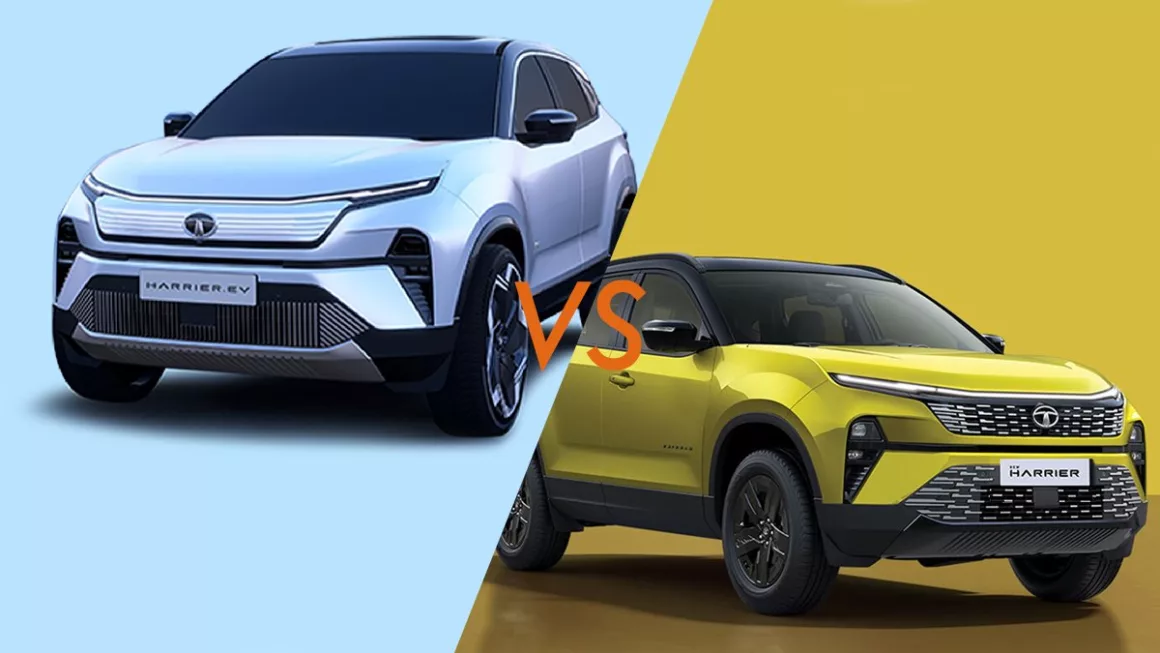
The Tata Harrier has been a substantially successful car, and under Rs 30 lakhs, the Indian 5-seater SUV offers a valuable package to those looking for a stunning SUV that delivers a plush experience. However, with the launch of the Tata Harrier EV, buyers now have the option to own a Harrier in an electric-powered form. A key point to remember here is that the Tata Harrier EV is not an electric-powered version of the Tata Harrier. Built on Tata’s dedicated EV platform, Acti.ev+, the Harrier EV is a completely new car and is even slightly larger than the ICE-powered Harrier. Circling back to the point, if you are looking for a Tata Harrier, between the standard Harrier and the Harrier EV, which one should you buy? In this Tata Harrier EV vs Tata Harrier Diesel comparison, we answer this question by comparing the two on key parameters and determining which one suits your needs.
Tata Harrier EV vs Tata Harrier Diesel: Dimensions & Design
| Tata Harrier EV | Tata Harrier Diesel | |
| Length | 4,607 mm | 4,605 mm |
| Width | 2,132 mm | 1,922 mm |
| Height | 1,740 mm | 1,718 mm |
| Wheelbase | 2,741 mm | 2,741 mm |
| Ground Clearance | 200 mm | 205 mm |
| Boot Space | 502 litres (boot), no official figures for frunk capacity | 445 litres |
As mentioned, the Tata Harrier EV is slightly larger than the Tata Harrier Diesel. If we go by the measurements, the Tata Harrier EV is 2 mm longer, 210 mm wider, and 22 mm taller than the Tata Harrier Diesel, while the wheelbase is the same 2,741 mm. Nonetheless, five adults would find enough room to make themselves comfortable in the cabin of each of these SUVs; there is loads of room. But, of course, being the larger one, the Harrier EV offers more space. Moreover, the Harrier EV offers a larger 502 litres boot space, and there is some space in the frunk to pack the charging cable.
As far as looks are concerned, while the Tata Harrier EV looks quite like the Tata Harrier Diesel, there are enough design elements to keep it distinguishable. At the front end, the Harrier EV gets a closed-off grille with a horizontal stripes pattern on the grille area and vertical stripes on the front bumper. Whereas, the Harrier Diesel gets metal-like embellishments on the grille and the front bumper, which look flashy. The difference in the side profiles is mainly in the design of alloy wheels. The Harrier EV features dual-tone 19-inch aero-optimised alloy wheels and ‘EV’ badging on the front doors, while the Harrier Diesel gets blacked-out alloys with a different design. At the rear, both SUVs look almost similar; however, the ‘Harrier.EV’s lettering on the tailgate is what sets it apart from the Harrier Diesel.
The Tata Harrier EV is larger than the Tata Harrier Diesel and sports some EV-specific design elements that keep it distinguishable from the Tata Harrier Diesel.
Tata Harrier EV vs Tata Harrier Diesel: Battery Pack & Range
| Tata Harrier EV | Tata Harrier Diesel | |
| Battery / Engine | 65 kWh (base variants)75 kWh (top variants) | 2-litre turbo diesel engine |
| Power | 238 PS (base variants)313 PS (top variants) | 170 PS |
| Torque | 504 Nm | 350 Nm |
| Transmission | 6-speed manual gearbox & 6-speed torque converter automatic | |
| Range / mileage | 538 km (base variants)627 km (top variants) | 14.60 – 16.80 km/l |
When it comes to powertrains, it will not be wrong to say that this is the comparison of apples and oranges, as a battery-powered drive can not really be compared to an engine-powered drive. However, comparing some facets can help you make a better judgment. The higher variant of the Harrier has a claimed driving range of 627 km, but in real-world driving conditions, the driving range should be around 550 km. Whereas, the Tata Harrier Diesel has a fuel tank capacity of 50 litres, and even if it delivers a mileage of 14.60 km/l, in one full tank, which means 50 litres of diesel, it can drive up to 730 km. At the same time, it is important to consider that the number of diesel pumps is far greater than the number of EV charging stations in India.
In terms of performance, the Tata Harrier EV offers a zippy drive, thanks to a dual-motor setup (in higher variants), which generates a lot of power and walloping 504 Nm torque. As a matter of fact, with the capability to do a 0 to 100 km/hr sprint in 6.3 seconds, the Harrier EV is the fastest made-in-India car. Meanwhile, it is important to know it is going to be a hushed drive. While you may enjoy just a gentle dab on the accelerator and quick speeding, you might miss the sound of the revs of an internal combustion engine.
What the Harrier EV can offer you and the Harrier Diesel cannot is off-roading capability. With the all-wheel-drive setup, the Harrier EV offers some off-roading features, which include off-road assist, terrain modes, and a 540-degree camera. The off-road assist works like cruise control, in which the SUV can maintain a speed as low as 5 km/hr. With the terrain modes – Normal, Snow/Grass, Mud ruts, Sand, Rock Crawl, and Custom- the SUV can adjust its drivability, depending on various driving conditions. Moreover, the Harrier EV offers a 540-degree camera. It is essentially a multiple-camera setup wherein, in addition to the 360-degree view of outside the SUV, there is an underbody camera, which provides live feed from under the bonnet. This feature can alert the driver if any of the wheels come too close to a curb, improving manoeuvrability in tight spaces. Along with these off-roading features, the Harrier EV is designed to have a 25.3-degree approach angle, 26.4-degree departure angle, and 16.6-degree ramp break-over angle. The Harrier EV also offers a 600 mm water wading capacity, which can make life easy in troublesome waterlogging on roads in the monsoon season.
In terms of the ride quality, the Tata Harrier Diesel has long been the best in its segment. However, the Tata Harrier EV is even better as it debuts Tata’s new all-independent suspension system with frequency-dependent dampers. With this suspension system, the Harrier EV offers a suave ride comfort and an impressive balance at high speeds.
On a full tank, the Tata Harrier Diesel can be driven longer than the top driving range of the Tata Harrier EV. However, the Tata Harrier EV offers better off-roading calibre and ride comfort than the Tata Harrier Diesel.
Tata Harrier EV vs Tata Harrier Diesel: Features & Comfort
| Tata Harrier EV | Tata Harrier Diesel | |
| Infotainment system | 14-inch touchscreen infotainment system | 12.3-inch touchscreen infotainment system |
| Music system | 10-speaker JBL music system | 10-speaker JBL sound system |
| Climate control | Dual-zone automatic | Dual-zone automatic |
| Ventilated seats | Front ventilated seats | Front ventilated seats |
| Adjustable steering | Tilt and telescopic | Tilt & telescopic adjust |
| Drive modes | Eco, City, Sport, & Boost6 Terrain Modes (Normal, Snow/Grass, Mud-Ruts, Sand, Rock Crawl, Custom) | Drive modes: Eco, City, SportsTerrain modes: Normal, Wet, Rough |
| Instrument cluster | 10.25-inch digital instrument cluster | 10.25-inch digital instrument cluster |
| Sunroof | Panoramic sunroof | Panoramic sunroof |
| Adjustable seats (manual or electric) | 8-way powered driver seat & 4-way powered front passenger seat | 6-way power driver seat & 4-way powered front passenger seat |
| Rear AC vents | Available | Available |
| 60:40 rear seat split | Available | Available |
| Cruise control | Available | Available |
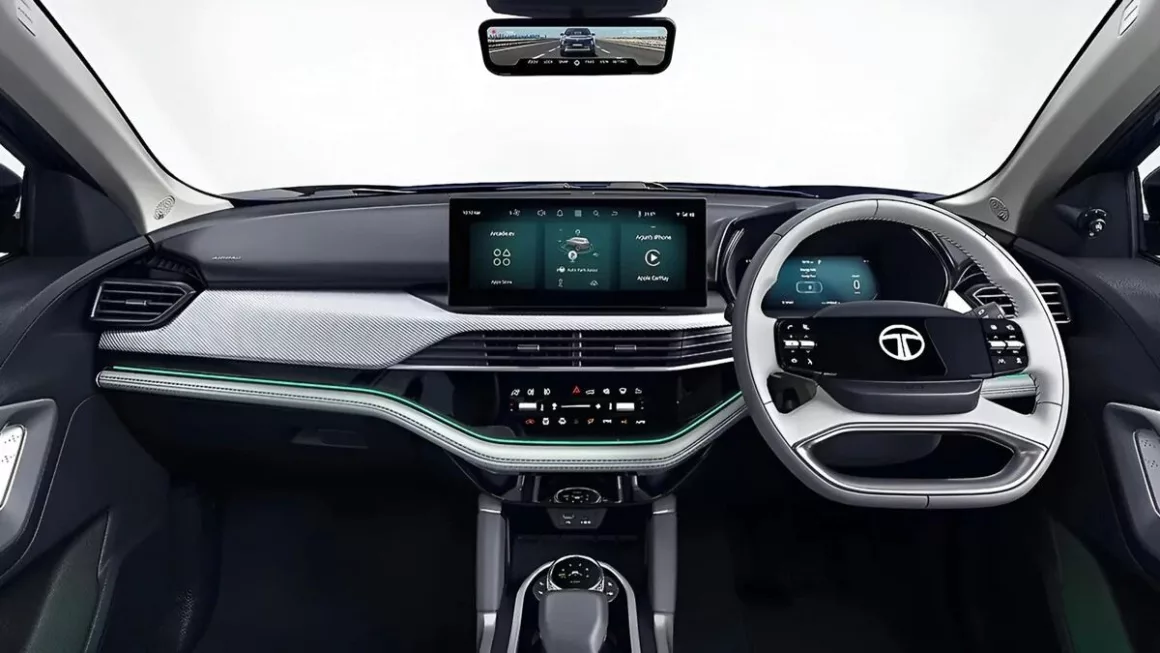
On the inside, the Tata Harrier EV looks and feels almost like the standard Tata Harrier. There is the same layered dual-tone dashboard with trapezoidal AC vents. The gloss black touch-based panel for the climate control system and the flat-bottom steering add a modern touch. A key difference from the standard Harrier is the larger 14-inch touchscreen infotainment system that features a world-first Samsung Neo QLED display that offers an immaculate image quality.

As far as features are concerned, it is worth highlighting that the Indian carmaker has given the Tata Harrier EV its best shot. The Tata Harrier EV is significantly more feature-loaded than the Tata Harrier Diesel. While the Harrier EV and Harrier Diesel share many upmarket features, for example, a panoramic sunroof, front ventilated seats, JBL sound system, powered driver and front passenger seat, the Harrier EV additionally offers auto parking, reverse assist, and digital mirror. In auto parking, the car uses multiple radars, cameras, and sensors to park itself without the driver’s input. With auto parking onboard, you do not even need to be in the SUV to park it. Whereas, the reverse assist feature memorises the last 50 meters of your driving path and can automatically reverse the SUV without the need for any intervention at the steering or pedals. The digital IRVM works like a front and rear dashcam. Not only does it act as a screen and relays feed from a roof-mounted camera, but it also records every drive in high definition.
On the inside, the Tata Harrier EV and Tata Harrier Diesel look and feel almost the same; however, the Tata Harrier EV offers more technological perks than the Tata Harrier Diesel.
Tata Harrier EV vs Tata Harrier Diesel: Safety Features
| Tata Harrier EV | Tata Harrier Diesel | |
| NCAP Safety Rating | 5-star in Bharat NCAP | 5-star in Bharat NCAP |
| Airbags | Six airbags as standard & 7 airbags in top variants | Six airbags as standard & 7 airbags in the top two variants |
| ABS with EBD | Yes | Yes |
| ESC | Yes | Yes |
| Traction Control | Yes | Yes |
| Automatic headlamps | Yes | Yes |
| Rain-sensing Wipers | Yes | Yes |
| Hill hold assist | Yes | Yes |
| Hill descent control | Yes | Yes |
| Rear sensors | Yes | Yes |
| Rear parking camera | Yes | Yes |
| ISOFIX Child seat anchor points | Yes | Yes |
| ADAS | Level-2 ADAS features | Level-2 ADAS features |
Both the Tata Harrier EV and Tata Harrier Diesel are solidly built SUVs and have scored a full 5-star rating in the Bharat NCAP safety test, proving their structural strength. Moreover, both offer a Level-2 ADAS safety suite which include Adaptive Cruise Control with Stop & Go, Lane Centring System, Lane Departure Warning, Lane Keep Assist, Forward Collision Warning (pedestrian, car, cyclist), Autonomous Emergency Braking (pedestrian, car, cyclist), Rear Collision Warning, Rear Cross Traffic Alert, Blind Spot Detection, High Beam Assist, Lane Change Alert, Blind Spot View Monitor, and more.
Tata Harrier EV and Tata Harrier Diesel are robust and equally safe SUVs.
Tata Harrier EV vs Tata Harrier Diesel: Price comparison
| Tata Harrier EV | Tata Harrier Diesel | |
| Base variants (Ex-Showroom) | Rs. 21.49 – 22.48 lakh | Rs 15 – 15.85 lakh |
| Mid variants (Ex-Showroom) | Rs 22.39 – 24.48 lakh | Rs 16.85 – 17.35 lakh |
| Upper mid variants (Ex-Showroom) | Rs 24.99 – 24.48 lakh | Rs 18.55 – 20 lakh |
| Top variant | Rs 27.49 – 30.23 lakh | Rs 19.55 – 26.50 lakh |
When it comes to prices, it is worth appreciating that Tata has smartly priced the Tata Harrier EV. While the Tata Harrier EV is more expensive than the standard Tata Harrier Diesel, it is not as expensive as electric cars are usually pricier than their ICE counterparts. Moreover, considering the subsidies and tax concessions on electric cars, the Tata Harrier EV offers great value.
Tata Harrier EV vs Tata Harrier Diesel: Summary
Now the question is which one you should buy!
Without a shadow of doubt, the Tata Harrier EV is a phenomenal EV. Considering the driving range factor, which is generally what makes buyers apprehensive in buying electric cars, the Tata Harrier EV offers more than enough to do most inter-city travelling. However, given the electric car charging infrastructure in India, most buyers still prefer ICE-powered cars to EVs, and so can be the case with the Tata Harrier EV and Tata Harrier Diesel. At the same time, it is important to remember the off-roading calibre and technological perks of the Tata Harrier EV.
So, if you want a Harrier for city drives, occasional long trips, and some off-road adventures, the Tata Harrier EV will serve you better than the Tata Harrier Diesel. However, if you can do without some technological perks, or prefer them to be installed after market, and lean towards the conventional way of fuelling your SUV, the Tata Harrier Diesel should be your choice.
Tata Harrier EV vs Tata Harrier Diesel: FAQs
Q. Among the Tata Harrier EV and the Tata Harrier Diesel, which is larger?
Tata Harrier EV is 4,607 mm long, 2,132 mm wide, 1,740 mm tall, and has a wheelbase of 2,741 mm. Tata Harrier Diesel is 4,605 mm long, 1,922 mm wide, 1,718 mm tall, and has a wheelbase of 2,741 mm. Therefore, the Tata Harrier EV is 2 mm longer, 210 mm wider, and 22 mm taller than the Tata Harrier Diesel, while the wheelbase is the same 2,741 mm.
Q. Among the Tata Harrier EV and the Tata Harrier Diesel, which car is more powerful?
The Tata Harrier EV offers two battery packs: 65 kWh and 75 kWh. The smaller 65 kWh battery comes connected to a single rear-axle-mounted motor, which produces 238 PS of power. Whereas, the larger 75 kWh battery pack comes connected to two electric motors, one on the front axle and the second on the rear axle; both motors produce 313 PS combined. Meanwhile, the Tata Harrier Diesel offers a 2-litre turbo diesel engine, which generates 170 PS power. Therefore, the Tata Harrier EV is substantially more powerful than the Tata Harrier Diesel.
Q. Among the Tata Harrier EV and the Tata Harrier Diesel, which has better sound quality?
Both Tata Harrier EV and Tata Harrier Diesel offer a 10-speaker JBL sound system and offer equally premium music experiences.
Q. Does the Tata Harrier Diesel offer auto parking like the Tata Harrier EV?
No, the Tata Harrier does not offer an auto parking feature.