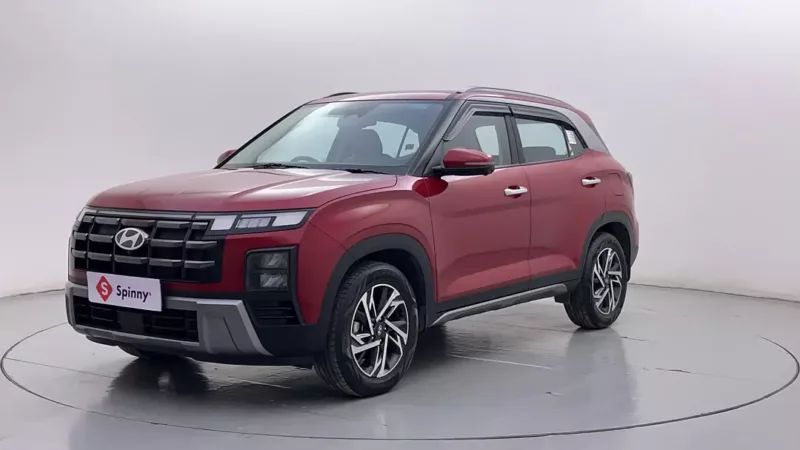
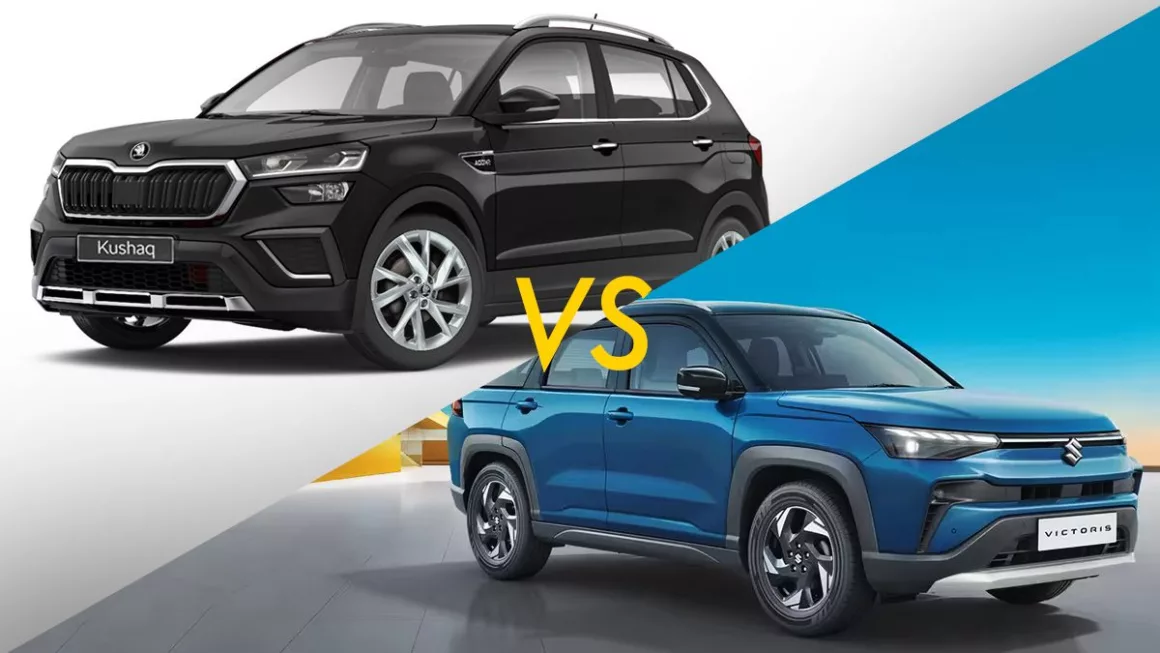
The Maruti Suzuki Victoris is the latest entrant to the mid-size SUV segment ruled by the Hyundai Creta. Like every other mid-size SUV, the Victoris is aimed to take on the Hyundai Creta; however, in addition to the Hyundai Creta, the Victoris must compete with many other rivals to attract buyers. One of the key highlights of the Victoris is the 5-star rating in Bharat NCAP as well as the Global NCAP car crash tests. With such safety ratings and many other characteristics, the Victoris can be an appealing alternative to its Czech rival, Skoda Kushaq, which also holds a 5-star rating in the Global NCAP safety test and Bharat NCAP safety test. In this article on Maruti Suzuki Victoris vs Skoda Kushaq, we weigh them against each other and find out which one meets your needs better.
Maruti Suzuki Victoris vs Skoda Kushaq: Dimensions & Design
| Maruti Suzuki Victoris | Skoda Kushaq | |
| Length | 4,360 mm | 4,225 mm |
| Width | 1,795 mm | 1,760 mm |
| Height | 1,655 mm | 1,612 mm |
| Wheelbase | 2,600 mm | 2,651 mm |
| Ground Clearance | 210 mm | 188 mm |
| Boot Space | 439 litres (mild-hybrid), 320 litres (CNG) | 385 litres |
The Maruti Victoris is 135 mm longer, 35 mm wider, and 43 mm taller than the Skoda Kushaq. However, the Skoda Kushaq has a 51 mm longer wheelbase than that of the Victoris. Considering the space offered inside these two SUVs, seating three adults in the rear seat will be a tight fit in both. The Kushaq offers better headroom and legroom, but not enough shoulder room for three to sit abreast, while the Victoris offers slightly better shoulder room, but limited headroom and legroom.
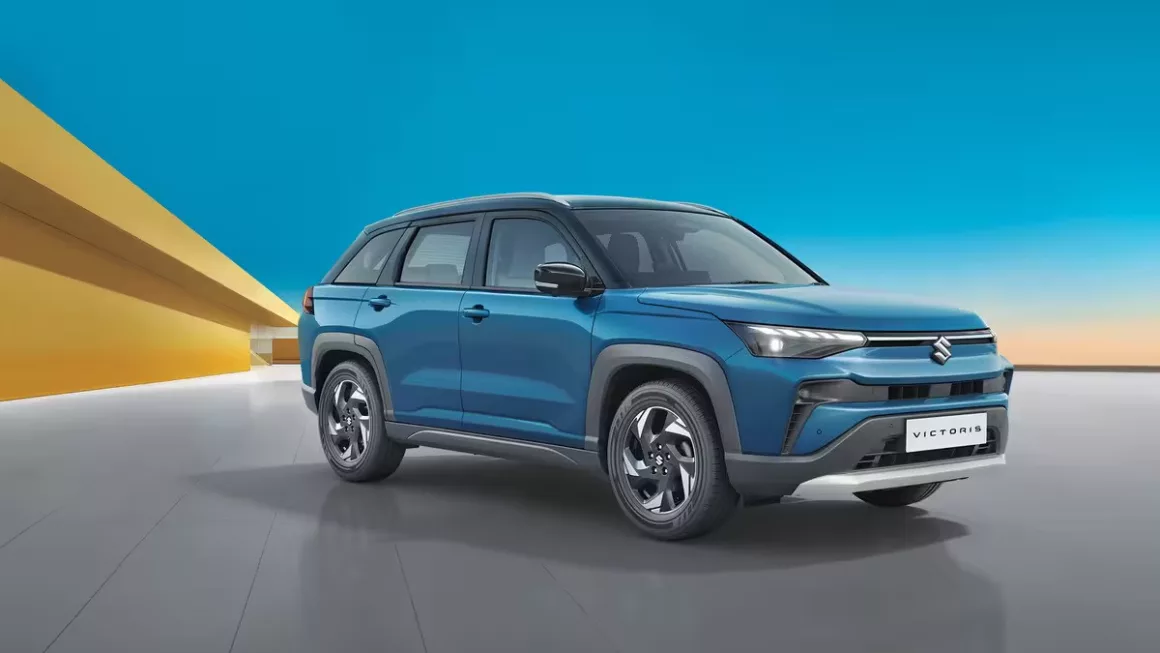
In terms of design, the Maruti Victoris looks sportier than the Skoda Kushaq, while the Kushaq looks more aggressive. At the front end, the Victoris features an angular bumper with a closed-off grille section, a wide air dam, and a faux skid plate. To the side, the Victoris features prominent character lines and squared-off wheel arches, with plastic cladding adding some muscle. The raked rear windscreen gives it a coupe-like rear profile. At the rear, like most modern mid-size SUVs, the Victoris features connected tail lamps in addition to a flat tail gate and a chunky dual-tone bumper.

On the other hand, the Kushaq looks more macho, especially when viewed from the front, where it sports the traditional Skoda butterfly grille inside the chrome housing. The sharp LED headlamps with slim DRLs add to the aggression, as do the honeycomb-patterned air dam and chrome-finished element at the bottom. The side profile highlights a prominent shoulder line and chromed underlining of the window housing. At the rear, the Kushaq features three-dimensional tail-lights with eye-catching crystalline structure, and like the Victoris, a flat tail gate.
The Maruti Suzuki Victoris is slightly larger than the Skoda Kushaq, but the space in the rear seat is comparatively better in the Skoda Kushaq.
Maruti Suzuki Victoris vs Skoda Kushaq: Engine & Transmission
| Maruti Suzuki Victoris | Skoda Kushaq | |
| Engine | 1.5-litre Mild Hybrid petrol 1.5-litre Strong Hybrid Petrol | 1.0 litre turbo petrol engine 1.5 litre turbo petrol engine |
| Power | 103 PS (mild hybrid) 87.8 PS (CNG mode) 100 PS (petrol mode) 116 PS (strong hybrid) | 115 PS (1-litre) 150 PS (1.5-litre) |
| Torque | 139 Nm (mild hybrid) 121.5 Nm (CNG mode) 137 Nm (petrol mode) 141 Nm (strong hybrid) | 178 Nm (1-litre) 250 Nm (1.5-litre) |
| Transmission | 5-speed manual with mild hybrid and CNG variants 6-speed torque converter automatic with mild hybrid e-CVT with strong hybrid | 6-speed manual and 6-speed torque converter automatic (1-litre) 7-speed DCT (1.5-litre) |
| Mileage | Up to 21.18 km/l (mild hybrid) Up to 27.02 km/kg (CNG) Up to 28.65 km/l (strong hybrid) | Up to 19.76 km/l (1-litre) Up to 18.86 km/l (1.5-litre) |
By their segment standards, on a scale of driving joy, the Skoda Kushaq should be at the top, and the Maruti Victoris should be at the bottom. Essentially, the Victoris is not built for driving entertainment; it is built for fuel-efficient driving. While its rather weak engines may need to downshift a gear or two for quick acceleration, all its powertrain combinations deliver appealing mileage figures. Such mileage figures help you a lot in keeping running costs in check. A special advantage that the Victoris offers not only over the Kushaq, but many of its rivals, is the optional all-wheel-drive drivetrain. Its all-wheel-drive drivetrain is available with the mild hybrid petrol-automatic variants only. With the all-wheel drive, the Victoris can drive through challenging terrains more comfortably than the Kushaq and many other mid-size SUVs. Another advantage of the Victoris over the Kushaq is the availability of CNG-powered models, which again are helpful in keeping the running cost as low as possible.
Meanwhile, as is the case with most Skoda cars, the Kushaq is a treat to drive. It handles sharply, and its turbocharged engines produce impressive power. Its smaller 1-litre 3-cylinder turbo petrol engine produces 115 PS power, and while these figures look decent on paper, this engine can thrill you to bits. The larger 1.5-litre turbo 4-cylinder petrol engine is even more exciting to drive, and since it is a 4-cylinder unit, it operates more refined. A key advantage of the larger engine is the Active Cylinder Deactivation (ACT) technology, which shuts down two of its four cylinders in light load conditions, improving fuel efficiency and reducing emissions.
The Skoda Kushaq is focused more towards driving entertainment, while the Maruti Victoris, with its appealing fuel efficiency figures, will keep your pocket happy. Nonetheless, Maruti Victoris’ all-wheel-drive models can be a good option for those who deal with poor roads frequently.
Maruti Suzuki Victoris vs Skoda Kushaq: Features & Comfort
| Maruti Suzuki Victoris | Skoda Kushaq | |
| Infotainment system | 10.1-inch touchscreen infotainment system | 10-inch touchscreen infotainment system |
| Music system | 8-speaker Infinity sound system with Dolby Atmos | 6-speaker sound system |
| Climate control | Automatic | Automatic |
| Ventilated seats | Front ventilated seats | Front ventilated seats |
| Adjustable steering | Tilt and Telescopic adjust | Tilt and Telescopic adjust |
| Drive modes | Terrain Modes – Snow, Sport, Lock, Auto (all-wheel drive only) Drive modes: ECO + Normal + Power (Strong hybrid only) | Not available |
| Instrument cluster | Digital instrument cluster | Digital instrument cluster |
| Sunroof | Panoramic sunroof | Single-pane sunroof |
| Adjustable seats (manual or electric) | 8-way powered driver seat | 6-way powered driver seat and co-driver seat |
| Rear AC vents | Available | Available |
| 60:40 rear seat split | Available | Available |
| Cruise control | Available | Available |
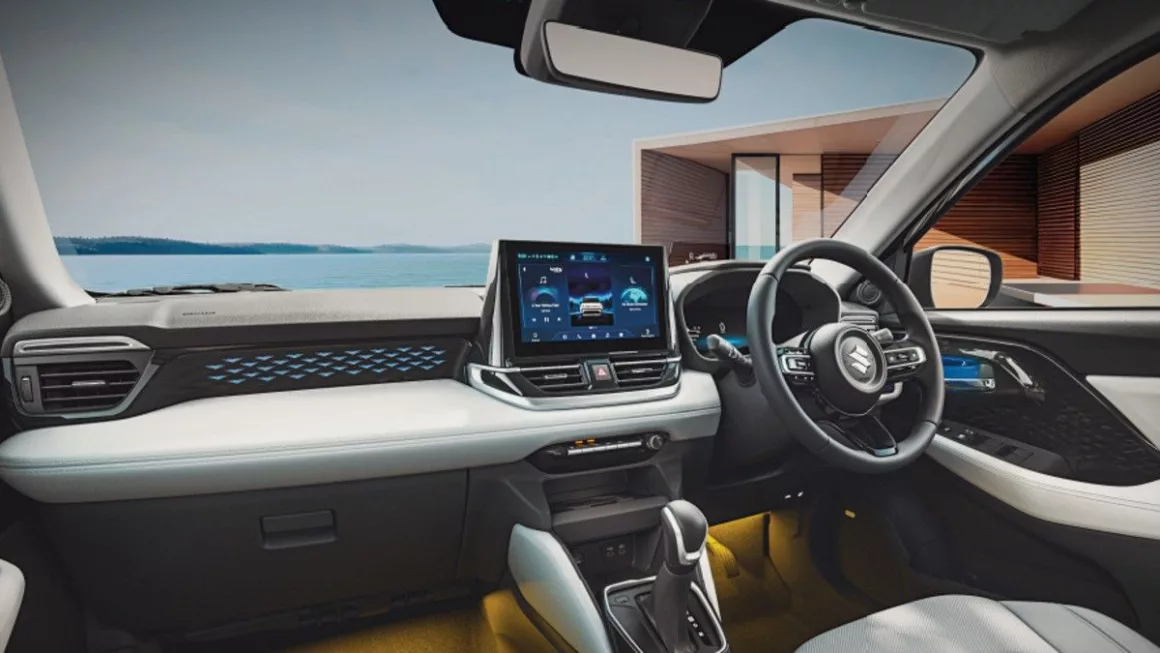
On the inside, both Maruti Victoris and Skoda Kushaq are equipped with premium interiors. The Maruti Victoris feels like a typical ‘Maruti,’ thanks to the trapezoidal free-standing touchscreen with trapezoidal AC vents below and the physical buttons on the HVAC panels, all of them designed the same as those in most modern Maruti cars. A unique element is the pixelated backlight on the front passenger’s side of the stepped dashboard with a leatherette finish at the bottom. Moreover, unlike the Grand Vitara, which gets a semi-digital instrument cluster, the Victoris features a fully digital instrument cluster and an all-new three-spoke steering wheel. The panoramic sunroof that draws the natural light and air inside enriches the overall atmosphere.
The Kushaq features a stylish chunky two-spoke steering wheel with a floating hub and neat chrome roller controls. Like the Victoris, the Kushaq has a layered dashboard but with a different design; this one has a multi-textured strip running across its width with hexagonal chrome-lined vents at both ends. The integrated touchscreen on the dashboard is not free-standing, and makes things look more intact. The single-pane sunroof connects the cabin to the atmosphere outside, but obviously, it cannot fill the shoes of a panoramic sunroof.
In terms of features, while both SUVs offer plenty of perks to offer a comfortable, convenient, and entertaining ride, the Maruti Victoris has an upper hand, especially due to a more premium sound system, a panoramic sunroof, and a powered tailgate with gesture control.
Both SUVs feel substantially premium on the inside. However, as far as features are concerned, the Maruti Victoris is slightly richer than the Skoda Kushaq.
Maruti Suzuki Victoris vs Skoda Kushaq: Safety Features
| Maruti Suzuki Victoris | Skoda Kushaq | |
| NCAP Safety Rating | 5-star in Bharat NCAP and Global NCAP | 5-star in Bharat NCAP and Global NCAP |
| Airbags | Six | Six |
| ABS with EBD | Yes | Yes |
| ESC | Yes | Yes |
| Traction Control | Yes | Yes |
| Automatic headlamps | Yes | Yes |
| Rain-sensing Wipers | Yes | Yes |
| Hill hold assist | Yes | Yes |
| Hill descent control | Yes | No |
| Rear sensors | Yes | Yes |
| Rear parking camera | 360-degree camera | Yes |
| ISOFIX Child seat anchor points | Yes | Yes |
| ADAS | Level-2 ADAS features | No |
Both Maruti Victoris and Skoda Kushaq have scored a 5-star rating in Bharat NCAP and Global NCAP safety tests, proving their structural strength to protect passengers from an unfortunate accident. However, because of the Level-2 ADAS safety suite, the Victoris is more capable of warding off accidents than the Skoda Kushaq. The Victoris’ ADAS safety suite consists of adaptive cruise control, lane keep assist, lane departure prevention, vehicle sway warning, automatic emergency braking, high beam assist, rear cross traffic alert, forward collision warning, and blind spot monitor.
Both Maruti Victoris and Skoda Kushaq offer strong passenger safety; however, the Victoris has the advantage of offering a Level-2 ADAS safety suite.
Maruti Suzuki Victoris vs Skoda Kushaq: Price comparison
| Maruti Suzuki Victoris | Skoda Kushaq | |
| Base variants (Ex-Showroom) | Rs 10.50 – 11.50 lakh | Rs 10.61 – 13.12 lakh |
| Mid variants (Ex-Showroom) | Rs 11.80 – 16.38 lakh | Rs 14.38 – 15.44 lakh |
| Upper mid variants (Ex-Showroom) | Rs 13.57 – 18.39 lakh | Rs 14.52 – 17.13 lakh |
| Top variant | Rs 15.24 – 19.99 lakh | Rs 15.82 – 18.43 lakh |
Except for the strong-hybrid variants, which are slightly on the pricier side, most variants of the Maruti Victoris are more or less in the same price range as the Skoda Kushaq. From a value standpoint, the Maruti Victoris is at par with the Skoda Kushaq.
Maruti Suzuki Victoris vs Skoda Kushaq: Which one should you buy
Overall, the Maruti Suzuki Victoris is a sensible family SUV, especially for someone looking to keep the ownership cost in check. In addition to frugal fuel efficiency, the Victoris offers cheap maintenance costs and the brand value of Maruti Suzuki, the largest carmaker in India. Moreover, and this is not something usually said about Maruti cars, but in comparison with the Skoda Kushaq, the Victoris is more feature-rich and designed to offer a more premium ride. The only drawback of the Victoris is its underpowered engines, and if you can get used to them, the Victoris can be a great deal for you.
At the same time, the Skoda Kushaq is one of the best mid-size SUVs for driving fun. Its turbocharged petrol engines are built to deliver an exciting drive. So, if you enjoy driving and like to spend more time in the driver’s seat rather than the passenger’s seat, you should go for the Kushaq.
Maruti Suzuki Victoris vs Skoda Kushaq: FAQs
Which is larger among the Maruti Suzuki Victoris and the Skoda Kushaq?
Maruti Suzuki Victoris is 4,360 mm long, 1,795 mm wide, 1,655 mm tall, and has a wheelbase of 2,600 mm. Skoda Kushaq is 4,225 mm long, 1,760 mm wide, 1,612 mm tall, and has a wheelbase of 2,651 mm. Therefore, the Maruti Victoris is 135 mm longer, 35 mm wider, and 43 mm taller than the Skoda Kushaq. However, the Skoda Kushaq has a 51 mm longer wheelbase than that of the Victoris.
Among the Maruti Suzuki Victoris and Skoda Kushaq, which SUV delivers more mileage?
The Maruti Suzuki Victoris can deliver a mileage of up to 21.18 km/l with a mild-hybrid engine, up to 27.02 km/kg with CNG, and up to 28.65 km/kg with its strong hybrid engine. Whereas the Skoda Kushaq can deliver a mileage of up to 19.76 km/l with its 1-litre turbo petrol engine and up to 18.86 km/l with its 1.5-litre turbo petrol engine. Therefore, the Maruti Victoris is more fuel-efficient than the Skoda Kushaq.
Among the Maruti Suzuki Victoris and the Skoda Kushaq, which offers better sound quality?
The 8-speaker Infinity sound system of the Maruti Suzuki Victoris offers a more premium sound quality than Skoda’s 6-speaker in-built sound system in the Skoda Kushaq.
Which safety features are available in the base variant of the Maruti Suzuki Victoris?
The safety features of the base LXi variant of the Maruti Suzuki Victoris include 6 airbags, ABS with EBD, hill hold control, electronic stability program, ISOFIX anchorages, and more.
What types of automatic transmission systems are available in the Maruti Suzuki Victoris and the Skoda Kushaq?
The Skoda Kushaq offers a 6-speed torque converter automatic and a 7-speed DCT automatic, while the Maruti Suzuki Victoris offer a 6-speed torque converter automatic and an e-CVT automatic.