
Among off-roading enthusiasts, the comparison between the Maruti Suzuki Jimny and the Mahindra Thar is a common topic of discussion. Many times, these discussions turn into arguments because both Jimny and Thar are extremely capable off-roaders, and it is hard to decide which one is better.
At the same time, even if a car is an off-roading champion, it is also judged on its practicality and suitability as a family car. It makes a lot of sense because not every day is such a car taken for off-roading adventures, and it must spend a significant amount of time on city roads and streets. On these parameters, the Thar and Jimny are quite different from each other.
So, if you are looking to buy one of these two, making a sound choice can be hard, considering their off-roading capabilities and practicality. To ease things for you, in this comparison of Maruti Suzuki Jimny vs Mahindra Thar 4×4, we pit them against each other based on practicality and off-roading calibre and find out which one suits your needs. The Thar is now sold as the Thar OG following its September 2026 update. If you are shopping pre-owned, we also compare a used Thar vs Jimny to see which off-road car offers better value.
Table of Contents
Maruti Suzuki Jimny vs Mahindra Thar 4×4: Dimensions & Design
| Maruti Suzuki Jimny | Mahindra Thar 4×4 | |
| Length | 3,985 mm | 3,995 mm |
| Width | 1,645 mm | 1,870 mm |
| Height | 1,720 mm | 1,855 mm |
| Wheelbase | 2,590 mm | 2,450 mm |
| Ground Clearance | 210 mm | 232 mm |
| Boot Space | 208 litres | NA |
While both the Maruti Jimny and the Mahindra Thar are almost equally long, the Thar is substantially larger than the Jimny. The Thar is 225 mm wider, 135 mm taller, and rides 22 mm higher in comparison to the Jimny. However, the Jimny’s wheelbase is 140 mm longer than that of the Thar, which makes it offer more legroom to rear-seat passengers. In addition to the longer wheelbase, two exclusive doors for the rear passengers add to the practicality of the Jimny, while the 3-door Thar scores less on this front. Moreover, while the official figures of the Thar’s boot space are not available, it is considerably smaller than the Jimny’s 208-litre boot, which again gives a few more practicality points to the Jimny.

When it comes to design, the Mahindra Thar beats not only the Jimny but also many other cars in the Indian market. As a matter of fact, it is the Thar’s macho and tough appeal that attracts most of its buyers, while significantly fewer own a Thar for its off-roading calibre. With a boxy silhouette, the Thar has a dominant profile. Its upright face features a high-set flat bonnet, a redesigned grille with Thar branding, new LED headlamps with C-shaped DRLs, and a chunky bumper. Over to the side, the Thar features a large single-unit window glass, contrasting roof, and chunky wheel arches housing larger 18-inch wheels, with 19-inch alloys on the top ZXT variant. At the rear, the spare tyre on the side-hinged tailgate and stubby rectangular LED tail lamps neatly round off the Thar’s dominant aura.
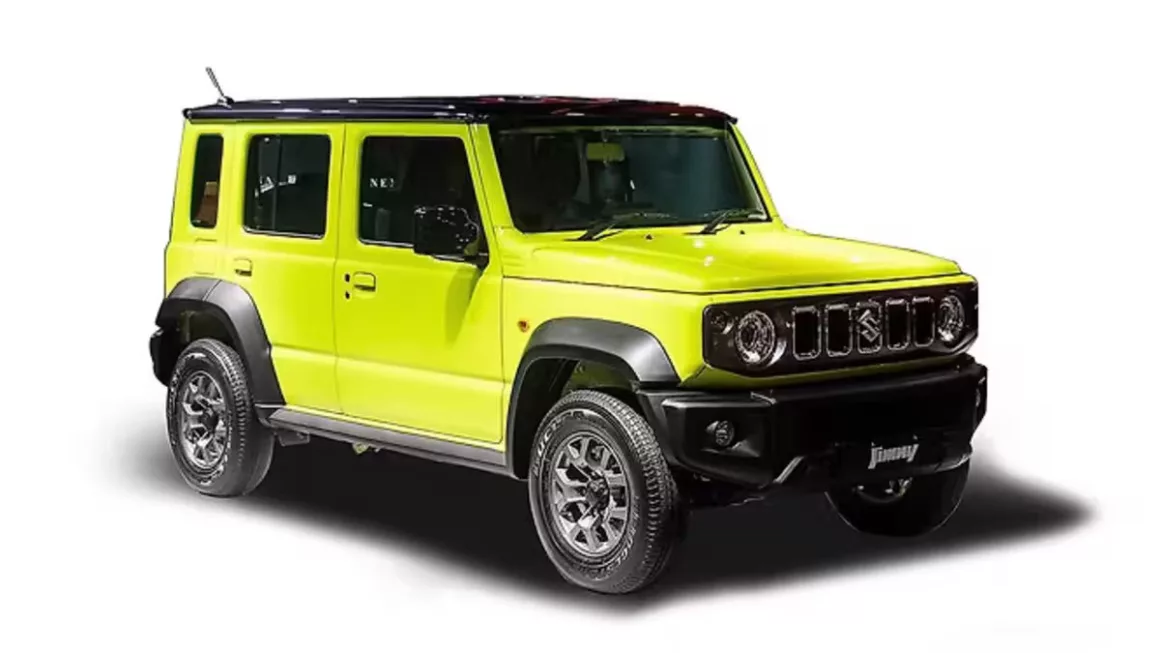
On the other hand, due to its shorter height, the Maruti Jimny appears to be longer in comparison with the Thar. Like the Thar, the Indo-Japanese SUV has a boxy design, but it does not look as intimidating as the Thar. At the front, it features a clamshell bonnet, chrome-finished five-slot grille, and round headlamps. On the side, apart from looking longer, what differentiates the Jimny from the Thar is a separate quarter glass towards the rear, which the Thar misses. The Jimny rides on 15-inch wheels, and at the rear, like the Thar, the Jimny features a spare tyre mounted on the side-hinged tailgate.
The Mahindra Thar is larger than the Maruti Suzuki Jimny. However, on the inside, the Maruti Jimny is more spacious, thanks to the longer wheelbase and smart space management by Maruti Suzuki. With that being said, the Mahindra Thar has a more dominant road presence than the Maruti Jimny.
Summary: The Jimny is the more practical choice, with rear doors, a longer wheelbase and a usable boot. The Thar wins on road presence and ground clearance, which is what draws most of its buyers.
Maruti Suzuki Jimny vs Mahindra Thar 4×4: Engine & Transmission
| Maruti Suzuki Jimny | Mahindra Thar 4×4 | |
| Engine | 1.5-litre NA petrol engine | 2-litre turbo petrol engine, 2.2-litre turbo diesel engine |
| Power | 105 PS | 162 PS (Petrol), 152 PS (Diesel) |
| Torque | 134.2 Nm | 330 Nm (Petrol), 330 Nm (Diesel) |
| Transmission | 5-speed manual gearbox and 4-speed torque converter automatic | 6-speed manual and 6-speed torque converter automatic with both engines |
| Mileage | 16.39–16.94 km/l | Up to 15.2 km/l (Petrol), Up to 17.5 km/l (Diesel) |
*The Thar’s 1.5-litre diesel (119 PS, 300 Nm) is offered only with rear-wheel drive.
Each of the Mahindra Thar’s engines produces more power than the naturally aspirated petrol engine of the Maruti Jimny. At the same time, it is important to note that the Thar is 525 kg heavier than the Jimny, which requires it to be more powerful. Despite the Jimny being lighter in comparison, the Thar feels more powerful on the go, especially on city roads. It is quicker, and the mighty 330 Nm of torque gives it zippy acceleration and makes it more exciting to drive. Moreover, a surprising yet very practical advantage of the Thar is a tighter 5.5-metre turning radius, whereas the Jimny has a turning radius of 5.7 metres. With that being said, where the Thar has traditionally fallen short is ride comfort. Based on a ladder frame chassis, the Thar has been known for uncomfortable body movements even on smooth city roads, though the Thar OG’s revised suspension with frequency dependent dampers aims to improve this.
The Jimny is weaker than the Thar and so can be felt in its drive, especially on city roads. You need to foot the accelerator hard or downshift gears in many conditions where you need to overtake a vehicle driving in front. However, to keep up with the flow of traffic, Jimny’s petrol engine is sufficiently powerful. The key advantage that the Jimny offers over the Thar is better ride comfort. While, like the Thar, the Jimny is based on a ladder frame chassis, which is notorious for jerky rides, Maruti has managed to tune the suspension to minimise the jerks.
The Mahindra Thar offers more engine options, and each of them is more powerful than the petrol engine of the Maruti Suzuki Jimny. With more power-packed engines, the Thar feels more powerful on the go. All the same, the Jimny offers a much better ride comfort than the Thar.
Summary: The Thar is the clear winner on performance, with turbocharged petrol and diesel engines and a modern 6-speed automatic. The Jimny is the better pick for easy city driving and a more comfortable ride.
Maruti Suzuki Jimny vs Mahindra Thar 4×4: Off-Road Features
| Maruti Suzuki Jimny | Mahindra Thar 4×4 | |
| Approach Angle | 36 degree | 41.2 degree |
| Ramp Breakover Angle | 24 degree | 26.2 degree |
| Departure Angle | 50 degree | 36 degree |
| Ground Clearance | 210 mm | 232 mm |
| Water Wading Capacity | 300 mm | 650 mm |
| Kerb Weight | 1,210 kg | 1,735 kg |
| 4X4 Low Range | Yes | Yes |
| Tyres | 195/80R15 | 255/65R18 (19-inch on ZXT) |
When it comes to off-roading features, the Mahindra Thar is better equipped. It has a better approach angle, ramp breakover angle, ground clearance, and water wading capacity, while the Jimny has the better departure angle. Moreover, the Thar has more capable all-terrain tyres in comparison to the highway terrain tyres of the Jimny. Another advantage of the Thar is an electronic locking rear differential along with a brake-locking differential and terrain modes, while the Jimny gets a brake-based limited-slip differential. Expectedly, both have four-wheel drive with a low-range transfer case.
While the Mahindra Thar is better equipped in terms of off-roading features, the story is not the same when it comes to the real-world off-roading capabilities of both. Let’s start with the Thar. Whether it is steep uphill climbs, downhill strolls, driving over rocks or through muddy terrains, the Thar smoothly goes about its business. Its hill start assist feature, locking differential, and hill descent control features assist it well while dealing with such conditions. Moreover, thanks to its powerful engines, the Thar never runs out of power. Due to a high-set driver seat, the Thar gives a more commanding and reassuring view, and you can easily see the edge of the bonnet. However, this is a car for pros, especially when it comes to off-roading adventures. It is because the Thar is quite heavy and powerful for its size. It needs an expert to handle so much power, and if such a heavy SUV gets stuck in off-roading ventures, it is difficult to get it out.
On the other hand, the Maruti Jimny is far lighter and smaller than the Thar and gives you confidence to pull it out with some helping hands, if it gets stuck. While its comparatively weaker engine needs you to press the accelerator slightly harder at times during off-roading, it gets the job done every time, and again, being lighter is what favours the Jimny in such conditions. There is hardly any off-roading task that the Thar can do and the Jimny cannot, despite not coming with all-terrain tyres as the Thar does.
Summary: The Thar is the more capable off-road car, with better angles, deeper wading and an electronic locking differential. In real-world trails, the lighter Jimny is just as effective and far easier for a beginner to handle.
Maruti Suzuki Jimny vs Mahindra Thar 4×4: Features & Comfort
| Maruti Suzuki Jimny | Mahindra Thar 4×4 | |
| Infotainment system | 9-inch touchscreen infotainment system (7-inch on Zeta) | 10.25-inch touchscreen infotainment system |
| Music system | 4-speaker music system | 6-speaker music system |
| Climate control | Automatic (Alpha) | Manual |
| Ventilated seats | Not available | Not available |
| Adjustable steering | Tilt | Tilt |
| Drive modes | Not available | Terrain modes (Mud, Sand, Snow) on 4WD |
| Instrument cluster | Analogue instrument cluster | Analogue instrument cluster with colour MID |
| Sunroof | Not available | Not available |
| Adjustable seats (manual or electric) | Height adjustable driver seat (manual) | Height-adjustable driver seat (manual) |
| Rear AC vents | Available | Available |
| 60:40 rear seat split | 50:50 split | 50:50 split |
| Cruise control | Available | Available |
On the inside, both the Mahindra Thar and the Maruti Jimny get dark-coloured themes and feel almost equally premium, while they differ in terms of interior design. The Jimny gets a neat interior layout, and its 9-inch touchscreen is slick to use. Below that are very handy chunky knobs for climate control with some toggle switches lower down, and rectangular AC vents.
On the other hand, the Thar features a curvy dashboard, which looks noticeably similar to that of the Jimny, especially due to the round AC vents at both ends. The difference starts from the bigger 10.25-inch touchscreen and buttons for the climate control. The Thar is slightly more practical too, especially due to cup holders in the central console, a new rear armrest with cupholders, and bottle holders in the doors that the Jimny does not offer.
Feature-wise, both Jimny and Thar are almost equally equipped. Both get AC with rear vents and music systems to enrich your off-roading adventures, though only the Jimny gets automatic climate control. However, the Jimny does offer the advantage of LED headlamps with its exclusive washers, which can be helpful as, during off-roading, the car’s headlamps easily get dirty.
The Mahindra Thar and Maruti Suzuki Jimny feel almost equally premium on the inside, and both offer all modern-day essentials expected of an off-roading SUV in their price bracket.
Summary: The Thar now edges ahead on features, with a bigger screen, a 6-speaker system and terrain modes. The Jimny counters with automatic climate control and headlamp washers, which are handy on muddy trails.
Maruti Suzuki Jimny vs Mahindra Thar 4×4: Safety Features
| Maruti Suzuki Jimny | Mahindra Thar 4×4 | |
| NCAP Safety Rating | Not tested in India | 4-star in Global NCAP (pre-OG model, 2020); Thar OG not yet tested |
| Airbags | Six airbags as standard | Dual front airbags (six on ZXT) |
| ABS with EBD | Yes | Yes |
| ESC | Yes | Yes |
| Traction Control | Yes | Yes |
| Automatic headlamps | Yes | Yes |
| Rain-sensing Wipers | No | Yes |
| Hill hold assist | Yes | Yes |
| Hill descent control | Yes | Yes |
| Rear sensors | Yes | Yes |
| Rear parking camera | Yes | Yes (ZXT) |
| ISOFIX Child seat anchor points | Yes | Yes |
| ADAS | No | No |
The Maruti Jimny has not been crash-tested by Global NCAP or Bharat NCAP in India, so no comments can be made about its structural strength. Whereas the earlier Mahindra Thar scored a commendable 4-star rating in the Global NCAP safety test in 2020. The Thar OG moves to the M_Glyde platform from the Thar Roxx, which Mahindra says is stiffer, but it is yet to be crash-tested. The Thar does feel more solidly built than the Jimny, and this can be easily judged by listening to the thud sound that these SUVs make when you shut their doors. All the same, the Jimny has the advantage of offering six airbags as standard in all variants, while the Thar offers six airbags only on its top ZXT variant.
The Mahindra Thar has a proven crash test record and feels sturdier, while the Maruti Suzuki Jimny offers more airbags as standard.
Summary: The Thar has the crash test rating, but the Jimny gives you six airbags in every variant. If you are buying a Thar, the ZXT variant is the one to pick for six airbags.

Maruti Suzuki Jimny vs Mahindra Thar 4×4: Price comparison
| Maruti Suzuki Jimny | Mahindra Thar OG | |
| Base variant (Ex-Showroom) | Zeta – Rs. 12.59 – 13.65 lakh | AXT – Rs. 10.32 lakh (RWD only) |
| Mid variant (Ex-Showroom) | — | LXT – Rs. 12.99 – 18.00 lakh (4WD from Rs. 16.43 lakh) |
| Top variant (Ex-Showroom) | Alpha – Rs. 13.46 – 14.67 lakh | ZXT – Rs. 13.99 – 18.99 lakh (4WD from Rs. 17.49 lakh) |
*Thar OG prices are introductory and valid for deliveries until November 30, 2026. Jimny prices are as of November 2026.
The lower variants of the Mahindra Thar come with a rear-wheel-drive setup, and the price of four-wheel-drive models starts from Rs 16.43 lakh. Whereas all variants of the Jimny come with a 4-wheel-drive setup. This makes the 4X4 Jimny about Rs. 3.84 lakh more affordable than the cheapest 4X4 Thar, and a more value-for-money offering in this comparison.
Summary: The Jimny is the better value if you want 4×4, as it is standard on every variant and costs much less. The Thar makes sense if you are happy with RWD or want the extra power and are willing to pay for it.
Used Thar vs Used Jimny: Which Off-Road Car Is Better Value?
If a new 4×4 feels too expensive, the used market is a good place to look. The used Thar vs Jimny choice is a little different from buying new, because the two have very different histories in India. The current Thar has been on sale since 2020, so there are plenty of options across years, engines and budgets. The five-door Jimny arrived only in 2023, which means used examples are newer and fewer.
| Parameter | Used Mahindra Thar | Used Maruti Jimny |
| Model years to look at | 2020–2026 (second generation), Thar OG from late 2026 | 2023 onwards (five-door) |
| Fuel options | Petrol, diesel | Petrol only |
| Drive | 4×4, or RWD from 2023 | 4×4 on every variant |
| Automatic options | 6-speed torque converter | 4-speed torque converter |
| Safety | 4-star Global NCAP (2020), dual airbags on most versions | Six airbags as standard |
Go for a used Thar
If you want strong performance, a diesel engine for long trips, or the Thar’s road presence. The Thar has always held its value well, so a well-kept one will also be easier to sell later. Check the drive type carefully, as Thars from 2023 onwards were also sold in RWD. Look for signs of hard off-roading, such as scraped underbody panels or bent skid plates. Also check whether any aftermarket modifications, such as lift kits or oversized tyres, have been made, as these can affect insurance and registration.
Go for a used Jimny
If you want a 4×4 that is easy to drive every day, has rear doors and costs less to run. When it comes to used Jimny value, the numbers work in your favour. The Jimny often came with big discounts when new, so a used one can be a cost-effective way into a capable 4×4. With fewer cars on the market, though, you may need a little patience to find the right colour and variant.
Whichever you choose, check the service history, the number of previous owners and the condition of the 4×4 system, and take a test drive that includes engaging low range. Every car on Spinny goes through a 200-point inspection and comes with Fixed Price Assurance, so you can compare a second-hand Thar and a used Jimny side by side.
Summary
While the Mahindra Thar and Maruti Suzuki Jimny are almost equally capable off-roaders, if you want a more exciting car overall, you should go with the Mahindra Thar. It is more powerful and more exciting to drive, and its road presence immediately commands respect, which is often the reason folks buy this legendary off-roader. However, with the Thar comes a firmer ride and tight space for rear passengers. At the same time, if you want a more practical off-roading SUV with better ride comfort and more space for rear passengers, it is the Jimny you should put your money on. If you’re weighing a used Thar vs Jimny, Spinny lets you compare both side by side. Every car goes through a 200-point inspection and comes with Fixed Price Assurance, and you can book a test drive of each before you decide.
Related Blogs:
Complete Guide to Buying a Mahindra Thar
Complete Buying Guide: Maruti Suzuki Jimny
FAQs about Maruti Suzuki Jimny and Mahindra Thar 4×4
Q. Which is larger among the Maruti Suzuki Jimny and the Mahindra Thar 4×4?
Maruti Suzuki Jimny is 3,985 mm long, 1,645 mm wide, 1,720 mm tall, and has a wheelbase of 2,590 mm. Mahindra Thar 4×4 is 3,995 mm long, 1,870 mm wide, 1,855 mm tall, and has a wheelbase of 2,450 mm. Therefore, the Mahindra Thar 4×4 is considerably larger than the Maruti Suzuki Jimny. The Thar is 225 mm wider, 135 mm taller, and rides 22 mm higher in comparison to the Jimny. However, the Jimny has a 140 mm longer wheelbase.
Q. Among the Maruti Suzuki Jimny and the Mahindra Thar 4×4, which car is more powerful?
The 2-litre turbo petrol engine and 2.2-litre turbo diesel engine of the Mahindra Thar 4×4 produce 162 PS and 152 PS, respectively, while the RWD-only 1.5-litre diesel makes 119 PS. Whereas, the 1.5-litre naturally aspirated petrol engine of the Maruti Suzuki Jimny produces 105 PS power. Therefore, the Mahindra Thar is significantly more powerful than the Maruti Suzuki Jimny.
Q. Among the Maruti Suzuki Jimny and the Mahindra Thar 4×4, which is a better off-roading SUV?
The Mahindra Thar and Maruti Suzuki Jimny are equally capable off-roading SUVs. However, both have different ways to cross challenging terrains. Being the more powerful, the Mahindra Thar uses its might and off-roading features to drive through rocky, muddy, or any other kind of unfavourable stretch for driving. Whereas the Jimny, being about 525 kg lighter and smaller, is easier to navigate through challenging tracks.
Q. Which safety features are available in the base variant of the Maruti Suzuki Jimny?
The safety features of the base Zeta variant of the Maruti Suzuki Jimny include 6 airbags, ABS with EBD, hill hold control, hill descent control, electronic stability program, brake limited slip differential, rear camera, engine immobiliser, and more.
Q. What types of automatic transmission systems are available in the Maruti Suzuki Jimny and the Mahindra Thar 4×4?
The Mahindra Thar 4×4 offers a 6-speed torque converter automatic with both its petrol and diesel engines, while the Maruti Suzuki Jimny offers a 4-speed torque converter automatic.
Q. Which off-road car is better value: a used Thar or a used Jimny?
For most buyers, a used Jimny is better value. It comes with 4×4 and six airbags as standard, is easier to drive every day and costs less to run. A second hand Thar costs more but gives you more power, a diesel option and stronger resale value, so it suits buyers who want performance and road presence.
Q. Does a used Jimny hold its value as well as a second-hand Thar?
The Thar has a long track record of strong resale value in India, helped by high demand. The Jimny is newer to the Indian market and was often sold at a discount when new, so used Jimny value tends to be more attractive for buyers today. If resale matters most to you, the Thar has the edge. If buying price matters more, the Jimny is the smarter choice.