With constant innovations making EVs smarter, better and more affordable with every launch, the Indian EV market has had the entire world talking. Ever since Mahindra announced its all-new Electric-Origin SUV lineup based on a purpose-built EV platform, the time has come for Indian manufacturers to shine across the globe. With the Mahindra XEV 9e taking over the market with its flagship features, new-age looks, robust safety and aggressive pricing, the stage is set for the SUV to take on some of the biggest names in the luxury EV segment, including the ever-popular Mercedes-Benz EQB. With Mahindra’s new XEV 9e equipped enough to take on a challenge, it would be interesting to see how the Coupe-SUV does against the German carmaker’s flagship electric SUV. So here is a head-on comparison between the all-new Mahindra XEV 9e and the Mercedes-Benz EQB.
Check out the best used luxury Mercedes-Benz cars in India.
Mahindra XEV 9e vs Mercedes-Benz EQB: Dimensions
| Car | Mahindra XEV 9e | Mercedes-Benz EQB |
| Length | 4,789 mm | 4,684 mm |
| Width | 1,907 mm | 1,834 mm |
| Height | 1,694 mm | 1,689 mm |
| Wheelbase | 2,775 mm | 2,829 mm |
| Boot Space | 663 litres (boot) & 150 litres (Frunk) | 495 litres |
| Ground Clearance | 207 mm | 155 mm |
A glance at the head-on comparison above and you will realise that both SUVs, despite sharing a lot in common, are still very different in their approach when it comes to overall dimensions, looks and space on board. A big reason behind the difference is the Mahindra XEV 9e’s coupe-SUV look that is rather distinct and truly appealing.
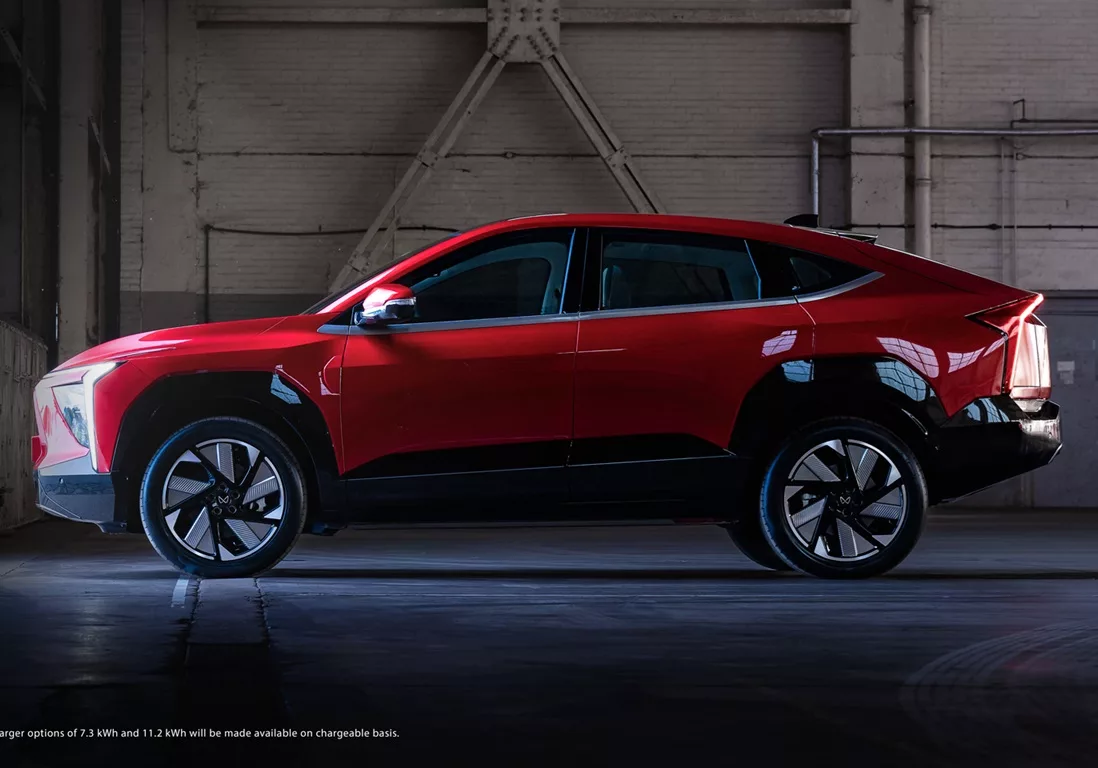
Talking about the looks, the XEV 9e offers a modern appeal with a muscular and futuristic design language with assertive creases and cuts that really go well with the SUV’s overall proportions. When compared head-on, the XEV 9e with its coupe silhouette stands 73 mm wider, 5 mm taller and 105 mm lengthier. The extra length onboard helps the XEV 9e come across as a more practical option with a substantially bigger boot space of 663 litres with an additional 150 litres of frunk space. Talking about the height, despite the difference being a mere 5 mm, the ground clearance offered by the XEV 9e is 52 mm more, which really comes in handy when tackling difficult roads.
Coming to the Mercedes-Benz EQB, the SUV takes forward the classic Mercedes approach that offers modern styling with a muscular yet sporty stance, and an appeal that reflects grandeur and luxury. When compared with the XEV 9e, the Mercedes-Benz EQB chooses not to offer anything polarising, playing well on things that have always worked for the German caramaker.
Compared to the XEV 9e’s coupe bodyline, the EQB, despite being comparatively narrower and slightly shorter, does not feel smaller by any angle. In fact, the EQB comes across as more proportionate amongst the two. One area where the EQB truly shines is its larger wheelbase that offers better in-cabin space and comfort. The boot is spacious enough to take care of your family’s luggage needs, even though it is not as large as that on the XEV 9e.
Overall, when compared, both SUVs are stylish, smart, assertive and modern. While the final choice in terms of looks is rather subjective, when it comes to dimensions and space on offer, the XEV 9e offers the advantage of having a bigger boot and additional frunk space, along with a lengthier and wider stance. With that said, the EQB is not miles behind and offers the advantage of a larger wheelbase and slightly better in-cabin comfort.
Overall winner: XEV 9e for its space and practicality and EQB for its proportional body line and larger wheelbase.
Mahindra XEV 9e vs. Mercedes-Benz EQB: Performance and Charging
| New Mahindra XEV 9e v Mercedes-Benz EQB: Performance and Charging | ||||||||
| Cars | Mahindra XEV 9e | Mercedes-Benz EQB | ||||||
| Battery Pack | 59 kWh | 79 kWh | 66.5 kWh | 70.5 kWh | ||||
| Power | 231 PS (170 kW) | 286 PS (210 kW) | 288 PS (215 kW) | 190 PS (140 kW) | ||||
| Torque | 380 Nm | 380 Nm | 520 Nm | 385 Nm | ||||
| 0 to 100 km/h | 6.7 Seconds | 6.2 Seconds | 8.9 Seconds | |||||
| Transmission (Automatic) | Single-Speed Automatic | Single-Speed Automatic | ||||||
| Claimed RangeMIDC Standards | 542 km on a single charge | 656 km on a single charge | 447 km on a single charge | 535 km on a single charge | ||||
Performance is one area where both SUVs truly lock horns in a way that is rather interesting. With both SUVs offering a choice of two battery packs, what each one of those offer in terms of performance is a completely different story.
Talking about the battery packs on offer, the XEV 9e offers a choice between a smaller 59 kWh pack or a larger 79 kWh pack. The Mercedes Benz EQB, on the other hand, offers a choice between a smaller 66.5 kWh pack or a bigger 70.5 kWh pack. Now, you might think that the larger battery pack onboard both SUVs would evidently be the better one, however, that is not the story for the EQB.
Talking about the base battery pack on offer, when compared head-on, the XEV 9e’s 59 kWh battery pack, despite being smaller than the 70.5 kWh battery pack of the EQB, still manages to offer much better performance and range. In terms of raw performance, the XEV 9e’s smaller battery pack offers substantially better power figures of 231 PS compared to the 190 PS offered by the EQB’s bigger base battery pack. Even after offering much better performance figures, the XEV 9e does not compromise on the range, offering up to 542 km on a single charge, compared to 535 km offered by the EQB.
The top-spec battery pack of both SUV is where things get rather spicy. As far as the EQB is concerned, the EQB’s smaller 66.5 kWh battery pack is pitched as the more advanced one with two electric motors offering a four-wheel drivetrain. The XEV 9e on the other hand offers the larger 79 kWh battery pack as its top-end performer with a two-wheel drivetrain onboard.
Comparing the performance, the Mercedes-Benz EQB, despite offering a smaller battery pack, delivers a punchier performance with slightly better performance and substantially better torque figures. In terms of real-world performance, the 2 PS of additional power and 140 Nm of better torque offered by the EQB translates to exhilarating performance and superior acceleration, which is also evident from the SUV’s 0 to 100 sprint, which it achieves in merely 6.2 seconds.
While the EQB shines in terms of the top-spec battery pack’s raw performance, the range is where the XEV 9e completely obliterates the EQB with a substantially higher range of 656 km on a single charge compared to the 447 km offered by the EQB. With both SUVs offering superior performance, the additional 209 km of range offered by the XEV 9e truly makes up for its slightly inferior acceleration and four-wheel drive train.
Overall, when considering the performance of both SUVs, the entry-level battery pack is where the Mahindra XEV 9e obliterates the Mercedes-Benz EQB, leaving it miles behind when it comes to both power and range. The top-end battery pack, however, is where the EBQ shines, with slightly better power and great torque onboard with a four-wheel drive advantage. However, overall range is still an area where the XEV 9e shines, with a range that goes as high as 683 km on a single charge.
Overall Winner: Mahindra XEV 9e for its overall performance and practicality and the top-end EQB for its raw performance and acceleration.
Mahindra XEV 9e vs. Mercedes-Benz EQB: Features and Comfort
| Mahindra XEV 9e | Mercedes-Benz EQB | |
| Infotainment system | 12.3-inch touch infotainment system with Android Auto and Apple Car Play + 12.3 Inch Touch Multimedia Display | 10.25-inch touch infotainment system with Android Auto and Apple Car Play |
| Instrument Cluster | 12.3 Inch Digital Instrument Cluster | 10.25-Inch Digital Instrument Cluster |
| Music System | 16 Speaker Premium Harman Kardon Audio Setup with DOLBY | 12-Speaker Premium Burmester Audio Setup with DOLBY ATMOS |
| Climate Control | Yes, Dual Zone | Yes, Dual Zone |
| Sunroof | Fixed Glass Panoramic Sunroof with Segment First Integrated Ambiet Lighting | Sliding Panoramic Sunroof |
| Ambient Lighting | Yes | Yes |
| Front Ventilated Seats | Yes | No |
| Adjustable Seats | Yes, 6-Way Powered Driver’s Seat | Yes, Electronically Adjustable Driver and Co-Driver Seat with Memory Function |
| Rear AC Vents | Yes | Yes |
| Cruise Control | Yes | Yes |
| Wireless Charger | Yes | Yes |
| 360-Degree Camera | Yes, with Live View and Recording | Yes |
| Connected Car Tech | Yes | Yes |
| ADAS | Level-2 | Level-2 |
| Gesture-Controlled Tailgate | Yes | Yes |
| Augmented-Reality Projection Heads-Up Display | Yes | No |
| Fully Automatic Parking | Yes | No |
Be it dual-zone climate control or premium audio setups, the comparison above makes it clear that both electric SUVs are loaded to the brim with onboard features that are truly top-notch.
However, when compared head-on, the XEV 9e seems to outperform the luxurious EQB with a few special features that the Mercedes EQB seems to miss out on. These include offerings such as:
- Larger 12.3-inch triple displays
- Panoramic sunroof with integrated ambient lighting
- Front ventilated seats
- 360-degree camera with live recording and surveillance
- AR-Infused Heads-Up-Display
- Fully Automatic Parking
But with that said, the Mercedes-Benz EQB is not an inferior SUV in any way, with several luxurious features onboard. While the XEV 9e does offer a little more, features such as Electronically Adjustable Driver and Co-Driver Seat with Memory Function, Sliding Panoramic Sunroof and Burmester Premium Audio Experience with Dolby ATMOS are still exclusive to the EQB.
To conclude, the feature game is an area where both SUVs truly compete, with the overall choice based on what the consumer expects. Both SUVs offer features that are exclusive to one another, with a list of common features that include almost every contemporary feature.
Overall Winner: Tie
Mahindra XEV 9e vs. Mercedes-Benz EQB: Safety Features
| Mahindra XEV 9e | Mercedes-Benz EQB | |
| Airbags | 6 as standard | 7 as standard |
| ABS with EBD | Yes | Yes |
| ESC | Yes | Yes |
| Hill Assist | Yes | Yes |
| TPMS | Yes | Yes |
| Rear Parking Sensor | Yes | Yes |
| Front Parking Sensors | Yes | Yes |
| 360-Degree Camera | Yes, with Live View and Recording | Yes |
| All 4 Disc Brakes | Yes | Yes |
| Level-2 ADAS | Yes | Yes |
Coming to onboard safety, there is no doubt that both the Mercedes-Benz EQB and the Mahindra XEV 9e are superior offerings with almost all safety feature onboard. With both SUVs being the latest offerings from their respective manufacturers, the race here is truly head-on.
However, when compared, the Mahindra XEV 9e seems to offer a slightly better package with a few additional features, such as fully automatic parking, AR-infused heads-up display, and a 360-degree camera that also offers live recording and surveillance features.
Overall, both SUVs are true winners when it comes to onboard safety.
Mahindra XEV 9e vs Mercedes-Benz EQB: Price Comparison
| Variant | Mahindra XEV 9e Price Ex-Showroom | Mercedes-Benz EQB Price Ex-Showroom |
| Base Variant | Rs 21.90 lakh | Rs. 72.20 Lakh to Rs. 78.90 Lakh |
| Mid Variant | Rs 24.90 lakh | |
| Upper Mid Variant | Rs 27.90 lakh | |
| Top Variant | Rs 30.50 lakh |
When it comes to the price comparison, the Mahindra XEV 9e is available in four variants: Pack ONE, Pack TWO, Pack THREE SELECT, and Pack THREE. Of all these variants, only the Pack THREE variant is powered by a 79 kWh battery, while the rest are powered by a 59 kWh battery. On the other hand, the Mercedes-Benz EQB’s variant lineup is a no-brainer, with only two variants on offer, which are the EQB 250+ and the EQB 350 4MATIC.
Considering every aspect of the head-on comparison, if you are of the view that Indian cars are no match in front of foreign luxury cars, then it is time to finally burst the bubble. With the top-end trim of the Mahindra XEV 9e priced at about Rs. 48.4 Lakh, cheaper than the Mercedes-Benz EQB’s top-end trim, you can literally bring home two top-end XEV 9Es and still be left with over Rs. 17.9 Lakh in your pockets.
While this price advantage is in itself a huge win for the XEV 9e, the cherry on the cake is the fact that the coupe-SUV offers more than the EQB in almost every aspect, including range, safety, features and even performance, especially with the base battery pack.
Thus, considering all the aspects, the XEV 9e offers better value for your money throughout its variant lineup with savings that can go as high as Rs. 57 Lakh.
Mahindra XEV 9e vs. Mercedes-Benz EQB: Summary
Be it the Mahindra XEV 9e or the Mercedes-Benz EQB, both premium EVs offer a feature-loaded package that is exciting from every angle. Both SUVs offer a modern design that is sporty yet assertive. With the XEV 9e following a more polarising approach, the Mercedes-Benz EQB plays it elegant with a much more sophisticated look. Coming to the performance and range, while both SUVs offer a choice of two battery packs, when it comes to overall performance and range, the XEV 9e takes the ultimate edge. However, the EQB, with its four-wheel drive setup and top-notch performance, offers superb performance with its top-end battery pack; however, the range on offer is still miles behind the XEV 9e.
Feature-wise, both SUVs are topped with a great package, but again, it is the XEV 9e that takes the win with several top-notch offerings and exclusive features. Safety, however, is where both SUVs truly lock horns with great inclusions, including Level-2 ADAS. However, it is the price that pitches the comparison strongly in favour of the Mahindra XEV 9e puts the final nail in the EQB’s coffin, with the XEV 9e obliterating the EQB left, right and center.
FAQs
Q. Which of the two – Mahindra XEV 9e or Mercedes-Benz EQB – is larger?
The Mahindra XEV 9e is larger than the Mercedes-Benz EQB, with a wider, taller and lengthier stance, longer wheelbase, and bigger boot space.
Q. Which of the two – Mahindra XEV 9e or Mercedes-Benz EQB – offers a better range?
The Mahindra XEV 9e offers a better range overall than the Mercedes-Benz EQB, with the 59 kWh pack offering 557 km of range and the 79 kWh battery pack offering 656 km of range on a single charge compared to the 535 km range offered by the EQB.
Q. Which of the two – Mahindra XEV 9e or Mercedes-Benz EQB – has more advanced features?
Both SUVs offer top-notch features onboard; however, features like ambient lighting, an integrated sunroof, a 360-degree camera with live recording and surveillance, fully automatic parking, and an AR-integrated heads-up display are where the XEV 9e wins. On the other hand, however, features like Electronically Adjustable Driver and Co-Driver Seat with Memory Function, Voice-Enabled Panoramic Sunroof and Burmester Premium Audio Experience with Dolby ATMOS are still exclusive to the EQB.
Q. Which of the two – Mahindra XEV 9e or Mercedes-Benz EQB – offers better value for money?
The Mahindra XEV 9e offers better value for money across all trims compared to the Mercedes-Benz EQB, with savings that can go as high as over Rs. 57 Lakh.