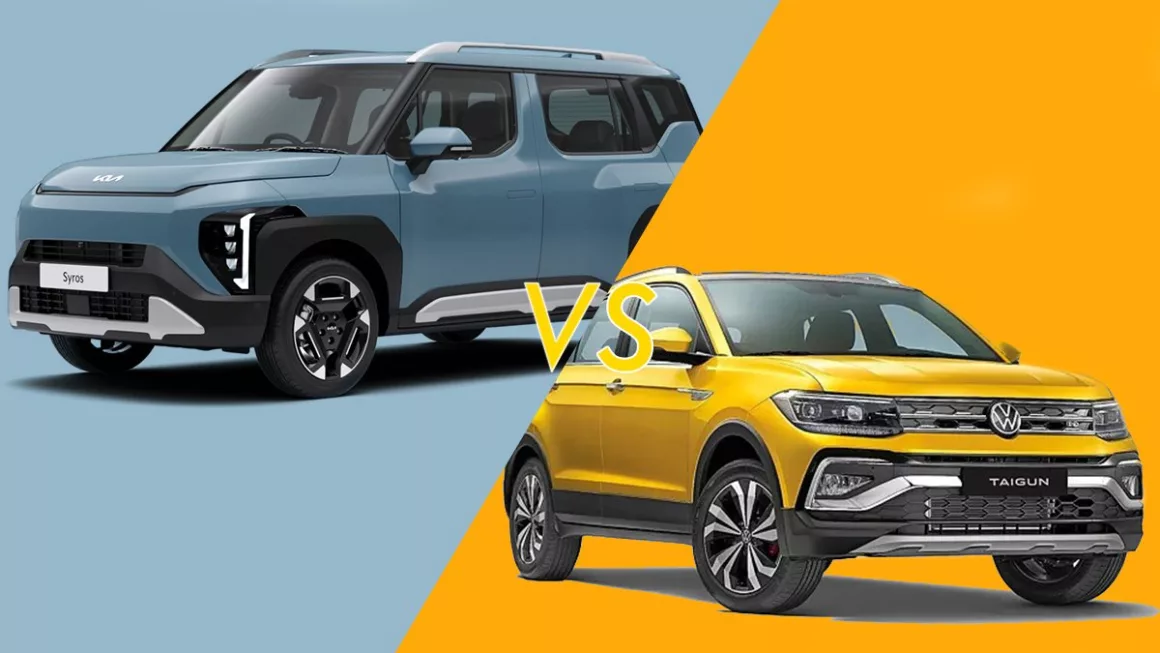
While its sales figures are not as high as those of the segment leaders, the Volkswagen Taigun is undoubtedly an excellent mid-size SUV. As far as competition is concerned, like most others in its segment, the Volkswagen Taigun has always faced strong competition from Koreans, such as the Hyundai Creta and Kia Seltos. However, recently, the Kia Syros has come on the scene as another Korean rival. In a way, the Kia Syros is a stronger competitor to the Taigun than the Hyundai Creta and the Kia Seltos, especially due to the amount of space and features it offers at a more affordable price. Hence, if you are looking to own a Volkswagen Taigun, it would be wise to weigh it against the Kia Syros to make sure you are making the right decision. To ease things for you, in this comparison of Kia Syros vs Volkswagen Taigun, we compare the two on every vital parameter and find out which one is better for you.
Kia Syros vs Volkswagen Taigun: Dimensions & Design
Kia Syros | Volkswagen Taigun | |
Length | 3,995 mm | 4,221 mm |
Width | 1,805 mm | 1,760 mm |
Height | 1,680 mm | 1,612 mm |
Wheelbase | 2,550 mm | 2,651 mm |
Ground Clearance | 190 mm | 188 mm |
Boot Space | 390 - 465 litres | 385 litres |
While the Volkswagen Taigun is 226 mm longer than the Kia Syros, the Kia Syros is 45 mm wider and 68 mm taller in comparison. Moreover, the Volkswagen Taigun has a 101 mm longer wheelbase than the Kia Syros. With a longer wheelbase, the Volkswagen Taigun offers more legroom than the Kia Syros. However, the legroom offered in the Kia Syros is more than sufficient, and due to extra width, it is the better of the two when it comes to accommodating three adults in the rear seat. At the same time, a special advantage of the Kia Syros is the slidable rear seat. When the rear seat is in its furthest position, the Kia Syros offers a rather generous 465 litres of boot space, and in the rear-most position of the rear seat, it offers 390 litres of boot space and a lot of legroom for the rear passengers.
Looks are where the Kia Syros stands apart as a boxier, more modern, and futuristic-looking SUV. Upfront, the Kia Syros gets the more upright face and a digitised appeal with clean surfaces, neat triple ice cube headlights bracketed by slim vertical LED DRLS fixed in the black cladding, and a closed-off grille area. Lower down on the bumper, the blacked-out air intake is split by the number plate, and below that is the silver embellishment, which is repeated at the sides and on the rear bumper, too. Like the front, the side profile highlights the boxy design, while there is chunky black cladding covering the SUV’s bottom, adding some muscle. The futuristic appeal is carried to the rear as well, especially with cool-looking L-shaped DRLS that flank the rear windshield, while the tail lamps are integrated into the black cladding near the rear fenders.
On the other hand, the Taigun looks elegant and sportier, much like its character. The front end highlights the creases on the bonnet, and the stylish three-slat chrome grille seamlessly merges into the large headlamp assemblies, giving it a purposeful face. Lower down on the bumper, the German carmaker has used chrome extensively to suit the Indian taste. Like the front, the side profile features sporty creases, while the chunky black cladding at the bottom adds some muscle. The Taigun’s most stylish section is its tail-end, with its stylish LED tail-lamps linked by a functional light bar, and this whole assembly nestled in a futuristic-looking glass panel.
If you want to accommodate five adults comfortably, the Kia Syros is a better option than the Volkswagen Taigun. Meanwhile, the Kia Syros looks more futuristic and practical, while the Volkswagen Taigun has an elegant and sporty appeal.
Kia Syros vs Volkswagen Taigun: Engine & Transmission
Kia Syros | Volkswagen Taigun | |
Engine | 1-litre turbo petrol engine 1.5-litre turbo diesel engine | 1 litre turbo petrol engine 1.5 litre turbo petrol engine |
Power | 120 PS 116 PS | 115 PS 150 PS |
Torque | 172 Nm 250 Nm | 178 Nm 250 Nm |
Transmission | 6-speed manual transmission with both engines 7-speed DCT automatic with the petrol engine 6-speed torque converter automatic with the diesel engine | 6-Speed Manual for both engines 6-speed torque converter for 1 litre engine 7-speed DTC automatic for 1.5 litre engine |
Mileage | 17.68 to 18.2 km/l (petrol) 17.65 to 20.75 km/l (diesel) | 17.2 – 19.2 km/l |
The Volkswagen Taigun has two turbocharged petrol engines, and both these engines shine brighter as far as performance is concerned. If you enjoy driving, the Volkswagen Taigun is the one which will strike your fancy. As mentioned before, the Volkswagen Taigun is one of the most exciting cars to drive in its segment. While its smaller 1.0-litre petrol engine is exhilarating enough, it is the larger 1.5-litre TSI engine, which offers the most enjoyable high-octane performance and driving thrill. Complementing this engine is fantastic handling and a dual-clutch transmission, which is proven to be sportier than the dual-clutch transmissions offered by Hyundai and Kia. At the same time, the Volkswagen Taigun maintains a great balance between driving fun and ride comfort and competently absorbs all bumps and jerks. Meanwhile, the Volkswagen Taigun’s larger 1.5-litre TSI engine comes with cylinder deactivation technology, which shuts off two cylinders under less stressful conditions and thus delivers better mileage.
The Kia Syros, however, is a more family-friendly SUV. While its 1-litre turbo petrol engine is slightly more powerful than the 1-litre turbo petrol engine of the Volkswagen Taigun, the power delivery is less urgent. Even its dual-clutch transmission is more comfort-oriented, rather than sporty. What gives the Kia Syros a great edge over the Volkswagen Taigun is the availability of a diesel engine, which is important for those who frequently do long-distance travelling. As far as ride comfort is concerned, the Kia Syros delivers above-average performance, but not as good as the Volkswagen Taigun.
With peppy turbo petrol engines and well-tuned steering, the Volkswagen Taigun is a more fun-to-drive SUV. Meanwhile, the Kia Syros is more family-friendly with linear power delivery, however, offers the advantage of a diesel engine.
Kia Syros vs Volkswagen Taigun: Features & Comfort
Kia Syros | Volkswagen Taigun | |
Infotainment system | 12.3-inch touchscreen infotainment | 10.1-inch touchscreen infotainment system |
Music system | 8-speaker Harman Kardon music system | 6-speaker Volkswagen inbuilt music system |
Climate control | Automatic | Automatic |
Ventilated seats | Front ventilated seats and thigh-only ventilation for the rear seats | Front ventilated seats |
Adjustable steering | Tilt | Tilt and telescopic |
Drive modes | Eco, Normal, Sport | Not available |
Instrument cluster | 12.3-inch digital instrument cluster | 8-inch digital instrument cluster |
Sunroof | Panoramic sunroof | Single pane sunroof |
Adjustable seats (manual or electric) | 4-way powered driver seat | Powered front seats |
Rear AC vents | Available | Available |
60:40 rear seat split | Available | Available |
Cruise control | Available | Available |
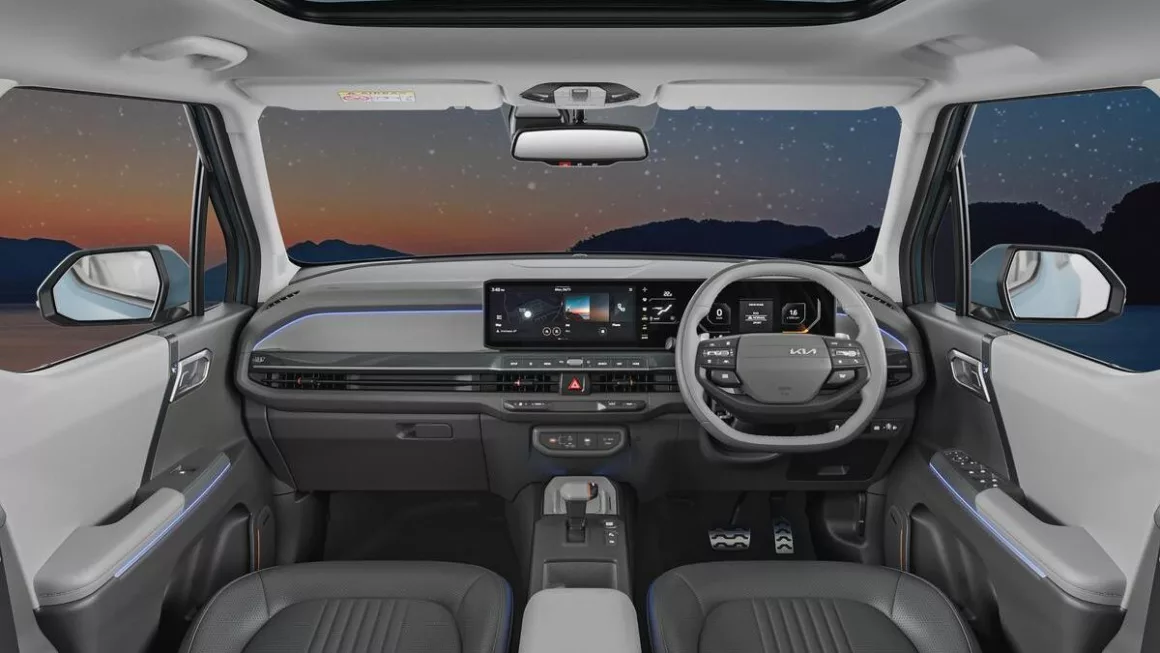
Inside their cabins, the Kia Syros and Volkswagen Taigun feel premium but offer vastly different atmospheres. The Kia Syros has a well-laid-out interior with a clean dual-tone dashboard. Taking centre stage is a 30-inch glass panel, which houses a 12.3-inch central touchscreen for infotainment, a 12.3-inch digital instrument cluster with customisable displays, and a 5-inch HVAC touchscreen in the middle. While the HVAC touchscreen has all HVAC controls, such as temperature and blower speed, you also get more easy-to-use physical buttons on the centre console for the same controls. Moreover, there is a nicely styled cube-like gear knob with an illuminated P-R-N-D indicator, and the squarish two-spoke steering wheel to make things look cutting-edge. Compared to the Volkswagen Taigun, the Kia Syros feels airier on the inside due to its lighter colour theme and a panoramic sunroof.
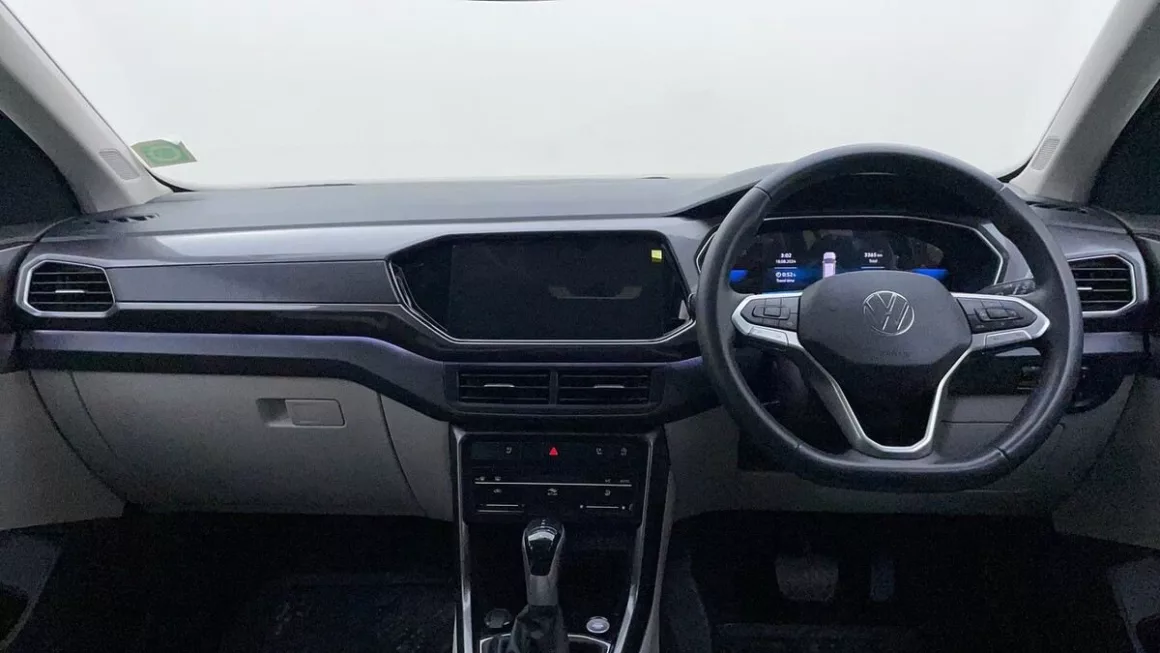
Meanwhile, the Volkswagen Taigun embodies the typical ‘Volkswagen’ feel with a neat fit and finish across the cabin, with a touch of uniqueness. For example, the octagonal housing of the touchscreen is seamlessly integrated into the dashboard. Moreover, the dashboard has a body-coloured, sharp-edged glossy panel and faux carbon-fibre inserts. As opposed to the Kia Syros, the Volkswagen Taigun gets a darker interior theme that is in line with its performance-oriented character. As far as seats are concerned, both fabric and faux leather upholstery feel upmarket, and the upholstery is aptly bolstered.
In the feature department, while both SUVs are packed with enough goodies to ensure a rich experience, the Kia Syros beats the Volkswagen Taigun by a long distance. Special features that the Kia Syros offers and Volkswagen Taigun misses are a panoramic sunroof, a much better-sounding 8-speaker Harman Kardon music system, rear seat ventilation (squab only), reclinable rear seats, and a dual-camera dashcam. All the same, the Volkswagen Taigun has the advantage of offering a powered front passenger seat.
On the inside, while both SUVs feel premium, the Kia Syros comes in as a more family-friendly offering with a panoramic sunroof lighting up the cabin, and a lighter colour theme. Meanwhile, the Syros is also a better offering if you want a more feature-rich experience.
Kia Syros vs Volkswagen Taigun: Safety Features
Kia Syros | Volkswagen Taigun | |
NCAP Safety Rating | 5-stars in Bharat NCAP | 5-stars in Global NCAP |
Airbags | Six airbags as standard | Six |
ABS with EBD | Yes | Yes |
ESC | Yes | Yes |
Traction Control | Yes | Yes |
Automatic headlamps | Yes | Yes |
Rain-sensing Wipers | Yes | Yes |
Hill hold assist | Yes | Yes |
Hill descent control | No | No |
Rear sensors | Yes | Yes |
Rear parking camera | 360-degree camera | Yes |
ISOFIX Child seat anchor points | Yes | Yes |
ADAS | Level-2 ADAS features | No |
In terms of safety, both Kia Syros and Volkswagen Taigun have been proven to be among the safest cars in India. The Kia Syros has scored a full 5-star rating in the Bharat NCAP car safety test, while the Volkswagen Taigun has scored a 5-star rating in the Global NCAP safety test. All the same, the Kia Syros has a key advantage of offering a Level-2 ADAS safety suite, which solidly prevents the occurrence of accidents in the first place. This suite consists of front collision warning and avoidance assist, leading vehicle departure alert, lane departure warning, lane keep assist, lane follow assist, adaptive cruise control with stop and go, high-beam alert, driver attention warning, and parking collision avoidance assist.
Both Kia Syros and Volkswagen Taigun offer robust safety, however, the Kia Syros offers the coveted Level-2 ADAS safety suite.
Kia Syros vs Volkswagen Taigun: Price comparison
Kia Syros | Volkswagen Taigun | |
Base variants (Ex-Showroom) | Rs. 9 - 11 lakh | Rs 11.80 lakh |
Mid variants (Ex-Showroom) | Rs. 11.5 – 12.8 lakh | Rs 13 – 14.40 lakh |
Upper mid variants (Ex-Showroom) | Rs. 13.3 – 14.6 lakh | Rs 14.80 – 15.90 lakh |
Top variant | Rs. 16 – 17.80 lakh | Rs 16.60 – 19.83 lakh |
The Kia Syros variants are Rs. 2 to 3 lakh more affordable than their rival variants of the Volkswagen Taigun. This makes the Kia Syros a more value-for-money offering, especially from a family ownership standpoint.
Kia Syros vs Volkswagen Taigun: Summary
For the kind of package that the Kia Syros is, its instant success is not surprising at all. Whether it is space, comfort, features, or safety, the Korean compact SUV offers almost everything one expects from a mid-size SUV. As far as driving joy is concerned, while the Kia Syros is not as exciting as the Volkswagen Taigun, it is not lacklustre either and packs enough power to meet all your driving needs. Moreover, its price difference from the Volkswagen Taigun makes it a more value-for-money offering, a considerable point for someone looking to save money on car expenditure. Overall, the Kia Syros is a clear pick if you want an SUV which you and your family can comfortably travel in.
All the same, the Volkswagen Taigun comes from one of the most prestigious brands in the world. While the German mid-size SUV has its limitations of space and features, it offers an unparalleled premium finesse across its body inside and outside and the reputation of the ‘Volkswagen’ marquee. Moreover, if you are a driving enthusiast, then the Volkswagen Taigun is the car for you.
Kia Syros vs Volkswagen Taigun: FAQs
Among the Kia Syros and Volkswagen Taigun, which is larger?
Kia Syros is 3,995 mm long, 1,805 mm wide, 1,680 mm tall, and has a wheelbase of 2,550 mm. Volkswagen Taigun is 4,221 mm long, 1,760 mm wide, 1,612 mm tall, and has a wheelbase of 2,651 mm. While the Volkswagen Taigun is 226 mm longer than the Kia Syros, the Kia Syros is 45 mm wider and 68 mm taller in comparison. Moreover, the Volkswagen Taigun has a 101 mm longer wheelbase than the Kia Syros.
Among the Kia Syros and Volkswagen Taigun, which car is more powerful?
The 1-litre turbo petrol engine and 1.5-litre turbo diesel engine of the Kia Syros produce 120 PS and 116 PS, respectively. Whereas, the 1-litre turbo petrol engine and 1.5-litre turbo petrol engine of the Volkswagen Taigun produce 115 PS and 150 PS respectively. The smaller 1-litre engine of the Kia Syros is slightly more powerful than the 1-litre engine of the Volkswagen Taigun, while the 1.5-litre engine of the Volkswagen Taigun is more powerful than the 1.5-litre diesel engine of the Kia Syros.
Among the Kia Syros and the Volkswagen Taigun, which has better sound quality?
The Kia Syros’s 8-speaker Harman Kardon sound system offers a better and more premium music experience than the Volkswagen Taigun’s in-built music system.
Which safety features are available in the base variant of the Kia Syros?
The safety features of the base HTK variant of the Kia Syros include 6 airbags, rear parking sensors, electronic stability control, front parking sensors, ABS with EBD, hill-assist, ISOFIX anchorages, and 3-point ELR seat belts for all passengers.
What types of automatic transmission systems are available in the Kia Syros and the Volkswagen Taigun?
The Volkswagen Taigun offers a 6-speed torque converter automatic and a 7-speed DSG automatic. The Kia Syros also offers a 6-speed torque converter automatic and a 7-speed DCT automatic